Inspiration
I went to elementary school in Korea, then to school in Addis Ababa, and now I study at Duke in North Carolina. Durham is 14 hours behind Seoul and 8 hours behind Addis Ababa. My evening is someone's early morning, and my free afternoon is someone else's midnight. I kept reaching out to the people I care about at the wrong time. They were asleep, in class, at work, or driving. After enough missed calls, we simply called less.
Talking with friends at Duke, I found out how common this is. International students, immigrant families, military families and people caring for aging parents all deal with it. Group chats help, but no app knows that 9 PM for me is 11 AM the next day for someone back home. We wanted to build something that does.
Market size
Families split across borders are not a niche. They are a large and growing part of the world.
| People | Source | |
|---|---|---|
| International migrants worldwide (2024) | 304 million, about 3.7% of the world's population and nearly double 1990 | UN DESA |
| Immigrants living in the United States (June 2025) | 51.9 million, about 15.4% of US residents | Pew Research Center |
Every one of these people has family somewhere else, and the relatives on the other end of the call are not counted in these numbers. So the number of people who deal with this problem is larger than the figures above.
Even outside migration, distance alone makes families miss moments. Kairo starts with the groups we know best: international students, immigrant families, military families, and people caring for aging parents in another time zone.
It affects our whole team
This is not one person's problem. Everyone in our group has family in another country, and each of us works around a different schedule.
- Sophia and Michelle have family in China.
- Aaron's family is in Korea.
- Eunchan's family is in Ethiopia and Korea.
We all have classes, work and lives of our own, so finding a time to call is hard for everyone on the call. Looking at when two people are free on paper is only half of it. Being free is different from being ready to talk.
If my classes end at 3 PM, on paper I can call my family any time after that. But if they call at 3:05, I might have just failed a midterm and be in a bad mood. I won't want to talk, and the conversation turns into filler. Kairo is built to find the moment when everyone in the family is free and in a good place to talk.
What it does
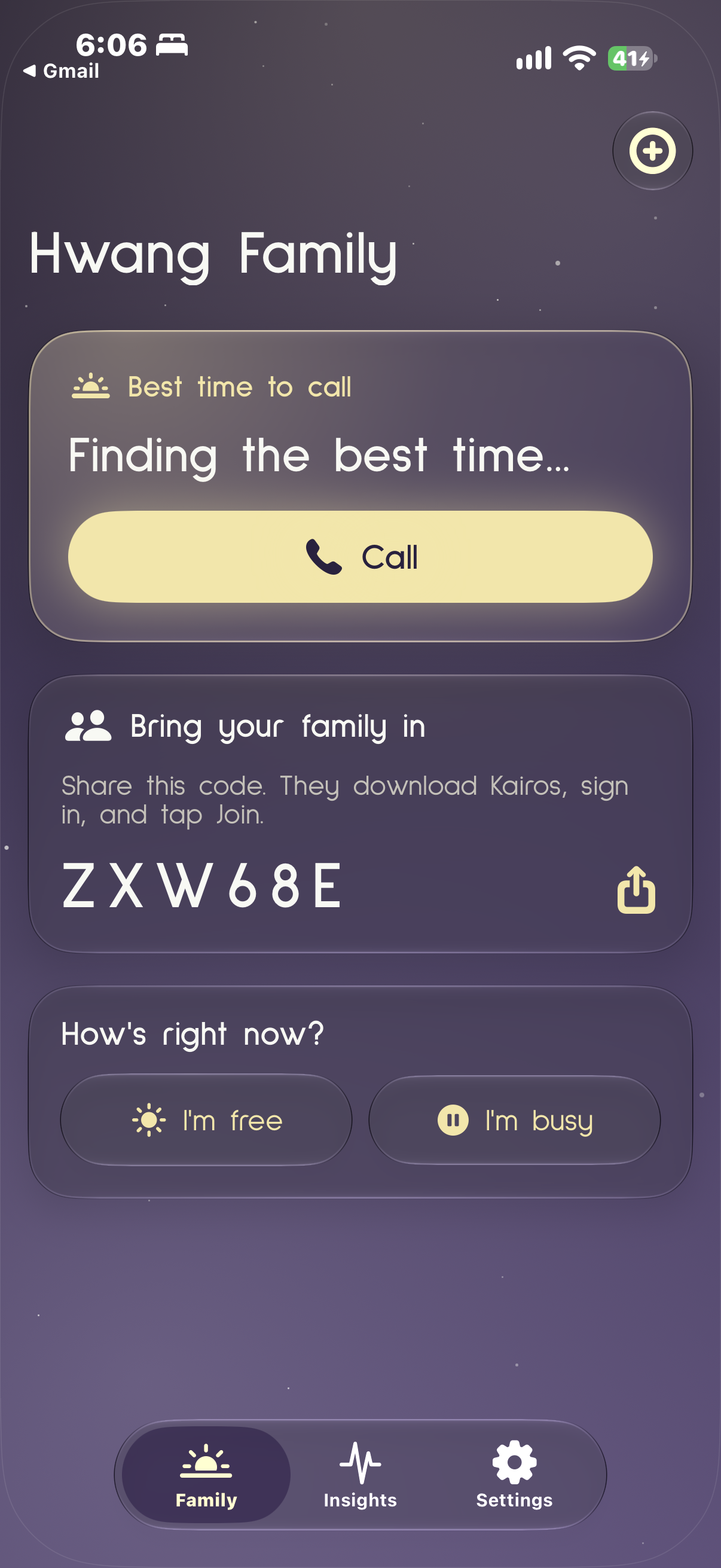
Kairo is a widget and app that finds the best moment for your family to call.
- Add your people. Choose the family members you want to share availability with.
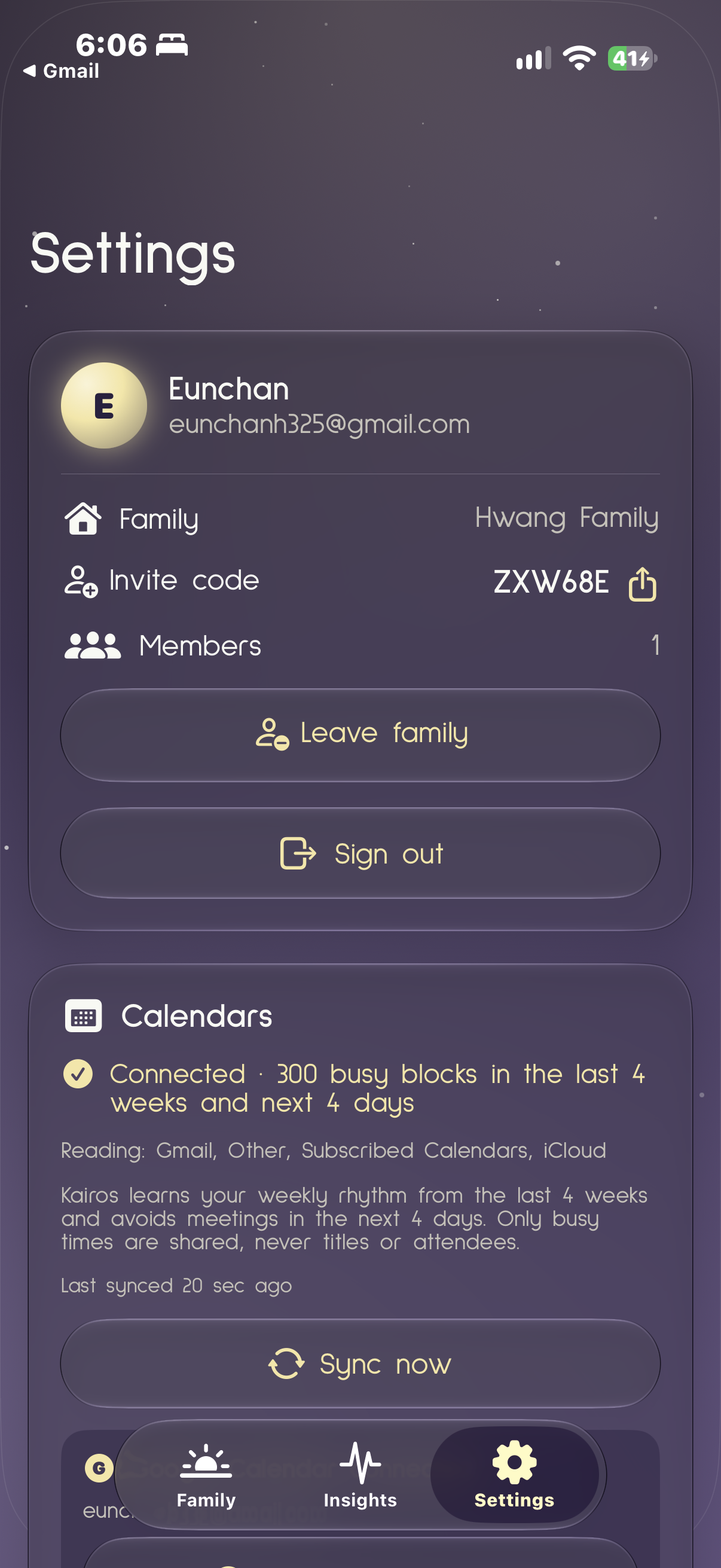
- Connect your calendar (optional). Bring in Google Calendar, Apple Calendar or another calendar so Kairo knows when you are busy.
- Let Kairo learn from your calls. Kairo tracks how many missed calls come before someone picks up, how long it takes either side to pick up, and how long the call lasts. It uses the timing of calls and texts, never the content.
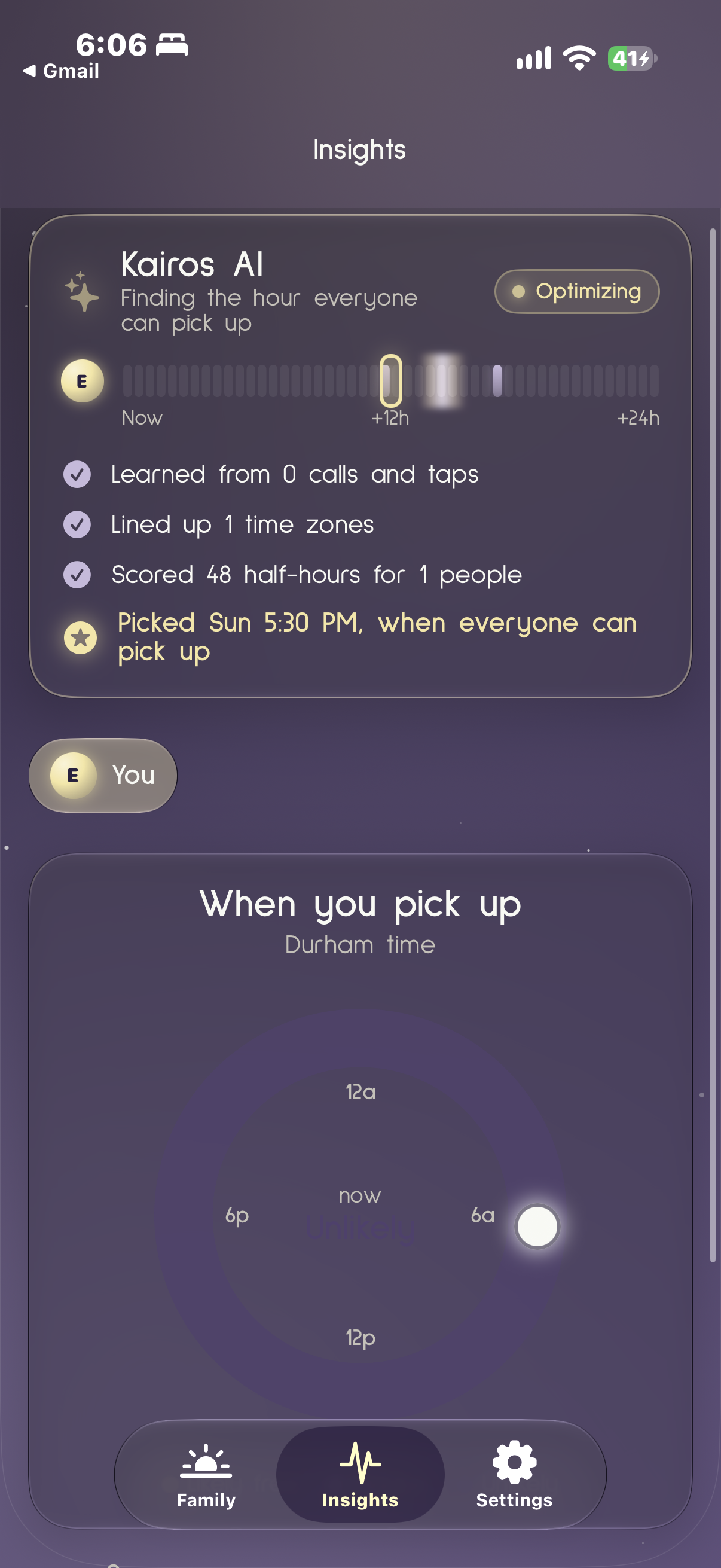
- See the best moment. Kairo combines your schedule, your call history and the other person's side, and slowly updates a clock-style circle. A glowing yellow arc shows when the best time to call is.
Behind the scenes, each family member has a personal AI agent that learns when its person is usually free. The agents compare availability across time zones and find the best moments for two people to connect.
A home screen widget shows each family member's local time, a live status (likely free, maybe, or asleep) and a countdown to the next kairo.
How we built it
The app. We built an iOS app with SwiftUI, a WidgetKit widget with interactive App Intents, and Live Activities for the countdown. The backend runs on Supabase, and each agent is Claude with tool calls.
The data. Apple does not let apps read call history or Messages, so calls and texts between family members happen inside Kairo. For every call we log when it rang, whether it was answered, how many missed calls came before it was answered, how long it took to pick up, and how long it lasted. For every text we log when it was sent and read. Message content is never analyzed. Calendar import is optional and adds busy and free times as another signal.
The model. We split the week into 336 half-hour slots in each person's local time and built four layers.
- Population prior. We labeled real 24-hour diaries from the American Time Use Survey, the Korea Time Use Survey and the Multinational Time Use Study as callable or not callable. A logistic GAM with cyclic splines over time of day, conditioned on age, work status, day type and country, gives a prior probability $m_s$ for each slot. It turns into Beta pseudo-counts
$$\alpha_{0,s} = \kappa\, m_s, \qquad \beta_{0,s} = \kappa\,(1 - m_s)$$
- Personal posterior. Each contact attempt $i$ has an outcome $y_i \in {0,1}$ (answered or replied fast, versus missed or replied slowly). Older events count less, with a 14-day half-life $h$, and evidence is shared with neighboring slots through a circular kernel $K$.
$$w_i = 2^{-(t_{\text{now}} - t_i)/h}$$
$$\alpha_s = \alpha_{0,s} + \sum_i K(s, s_i)\, w_i\, y_i, \qquad \beta_s = \beta_{0,s} + \sum_i K(s, s_i)\, w_i\,(1 - y_i)$$
$$\hat{p}_s = \frac{\alpha_s}{\alpha_s + \beta_s}$$
- Live adjustment. Signals like Focus mode, calendar events, a recent missed call or slow replies shift the next hour or two.
$$p_{\text{now}} = \sigma\big(\operatorname{logit}(\hat{p}_s) + f(\mathbf{x})\big)$$
- Family matching. For each overlapping slot we sample from every member's Beta distribution (Thompson sampling) and multiply the results, so the agents sometimes try uncertain slots and discover new good times.
$$J_s = \prod_{m \in \text{family}} \tilde{p}{m,s}, \qquad \tilde{p}{m,s} \sim \mathrm{Beta}(\alpha_{m,s}, \beta_{m,s})$$
OR-Tools CP-SAT then picks the weekly set of moments $S$ that maximizes expected connections minus an inconvenience cost $c_{m,s}$, with the constraint that everyone is awake and the early morning slots rotate fairly.
$$\max_{S} \; \sum_{s \in S} J_s \; - \; \lambda \sum_{s \in S} \sum_{m} c_{m,s}$$
Testing. We built family personas by stitching together real survey diaries for students, working adults and seniors, simulated call and text attempts against their hidden schedules, and also tested on public phone datasets like StudentLife and the Copenhagen Networks Study.
Challenges we ran into
- Apple's privacy rules. iOS gives no access to call logs or texts, so we made Kairo the family's own channel for calls and texts.
- Silence is not the same as busy. If nobody tried to reach you at 3 PM, that says nothing about 3 PM. Keeping an uncertainty estimate for every slot fixed this.
- Seniors leave little data. A grandparent might make only a few calls a week. Priors from people their own age give them a reasonable schedule from day one.
- Time zones are messy. Korea and Ethiopia do not use daylight saving time but the US does, so family overlap windows shift twice a year. We store everything in each person's local slots and recompute overlaps every week.
- Calibration matters. Multiplying probabilities across family members makes overconfident scores fall apart quickly, so we tracked Brier score and calibration along with accuracy.
What we learned
The timing of calls and texts alone says a lot about someone's life, so we designed for privacy from the start. Each phone shares only 336 availability scores and nothing else. We also learned that with sparse personal data, a small Bayesian model that explains itself fits better than a deep network. Finally, we learned that fairness matters in families too. Nobody should always be the one waking up at 6 AM.
What's next
We want to test Kairo with real multigenerational families, add translation between languages so grandparents and grandkids can text in their own language, and support SMS for relatives who do not use smartphones.
Sources for market size: UN DESA, International Migrant Stock 2024 · Migration Policy Institute, Top Statistics on Global Migration · Pew Research Center, Key findings about US immigrants
Built With
- claude
- python
