-
-
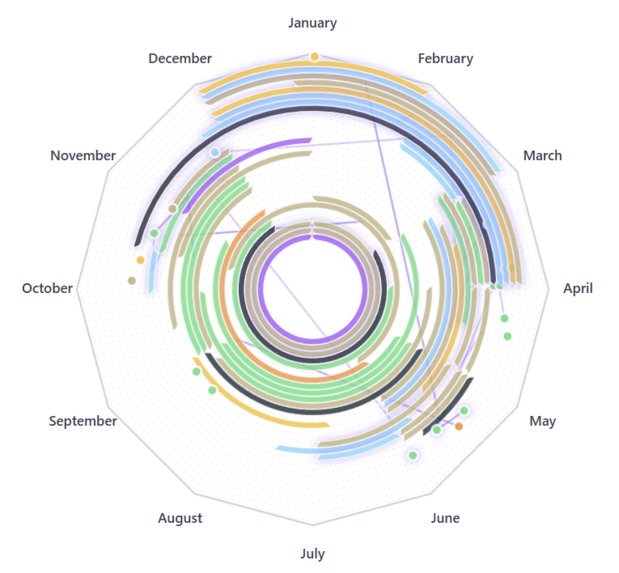
Ecological Calendar of Warren County, New York
-
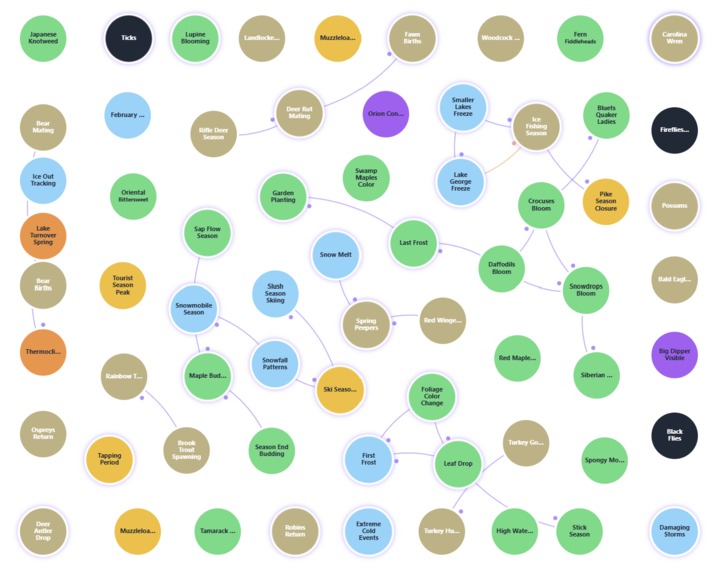
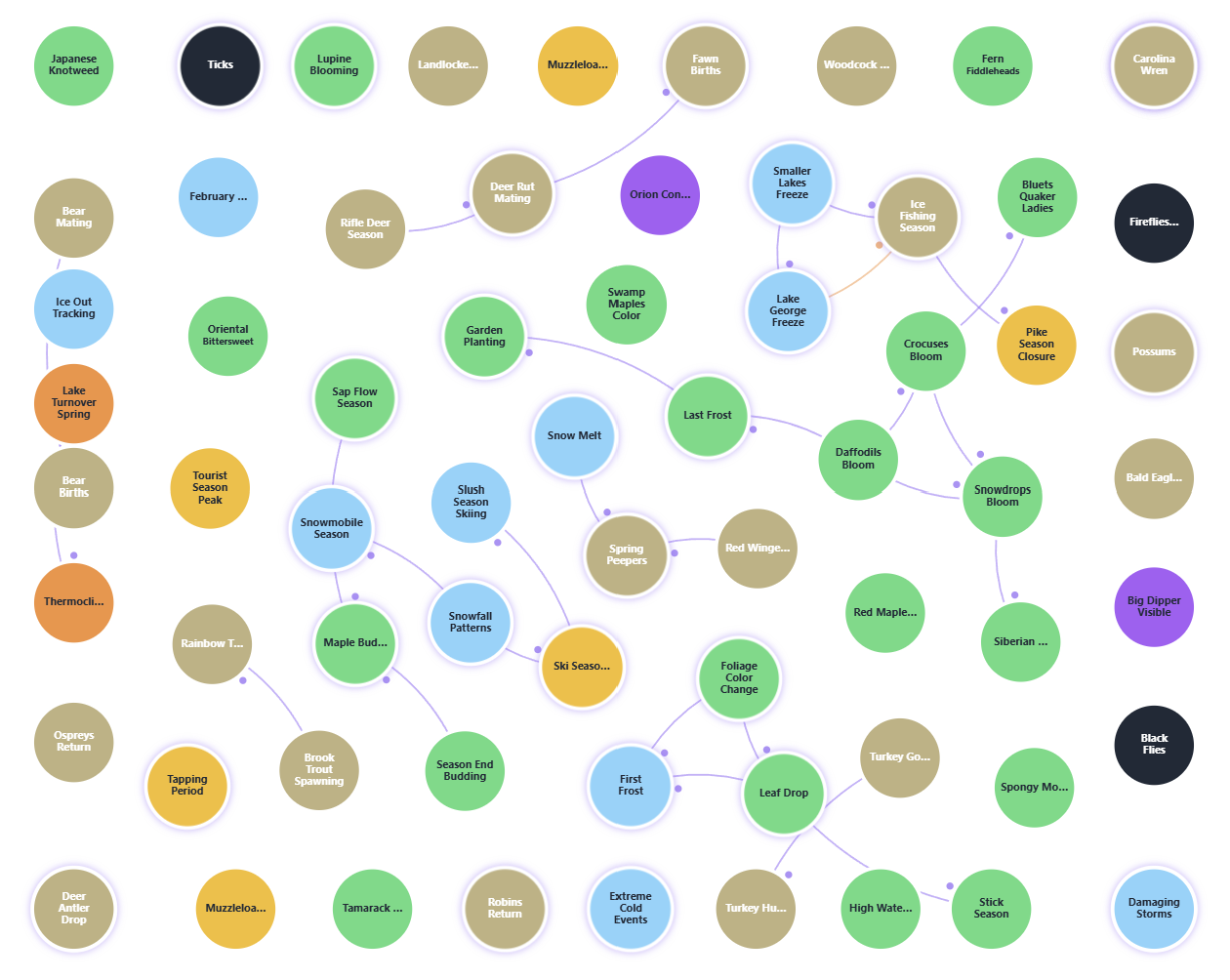
Network of Ecological Relations
-
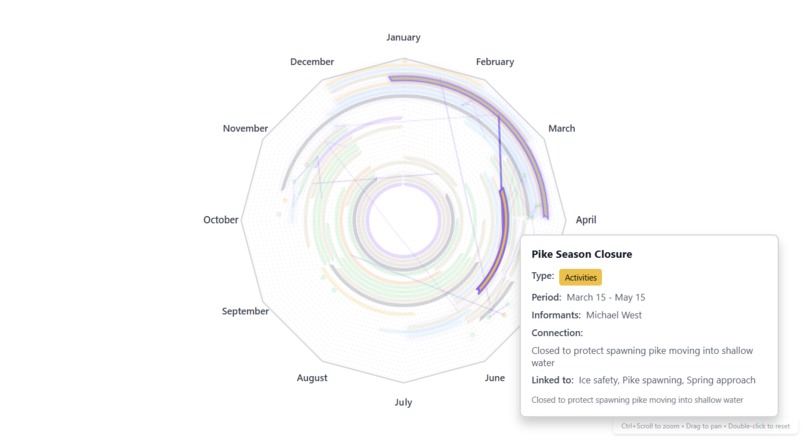
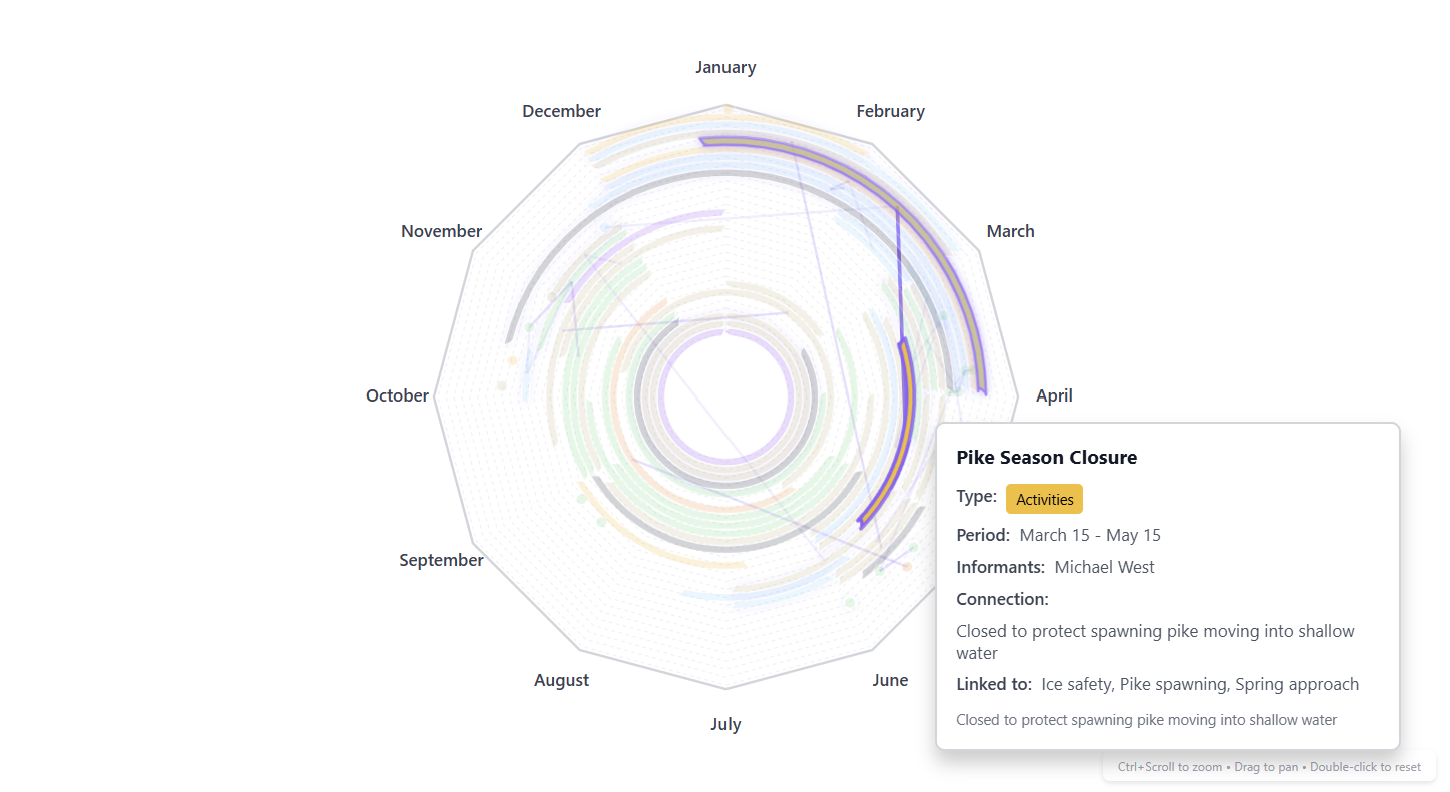
Hover Effect
-
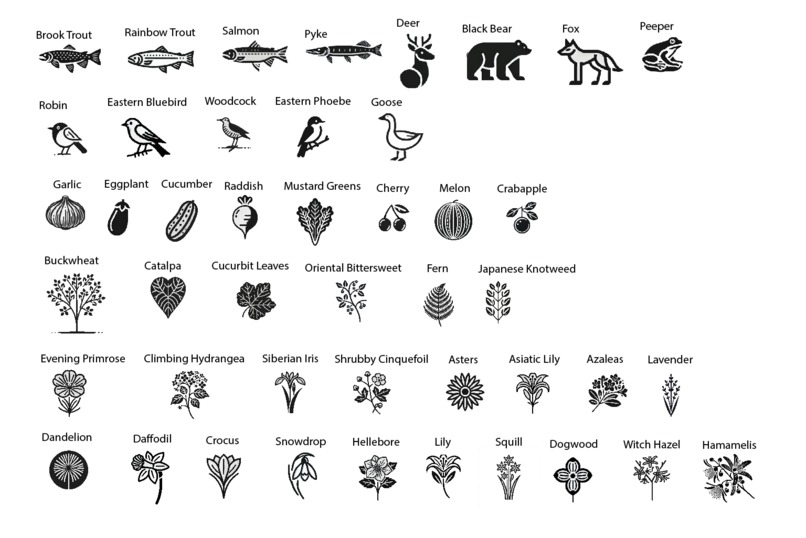
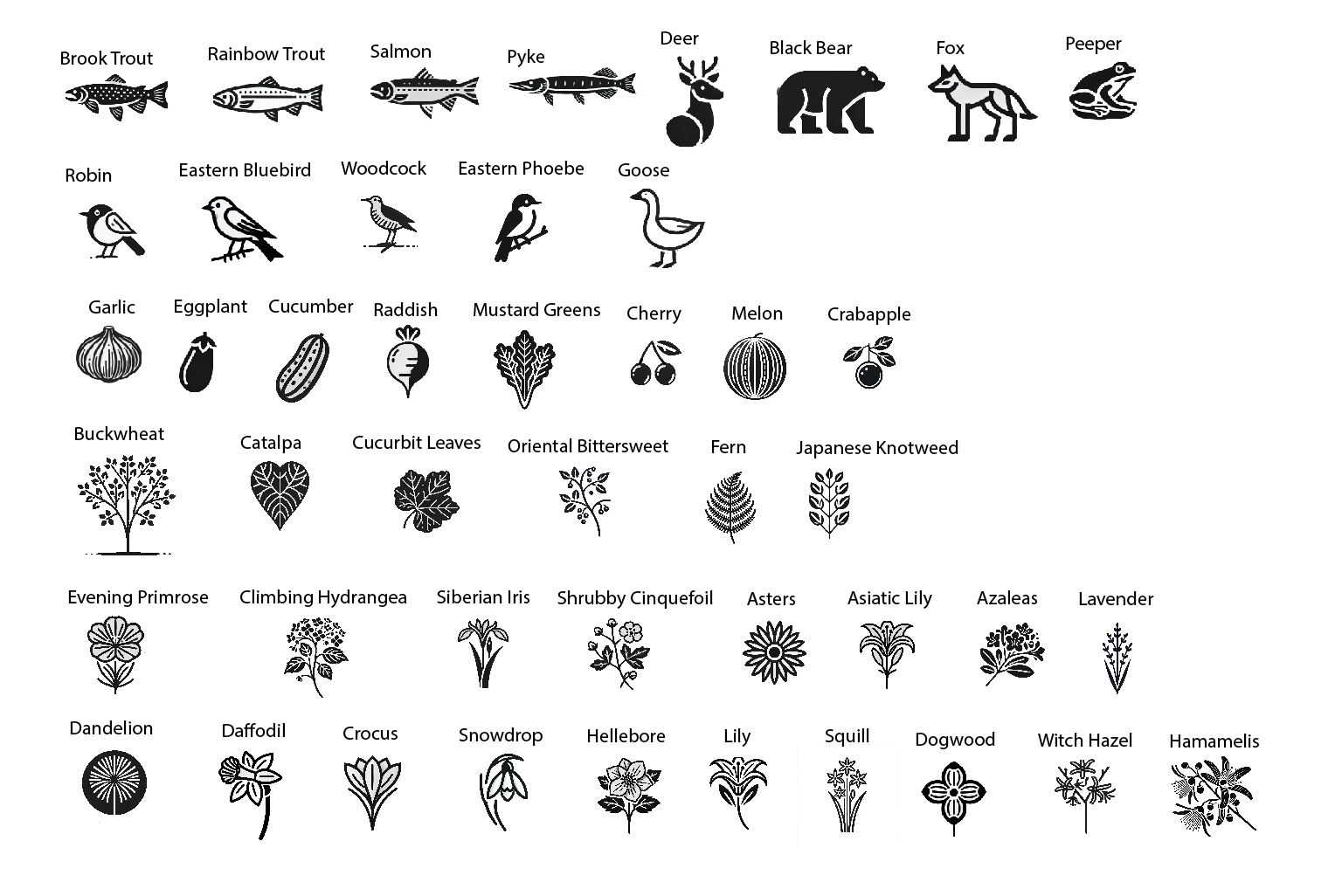
Seasonal Indicators
-
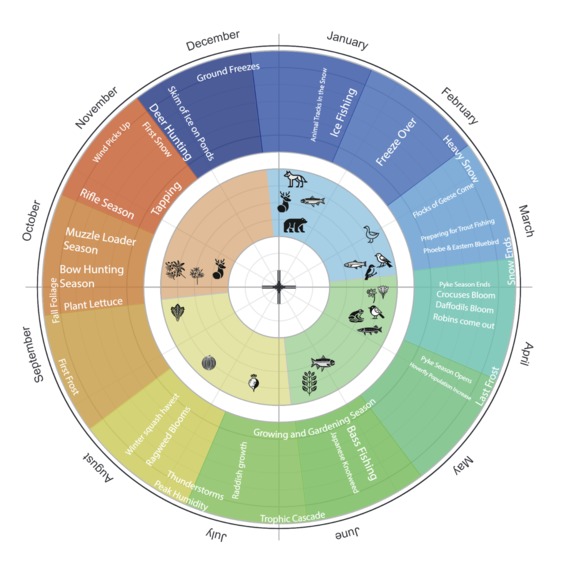
Digital Seasonal Round with Indicator Icons
-
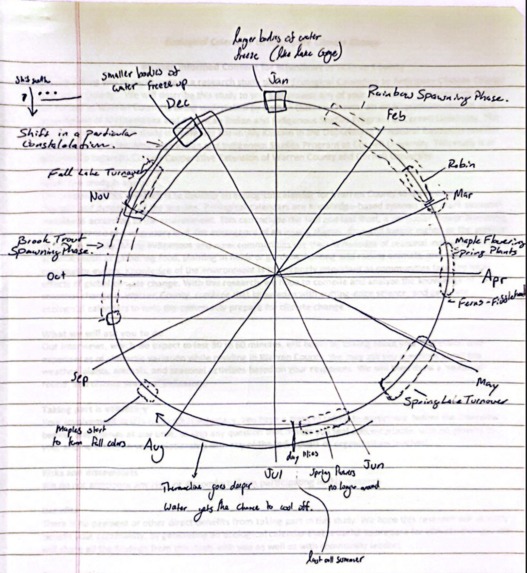
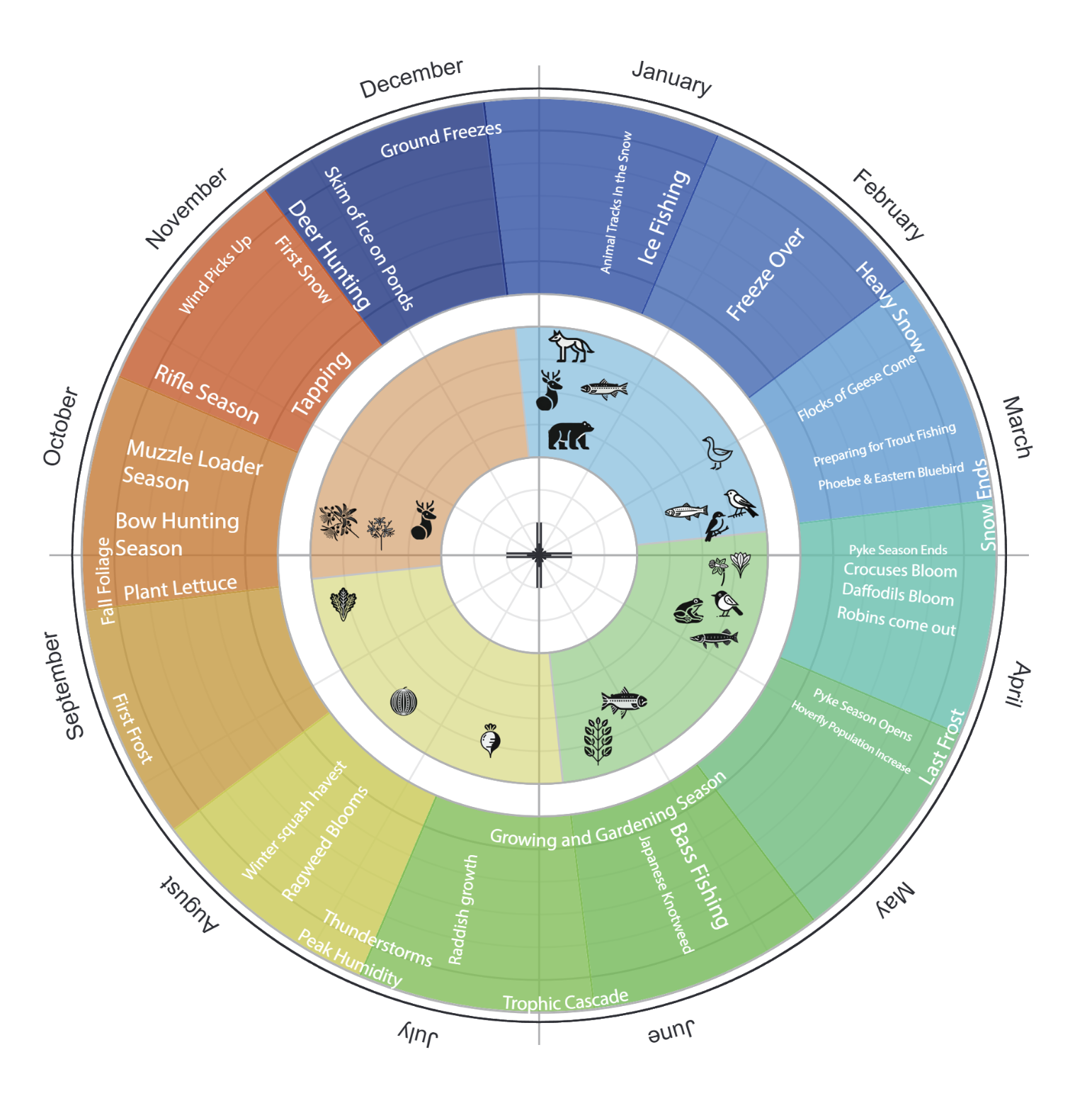
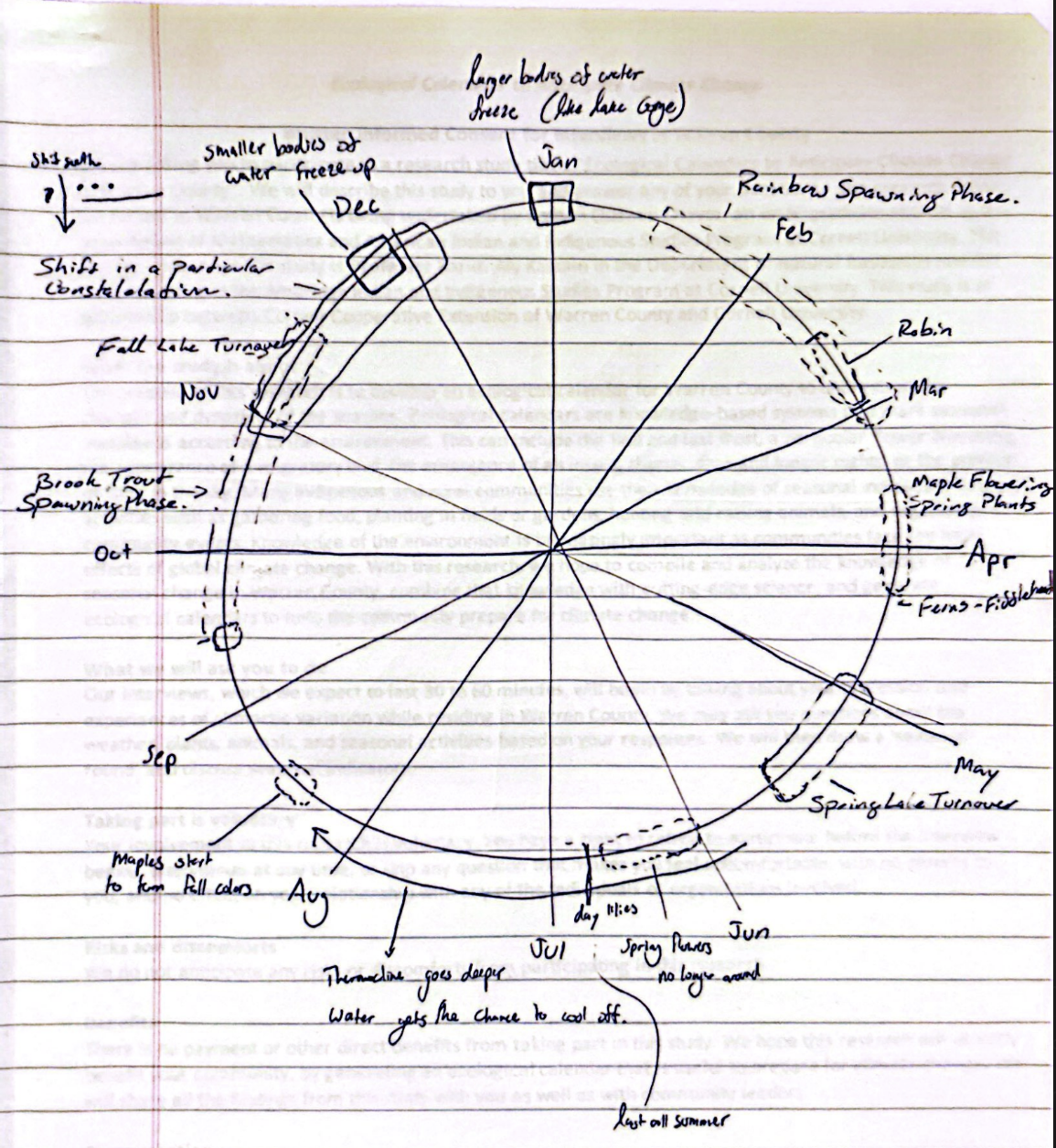
Seasonal Round
-
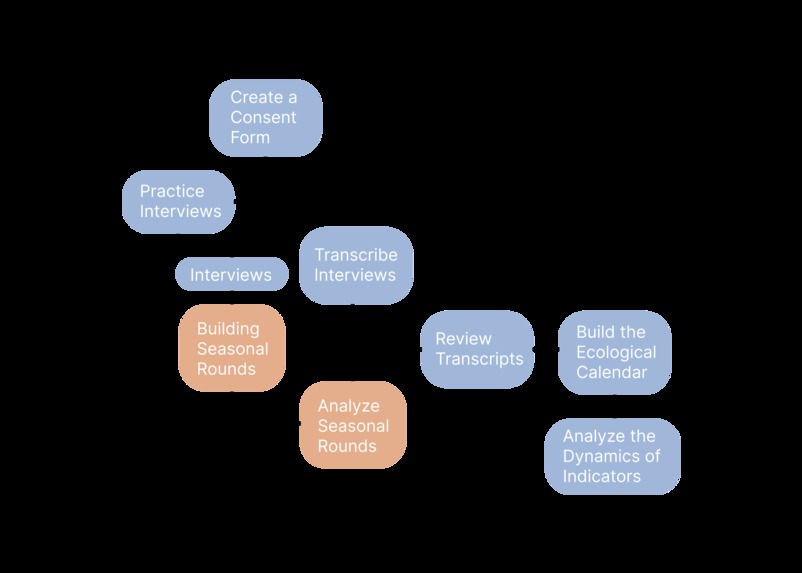
Architecture for Research
Goji
Communities have always read time from the land. Goji makes sure they still can.
Goji is an AI-powered ecological calendar platform that turns place-based community observation into a structured, interactive, living knowledge system. It is the first platform to generate ecological calendars using AI, and it is grounded in field research conducted at Cornell University on the seasonal knowledge systems of Warren County, New York.
What Is an Ecological Calendar?
An ecological calendar is a composition of seasonal indicators that mark the transitional periods between seasons. Unlike the Gregorian calendar, which imposes a universal and abstract grid onto time, an ecological calendar emerges from what a community observes: a flower blooming, a bird returning, a lake freezing, sap beginning to flow. These indicators are not neutral data points. They are relational expressions of how life unfolds across a landscape. They encode the anticipatory capacity of a community, which is the ability to read present ecological signals and project forward, to know from where you are in the annual cycle what is coming next.
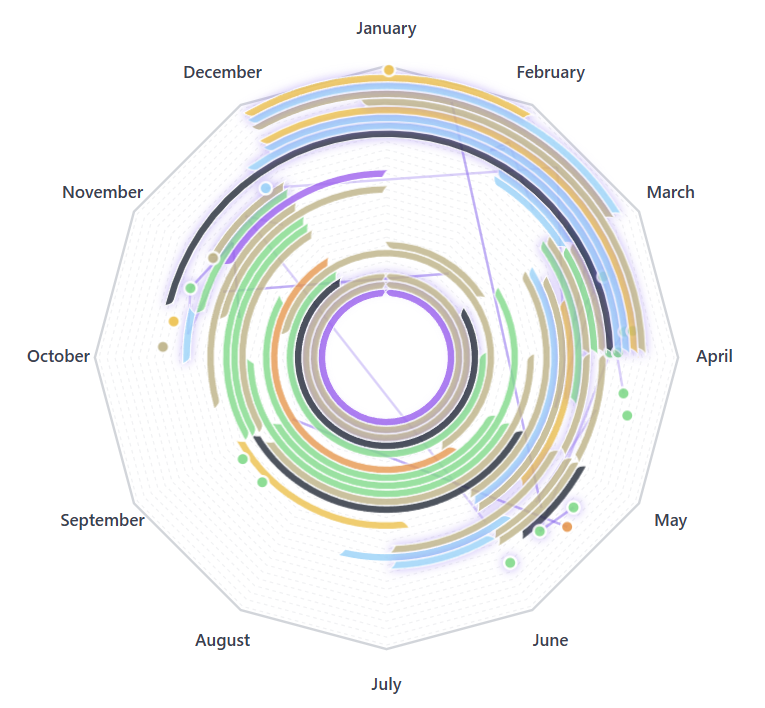
The indicators documented in Goji's Warren County dataset span seven categories: plants, animals, insects, weather, human activities, observable ecological signals, and environmental changes. Together they form not a timeline but a network, a web of dependencies, triggers, and cascade effects that structures seasonal life.
Research Foundation
Goji is built on an honors thesis developed at Cornell University under Professor Karim-Aly Kassam (Department of Natural Resources and the Environment) and Professor Yusheng Luo (Department of Mathematics), in collaboration with Cornell Cooperative Extension of Warren County.
Fieldwork
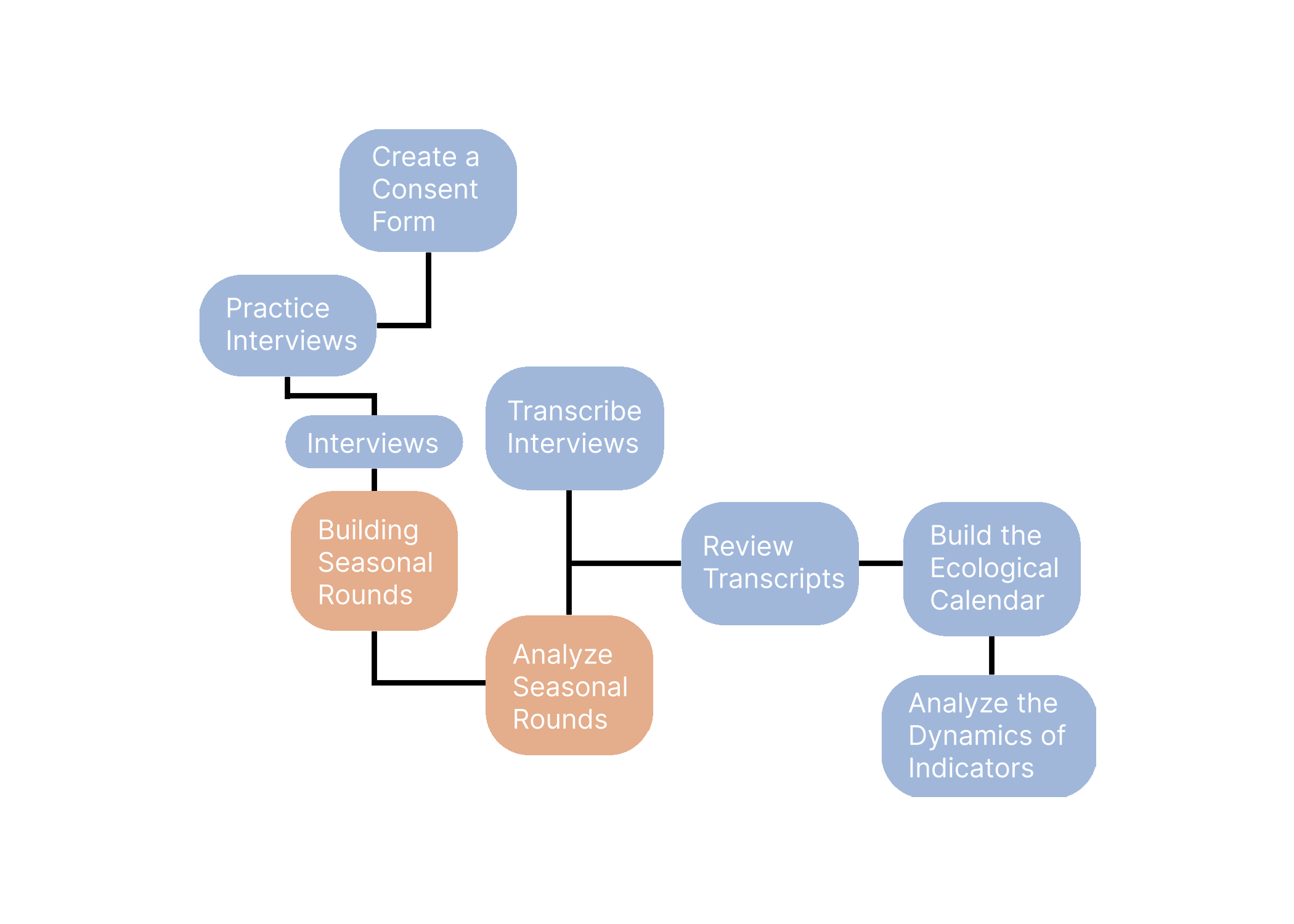
Twenty-one community members of Warren County, including farmers, hunters, fishers, foragers, and recreationalists, were interviewed through a semi-structured protocol approved by Cornell's Institutional Review Board. Their observations were transcribed, inductively coded, and organized into a seasonal round that captures the community's temporal engagement with their habitat across the full annual cycle. Over 80 seasonal indicators were documented and integrated into an interactive digital Ecological Calendar, available at:
romanqc.github.io/Warren-County-Ecological-Calendar
Mathematical Framework
The thesis develops a formal mathematical framework for the ecological calendar, treating it as a topological object. The framework proceeds in three interlocking parts.
Part I: The Calendar as an Arc System on S1. The annual cycle is modeled as the circle S1. Each seasonal indicator is represented as a connected arc with a documented onset day and cessation day. The arc measure of indicator I_i is computed as:
L_i = d+_i - d-_i             (standard window)
L_i = 365 + (d+_i - d-_i)     (year-wrapping window)
The set of all indicator arcs forms a cover of S1. The nerve of this cover is the simplicial complex encoding all patterns of temporal co-occurrence. By the Nerve Lemma (Borsuk, 1948), it is homotopy equivalent to the covered region, which means all topological information about the calendar's coverage, connectivity, and gaps is readable from the combinatorial overlap data alone.
Four dependency edge types are defined on the indicator set: causal, correlational, cue, and block. Each edge carries a lag weight representing the expected delay in days between one indicator's cessation and the next indicator's onset. A perfect hinge has lag = 0 and is structurally fragile under perturbation. A productive gap has lag > 0 and provides a buffer for climate-driven drift.
Part II: Climate Endomorphisms and Vitality Dynamics. Climate change is modeled as a one-parameter family of maps acting on the arc product space, shifting indicator onset and cessation days at signed drift rates. The arc length of each indicator evolves as:
L_i(t) = L_i(0) + (mu+_i - mu-_i) * t
Four structural modes of arc deformation are identified: onset-delay collapse, terminus-advance collapse, phenological decoupling, and unit-gain relay.
The vitality of each indicator, its fractional arc measure relative to the historical baseline, is modeled using a Lotka-Volterra dynamical system coupling an upstream ecological resource v_u with a downstream community practice v_d:
dv_u/dt = r_u * v_u * (1 - v_u) - alpha * v_u * v_d - h(t) * v_u
dv_d/dt = beta * v_u * v_d - gamma * v_d
The central analytical result is the Two-Stage Collapse Theorem. For climate forcing h* < h < r_u, practice vitality v_d converges to 0 while resource vitality v_u converges to 1 - h/r_u > 0. Community knowledge of a seasonal indicator dissipates before the indicator's ecological ground disappears. The forcing threshold h* = r_u * (1 - gamma/beta) is determined by the ratio gamma/beta, the cultural decay rate of the practice relative to the ecological sustenance rate. A high ratio means knowledge erodes faster.
Part III: Persistent Homology and Cech Cohomology. As climate forcing collapses indicators, the nerve loses simplices. Persistent homology tracks when topological features, connected components and coverage gaps, are born and destroyed across this filtration. The resulting persistence diagram is an invariant of the calendar under climate forcing, and the bottleneck distance between two persistence diagrams gives a rigorous metric for cross-calendar comparison across communities and regions.
The Cech cohomology of the arc cover provides a dual perspective. The first cohomology group H1 counts coverage gaps, and each new gap created by arc collapse contributes a generator. Climate change increases H1. The calendar defect, which accounts for temporal co-occurrences not yet articulated as documented dependencies, is represented as a cochain whose cohomological class measures the latent relational content of the calendar awaiting further inquiry.
Four Worked Dependency Chains: Warren County
| Chain | Key Arcs | Dep. Type | Resilience | Deformation Mode |
|---|---|---|---|---|
| Pike Complex | L2 = 83d, L4 = 61d, L6 = 155d | Sequential + block | rho = 1 | Onset-delay collapse |
| Maple Sugaring | LM1 = 39d, LM2 = 23d, LM3 = 7d | Nested + dual-trigger | rho = 1 | Terminus-advance collapse |
| Spring Cascade | LP1 = 45d, LP3 = 30d, LP4 = 16d | Convergent parallel | rho = 2 | Phenological decoupling |
| Deer Chain | LD1 = 21d; biological lag = 185d | Fixed-lag relay | rho = 1 | Unit-gain relay |
The Pike Complex is the clearest illustration of what fixed regulatory dates do to a calendar's structure. The March 15 closure creates a perfect hinge (lag = 0) between the ice fishing arc and the spawning closure arc. Because the closure date is regulatory rather than ecological, the perturbation expansion fails at first order for any nonzero climate forcing. There is no buffer to absorb drift. As warming advances spawning onset, the closure window compresses from below, closing before spawning is complete. A biologically responsive closure would track actual spawning onset and maintain a stable arc length.
Goji: The Platform
Goji is the accessible face of this research. It makes the methodology of building an ecological calendar available to any community without requiring fieldwork at the scale of an academic thesis.
How It Works
A user enters their location and describes what they observe seasonally, plants blooming, animals returning, weather shifting, ice forming or failing to form, by conversing with Goji's AI engine. Goji uses Perplexity Sonar for real-time ecological data retrieval and Gemini for intelligent structuring and parsing. The result is a structured JSON object that feeds directly into the visual calendar: indicator arcs positioned on a circular annual cycle, with relational links showing how indicators depend on, cue, and terminate one another.
The calendar is interactive. Users can filter by indicator category, hover to explore relational networks, and navigate between connected indicators. Indicators with documented temporal shifts are flagged. Community members can expand the calendar as their observations accumulate across seasons.
Architecture
goji-frontend/          React + Tailwind CSS
  src/components/
    User.jsx            Identity: name, initializes calendar in MongoDB
    LocationForm.jsx    Place: geolocation via Nominatim
    ChatBot.jsx         Purpose: ecological inquiry, drives AI pipeline
    EcoCalendar.jsx     Visualization: arc rendering, relational links

goji-backend/           FastAPI
  app/
    chat_logic.py       AI querying, Perplexity integration
    parsers.py          Gemini postprocessing, JSON structuring
    calendar_service.py Calendar construction and MongoDB storage
    geo_utils.py        ZIP-to-coordinate resolution, reverse geocoding
    db.py               MongoDB connection
Why Perplexity Sonar? Ecological data is time-sensitive and geographically specific. Sonar's web-aware architecture ensures that Goji's calendars reflect current ecological conditions rather than static training data. Recent phenological shifts like earlier ice-out, compressed sap seasons, and advancing bloom dates are incorporated in real time.
Why MongoDB? Each user's calendar is a document that evolves across the three-stage journey: identity, place, purpose. The document structure mirrors the relational logic of the ecological calendar itself, with each indicator stored alongside its temporal metadata, environmental triggers, linked indicators, and informant attribution.
Why This Matters
Climate change does not simply remove indicators from the calendar. It accelerates ecological change faster than communities can integrate new patterns into their relational knowledge. The mathematical framework developed in this research formalizes this precisely: community practices erode before their ecological ground disappears. A fisherman loses the knowledge of where pike move before the pike are gone. A maple farmer loses the ability to time the tap before the sap stops running.
The window between knowledge collapse and ecological collapse is where intervention matters. Ecological calendars are useful here not because they freeze knowledge in place, but because they make the structure of that knowledge visible, navigable, and updatable as conditions shift.
Goji exists in that window.
Equity and Positionality
Ecological calendars have historically been the domain of Indigenous and land-based communities whose intergenerational relationships with their landscapes encoded knowledge that formal science is only beginning to formalize. The Warren County research was conducted on unceded Indigenous territory, with IRB approval, full participant consent, and a methodology grounded in epistemic humility and the Two-Eyed Seeing framework, which holds Indigenous ecological knowledge and academic science simultaneously without flattening either.
The communities whose knowledge Goji encodes must own and govern that knowledge. The platform is designed to be accessible without technical expertise, and future development needs to take seriously the question of offline and low-infrastructure access, because the knowledge encoded in these calendars needs to be able to travel beyond screens.
Next Steps
- Fragility layer: Surface the mathematical fragility analysis as a visible overlay in the calendar, showing users which indicator chains are most at risk under continued climate forcing based on resilience scores and deformation mode classification.
- Community co-design: Iterate on the calendar interface with Warren County residents through structured workshops, incorporating feedback on usability, cultural fit, and knowledge sovereignty.
- Offline formats: Develop printable seasonal round and field guide formats so the relational knowledge encoded in the calendar can persist without digital infrastructure.
- Cross-calendar comparison: Implement the bottleneck distance metric to enable structural comparison across calendars from different communities and regions, supporting the comparative analysis that Kassam's cross-regional work calls for.
- Chat memory: Allow users to revisit past calendar-building conversations so the calendar can grow incrementally across seasons rather than being rebuilt from scratch.
References
The full bibliography is available in the underlying thesis. Key sources include:
- Kassam, K.-A. (2018). Anticipating Climatic Variability: The Potential of Ecological Calendars. Human Ecology, 46, 249-257.
- Kassam, K.-A. (2022). Rhythms of the Land: Seasonal Calendars and Climate Change. McGill-Queen's University Press.
- Lotka, A. J. (1925). Elements of Physical Biology. Williams & Wilkins.
- Strogatz, S. H. (2015). Nonlinear Dynamics and Chaos. Westview Press.
- Edelsbrunner, H., Letscher, D., and Zomorodian, A. (2002). Topological Persistence and Simplification. Discrete & Computational Geometry, 28(4), 511-533.
- Borsuk, K. (1948). On the Imbedding of Systems of Compacta in Simplicial Complexes. Fundamenta Mathematicae, 35(1), 217-234.
Contact
Roman Q. Chavez Cornell University [email protected]
Built With
- gemini
- html
- javascript
- perplexity

Log in or sign up for Devpost to join the conversation.