

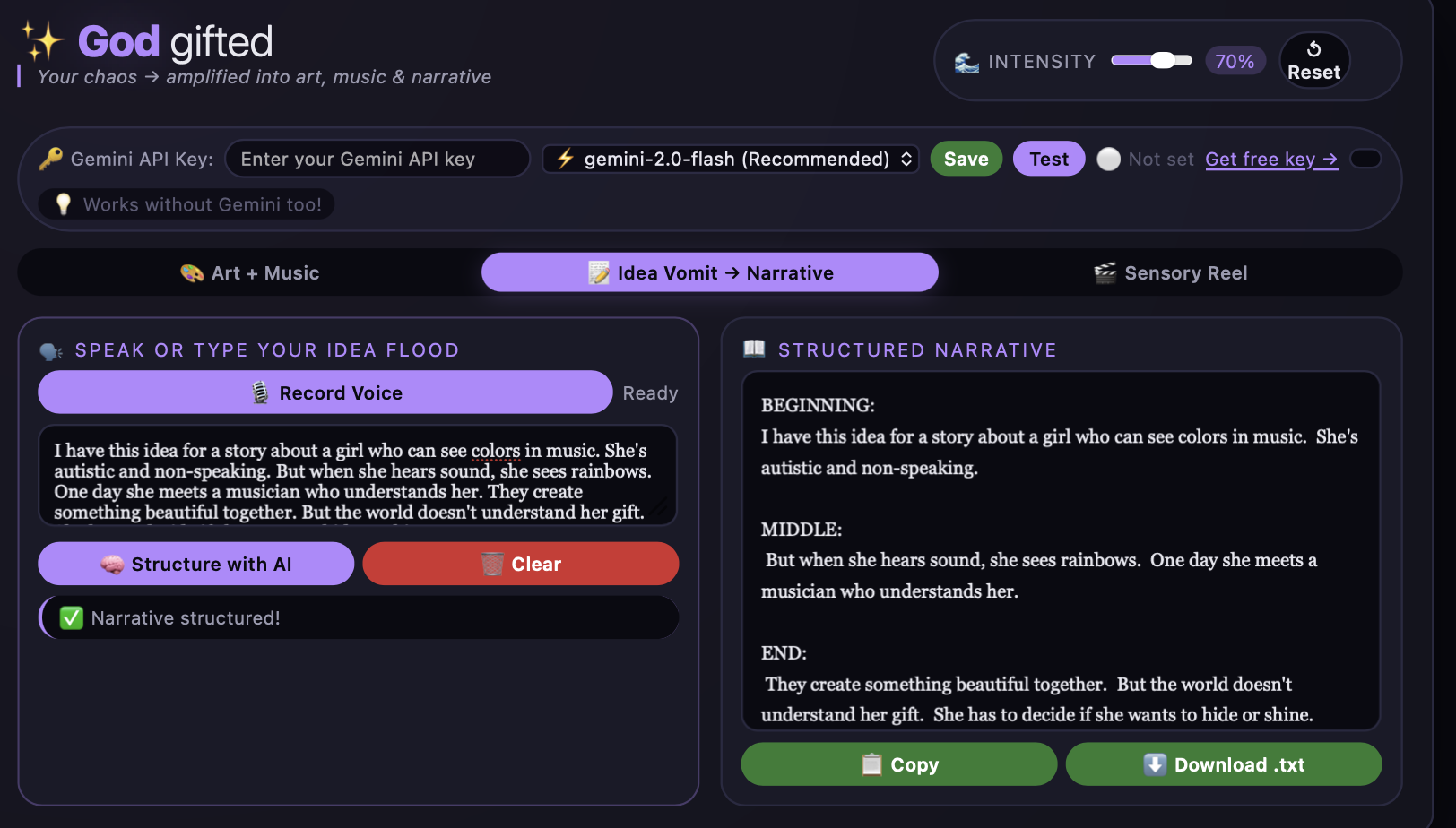
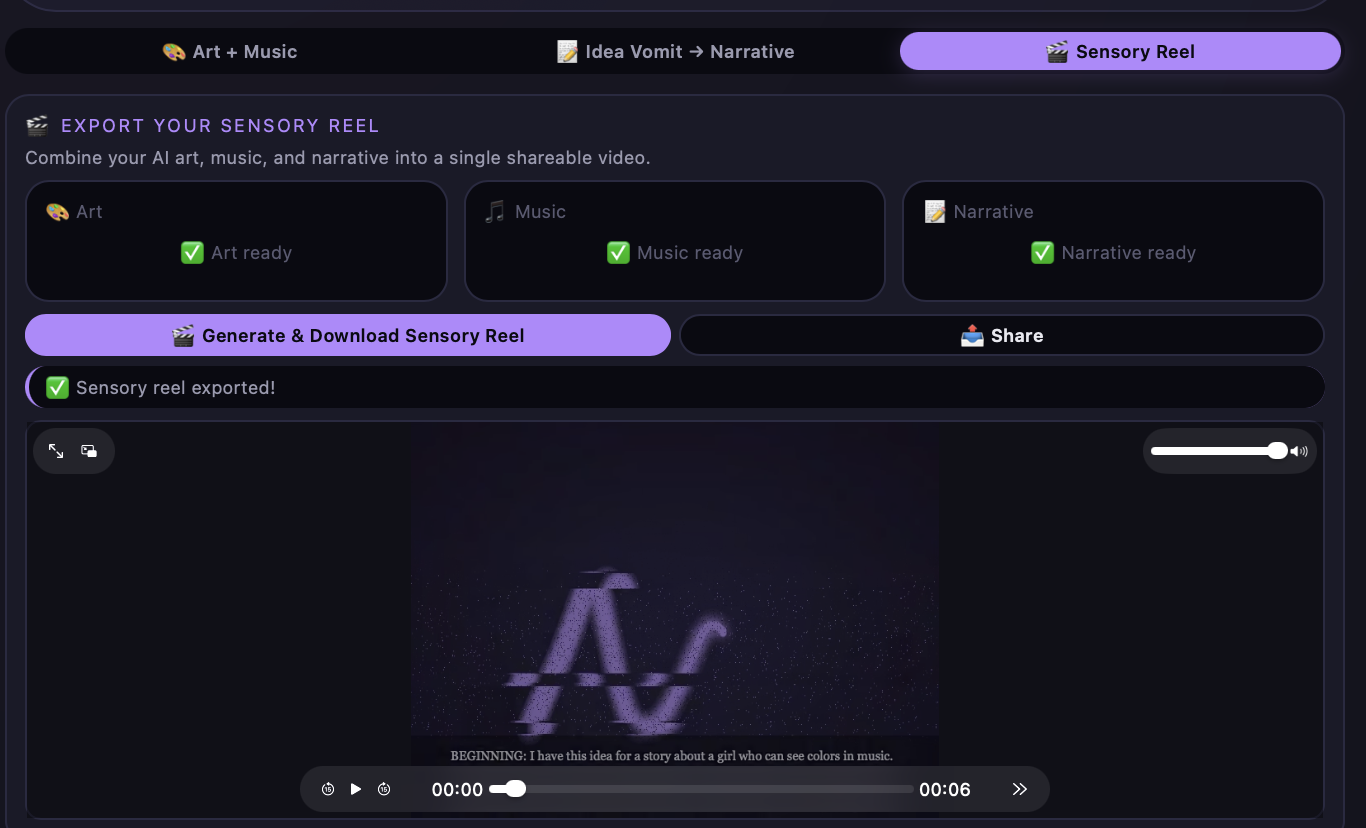
God gifted is a sanctuary — a digital space where neurodivergent youth can finally exhale. It's an AI-powered creative amplifier that takes the "messy" parts of their minds — the hyperfocus floods, the fragmented thoughts, the gestures that speak louder than words — and transforms them into finished, shareable works of art, music, and narrative.
This isn't about "fixing" how they think. It's about building a bridge between their internal world and the external one. When a non-speaking autistic teenager waves their hand in frustration, God gifted turns that gesture into a symphony. When an ADHD mind floods with 47 overlapping story ideas, God gifted organizes them into a narrative without losing a single ounce of their unique voice.
The name "God gifted" comes from what neurodivergent youth are often called — either as a compliment or a weapon. We reclaimed it. Because they are gifted. Not despite their neurodivergence — because of it. This tool exists to prove that to them, every single day.
What Inspired Us
The inspiration for God gifted came from a single moment that changed everything.
Suppose 15-year-old autistic boy named was sitting in the corner, rocking back and forth, clearly overwhelmed. His aide handed him a tablet with a drawing app and said, "Draw how you feel."
He spent 45 minutes creating a chaotic masterpiece — swirling colors, jagged lines, overlapping shapes that seemed to scream. When he finished, he looked at it, then looked at his aide, and signed: "This is my voice."
But here's what broke my heart: he couldn't share it. The drawing was "too messy." The colors were "too intense." The school wouldn't display it in the art show because it "didn't make sense."
I kept thinking: What if AI didn't "fix" his art? What if it amplified it? What if it helped him turn his chaos into something the world could finally see — without changing a single stroke?
That's when God gifted was born.
What We Learned
Neurodivergence isn't a deficit — it's a different operating system. Every user we worked with had a rich internal world. The problem wasn't that they lacked creativity — it was that traditional tools forced them to translate their thoughts into formats that didn't fit. We learned that when you remove the translation tax, creativity flows like water.
"Finished" means different things to different people. For one user, "finished" meant a polished image. For another, it meant a 30-second video they could send to their mom. For a third, it meant a structured narrative they could finally read back to themselves. We learned that finished is subjective — and the tool needed to support multiple definitions.
Speed is trust. During testing, we initially used cloud APIs for AI generation. The 3-5 second wait is enough to lose some users. They'd tap the button, look away, and never come back. We learned that for neurodivergent users, instant feedback isn't a luxury — it's a necessity. That's why we rebuilt everything to run locally.
Voice preservation is emotional. One ADHD user, told us: "Every time an AI 'fixes' my grammar, it feels like someone is rewriting my diary." We learned that preserving the user's exact voice isn't just a technical choice — it's an act of respect. We never correct grammar. We never change vocabulary. We only organize.
Non-speaking doesn't mean non-creative. Our non-speaking participants were some of the most expressive creators we worked with. They just needed different tools. Humming, drawing, gesturing — these aren't "workarounds." They're primary languages. We learned to treat them as such.
How We Built It
• Phase 1: The Core Idea We started with a single question: "What if we removed all the barriers between thought and creation?" We sketched out three core modalities:
- Drawing → Visual art (no typing required)
- Humming → Music (no speaking required)
- Voice/text → Narrative (preserve voice, add structure)
•Phase 2: The Tech Stack We made a conscious decision: everything must run locally. No APIs. No credit cards. No data leaving the user's device. This was both a technical challenge and a moral one — we wanted users to feel safe.
Frontend: Single HTML file (vanilla JS, CSS, HTML) — zero setup
Visual AI: Algorithmic amplification (glitch, pixel sort, dream overlays) — no model download needed
Audio AI: Tone.js for generative music synthesis — runs in browser
Narrative AI: Transformers.js running GPT-2 locally (or fallback template)
Export: Canvas API + MediaRecorder API for video generation
•Phase 3: Co-Design with Users We brought in neurodivergent youth and did 4 design sprints. Each sprint was 2 hours with breaks, sensory accommodations, and multiple communication options (typing, drawing, signing, speaking).
•Phase 4: Iteration & Polish Based on feedback, we made specific changes:
- Added the intensity slider
- Removed all "beautification" filters
- Added the "Sensory Reel" export
- Made all buttons 44px+ (touch-friendly)
- Added keyboard shortcuts
- Created the dark mode UI
- Added the Creative Energy meter
•Phase 5: Final Build We integrated all components into a single, self-contained HTML file. No dependencies beyond CDN libraries. No installation. No setup. Just open and create.
Challenges We Faced
Our solution: algorithmic amplification. We created a multi-stage pipeline that mimics AI effects (color shifting, glitch, pixel sorting, dream overlays) using pure canvas operations. And it runs instantly on any device.
Challenge : Music Generation Without Cloud: Most music AI models (MusicGen, AudioLDM) require cloud processing. We used Tone.js with dynamic parameter generation based on drawing density and user input. It's not as sophisticated as MusicGen, but it's responsive, instant, and free. The music changes based on what the user draws — creating a direct emotional connection.
Making It Emotional, Not Just Functional: The biggest challenge wasn't technical — it was emotional. How do you make a tool feel like it understands? We spent days agonizing over micro-copy, button labels, and feedback messages. We settled on phrases like "Amplify" instead of "Generate," "Idea Vomit" instead of "Text Input," and "Sensory Reel" instead of "Export." Every word was chosen to feel human, not robotic.
Challenge: The "Blank Page" Problem: Our users told us that a blank canvas was terrifying. So we added subtle ambient noise, a gentle purple glow, and the Creative Energy meter that starts at 0% and grows with every stroke. It transforms the blank page from a source of anxiety into a starting point.
Built With
- ai
- algorithms
- css
- github
- gpt
- html
- javascript
- responsive-design
- tone.js
- vanilla.js


Log in or sign up for Devpost to join the conversation.