GoBuddyGo
Inspiration
One in five children in the U.S. lives with a disability. For families enrolled in the WSU GoBabyGo program — where children with mobility challenges receive modified ride-on vehicles — play is transformative. But while the child in the car gains independence, siblings often stand on the sidelines, watching instead of participating. We wanted to change that. Buddy-Link AR was inspired by the simple belief that every child in a family deserves a role in playtime — and that technology should bring kids together, not create more distance.
What It Does
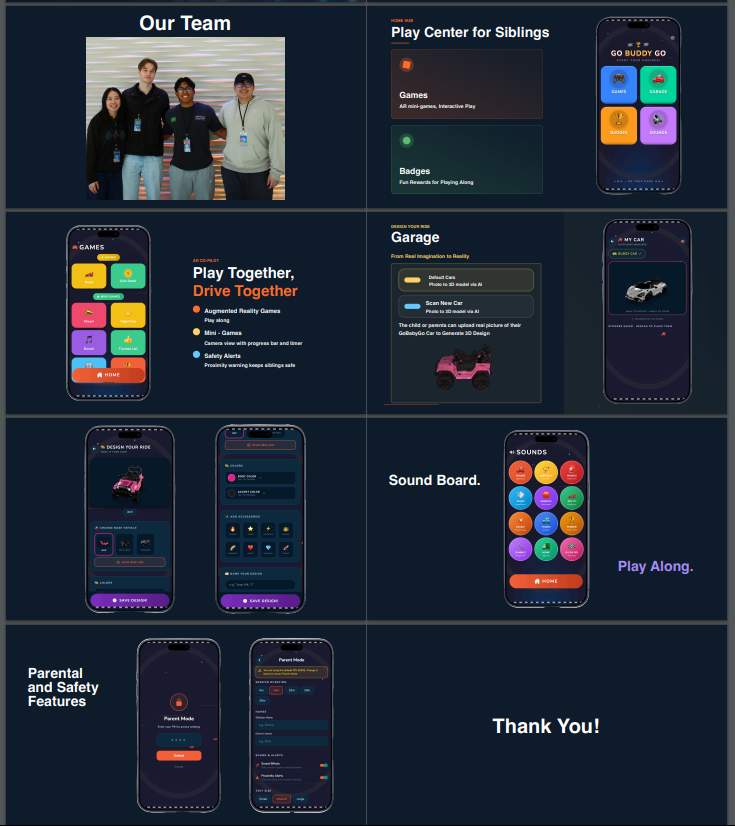
GoBuddyGo turns a sibling into an active co-pilot for GoBabyGo play sessions. Using their smartphone or tablet, the sibling views the physical car through an AR camera and receives real-time missions — "Cheer Loud!", "High Five!", "Do a Dance!", "Count Wheels!" — that keep them engaged alongside the driver.
Beyond the play session:
- Virtual Garage — Siblings can photograph their physical car, generate a personalized 3D digital twin via AI, and customize it with unlockable stickers.
- Badge System — Completing sessions and missions earns badges like "Speed Demon," "Drift King," and "Gearhead."
- Parent Mode — A PIN-protected settings panel lets parents configure session duration, mission difficulty, and view play history.
- Safety Alerts — Proximity and motion sensors warn siblings to give the driver space, keeping everyone safe.
How We Built It
- Mobile App: React Native + Expo, using
expo-camerafor the AR overlay andexpo-sensorsfor proximity safety monitoring. - 3D Model Generation: Users photograph their real car; the image is sent to our API server, which calls the Meshy AI API to generate a
.glb3D model returned to the app. - Backend: A TypeScript/Go API server handles model generation requests and asset management.
- AR Experience: Custom HUD with real-time mission cards, progress bars, timers, and celebration animations built using React Native Reanimated and Skia.
- Design: Built with accessibility and inclusivity at the forefront — large tap targets, high-contrast elements, and minimal cognitive load for young users.
Challenges We Ran Into
- AR without a dedicated framework: Building a smooth, performant AR overlay in React Native without ARKit/ARCore required creative use of the camera API combined with carefully layered UI components.
- 3D model generation latency: AI-generated models take time to process. We had to design a clear, non-frustrating loading experience while keeping the pipeline reliable.
- Stale asset URLs: Generated 3D model URLs from Meshy AI expire after a period of time, requiring us to build a re-fetch and caching strategy so models don't break on reload.
- Safety in an active play context: Detecting when a sibling is too close to a moving vehicle using only an accelerometer — without GPS — required careful tuning to avoid false positives that would interrupt the fun.
- Designing for two audiences at once: The app must be engaging for a sibling (ages 4+) while remaining fully configurable for a parent — balancing simplicity and control in the same product.
Accomplishments That We're Proud Of
- Built a genuine AR co-play experience that runs entirely on a standard smartphone — no headset, no extra hardware.
- Created an image-to-3D pipeline that lets any family generate a digital twin of their unique GoBabyGo car in minutes.
- Designed a safety system that passively monitors the play environment without interrupting the experience unless necessary.
- Built a badge and progression system that gives siblings a sense of ownership and growth across multiple sessions.
- Delivered a product that centers a group — siblings of children with disabilities — who are rarely the focus of assistive technology design.
What We Learned
- Inclusive design is not a feature — it's a foundation. Building for children with and without disabilities at the same time forced us to make better decisions at every layer of the product.
- Physical-digital play is an underexplored space. The most magical moments came not from what was on the screen, but from how the app changed what happened in the room.
- Latency matters more in a play context than almost anywhere else. A child will not wait — the experience has to feel instant or the moment is lost.
- Parent trust is earned through transparency. The more clearly we communicated what the app was doing (and what it wasn't), the more confident parents felt letting their kids use it.
What's Next for GoBuddyGo
- Multiplayer missions — Allow multiple siblings to join the same session from different devices, each with a unique co-pilot role.
- Driver-side companion — Explore a simplified screen or audio experience for the driver themselves to participate in missions.
- Expanded vehicle library — Grow the built-in 3D model catalog to cover more GoBabyGo vehicle types out of the box.
- Session sharing — Let families export session highlights — badges earned, missions completed, and memorable moments — to share with therapists or family members.
- Therapist dashboard — Provide occupational therapists with session data to track engagement, duration, and progress over time.
- Broader program support — Partner with additional adaptive play programs beyond WSU GoBabyGo to bring Buddy-Link AR to more families nationwide.
Built With
- google-docs
- meshy
- replit

Log in or sign up for Devpost to join the conversation.