Inspiration
I spend a huge part of my life behind a screen. I work on it, study on it, socialize through it, and even use it to relax.
That made me wonder: instead of building another AI tool that keeps us on our screens, what if AI could actually help us step away from them?
That idea became GO HUMAN.
I didn't want to build something that tells people to completely change their lifestyle or become more productive. I wanted something much smaller and more approachable.
When someone feels stuck, tired, disconnected, or simply doesn't know what to do next, GO HUMAN helps turn that feeling into one small, realistic action in the real world.
What it does
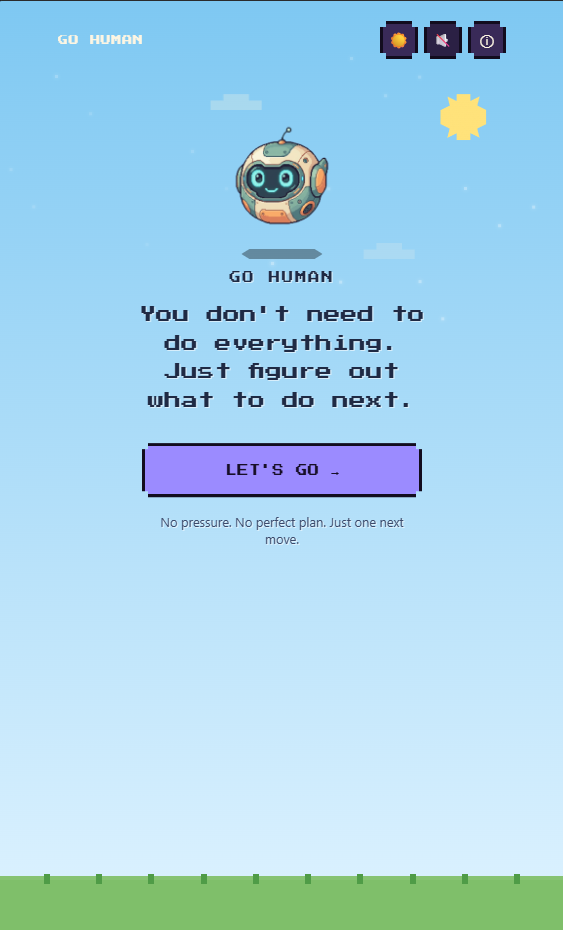
GO HUMAN is an AI-powered companion designed to help people take small steps away from their screens.
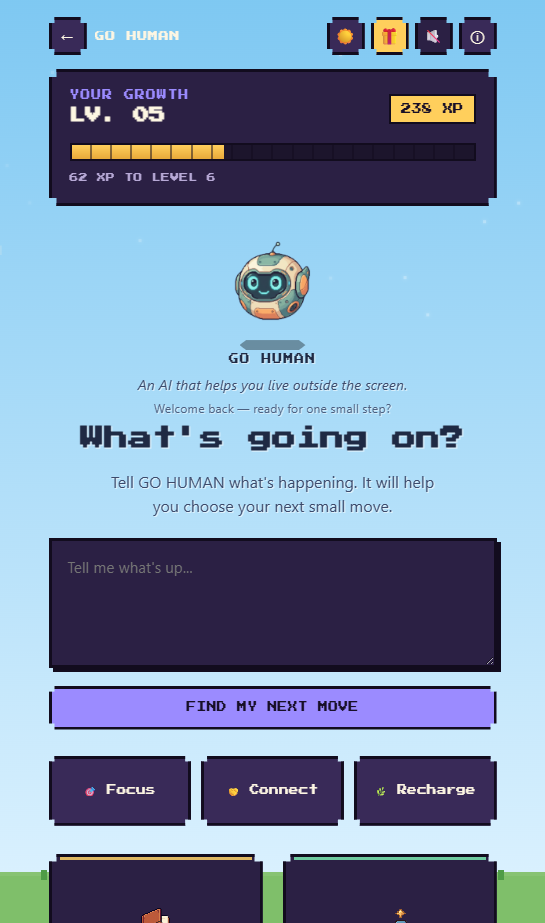
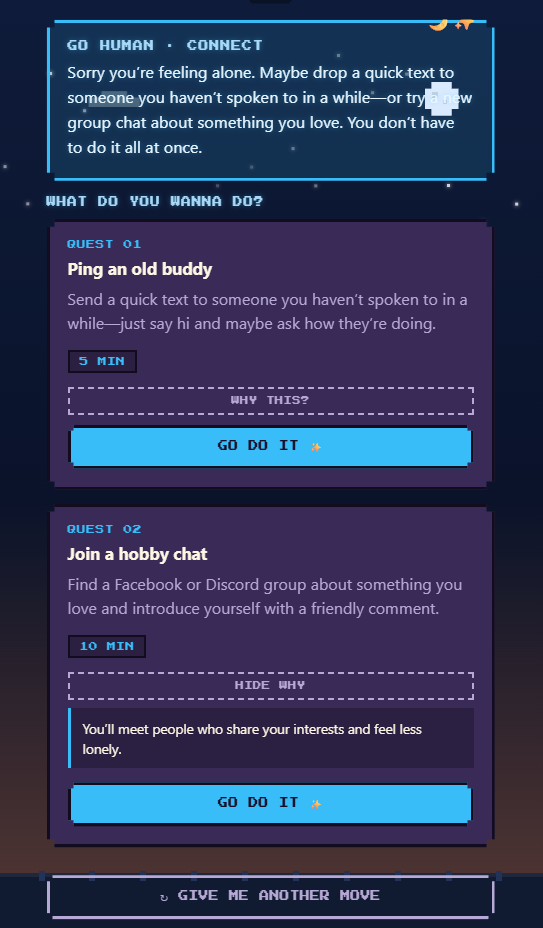
Users can start with three Quick Choices — Focus, Connect, or Recharge — or simply tell GO HUMAN what's going on in their own words.
The AI takes that context and turns it into a small Next Move that the user can actually do.
From there, users can:
- Ask Why This? to understand why a move was suggested.
- Request Another Move if the suggestion doesn't feel right.
- Use Make It Smaller when they run out of moves and the current action still feels too difficult.
- Start a simple timer and focus on doing the move.
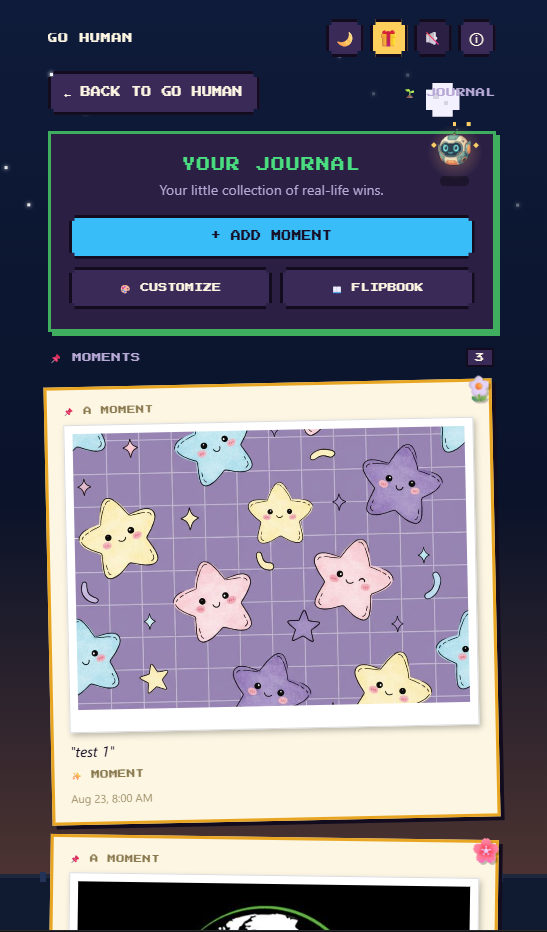
- Record the experience afterward as a Moment in the Journal.
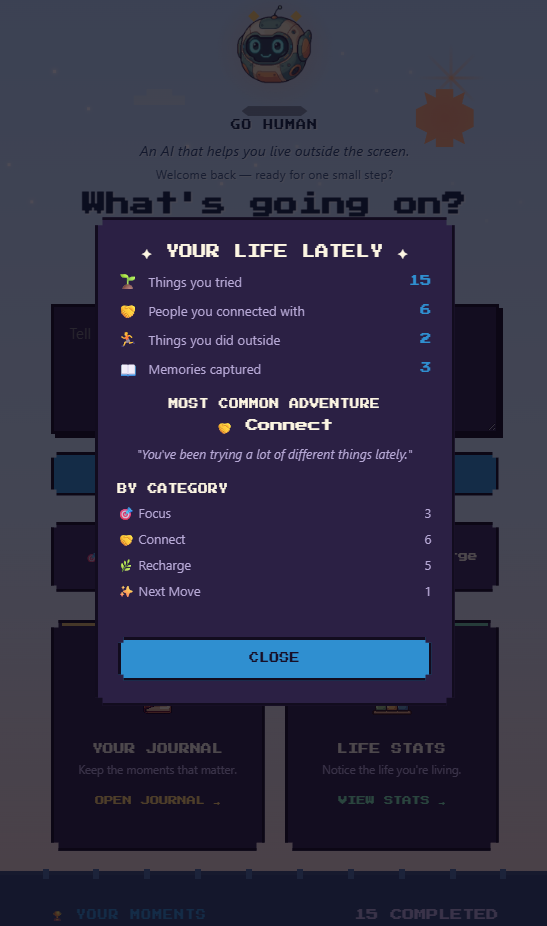
- Look back at their progress through Life Stats.
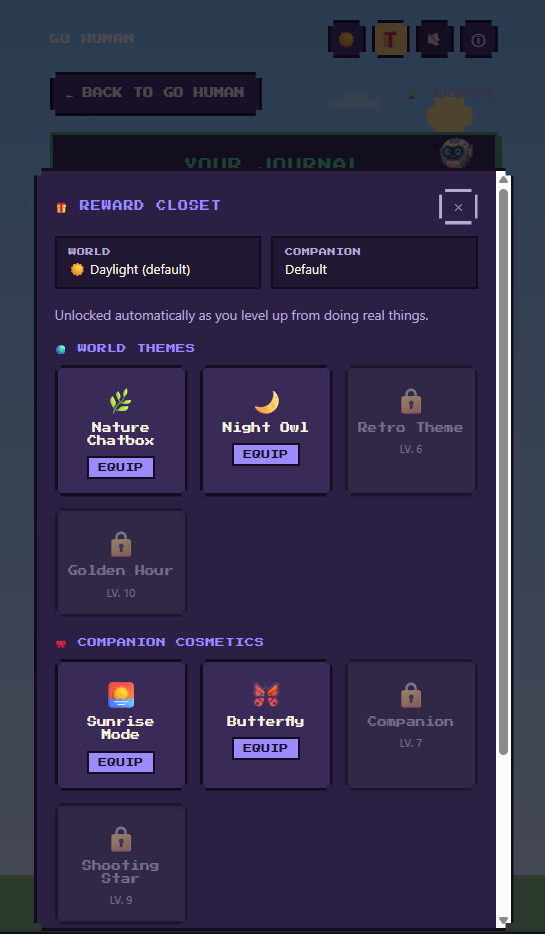
- Earn XP and unlock rewards as they continue making progress.
There's also a small Companion that reacts to the user's progress. It's not the main feature, but I wanted it to add a little personality and encouragement to the experience.
The idea is simple:
Less time planning what to do. More time actually doing it.
How I built it
I built GO HUMAN as a web application using React and Vite, with a pixel-art visual style inspired by cozy indie games.
The core experience is powered by AI. It takes what the user is feeling or dealing with and generates a personalized, realistic next action.
One of my biggest priorities was making the AI interaction feel natural rather than robotic. I didn't want it to feel like a chatbot simply giving generic productivity advice. I wanted the interaction to feel conversational and lead to something the user could realistically do right away.
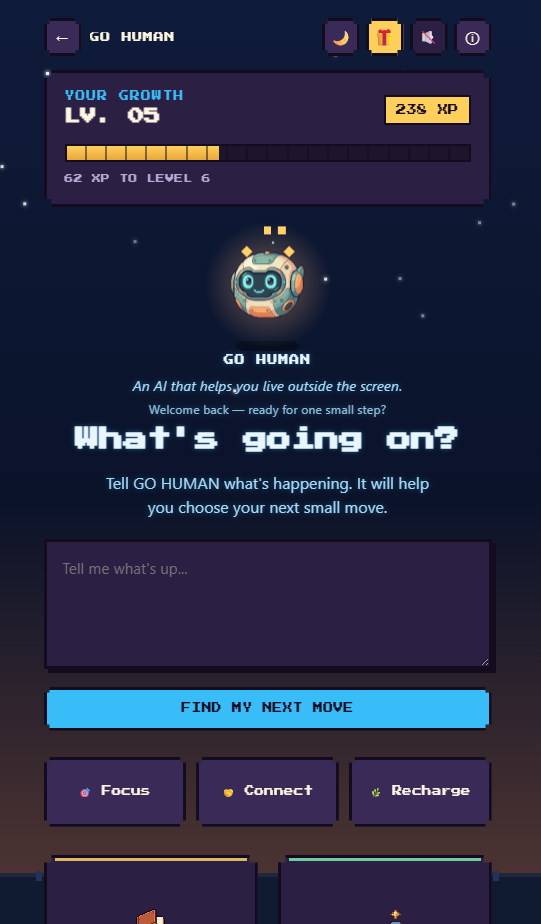
Around that core AI experience, I built the supporting systems for Quick Choices, Next Move, Another Move, Why This?, Make It Smaller, the timer, Moments, Journal, Life Stats, XP, Rewards, Day/Night themes, sound controls, and the Companion.
I also focused heavily on the UI, trying to balance the pixel-art identity with modern usability across both desktop and mobile.
Challenges I ran into
One of my biggest challenges was finding the right balance between AI capability and simplicity.
It would have been easy to let the AI generate long explanations or complicated plans, but that would go against the entire purpose of GO HUMAN.
I kept asking myself:
"Would a real person actually want to do this right now?"
That question influenced a lot of the design decisions.
Another challenge was making GO HUMAN feel different from a typical productivity tracker. I didn't want users to feel like they were being given another list of things they should be doing.
That's why I built features like Another Move, Make It Smaller, and Why This?. They give the user more control over the AI suggestion instead of simply accepting or rejecting it.
I also spent a lot of time refining the UI, especially making sure the pixel-art style could coexist with a clean and usable interface on smaller screens.
Accomplishments I'm proud of
I'm proud that GO HUMAN became more than just an AI prompt box.
The AI is connected to an actual experience: a suggestion can lead to a real-world action, that action can become a Moment, and those Moments can eventually become part of the user's longer-term story.
I'm especially proud of the Next Move → Another Move → Make It Smaller flow.
It recognizes something that many productivity systems overlook:
Sometimes the problem isn't that you don't know what to do. The problem is that the first step feels too big.
I'm also proud of the visual identity I created for GO HUMAN. I wanted it to feel warm, playful, and approachable while still being functional and easy to navigate.
Most importantly, I'm proud that the project stayed true to its original idea: using AI to encourage people to spend less time interacting with technology.
What I learned
I learned that building an AI feature isn't just about getting the model to produce a good answer.
The harder question is:
What happens after the AI answers?
For GO HUMAN, the answer had to be an action.
That changed how I approached the entire project. Instead of designing around the AI itself, I started designing around the user's journey:
feeling → suggestion → action → reflection
I also learned how much small UX decisions matter in an interactive product. Things like clear navigation, responsive layouts, feedback after completing an action, and small moments of celebration can make an AI experience feel much more human.
And as a solo developer, I learned a lot about making decisions quickly, prioritizing features, debugging problems, and knowing when an idea is worth implementing versus when it should wait.
What's next for GO HUMAN
The current version focuses on helping users take one small step at a time, but I see a lot of potential for where GO HUMAN could go next.
I'd like to make the AI better at understanding longer-term patterns while still keeping the experience lightweight and respectful of user privacy.
I'd also like to expand the world around GO HUMAN with more meaningful rewards, more ways to personalize the Journal, richer Companion interactions, and better ways to visualize the real-world moments users are collecting.
But the core idea wouldn't change.
I want to build technology that doesn't always ask us to spend more time with it.
Sometimes, the best thing an AI can do is help you close the screen, stand up, and go be human.
Built With
- assistant
- css
- groq
- javascript
- react
- vercel
- vite


Log in or sign up for Devpost to join the conversation.