-
-
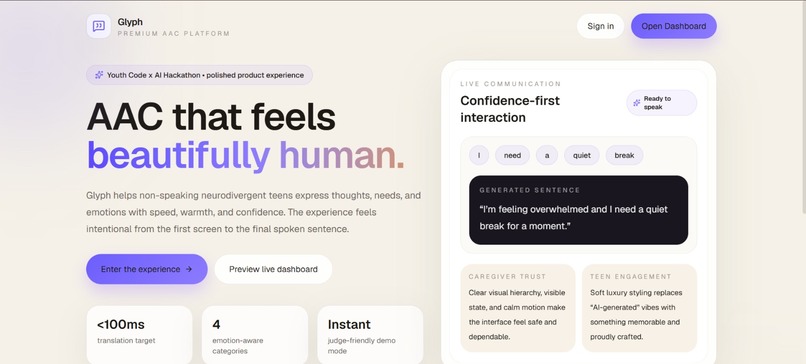
Intro Page
-
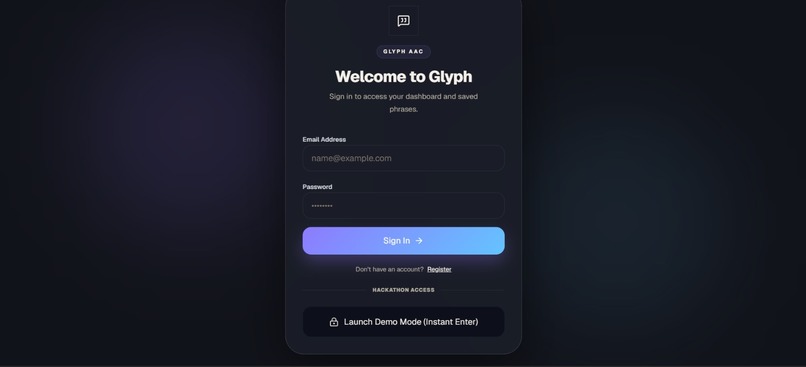
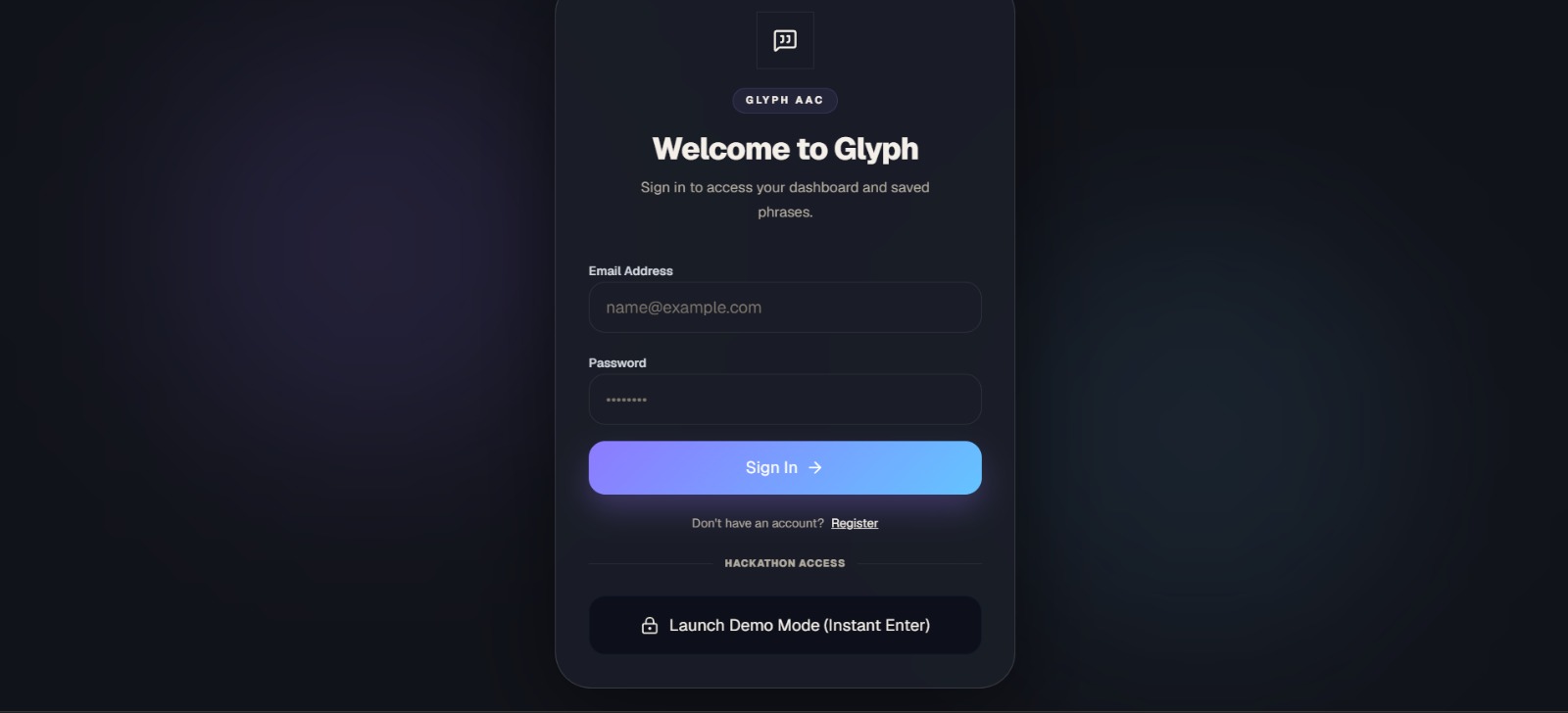
Login Page
-
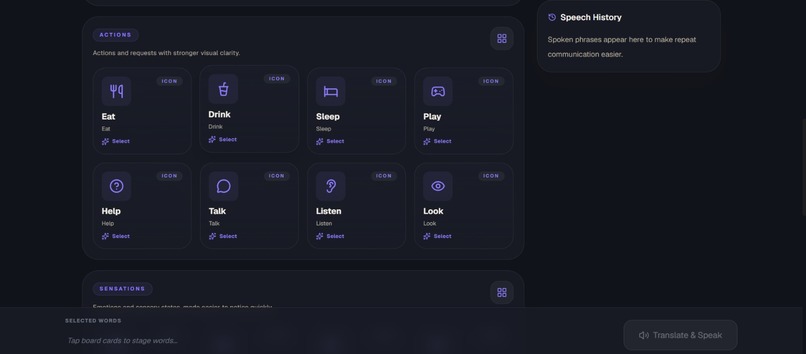
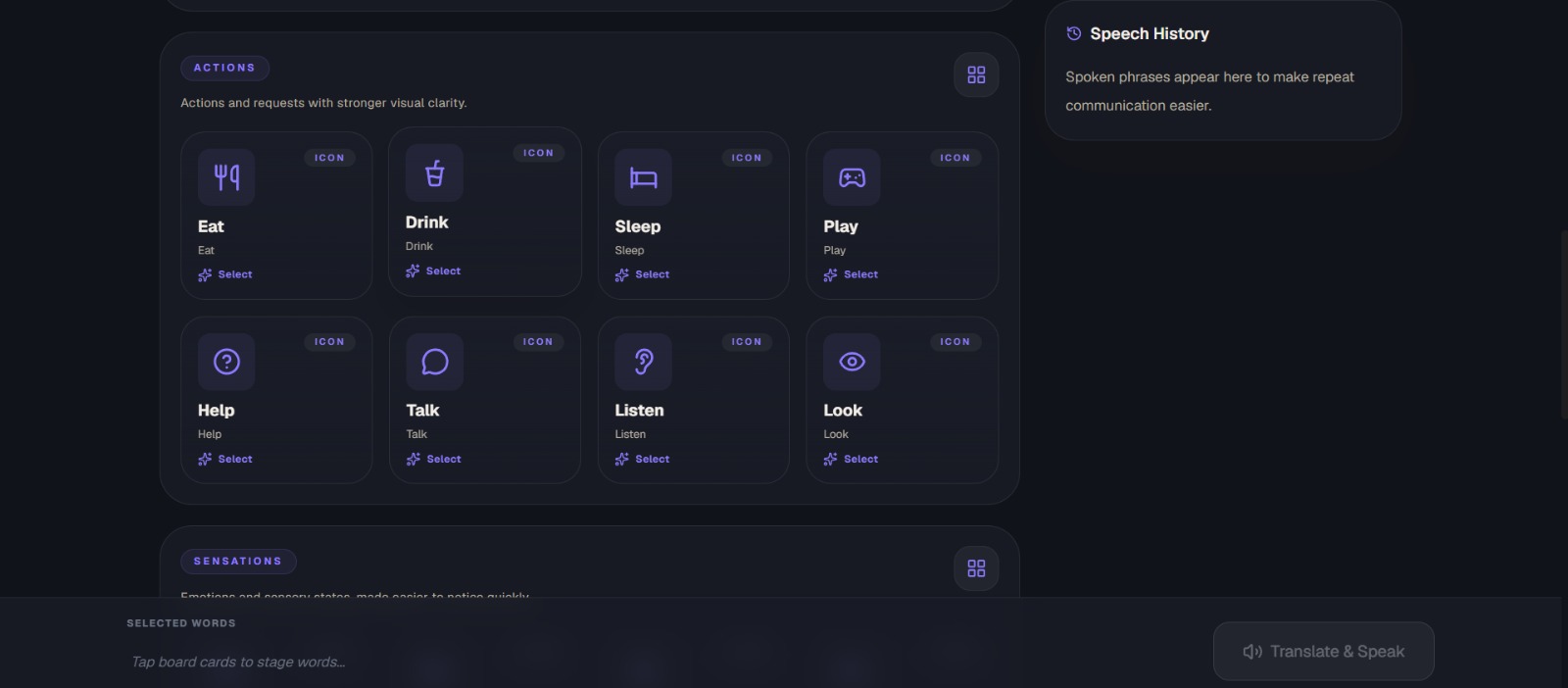
Main Page
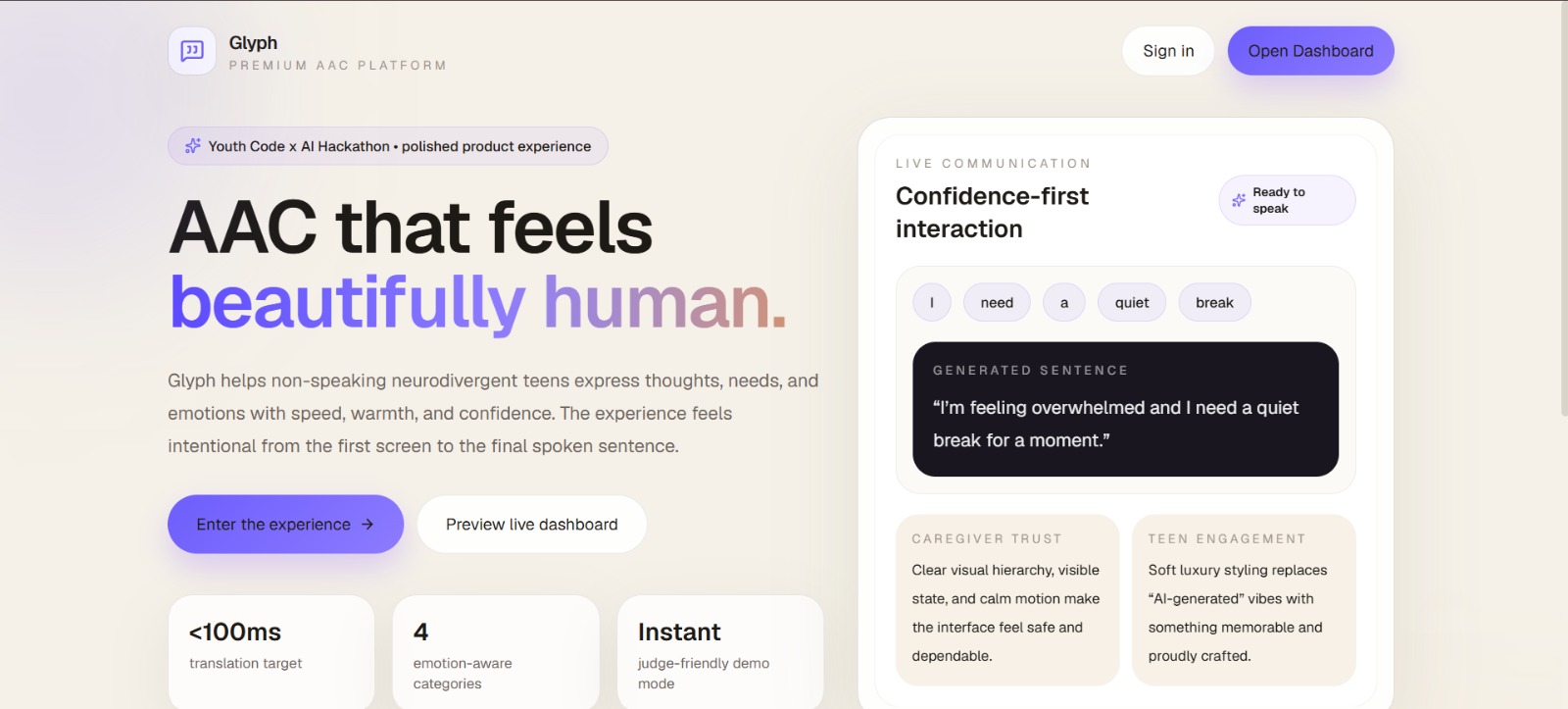
Inspiration
Communication shouldn't cost $250, and it shouldn't be exhausting. Traditional Augmentative and Alternative Communication (AAC) apps—the software non-speaking autistic and neurodivergent individuals use to express themselves—are locked behind massive paywalls, feature cluttered 90s-era grids, and require users to slowly navigate deep folder structures. When a teenager is experiencing a sensory meltdown or acute overstimulation, navigating a complex interface is a cognitive impossibility. Inspired by the core mission of supporting neurodivergent youth, we wanted to completely disrupt this space. We built *Glyph*: a 100% free, beautifully modern, and blazingly fast AI communication canvas designed to give non-speaking individuals an instant, fluid voice when they need it most.
What it does
Glyph flips the script on traditional speech tools by replacing tedious typing with a dynamic concept canvas:
- Contextual Tap-to-Speak: Instead of constructing sentences letter-by-letter, users tap 2 or 3 high-contrast, minimalist concept icons (e.g.,
[Feel]+[Overstimulated]+[Noise]). - Instant AI Translation: Using the ultra-fast Groq API, Glyph instantly synthesizes these fragmented concepts into a perfectly natural, polite, first-person sentence: "The environmental noise is making me feel incredibly overstimulated right now, I need a quiet moment."
- Native Vocalization: The app immediately voices the phrase aloud using the browser's native text-to-speech engine.
- The "Spark" Loop: To make communication engaging and routine-friendly, Glyph features a subtle, calming gamification system. Every successful interaction awards "Sparks" (XP) that fill a soothing neon progress ring and build a daily streak, offering positive reinforcement without sensory overload.
How we built it
We engineered Glyph from scratch to be portable, secure, and incredibly fast:
- Frontend: Built using *Next.js (App Router)** and Tailwind CSS for a mobile-first, high-performance web architecture.* * Animations: Leveraged *Framer Motion** to implement organic spring physics. Every tap feels tactile and physical, giving users satisfying visual feedback.*
- The Brain: Powered by the *Groq API** running Llama 3.1 8B. Groq's LPU architecture allowed us to achieve sub-100ms inference speeds, making communication truly real-time.*
- Backend & Auth: Integrated *Supabase** for secure user login (Email & Google). We designed a PostgreSQL schema that safely stores customized icon grids, historical phrases, and user "Spark" metrics.*
- Portability: Configured as a fully responsive *Progressive Web App (PWA)*. Users can install Glyph directly onto any iOS or Android home screen with a single tap, bypassing the app store completely.
Challenges we ran into
- The Latency Barrier: Standard LLM endpoints often take 2 to 3 seconds to return a sentence. For a non-speaking individual mid-crisis, this delay makes an app feel entirely broken. We bypassed this by migrating our entire inference pipeline to Groq, dropping our processing latency to near-zero.
- Designing for Sensory Sensitivity: Most modern app design relies on bright colors, flashing lights, and heavy animations. We had to unlearn typical web patterns. We spent hours refining our UI into a pure OLED dark-mode matrix utilizing ultra-soft blues, teals, and glassmorphic panels to ensure the app remains a calm haven during moments of high anxiety.
Accomishments that we're proud of
- Breaking the Cost Barrier: Creating a fully functional, cloud-synced, AI-driven accessibility tool that costs exactly $0 for the end-user.
- Sub-100ms Execution: Bridging the gap between icon inputs, cloud-hosted AI processing, and hardware speech output in the blink of an eye.
- Empathetic UX: Designing an interface that prioritizes accessibility and human dignity above all else, ensuring that minimal physical effort yields maximum expressive capability.
What we learned
We learned that exceptional UX in accessibility tools isn't about how many features you can add—it's about what you can intentionally subtract. By removing clutter, text-heavy menus, and unnecessary configurations, we created a tool that is highly functional precisely when the user's cognitive load is at its highest. We also gained deep experience in optimizing edge-ready API routes and handling localized states securely.
What's next for Glyph
- Custom Icon Boards: Allowing parents, teachers, and therapists to upload custom SVG icons tailored to the user's specific daily routines and environments.
- Offline Local AI: Integrating WebLLM to run smaller language models entirely within the browser cache, allowing Glyph to translate icon taps even in areas with zero internet or cellular connectivity.
- Hardware Switch Accessibility: Implementing assistive technology hooks so users with limited motor control can navigate the Glyph matrix using external physical switches or eye-tracking hardware.
Built With
- framer-motion
- groq
- llama-3.1
- next.js
- pwa
- supabase
- tailwind-css
- typescript
- web-speech-api


