-
-
Presentation
-
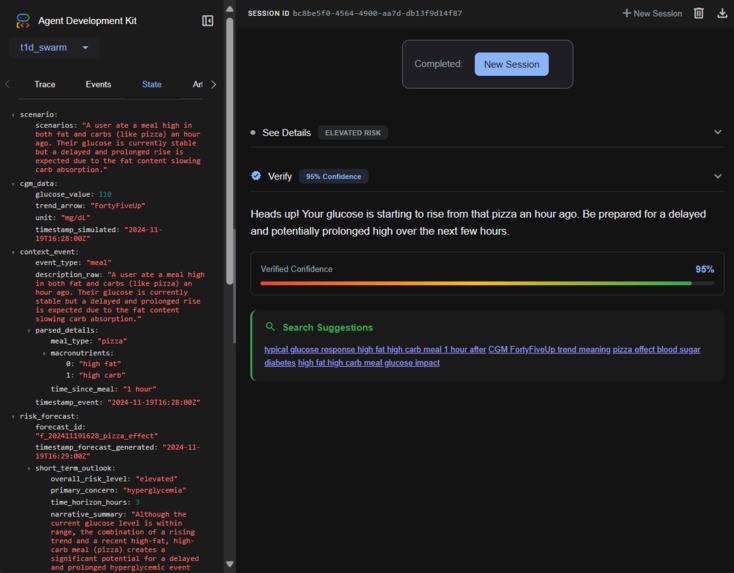
forecast example


Glycemic Sentinel: From Indignity to Innovation
He looked ancient, frail, yet his mind was sharp enough to coordinate the marking of national exams. I brought the water he'd sent for and left, wondering. That afternoon, I saw him again, this time struggling to walk. I grabbed his arm just as he started to fall. I helped him through the school gate. After he thanked me, I couldn't hold back my curiosity. "What's wrong?" I asked.
"I have Type 1 diabetes," he said.
Back then, all I knew was that diabetes was a disease related to sugar. Before I could ask what that meant, he began urinating right there on the pavement. That was my first encounter with the raw indignity of the disease.
The Quest for Proactive Care
Three years later, that memory was still with me as I began my research. I was exploring how smart, background AI could personalize insulin management by looking at everything at once: real-time glucose data, physical activity, even stress patterns. When I found a hackathon featuring new Google technology, I saw a chance to experiment. But brainstorming that night was a dead end. Every idea felt hollow.
I knew the answer was there, but I couldn't grasp it. Stumped, I turned to Gemini, which knew about my research. It prompted me: "Think about what you truly care about. What problem do you actually want to solve?"
That question threw me back to the old man at the school gate. Back to his struggle. His indignity.
"T1D care should be predictable and proactive," I typed. Most applications are reactive; they sound an alarm when things are already going wrong. What if that man had gotten a quiet warning an hour earlier? What if something could have told him, "The way you're feeling now might lead to trouble"? He could have prevented that moment. He deserved better care. Fueled by that memory, I worked with the AI to hammer the raw anger into a feasible idea.
To be truly proactive and trustworthy, this couldn't be just another alert system. It had to be a swarm of intelligent agents working in concert—each with specialized roles, each checking the others' work before any alert reached the user.
When Everything Falls Apart
My team was gone. I was alone with Angular, a framework I'd never touched. Starting from scratch was impossible in a hackathon, so I turned to an AI coding assistant for help. It was like trying to direct a blindfolded artist—it would generate code that was almost right, and then spectacularly wrong.
My one non-negotiable rule is sleep by midnight. I broke it every night. "Just one more try," I'd tell myself, staring at the screen. The fix always felt one build away, but every fix seemed to break two other features. It was a maddening cycle of progress and collapse. In the process, I learned Angular by force, one agonizing error at a time. My wireless mouse didn't survive; it shattered against the wall after one too many failed builds.
The moment it finally worked felt surreal, like the silence after a long battle. But it was a fragile victory. The project felt less like an engineered system and more like a gamble—working today, ready to break tomorrow.
The Promise
Through the frustration, one image kept me going: a person with diabetes getting a quiet heads-up about a rising blood sugar. A warning about a dangerous trend. And if they don't respond, a call goes to a loved one. A safety net. Suddenly, the frustration, the sleepless nights, and the shattered mouse were all worth it.
My goal was never to solve diabetes. It was to solve for the man at the school gate. It was to replace indignity with predictability; to build a system that wasn't reactive, but proactive.
That is the idea behind Glycemic Sentinel: a swarm of proactive agents standing guard. It's not a cure, but it is a promise—the promise that no one should have to face the indignity of this disease alone and unaware.
Want to understand how the multi-agent architecture actually works? Read the technical deep-dive: Building Proactive AI Swarms for Diabetes Care: A Technical Implementation Guide
Built With
- gemini
- google-cloud
- goolge-adk
- vertexai

Log in or sign up for Devpost to join the conversation.