GlucoTwin: An Adaptive Digital Twin for Glucose-Risk Prediction
Team: Team MeowMeow
Theme: AI × Healthcare
Inspiration
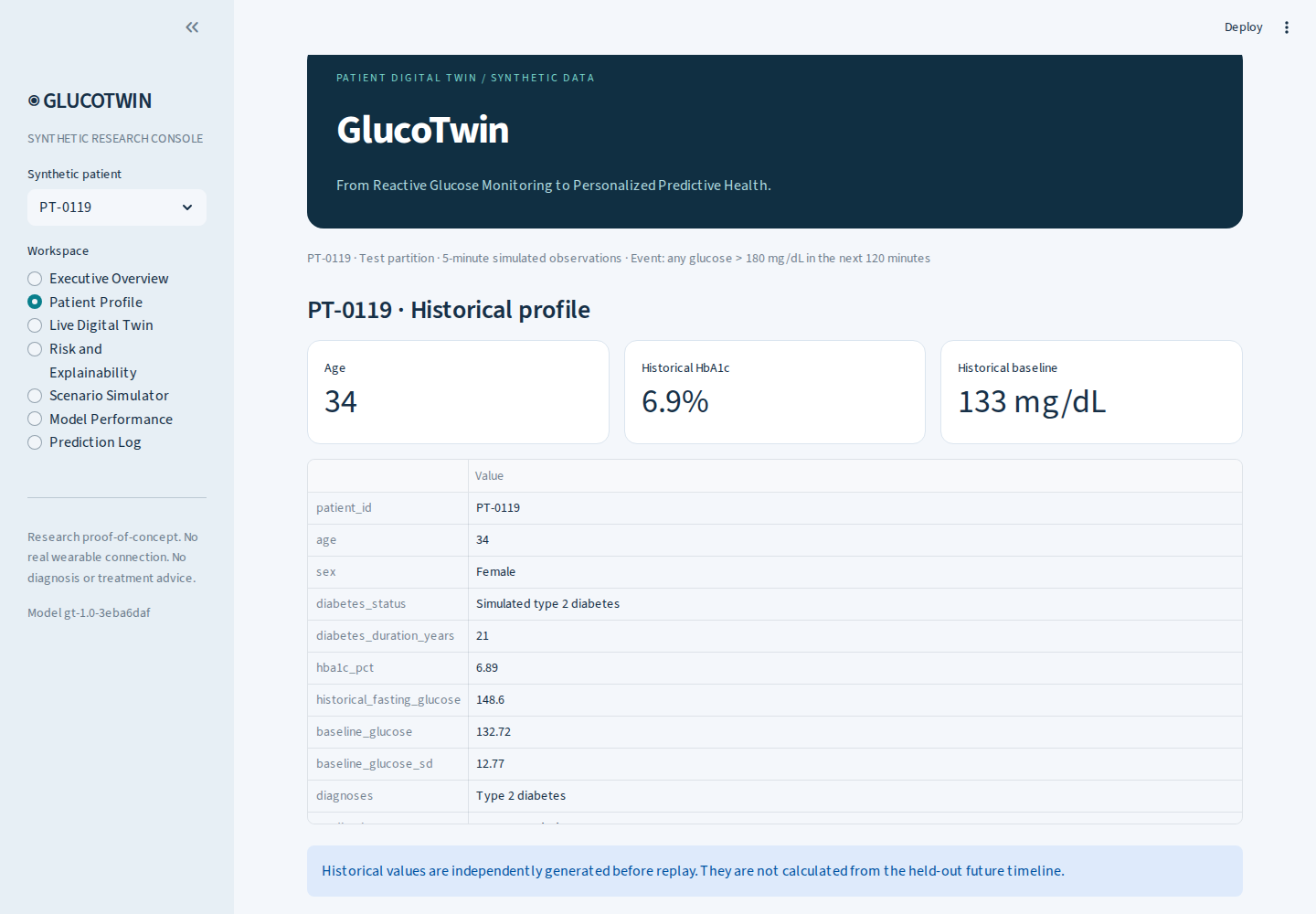
Glucose is dynamic. A single sensor reading cannot fully describe how it is changing, and interpreting a stream of measurements requires more context than looking at the latest number alone.
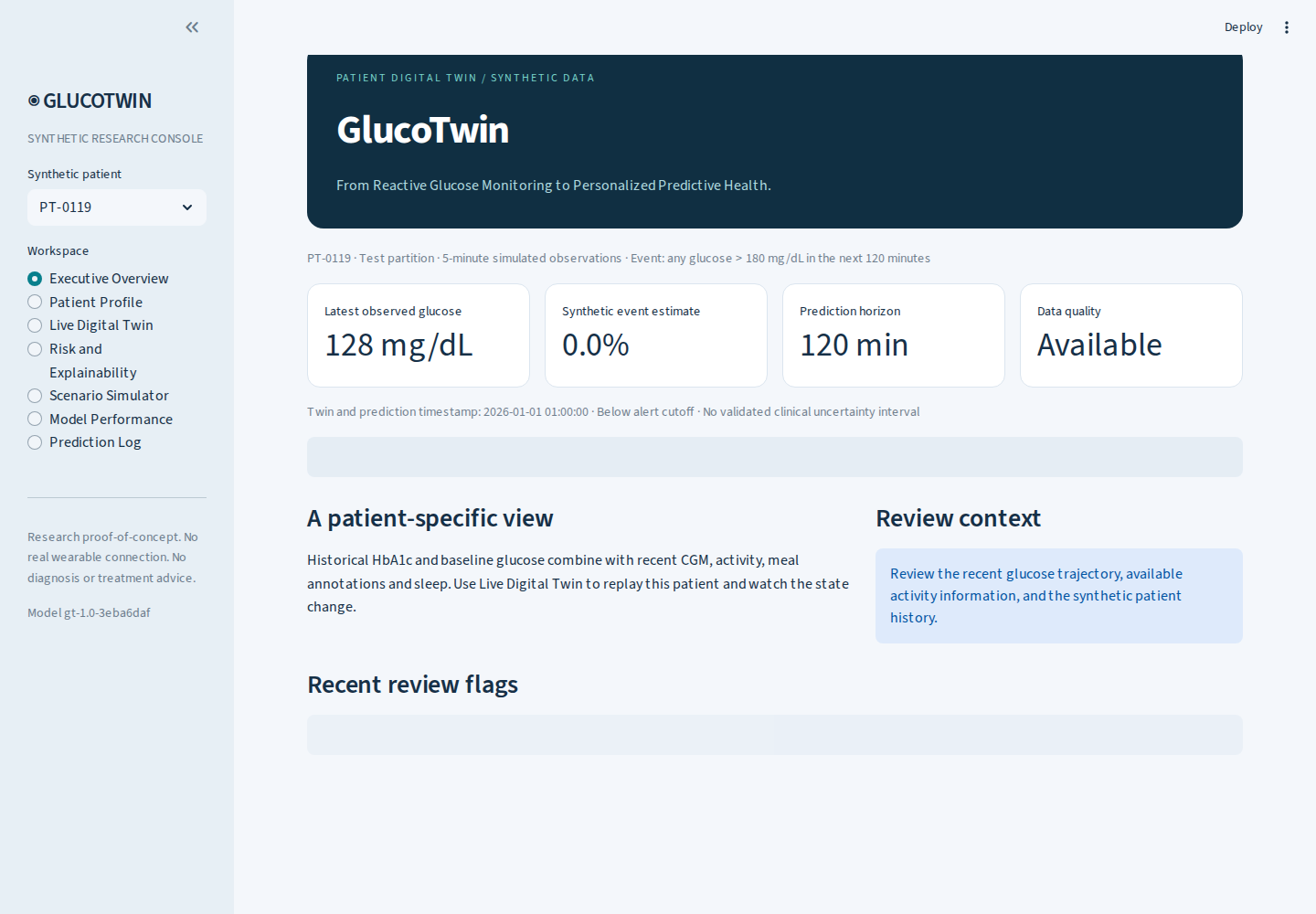
We built GlucoTwin to explore how a continuously updating digital twin could combine simulated sensor observations, temporal patterns, and patient context to estimate near-term glucose-threshold risk. Our goal was to create an interactive, inspectable prototype—not a black-box prediction demo.
What it does
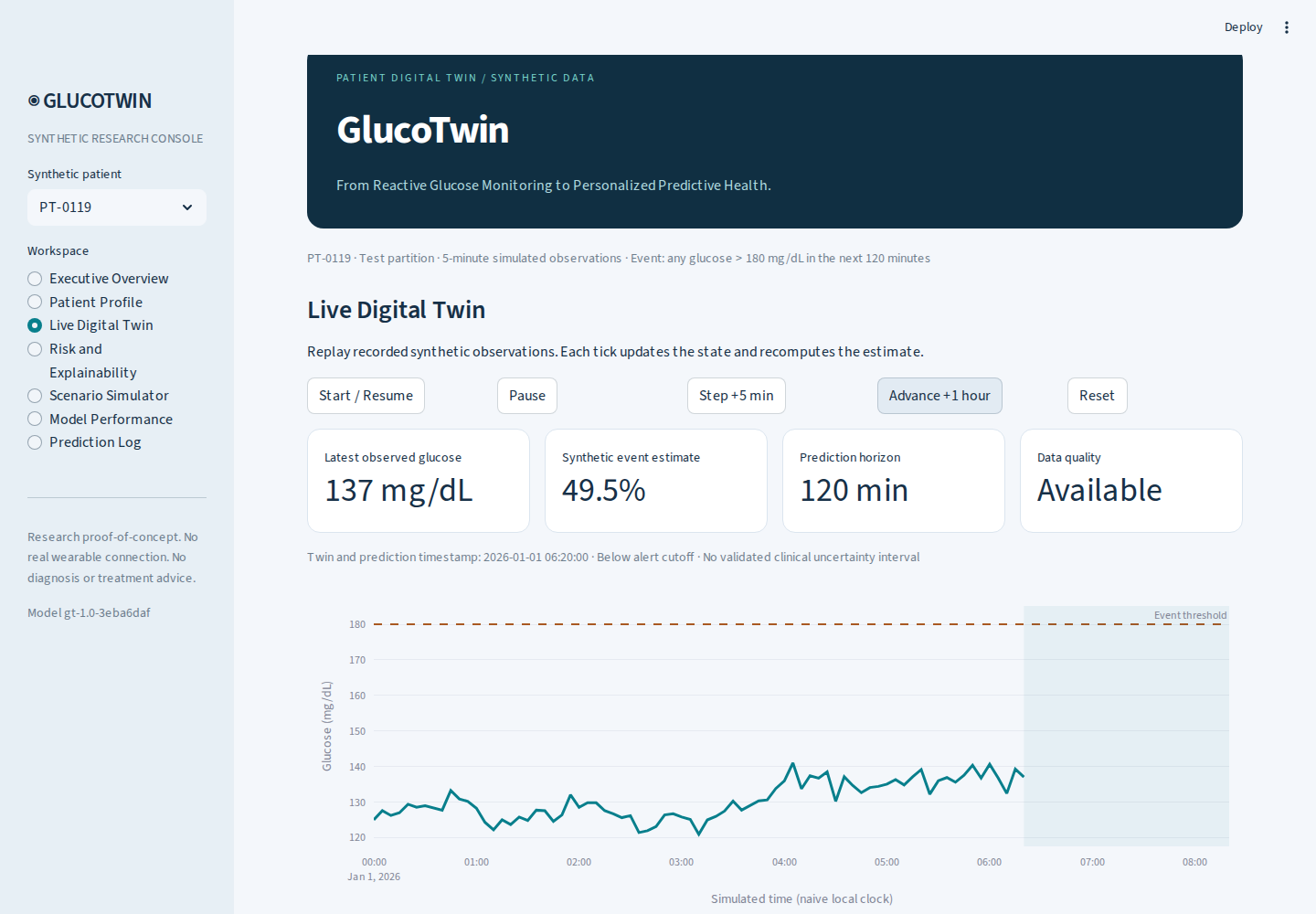
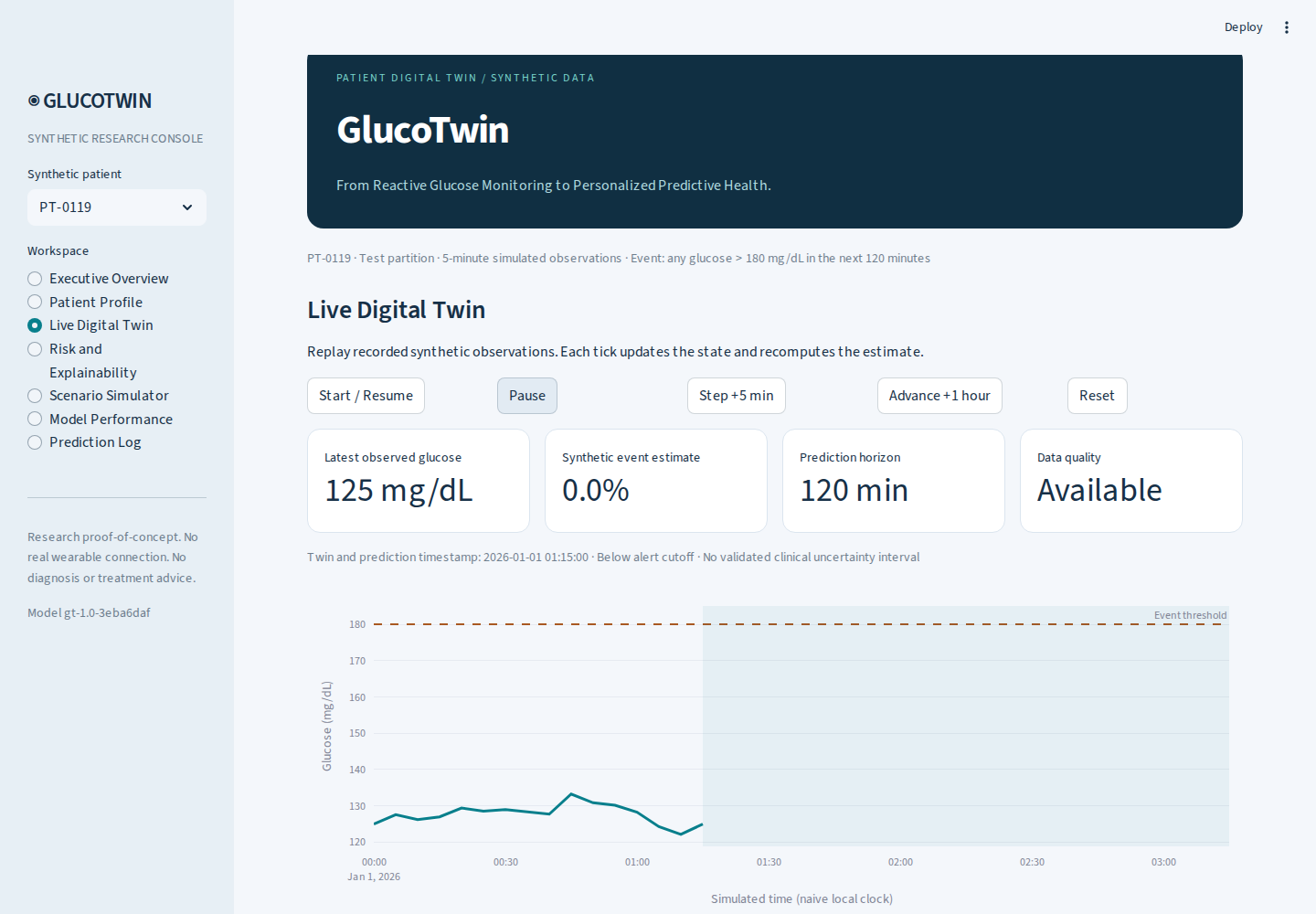
GlucoTwin replays simulated continuous glucose monitoring (CGM) data and estimates whether a future simulated glucose reading will exceed 180 mg/dL within the next 120 minutes.
The application brings together:
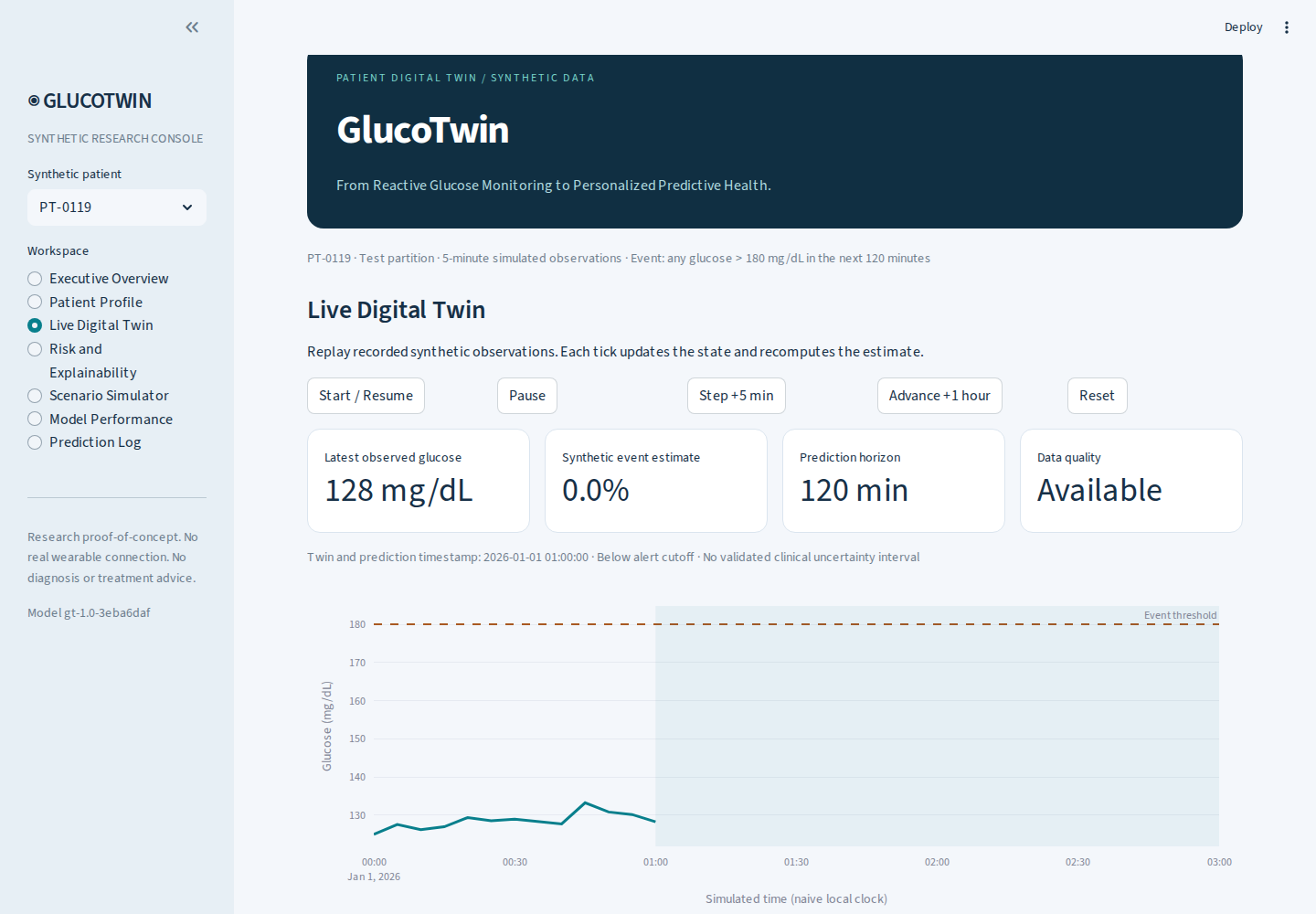
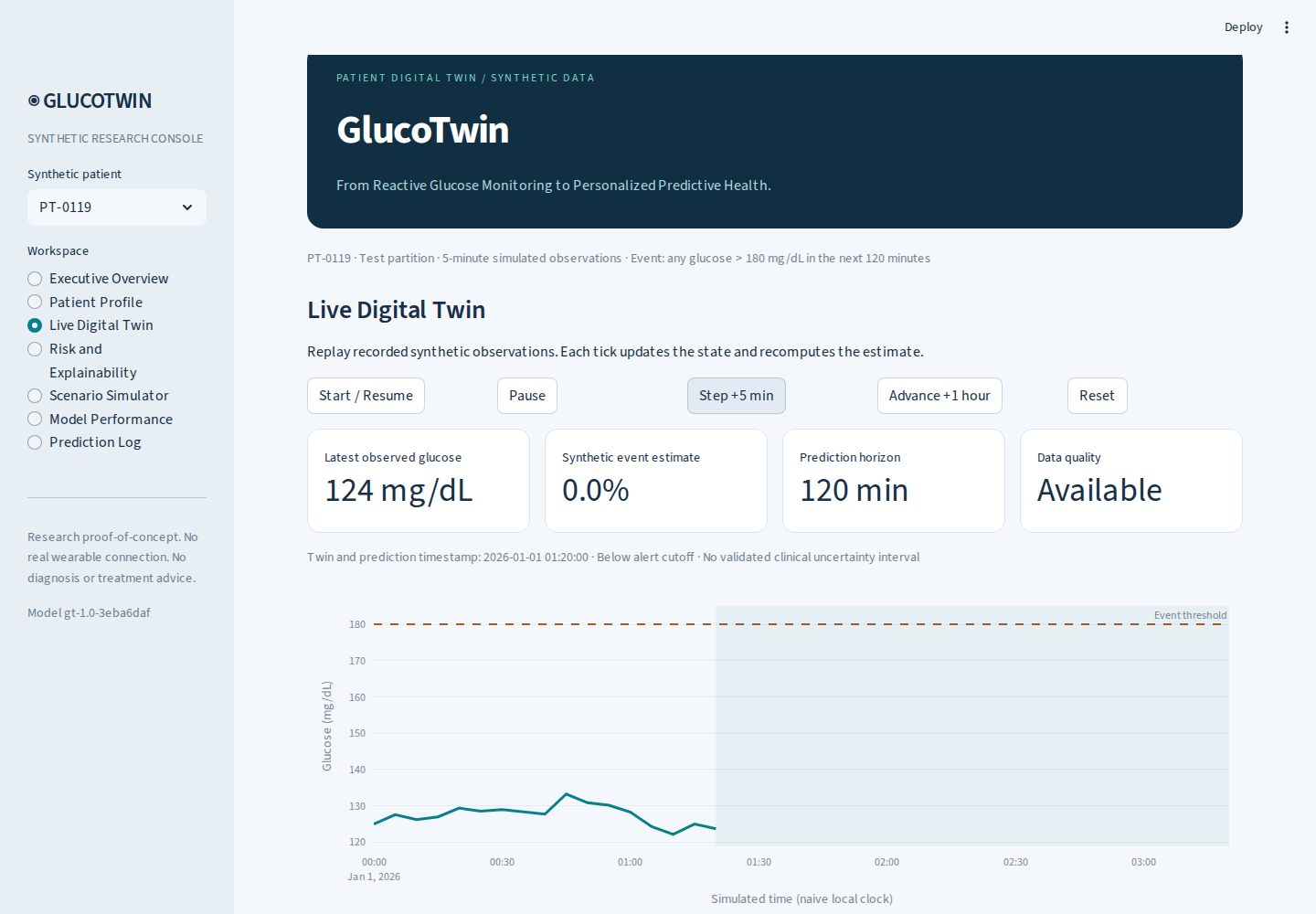
- Live digital-twin replay: Step through a simulated sensor stream and observe predictions update.
- Machine-learning inference: Use a trained HistGradientBoostingClassifier with calibrated probabilities.
- Temporal feature engineering: Summarize recent glucose dynamics and sensor quality using causal features.
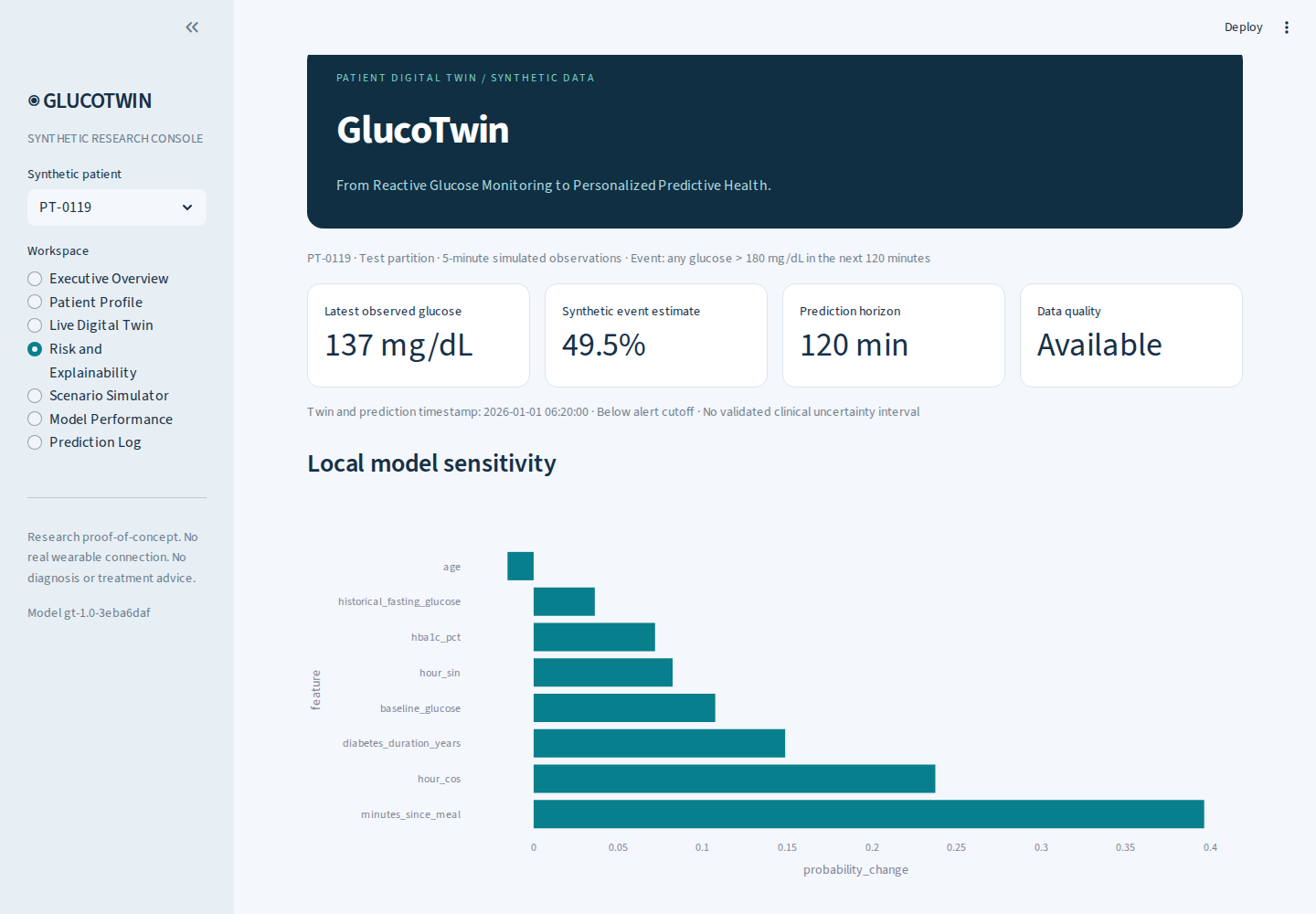
- Explainability: Inspect the factors associated with model predictions.
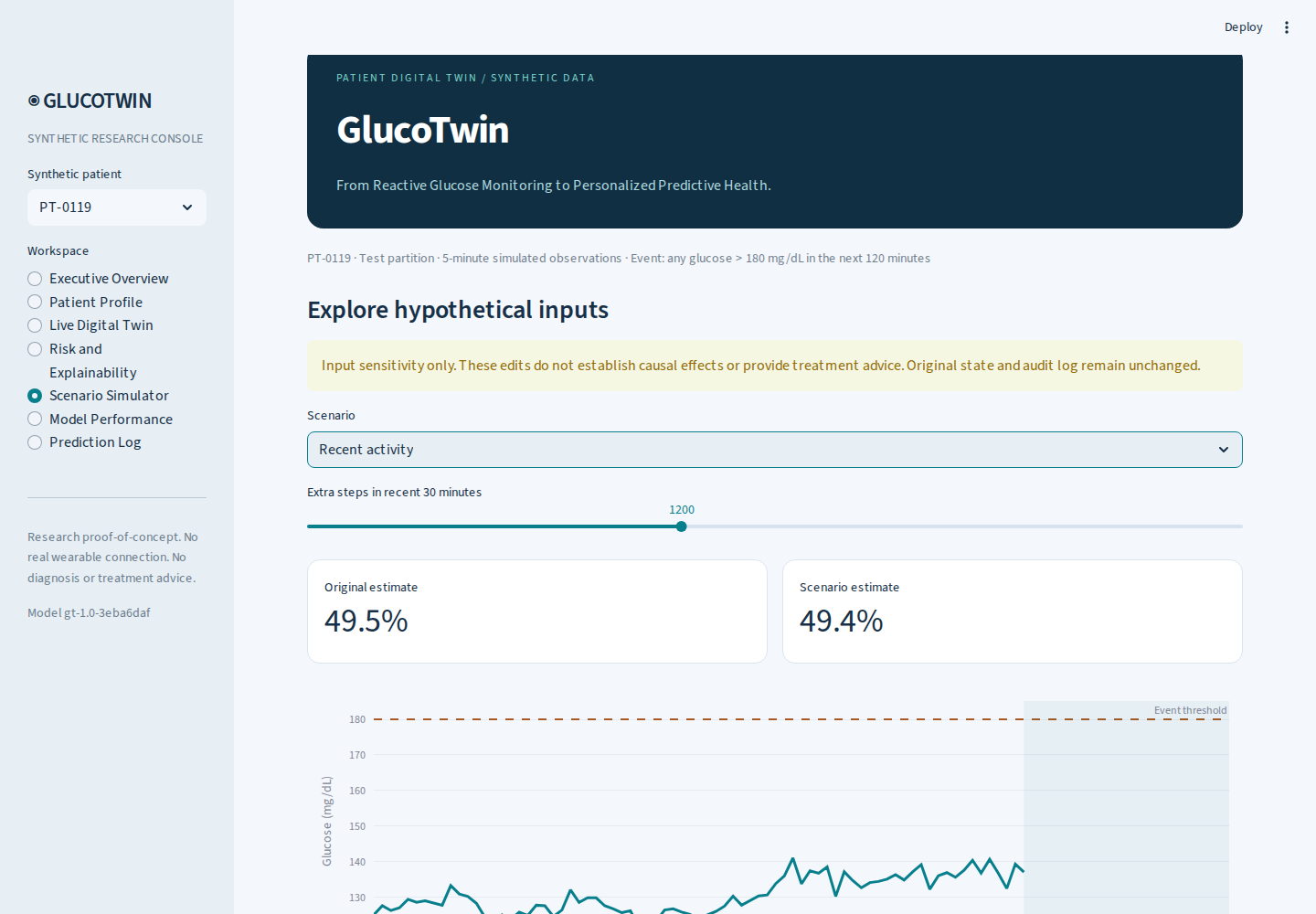
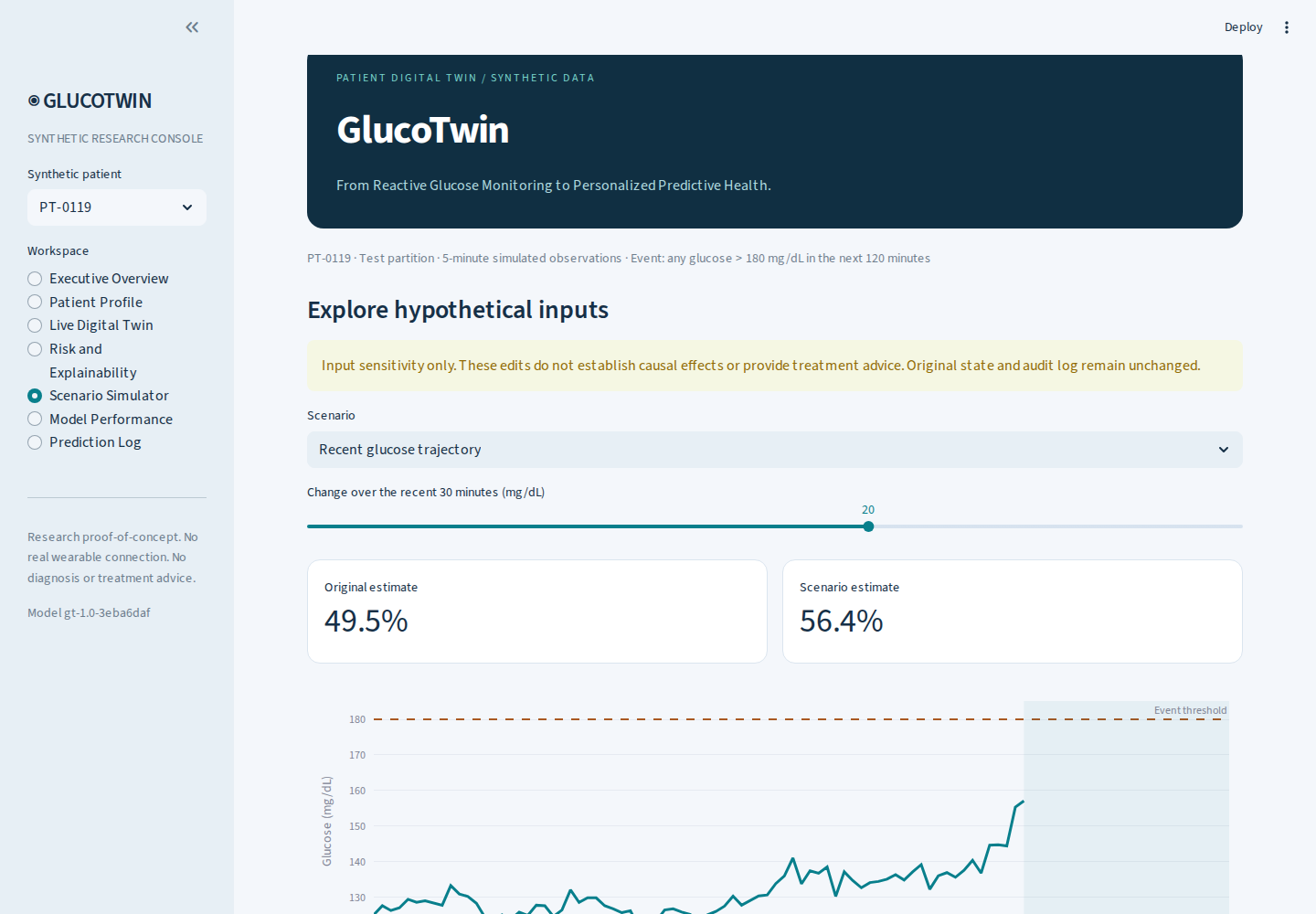
- Scenario simulation: Explore how changes to simulated meals, activity, and profile assumptions affect outputs.
- Data-quality safeguards: Withhold predictions when sensor data is insufficient or unreliable.
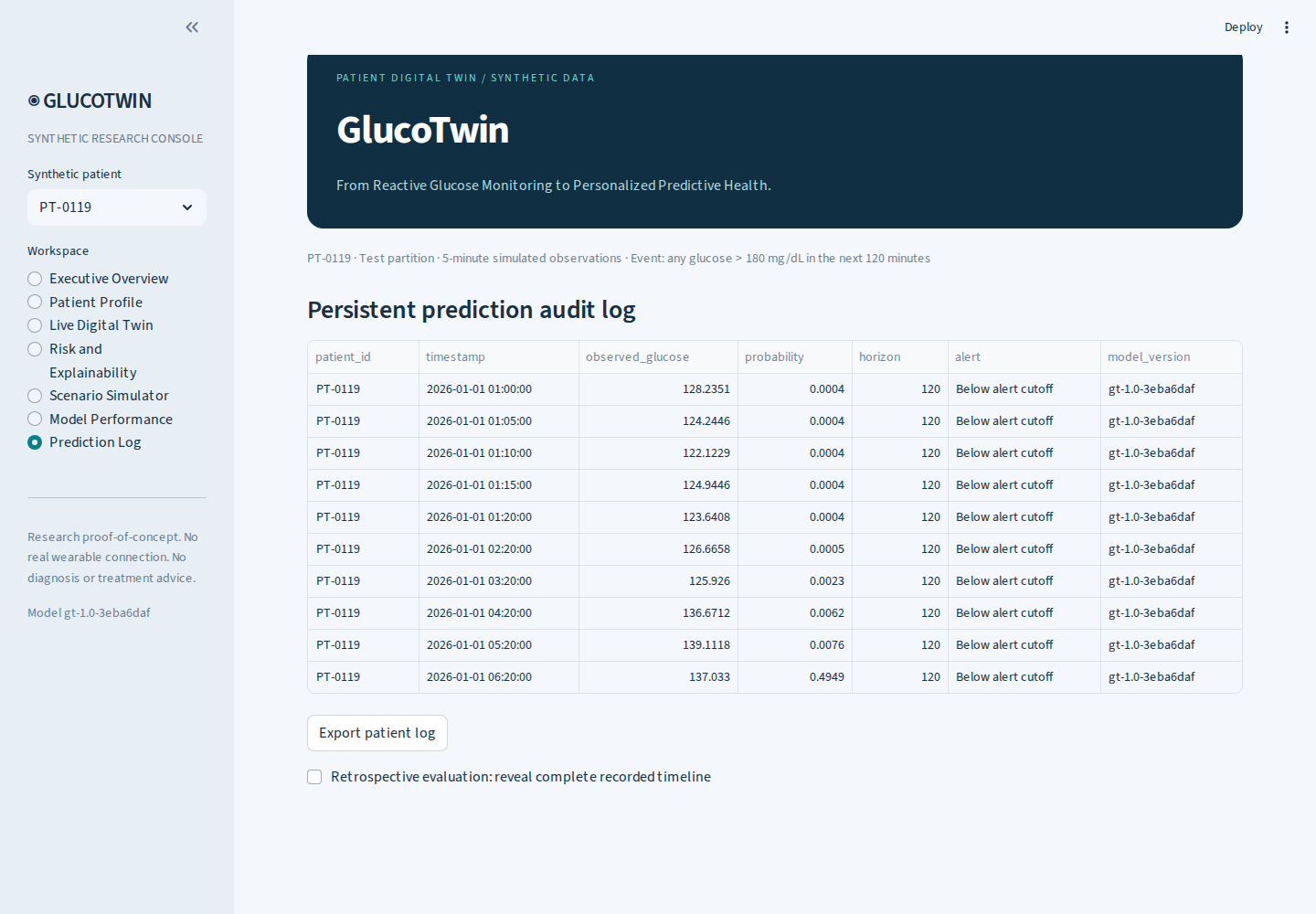
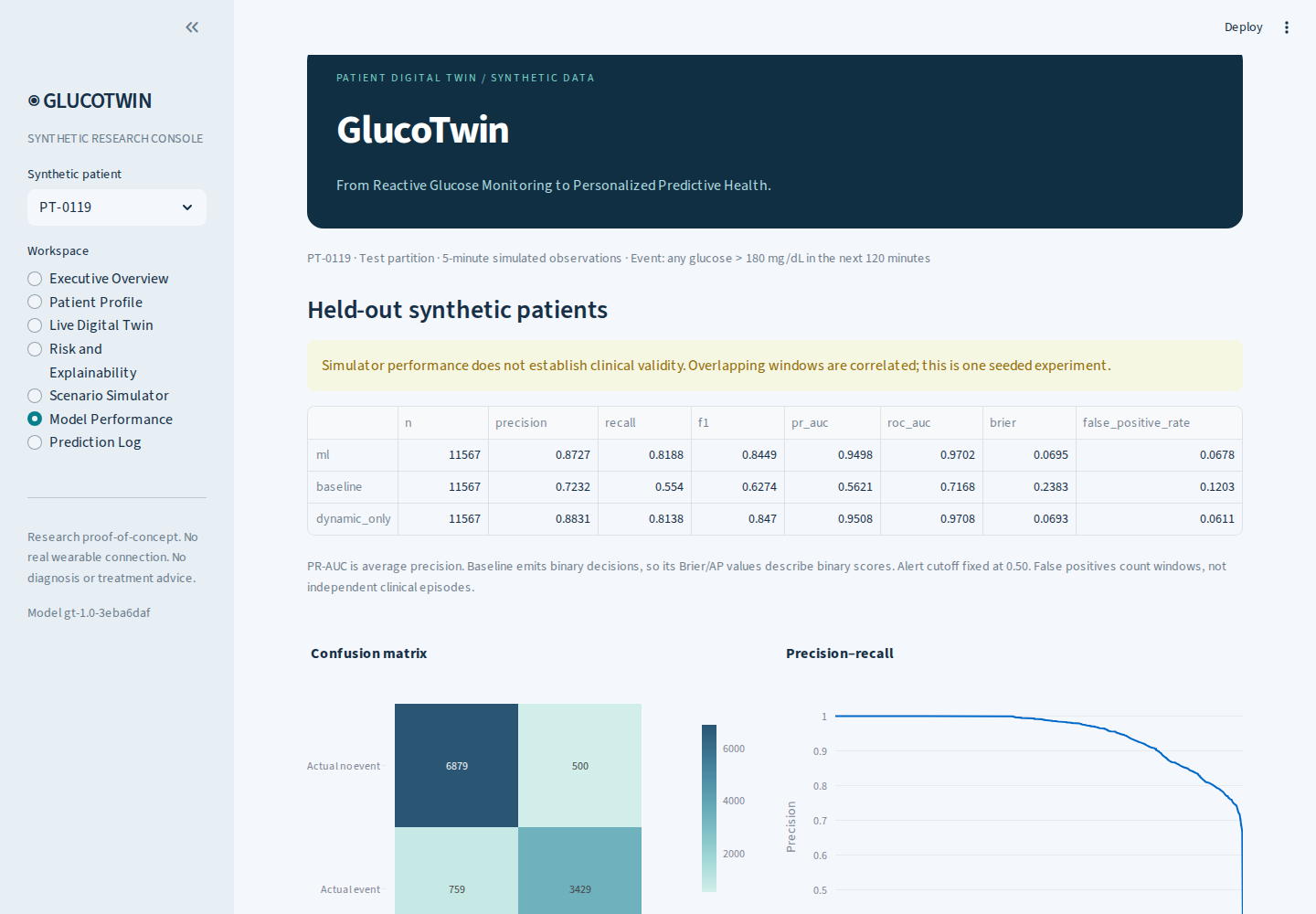
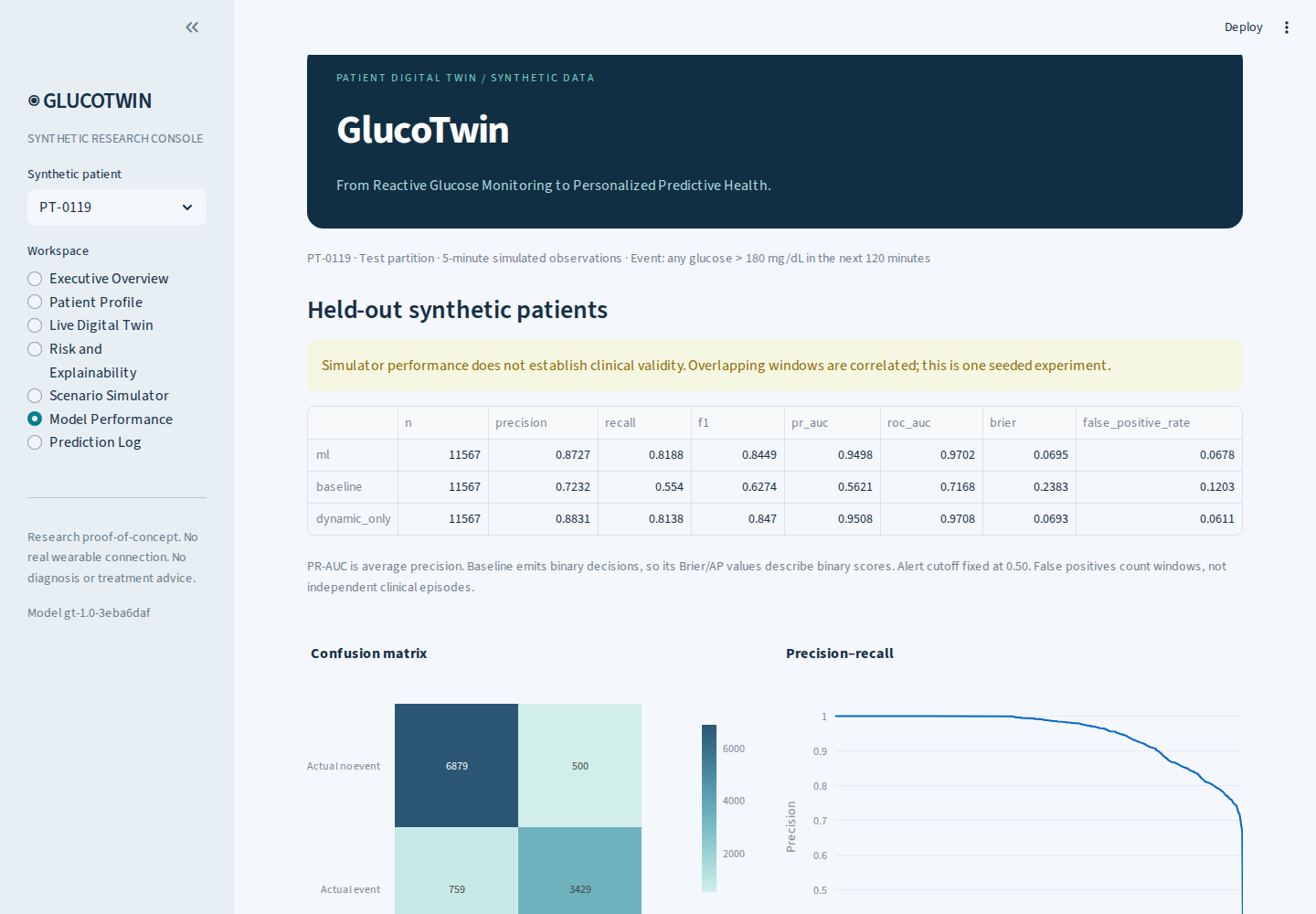
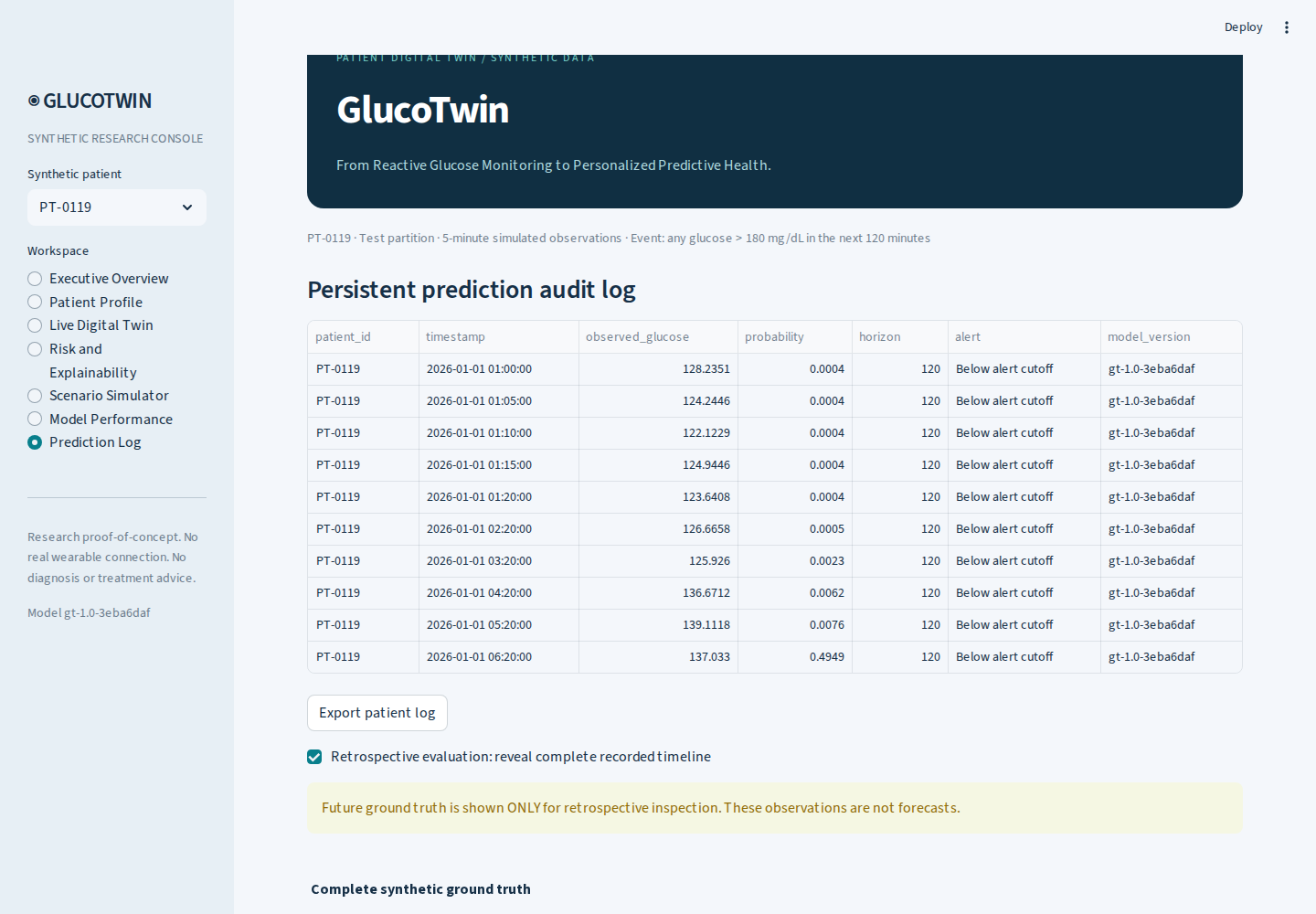
- Retrospective evaluation and audit logging: Review prior predictions and examine held-out model performance.
How we built it
The prototype uses Python, Streamlit, pandas, NumPy, scikit-learn, and SQLite. Its workflow includes synthetic-data generation, temporal feature engineering, patient-separated model development and evaluation, interactive inference, and prediction logging.
The reported evaluation uses 160 synthetic patients with five-minute sensor observations across seven simulated days. Training, validation, calibration, and test patients are separated to evaluate performance on held-out patients.
Results
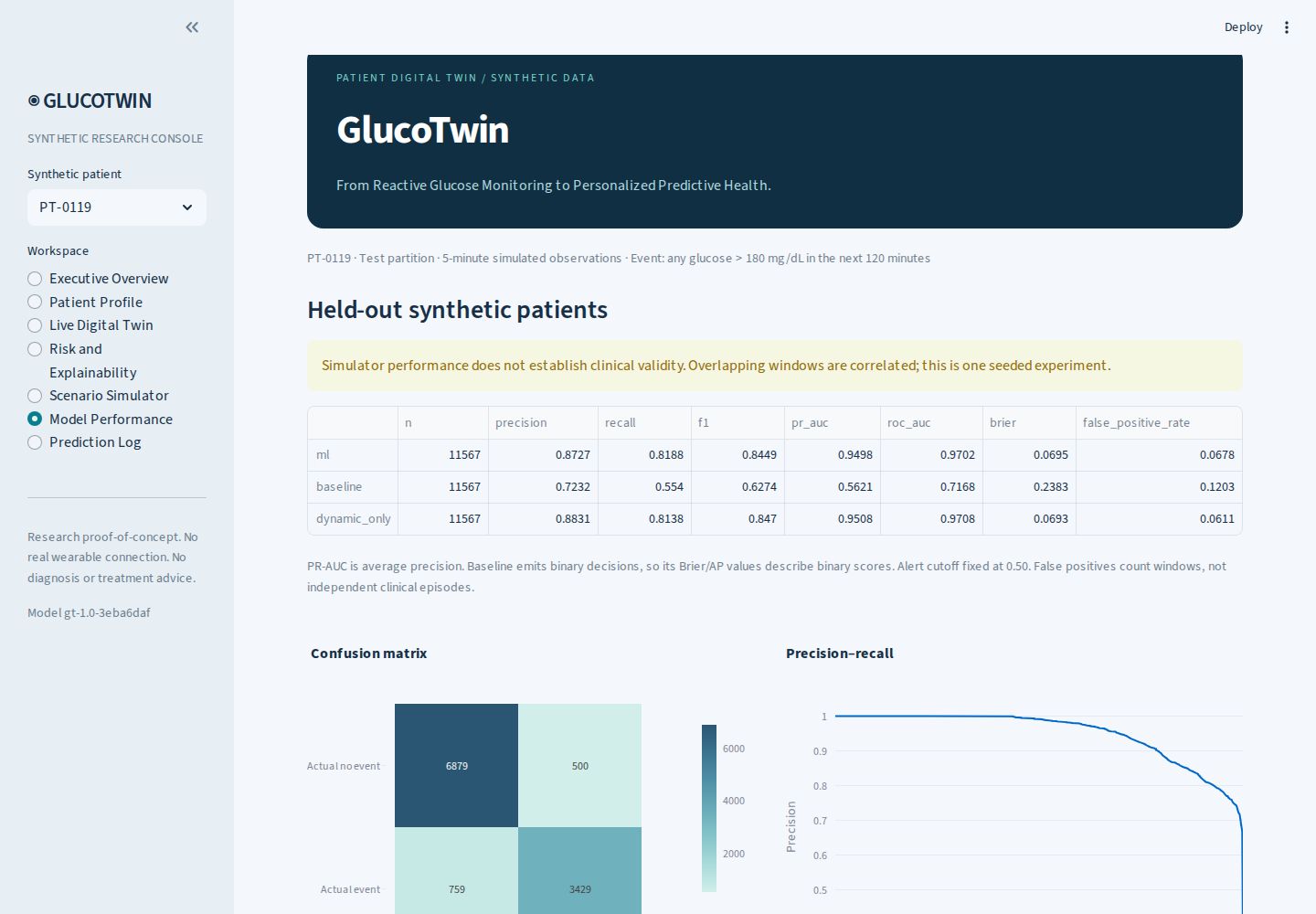
On the reported held-out evaluation, the fused model achieved:
- F1 score: 0.845
- Average precision: 0.950
- Precision: 0.873
- Recall: 0.819
- Brier score: 0.070
These are experimental results on synthetic data, not evidence of clinical performance. A dynamic-only ablation slightly outperformed the fused model on F1, so the current experiment does not demonstrate a predictive benefit from adding historical profile context. We treat this as an important finding and a direction for further work.
What we learned
A digital twin needs more than a prediction score. It needs a way to inspect evolving state, understand data quality, explore assumptions, and review previous outputs. We also learned that a more elaborate feature set is not automatically a better model: ablation results are essential to evaluating whether additional context helps.
What's next
Future work could investigate more realistic data-generating processes, stronger patient-level personalization, uncertainty-aware decisions, robustness to missing sensor data, and independent validation before any clinical use is considered.
Links
- Live app: https://glucotwin-ly6zwtonpno3y9bhx6bxqe.streamlit.app/
- GitHub repository: https://github.com/RajVamshi05/GlucoTwin
- Demo video: https://www.youtube.com/watch?v=yD8jaq5B5u8
Team MeowMeow
- J K Raj Vamshi Thakur — IIIT Allahabad
- Swasti Mishra — IIT (ISM) Dhanbad
Important limitation
All patient profiles and sensor readings are synthetic. GlucoTwin is an unvalidated research prototype, not a medical device. It must not be used for diagnosis, treatment, or real-world clinical decisions. The reported metrics do not establish clinical accuracy or benefit.
Built With
- numpy
- pandas
- python
- scikit-learn
- sqlite
- streamlit

Log in or sign up for Devpost to join the conversation.