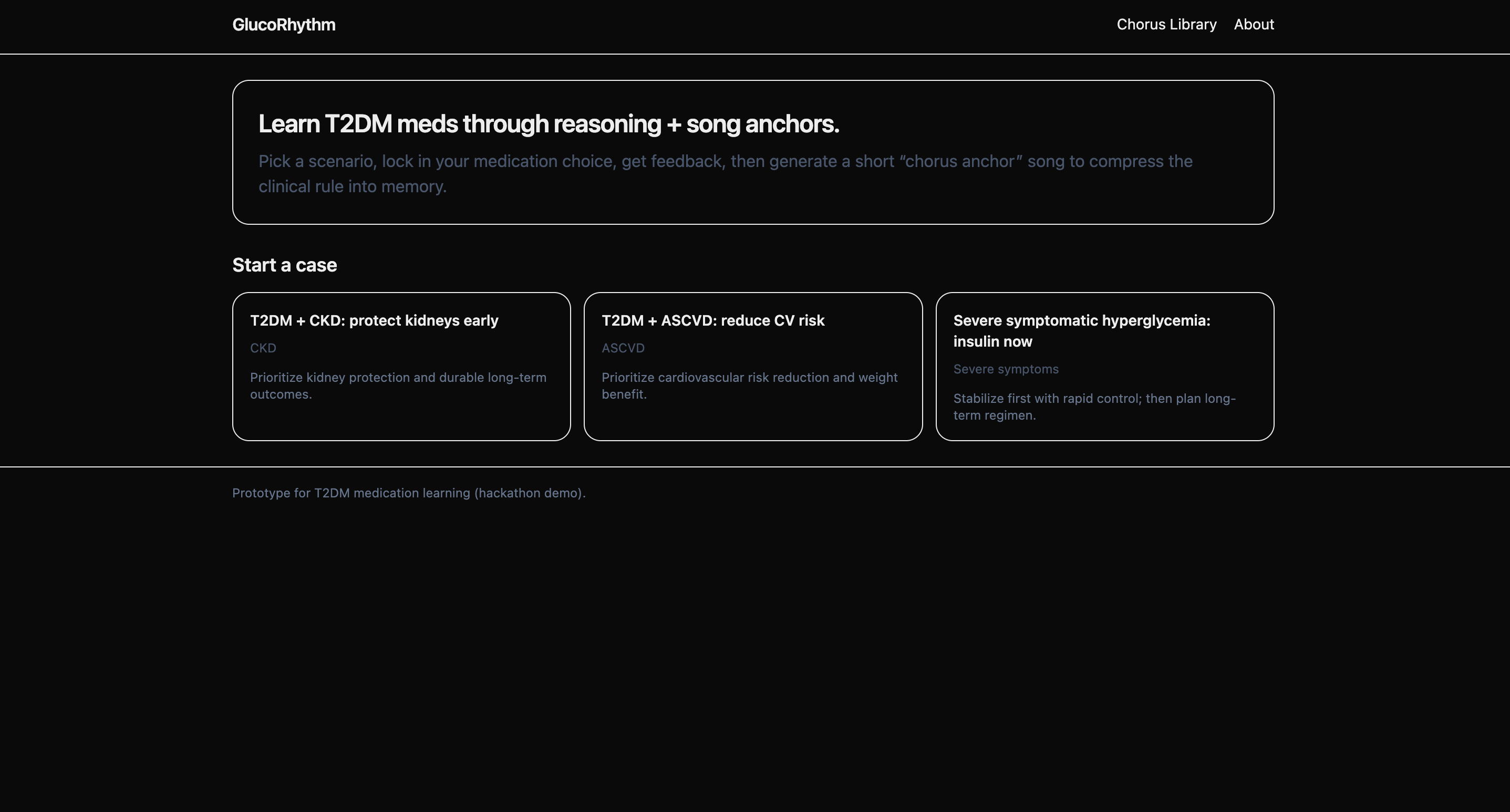
GlucoRhythm was inspired by how overwhelming medication learning can feel in real clinical settings, where students are expected to remember key drug information while also processing patient cues, time pressure, and the fear of making the wrong decision. I wanted to build a tool that makes high-yield Type 2 Diabetes (T2DM) medication concepts easier to retain by turning them into short, repeatable “chorus anchors” that learners can quickly review and recall under stress. The idea is that music-like repetition and compact phrasing can reduce cognitive load and help important rules stick, especially for future healthcare professionals who need fast recall during practice.
I built the project as a Next.js (App Router) web app using TypeScript and Tailwind CSS, with static case data and a deterministic rule engine that evaluates user choices and generates consistent, explainable feedback. After a user locks in their medication choice for a case, the app produces a structured chorus-style summary (song text) that reinforces the key learning point, and the prototype includes audio playback to simulate turning that learning output into something you can “listen to” for memorization. Along the way, I learned how to design a learning flow that stays simple and testable, how to translate clinical reasoning into explicit rules and outcomes, and how to build and debug a full stack Next.js prototype with routing, state, and API endpoints. The biggest challenges were deployment and project structure issues (especially root directory/nested folder problems), resolving TypeScript and import errors as files changed quickly during the build, and balancing a fun, memorable format with clinically responsible, clear outputs that don’t mislead learners.
Built With
- cursor
- vercel

Log in or sign up for Devpost to join the conversation.