-
-
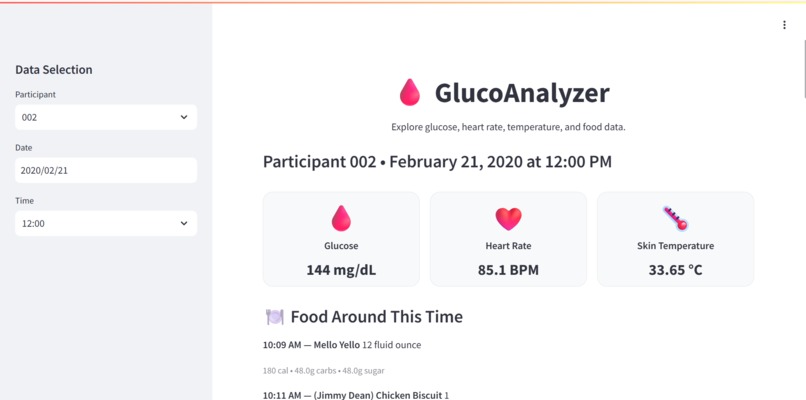
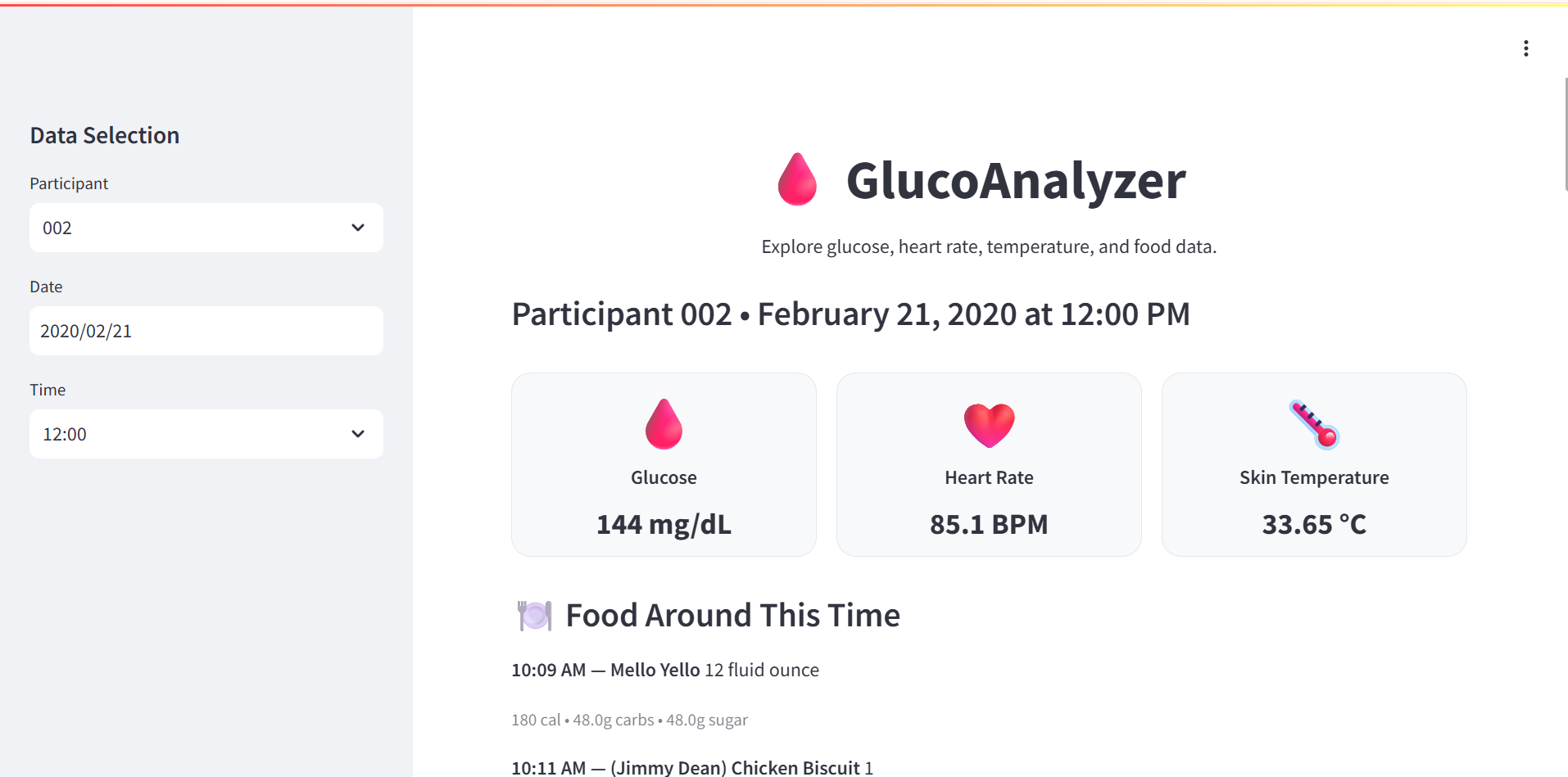
app interface
Inspiration
We chose this project because we felt that people who have blood sugar issues do not have a very easy way for users to take their health into their own hands. Managing blood glucose can be difficult because glucose levels are affected by activity, heart rate, stress, and other factors. While the data we used is preliminary, we believe this research is important, so we wanted to create a way to make the data more accessible and easier to understand.
What it does
GlucoAnalyzer analyzes wearable and food data to help users understand changes in their blood glucose. Users can select a participant from the research, date, and time to see their: Blood glucose Heart rate Skin temperature Food logged around that time Glucose trends over time The app also connects the data to an AI agent that can answer questions and make insights from the data.
How we built it
We built GlucoAnalyzer using Databricks, Streamlit, Python, and Pandas, using the PhysioNet Big Ideas Glycemic-Wearable dataset. We stored the data in a Databricks Unity Catalog volume and built the Streamlit application to load and organize the data. It deletes unnecessary sections of the data, converts the timestamps into dates and times, and organizes the timestamps in chronological order. We used Plotly to visualize the glucose trends over time. We also built an AI agent using Databricks Genie, which uses the same dataset to gather insights.
Challenges we ran into
One of our biggest challenges was that the dataset was not formatted consistently across participants. For example, Participant 003's food log had a different number of columns than the other participants. We had to identify these differences and build the application to handle them instead of assuming every file had exactly the same structure. We also had challenges getting the Streamlit app to access files stored in Databricks and figuring out how to embed the AI model. Lastly, we also had challenges downloading the vast amount of data needed.
Accomplishments that we're proud of
We are proud of being able to turn a large, confusing dataset into an application that could simplify it all with a clear UI, AI insights, and plotted data.
What we learned
We also learned how to use Databricks to store and access data, build a Streamlit application, and connect an AI agent to an application.
What's next for GlucoAnalyzer
Next for GlucoAnalyzer, we want to use Eleven Labs to integrate text-to-speech and speech-to-text. We also want the AI model to differentiate between users based on which participant is selected.

Log in or sign up for Devpost to join the conversation.