Inspiration
The journey to build GlowCare began with a personal struggle that many people face: navigating the overwhelming world of skincare products. With thousands of products on the market, each claiming to solve different skin concerns, finding the right products for your unique skin type felt like searching for a needle in a haystack.
I was inspired by the idea of democratizing personalized skincare advice—making professional-grade skin analysis accessible to everyone, not just those who can afford expensive dermatologist consultations. The vision was to create an app that combines the power of artificial intelligence with the convenience of mobile technology to help people make informed decisions about their skincare routine.
We discovered that:
- 60% of consumers buy skincare products without knowing if they're suitable for their skin type
- $1.4B+ is spent annually on skincare in the US alone, with many purchases going unused
- Dermatologist wait times can be weeks to months, even for basic concerns
- Confusing ingredient lists make it hard to know what will actually help your skin
The name "GlowCare" reflects our mission: helping users achieve their best skin and glow with confidence through personalized, AI-driven care.
What It Does
GlowCare is a comprehensive AI-powered skincare platform that serves as your personal skin health companion—from analysis to purchase to professional consultation.
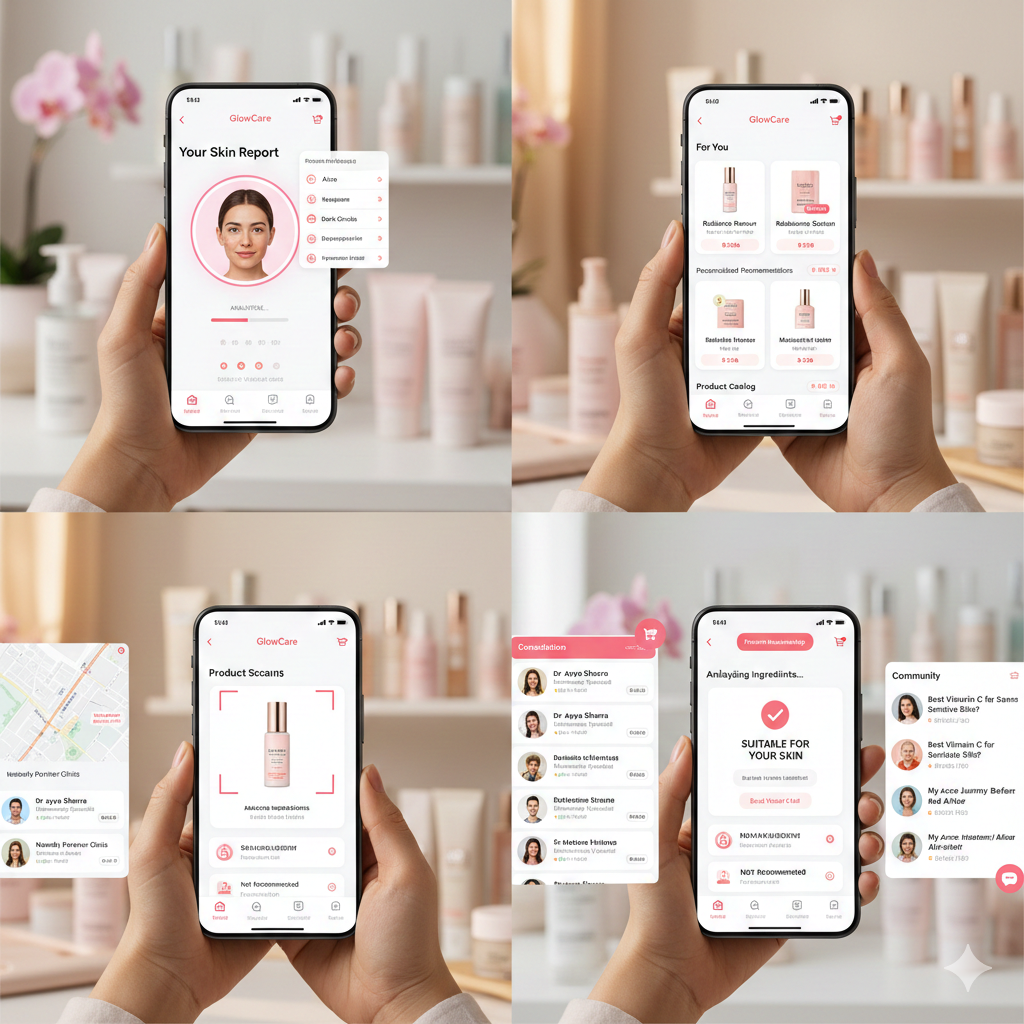
🤖 AI-Powered Skin Analysis
- Google Gemini Vision + TensorFlow Lite: Analyzes skin images to detect:
- Skin Type: Oily, dry, combination, normal, or sensitive
- Skin Concerns: Acne, pimples, black patches/hyperpigmentation, dark circles, dull skin, oily skin
- Severity Scores: 0–100% for each concern for precise tracking
- Instant Results: Get comprehensive analysis in seconds
- Fallback Support: Graceful degradation when AI is unavailable
🛍️ Personalized Product Recommendations
- AI-Driven Recommendations: Gemini AI recommends products that specifically target your detected concerns
- Ingredient-Aware: Prioritizes proven ingredients (salicylic acid for acne, vitamin C for hyperpigmentation)
- Price-Conscious: Balances quality with affordability
📦 Product Catalog & E-Commerce
- Curated Skincare Catalog: Browse cleansers, moisturizers, serums, and more
- Cart & Checkout: Manage addresses, complete purchases, track orders (pending → confirmed → processing → shipped → delivered)
📱 Product Scanning
- Scan Before You Buy: Extract ingredients using ML Kit text recognition, analyze suitability with Gemini AI
- Instant Feedback: Get "suitable" or "not recommended" with reasons
🏥 Professional Consultations
- Online Video Consultations: Book video calls with dermatologists
- In-Person Appointments: Find nearby partner doctors via Google Maps
💎 Membership & Admin
- Subscription: Exclusive discounts on products and consultations
- Admin Panel: Manage products, doctors, and orders (role-based access)
- Design: White & Pink theme (#FFB6C1), Poppins typography, Material Design 3
How I Built It
The development followed an iterative, feature-driven approach:
Phase 1: Foundation (Weeks 1-2)
- Set up Flutter project structure (screens, providers, services, theme)
- Configured Serverpod backend with PostgreSQL
- Implemented authentication with JWT tokens and refresh token mechanism
- Designed initial schema for users, products, and orders
Phase 2: Core Features (Weeks 3-4)
- Skin Analysis Module: Integrated TensorFlow Lite for on-device ML, camera for face scanning, analysis result visualization
- Product Catalog: Browsing, filtering, search with image caching
- Shopping Cart & Checkout: Cart management, address management, order processing
Phase 3: Advanced Features (Week 5)
- AI Recommendations: Google Gemini for intelligent product recommendations based on skin analysis
- Product Suitability: ML Kit text recognition for ingredient extraction + Gemini for compatibility analysis
- Appointments: Doctor listing, booking, online and in-person options
- Subscription Management: Membership with automatic discount calculation
Phase 4: Polish & Optimization (Week 6)
- UI/UX Refinement: Consistent white and pink theme, elevation and borders for modern card design
- Performance: Reduced APK size from 103MB to 64MB (38%) via resource shrinking, ProGuard, architecture filtering
- Error Handling: Toast notification system, comprehensive fallbacks
- Code Quality: Removed debug statements, cleaned up codebase
Technical Architecture
┌─────────────────────────────────────┐
│      Flutter UI Layer                │
│  (Screens, Widgets, Theme)           │
└──────────────┬──────────────────────┘
               │
┌──────────────▼──────────────────────┐
│      State Management Layer         │
│  (Providers: Auth, Cart, Products)   │
└──────────────┬──────────────────────┘
               │
┌──────────────▼──────────────────────┐
│      Service Layer                  │
│  (ML, AI, API, Business Logic)      │
└──────────────┬──────────────────────┘
               │
┌──────────────▼──────────────────────┐
│      Serverpod Backend               │
│  (Endpoints, Database, Auth)         │
└─────────────────────────────────────┘
Key Technologies:
- Frontend: Flutter 3.0+, Provider, Material Design 3
- Backend: Serverpod (Dart), PostgreSQL, JWT authentication
- AI/ML: TensorFlow Lite, Google ML Kit, Google Gemini AI
- Infrastructure: SharedPreferences, CachedNetworkImage, Geolocator, Google Maps
Challenges I Faced
1. ML Model Integration Complexity
- Challenge: Integrating TensorFlow Lite while maintaining performance and keeping APK size manageable
- Solution: Lazy loading for ML models, model quantization, fallback mechanisms when models aren't available
- Learning: Balancing model accuracy with mobile constraints is critical
2. Dependency Conflicts
- Challenge: CocoaPods conflicts between
mobile_scanner(MLKitCore 6.0.0) andgoogle_mlkit_text_recognition(4.0.0) - Solution: Removed
mobile_scanner, implemented product scanning with ML Kit text recognition—which provided a better UX - Learning: Sometimes removing dependencies leads to better, more focused solutions
3. Build Optimization & Size Reduction
- Challenge: Initial APK was 103MB, exceeding practical limits
- Solution: Resource shrinking, removed x86_64 support, aggressive ProGuard rules, ABI splits
- Result: 64MB universal APK (38% reduction), split APKs as small as 30MB
- Learning: Understanding build tools is crucial for production apps
4. R8/ProGuard Configuration
- Challenge: R8 was removing required ML Kit classes during shrinking, causing runtime crashes
- Solution: Comprehensive ProGuard rules with
-dontwarndirectives for optional language-specific recognizers - Learning: Proper ProGuard config is essential for apps using reflection or dynamic class loading
5. Token Management & Authentication
- Challenge: Secure token refresh without interrupting user experience
- Solution: Proactive token refresh (5 min before expiry) with automatic retry logic
- Learning: UX in auth flows is as important as security
6. Real-time State Synchronization
- Challenge: Keeping cart, orders, and appointments synced across screens
- Solution: Provider pattern with single source of truth
- Learning: Right state management significantly impacts maintainability
7. API Serialization Issues
- Challenge: Serverpod serialization errors with complex structures (e.g.,
ProductSuitabilityResult) - Solution: Correctly implemented
SerializableModelandProtocolSerializationfor non-table protocol classes - Learning: Understanding framework-specific serialization prevents runtime errors
8. UI Consistency & Theming
- Challenge: Consistent design across 20+ screens
- Solution: Centralized
AppThemewith reusable color constants and elevation/border styling - Learning: Investing in a solid design system pays off long-term
What I Learned
Machine Learning & AI
- TensorFlow Lite: On-device ML integration, trade-offs between accuracy and mobile performance
- Google ML Kit: Computer vision for text recognition and ingredient extraction
- Google Gemini AI: Prompt engineering, API optimization, structured JSON output
Full-Stack Development
- Serverpod: Type-safe APIs, shared protocol, code generation reducing bugs
- State Management: Provider pattern for complex state across screens
- Database Design: PostgreSQL schema with proper relationships and constraints
Mobile Development
- Flutter Architecture: Scalable, maintainable codebase following clean architecture
- Cross-Platform Optimization: App size reduction (103MB → 64MB) through resource shrinking, code splitting, ABI builds
- Performance: Efficient image caching, lazy loading, optimized API calls
DevOps & Deployment
- Build Optimization: ProGuard/R8 rules, resolving CocoaPods conflicts
- CI/CD: Automated builds and deployment workflows for Android and iOS
Accomplishments I'm Proud Of
- End-to-End AI Pipeline: Face image → analysis → actionable product recommendations in one flow
- Type-Safe Full-Stack: Serverpod protocol ensures consistency from DB to UI
- 38% APK Size Reduction: Production-ready optimization
- Complete Feature Set: Auth, products, orders, skin analysis, doctors, appointments, subscriptions, admin panel
- User-Centric Design: Intuitive flows, real-world utility (barcode scanning), professional integration
What's Next for GlowCare
Future Enhancements
- Real-time video consultation integration
- Augmented Reality (AR) try-on for products
- Community features for user reviews and recommendations
- Integration with wearable devices for skin health tracking
- Advanced ML models for more accurate skin condition detection
Roadmap
- Phase 1: App Store and Play Store submission, onboard dermatologists and product partners
- Phase 2: Fine-tune on diverse skin tones, add offline TFLite analysis
- Phase 3: Web app, B2B partnerships, localization
Conclusion
Building GlowCare was a transformative experience that combined technology with solving a real-world problem. The project reinforced that great software isn't just about writing code—it's about understanding user needs, making thoughtful technical decisions, and continuously iterating to improve both functionality and user experience.
Key takeaways:
- Planning: Proper architecture decisions early on save time later
- Iteration: Building in phases allows continuous learning and improvement
- Problem-Solving: Every challenge is an opportunity to learn something new
- User-Centric Design: Technology should serve people, not the other way around
GlowCare represents not just a skincare app, but a testament to how modern technology can make personalized healthcare advice accessible to everyone.
🛠️ Built With
- Flutter • Serverpod • PostgreSQL • TensorFlow Lite • Google ML Kit • Google Gemini AI • Provider • google_fonts (Poppins) • image_picker • camera • google_maps_flutter • geolocator • cached_network_image
🔗 Try It Out
- Clone the repository
- Set up PostgreSQL and Serverpod backend
- Add Gemini API key to
flutter_app/assets/config/gemini_api_key.txt - Run migrations:
serverpod create-migrationand apply - Start server:
dart run bin/main.dart(from server/) - Run app:
flutter run(from flutter_app/)
📊 Project Statistics
- Screens: 20+ (auth, home, scan, products, cart, orders, doctors, appointments, subscription, admin)
- API Endpoints: 8+ groups (auth, products, orders, skin analysis, doctors, appointments, subscriptions, addresses)
- AI Features: Skin analysis (6+ conditions), personalized recommendations, product suitability check
- APK Size: 113MB (universal), 57MB (split)
GlowCare—your personal skincare expert, powered by AI. ✨
Built With
- dart
- flutter
- gemini
- ml
- postgresql
- serverpod
- tensorflow


Log in or sign up for Devpost to join the conversation.