-
-

Glow & Seek Header
-
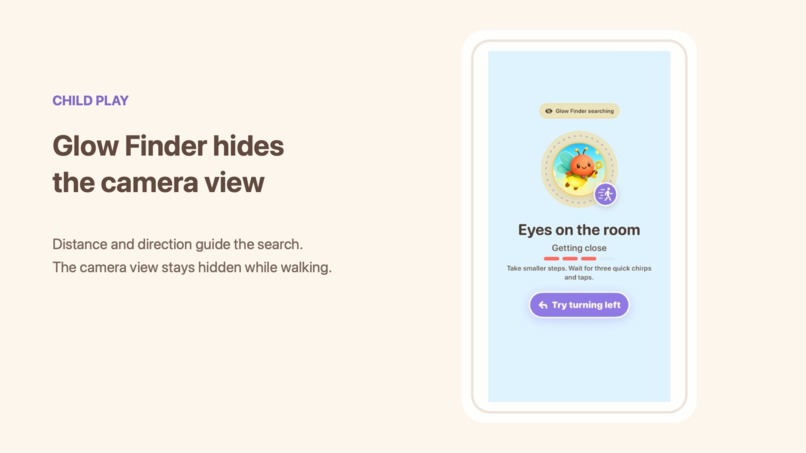
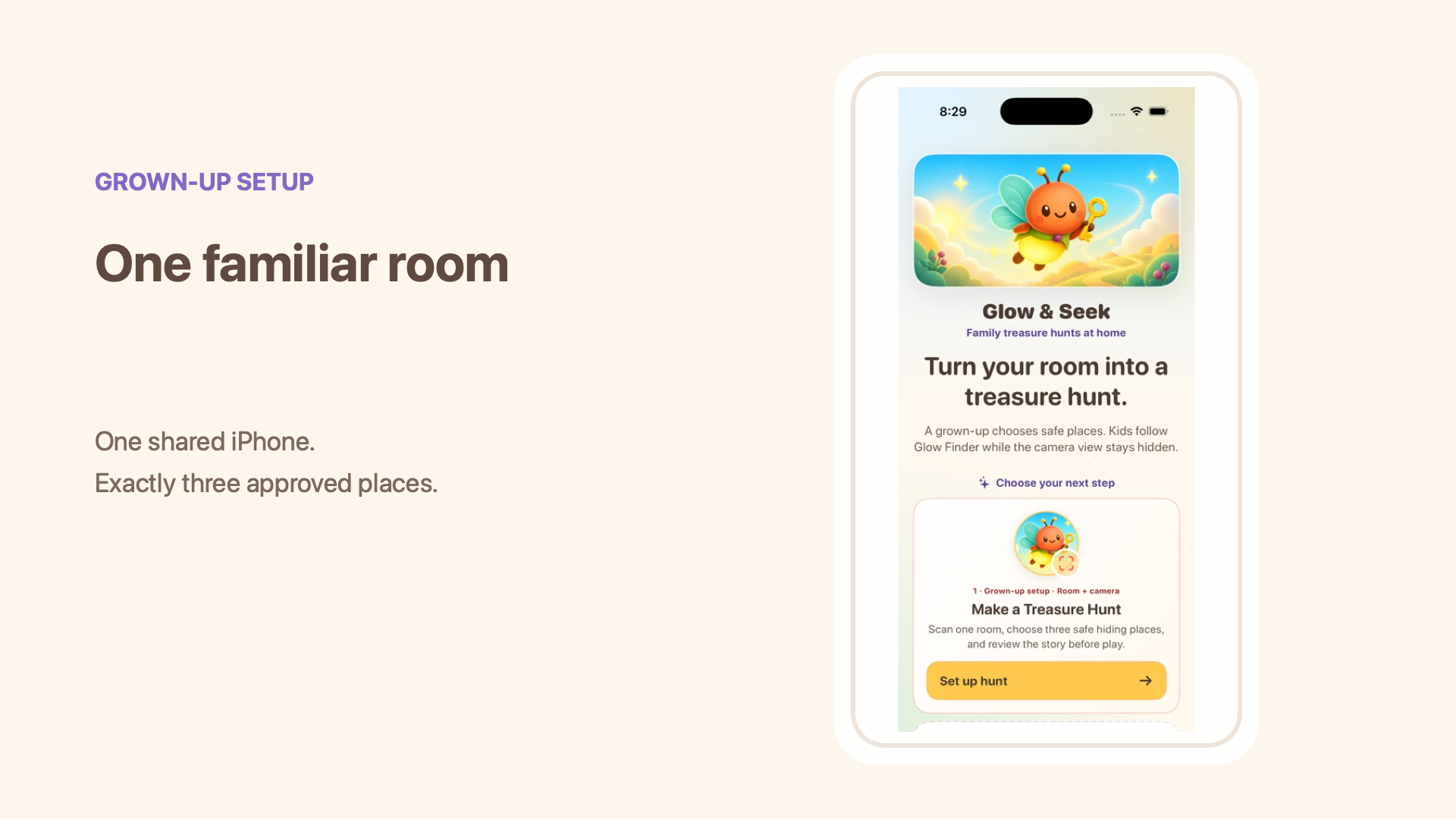
A grown-up sets up one familiar room on one shared iPhone and chooses exactly three approved treasure places.
-
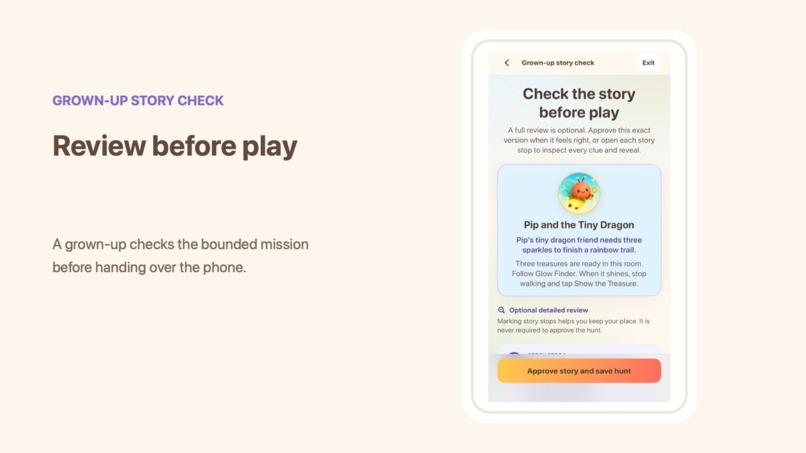
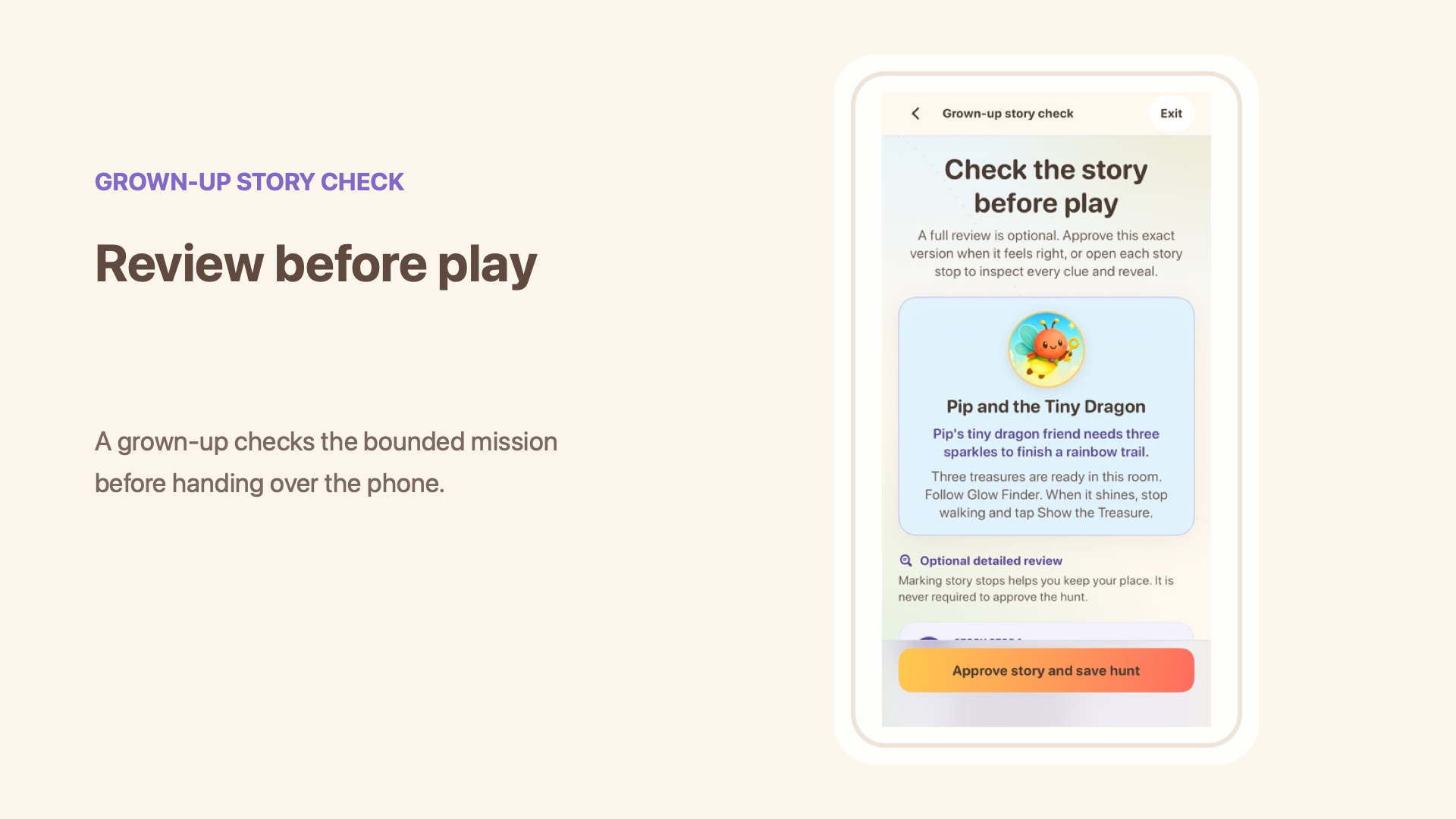
Before handoff, the grown-up can review and approve the exact bounded three-stage mission.
-
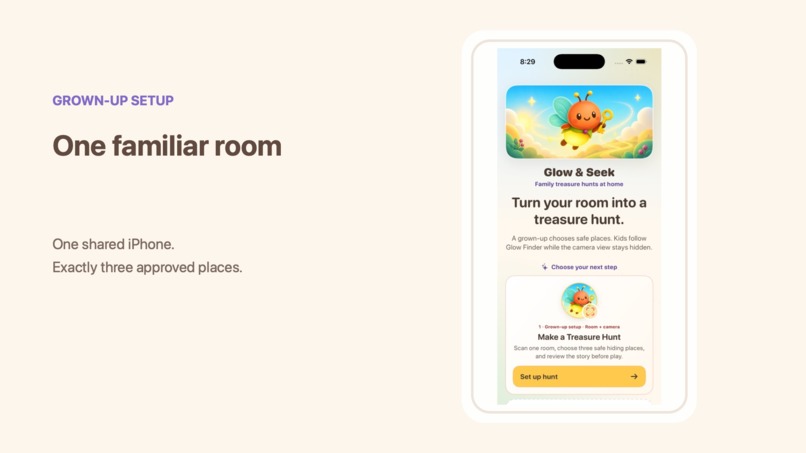
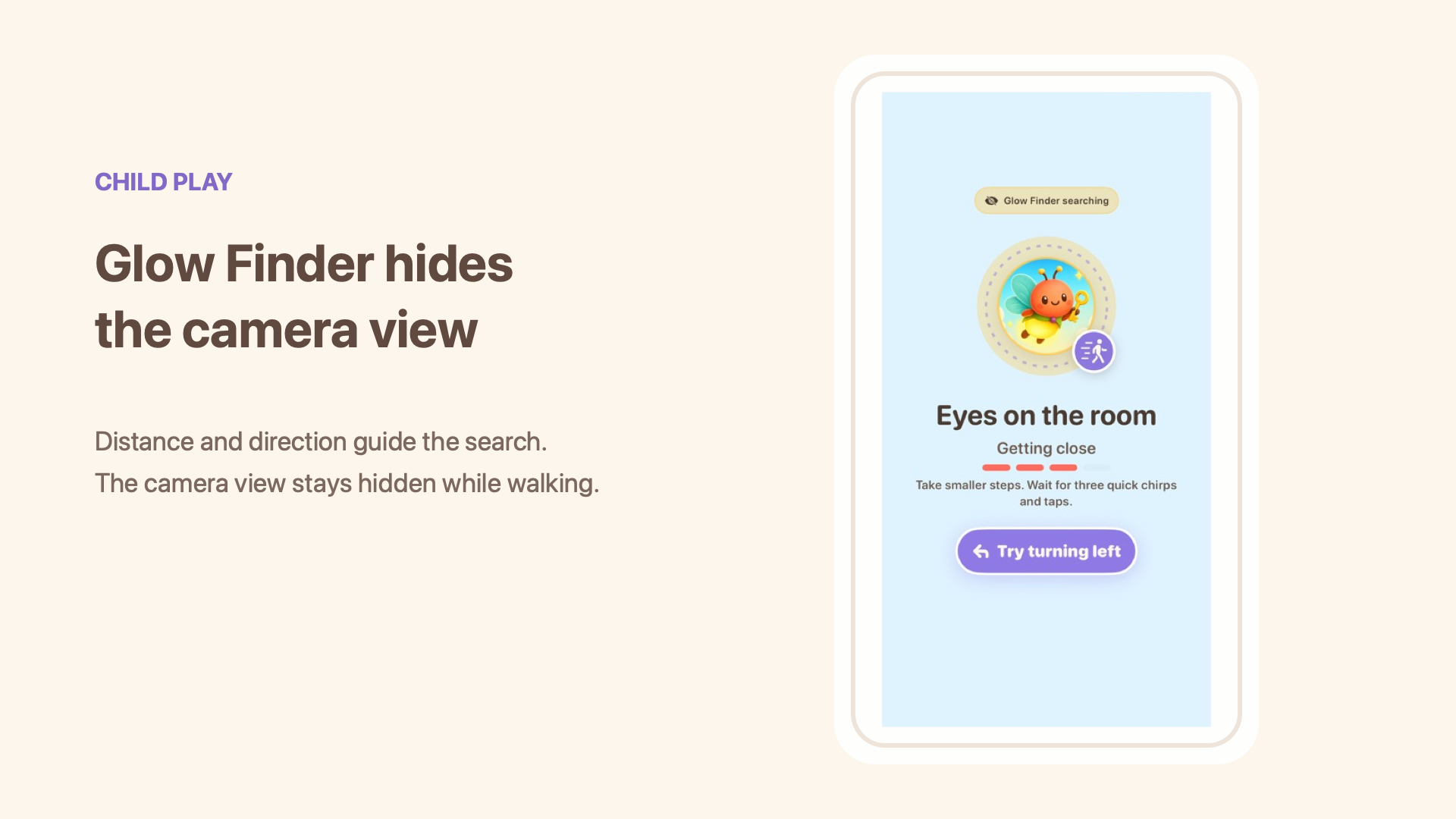
During child play, Glow Finder keeps the camera view hidden while distance and direction guide the search.

Glow & Seek
Turn one familiar room into a parent-approved AI treasure hunt.
Why I built it
As a parent, I love the magic of a physical treasure hunt. I do not love inventing every clue, hiding every object, and rebuilding the activity each time my child wants to play again.
Many AR experiences reduce that setup work by keeping the child focused on a camera screen. Glow & Seek takes a different approach. It uses one familiar room as the game board, lets GPT-5.6 create the adventure, and keeps the grown-up in control of every physical destination.
The goal is not more screen time. It is to use one shared phone to get a child moving, listening, thinking, and exploring.
What Glow & Seek does
A grown-up begins by scanning one familiar room with Apple’s RoomPlan. Glow & Seek converts that scan into a simplified local summary rather than sending household geometry to a server.
The grown-up can:
- Mark treasure-free areas using a full-scale core-and-buffer preview.
- Review three proposed destinations.
- Approve only locations that pass deterministic reachability and placement checks.
- Inspect the exact clue, hint, narration, treasure, and landmark mapping the child will receive.
- Approve one specific generated revision and seal it to the saved room package.
Each approved destination is recorded both as a semantic landmark, such as “near the chair,” and as a named RealityKit anchor. GPT-5.6 understands the semantic relationship. Native spatial code controls the physical placement.
What makes Glow & Seek different
Glow & Seek is not a conventional screen-based AR scavenger hunt, a clue generator, or an open-ended AI companion. It combines several deliberate choices into one family experience:
- The child does not navigate by watching the camera. The Glow Finder covers the live view and guides the child through sound, haptics, and a simple visual signal. AR appears only for the treasure reveal.
- The grown-up approves the physical game board. GPT-5.6 cannot invent an arbitrary place for the child to visit. Every destination begins with a landmark and anchor the grown-up has reviewed and approved.
- The AI creates within strict boundaries. GPT-5.6 writes the mission, clues, hints, and narration, while deterministic code controls placement safety, movement detection, recovery, state transitions, and reveal eligibility.
- The adventure belongs to the room. The approved story and three treasure locations are saved together, allowing the same hunt to return after the app is closed and the room is relocalized.
- Household spatial data remains private. The model never receives camera imagery, room geometry, coordinates, transforms, an address, or a child’s identity.
- There is no open-ended child chat. The experience is finite, inspectable by the grown-up, and limited to one approved three-stage mission.
The difference is not simply that Glow & Seek uses AI or AR. It uses AI to make a parent-approved physical space imaginative while keeping spatial control, safety, and family authority outside the model.
A treasure hunt without watching through the camera
During play, the child-visible camera feed is hidden behind the Glow Finder.
Instead of walking around while staring through AR, the child follows a combination of:
- A visual glow.
- Spatial audio cues.
- Haptic pulses.
- Progressive story hints.
Live distance to the active anchor, facing direction, device speed, and angular motion drive the strength and rhythm of those signals.
Finding the location is not enough. The child must get close and stop moving before the discovery is earned. Once earned, that discovery is latched so ordinary movement cannot revoke it, but the AR treasure reveal still waits for normal tracking.
That separation matters: Glow & Seek uses spatial sensing to guide movement while preserving a deliberate stop-before-reveal moment.
The recovery path is built around an equally important test. After a force quit and cold launch, the app can reopen the saved room package, relocalize in the familiar room, restore the same parent-approved anchors, and continue the adventure rather than generating a replacement hunt.
What GPT-5.6 does
GPT-5.6 is the story architect, not the safety system.
It receives only:
- The parent-approved semantic placement graph.
- The child’s age band.
- A selected story interest.
- Difficulty and duration settings.
- A fixed catalog of available treasures.
From that bounded input, GPT-5.6 selects the three-stage sequence and writes grounded clues, progressive hints, narration, and reveal copy under a strict output schema.
It never receives a camera image, room mesh, world transform, coordinate, address, household name, or child identity.
The grown-up can inspect every child-visible line before play and see exactly which landmark and treasure it references. The approved output is then stored with the room package, preventing an unseen regeneration from changing the adventure later.
What deterministic code controls
Glow & Seek deliberately keeps the model away from decisions that could affect physical safety or application integrity.
Native deterministic code owns:
- Treasure-free zones and placement validation.
- Reachability requirements.
- Tracking and relocalization.
- Distance and direction calculations.
- Stop-before-reveal eligibility.
- Discovery state transitions.
- Schema and mission validation.
- Recovery decisions.
- Safe fallback behavior.
This division of responsibility is central to the product. GPT-5.6 provides bounded creativity inside a world the grown-up has already approved. It does not independently decide where a child should go.
How Codex was used
Codex served as an engineering partner throughout the build, not simply as a source of generated snippets.
I began with a detailed product and technical packet defining the family experience, spatial architecture, model boundary, safety rules, privacy constraints, acceptance gates, and required evidence. Codex translated that contract into a native iOS and TypeScript product, including:
- A shared RoomPlan and RealityKit session.
- The Xcode project and application architecture.
- A four-file authoritative persistence package.
- A self-healing diagnostics mirror.
- Saved-room relocalization and recovery.
- The Glow Finder detector algorithm.
- Parent review and approval surfaces.
- Procedural RealityKit treasures.
- The GPT-5.6 server boundary.
- Safety and privacy hardening.
- A generated application icon.
- Automated tests, visual proof, and an evidence ledger.
Codex also helped challenge the implementation. It ran adversarial review loops, investigated failures, tightened state and privacy boundaries, produced diagnostic tooling, and performed fresh-clone validation rather than treating generated code as evidence that the product worked.
The result is not merely an interface wrapped around a model call. It is a spatial product with persistence, recovery, deterministic control systems, bounded model behavior, and testable proof surfaces.
Proving the physical experience
Physical AR behavior cannot be validated honestly through screenshots alone, so the DEBUG build contains a proof mode that does not alter the release child experience.
It can display and export:
- Live distance and direction.
- Device speed and turn rate.
- Detector signal strength.
- Ping timing.
- Tracking state.
- Missing-anchor events.
- Discovery timing across all three stages.
- The thresholds and build provenance used during the run.
The resulting named JSON trace excludes camera frames, transforms, coordinates, and room labels.
Separate allowlisted diagnostic receipts cover story provenance, save-and-restore behavior, and physical cold-launch trials. The cold-launch receipt binds each attempt to the saved package, application build, executable, device, operating system, save launch, and runtime launch. It records automatic restoration milestones and the grown-up’s structured three-marker inspection.
Trials fail closed when interrupted, retried improperly, restored during the same launch, performed after an environment change, or completed without the required inspection.
A separate one-shot server command can publish an allowlisted live GPT receipt only after validating the exact model, request status, token usage, and mission schema. It never publishes the raw story, prompt, secret, complete response identifier, or household data.
Privacy by design
Glow & Seek uses the room, but it does not need to reveal the home.
Its model requests and exported evidence exclude:
- Camera images and video.
- Room meshes and geometry.
- World transforms and coordinates.
- Addresses and household names.
- Device metadata from general diagnostics.
- Free-form household notes.
- Child identity.
- Raw prompts, responses, and secrets.
Only the minimum semantic and scalar information needed for generation or validation crosses each boundary.
Why this approach matters
Glow & Seek explores a different model for family AR.
The AI does not own the room. It does not openly chat with the child. It does not choose arbitrary destinations, and it does not replace the grown-up’s judgment.
Instead, the grown-up defines the safe physical world, GPT-5.6 turns that approved world into an adventure, and deterministic software protects the boundary between the two.
The result is a replayable treasure hunt where the technology recedes, the room becomes imaginative again, and the grown-up remains firmly in command.
Built With
- arkit
- codex
- gpt-5.6
- node.js
- openai
- realitykit
- roomplan
- swift
- swiftui
- typescript

Log in or sign up for Devpost to join the conversation.