-
-
Branding
-
Architecture
-
Splash Page
-
Patient Interface
-
Caregiver Interface
Inspiration
“It is far more important to know what person the disease has than what disease the person has.” – Hippocrates
Four months ago, David met Nobel Laureate Dr. Martin Chalfie, who shared a story about his grandmother. After developing a neurodegenerative disease, she lost her ability to speak and grew isolated. Despite all his efforts with medical treatments and therapies, his grandmother grew quieter and more isolated. Only after her passing did the family discover a hidden journal, filled with the emotions and memories she had never voiced.
Dr. Chalfie’s regret was clear: if they had offered her even a simple way to express herself, they would have known her heart better. That moment crystallized a truth: healthcare must not stand in the way of human relationships. Neurodegenerative diseases take more than memory — they take voice, connection, and dignity. Patients are left powerless, caregivers overwhelmed, and doctors buried in paperwork. This problem extends to all aspects of healthcare: physical, mental, and cognitive. So, we asked: what if technology could return control, companionship, and humanity to healthcare? It’s time we make healthcare human again.
Our larger vision
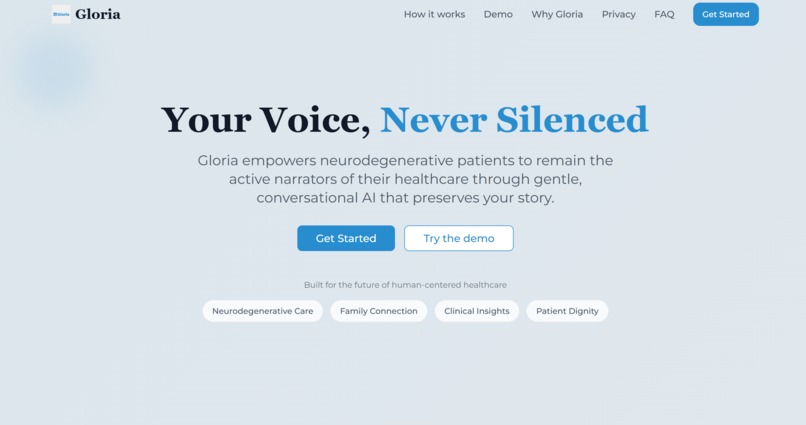
Gloria is an AI companion that gives neurodegenerative patients control over their healthcare through memory reflection and ownership of personal data, while fostering bonds with caregivers and doctors. But to us, Gloria is more than a chatbot — it is a model for all patients.
As a Pava Spark startup, we are building a decentralized, human-centered health platform on Web3 that combines AI companions for physical, mental, and cognitive health with a personal health data wallet — returning control to patients, easing caregiver burden, and enabling doctors to practice deeper, more connected medicine.
Gloria is not just a hackathon project; it is the pilot program of our larger health platform. While our demo focuses on neurodegenerative patients, its design reflects our vision to make healthcare more human.
Our platform’s vision
Democratizing control over data: Today, personal health data is fragmented and controlled by hospitals, insurers, pharmaceutical companies, and big tech. Patients lack real ownership of their information, leaving them disempowered and breaking trust. Our platform decentralizes health data from these intermediaries and returns full control to patients through a secure, Web3-based health data wallet. Patients can own, manage, and selectively share their records with providers without exploitation. We aim to mobilize Hopkins — with its unmatched expertise in health data management and vast research datasets — as a key partner.
Enabling deep medicine: Modern healthcare prioritizes efficiency and administration over humanity. Doctors and caregivers are burdened with documentation; patients are reduced to charts and lab values. Nearly 75% of healthcare workers say that documentation impedes their patient care. Our platform addresses this in two ways: a secure health data wallet combines fragmented records, saving doctors hours lost to paperwork; and AI companions capture the full spectrum of daily patient experience across physical, mental, and cognitive health, transforming them into structured insights. This streamlines the process, enabling doctors and caregivers to build deeper, more human bonds with patients.
Expanding access to quality care: Billions face doctor shortages and underfunded systems, particularly in Asia where aging populations are surging. With long wait times and uneven access to trusted providers, our AI assistants can provide informal, immediate support, while the personal health data wallet ensures personalized assistance for all patients.
Gloria: The Pilot Project
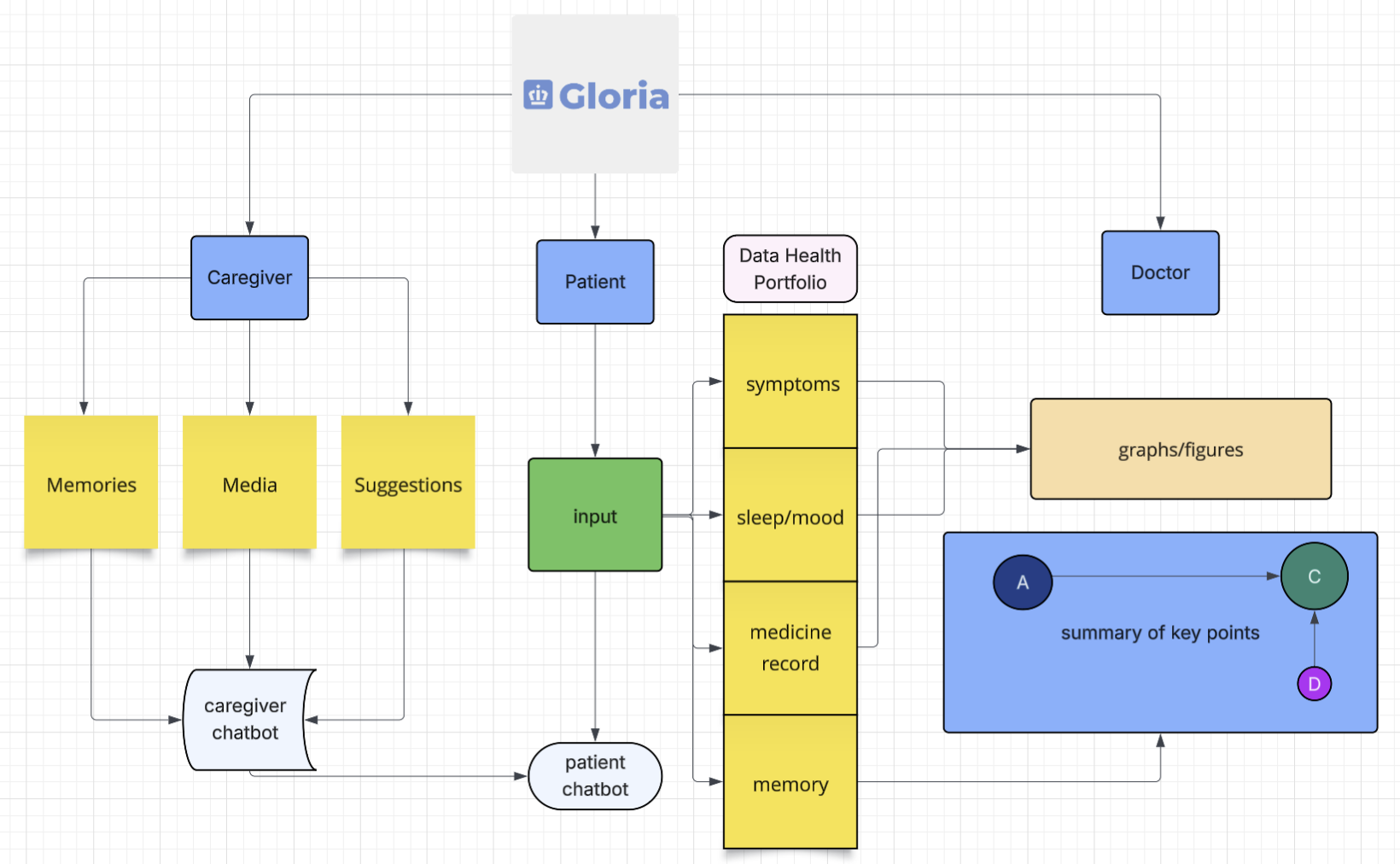
Gloria is our first step, designed to serve neurodegenerative patients by fostering deep connections with caregivers and doctors. Gloria consists of three user interfaces:
- For Patients → Gloria ensures that they remain the active narrator of their healthcare — their stories, their memories, and their data.
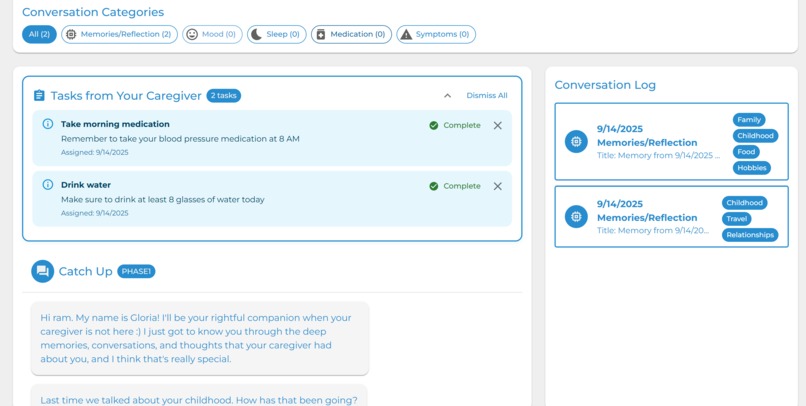
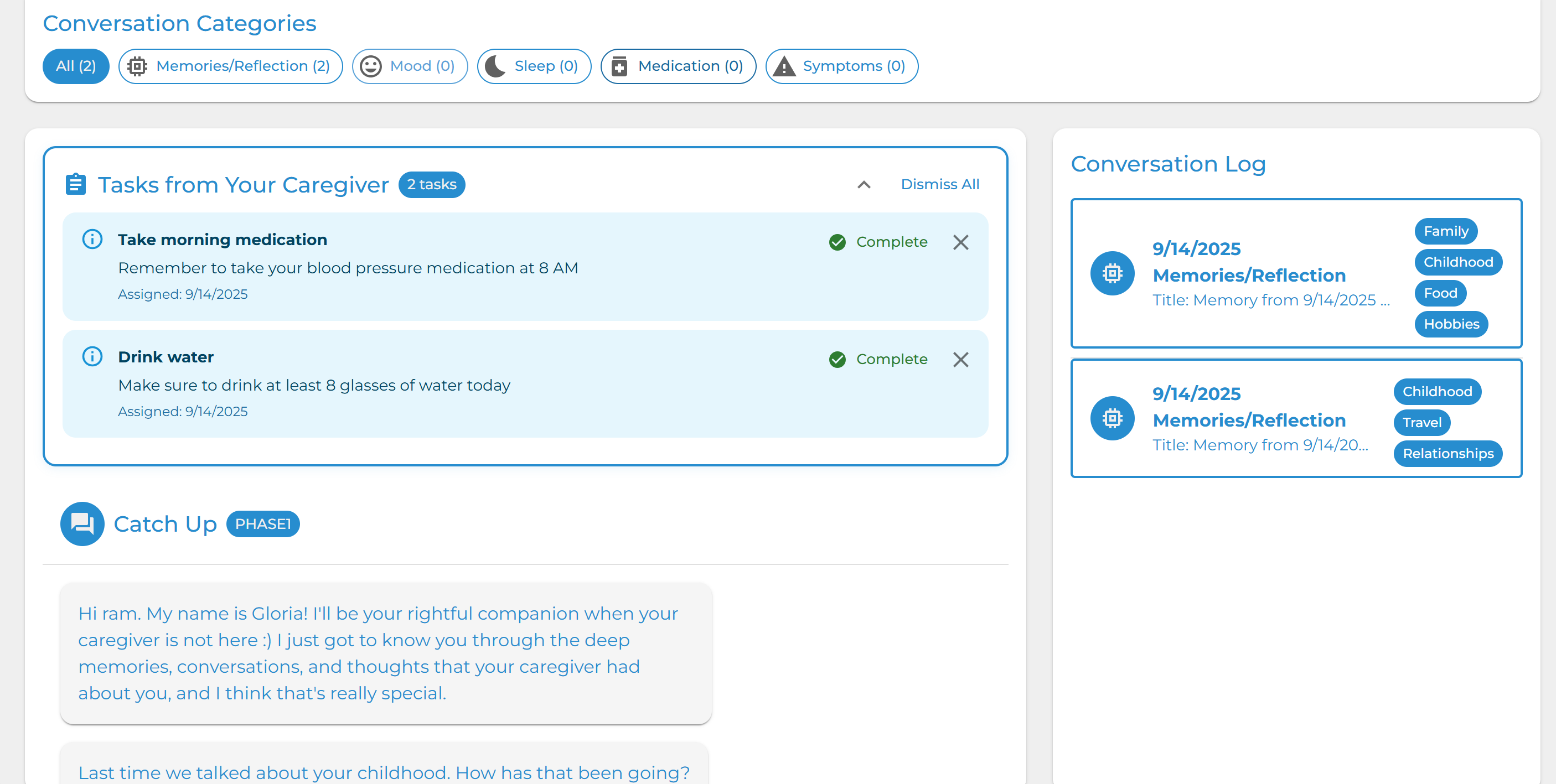
Globally, around one in four older people experience loneliness, with rates as high as 30.5%. Gloria addresses this by creating a simple, safe, and deeply personal space for patients. At its core is a chatbot that gently prompts reflection, reminiscence, and daily check-ins. Patients respond naturally — whether with memories, moods, or observations — and every entry is logged in a conversation history. Gloria organizes responses into five color-coded categories: (1) memories & reflections, (2) mood, (3) sleep, (4) medication, and (5) symptoms. Memories are further categorized into themes such as family, joy, or stress. Because a patient’s story is not linear but a web of memories, Gloria maps memories as a living network of meaning rather than a flat list. This helps caregivers spot patterns for richer conversations and enables patients to reclaim their identity, viewing their fragmented memories as a whole story. Doctors also receive concise summaries that capture the patient’s lived experience without raw transcripts.
The patient also holds a personal health data wallet — a secure hub where they, or their caregiver, manage what to share with healthcare providers. This wallet includes the categories most relevant for clinical insight (mood, sleep, medication, and symptoms) and offers an intuitive interface to toggle permissions. For the first time, patients and families can decide what enters the clinical conversation, instead of leaving their data locked in fragmented, opaque systems.
- For Caregivers(family/nurses) → Gloria allows caregivers to stay connected even when they cannot be physically present. It preserves companionship and dignity, ensuring caregivers remain part of the patient’s journey no matter where they are.
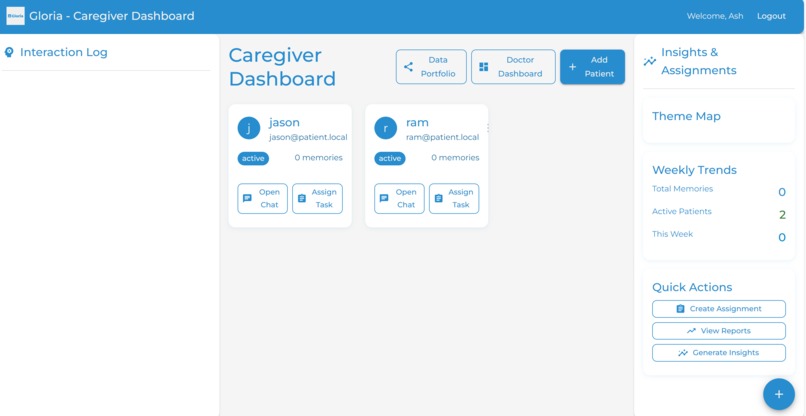
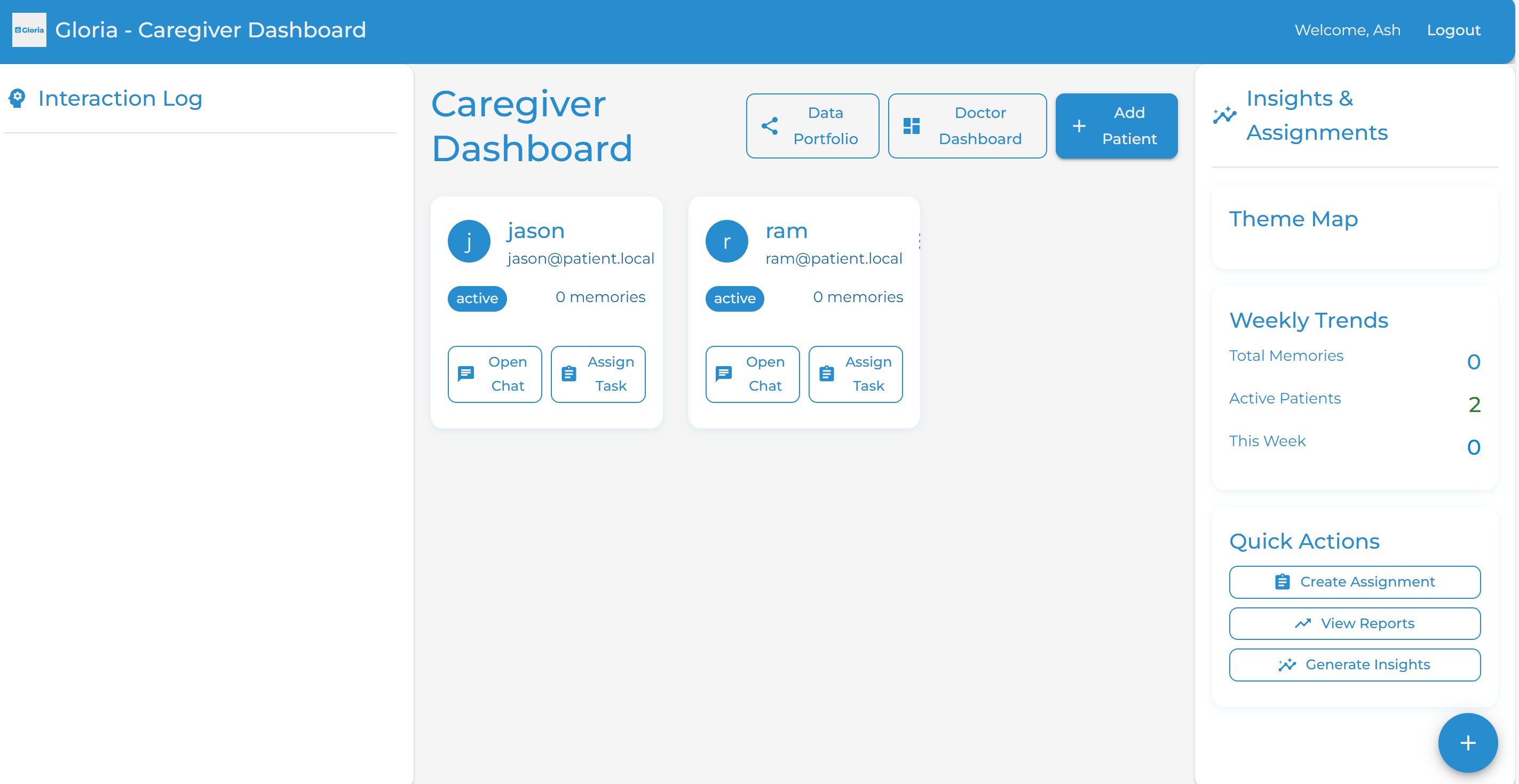
The caregiver plays the most intimate role in a patient’s life. Gloria’s caregiver interface highlights two essential functions. First, caregivers can actively enrich the patient’s world by adding photos, videos, prompts, or personal notes through a companion chatbot. These contributions are woven into future conversations, so even when a caregiver cannot be physically present, their encouragement continues to guide reflection and strengthen connection.
Second, caregivers gain a dynamic view of the patient’s experiences. Memories are displayed as a branching web of themes — moments of joy, struggle, family, or stress linked together. This visualization allows caregivers to see how stories evolve, recognize emerging challenges, and nurture more meaningful conversations.
Together, these tools ensure the caregiver’s presence and perspective remain an integral part of the patient’s daily journey.
- For Doctors → Gloria provides structured cognitive data and reflections, enabling physicians to see the whole patient rather than just symptoms. This saves time and enriches medical decision-making. Gloria addresses a critical gap in healthcare: while physiological data is widely tracked, there is little structured capture of cognitive and emotional health, especially for older patients. Gloria organizes patient reflections into concise, shareable insights that save time and enrich medical decision-making. Instead of raw transcripts, doctors see quick-view dashboards with trend charts (mood, sleep, medication adherence), flags and alerts (e.g., “3 confusion episodes this week”), and thematic insights from conversations displayed as interactive circles that reveal summaries on hover. Additional panels show compliance metrics, a medication calendar with adherence details, sleep patterns, and structured clinical notes highlighting emotional changes. By streamlining the organization of cognitive data, Gloria gives doctors more time to connect meaningfully with their patients.
Reminiscence therapy:
Reminiscence therapy — recalling past experiences like childhood memories or family milestones — has been shown to improve mood, cognition, and well-being in dementia and mild cognitive impairment. Traditionally, it happens in structured 30–45 minute sessions over 12 weeks.
Our AI companion builds on this proven method by offering continuous, personalized reminiscence, not just fixed sessions. It adapts to the patient’s responses, prompting stories with cues like photos, videos, or music shared by caregivers. This creates a living archive of memories while keeping patients engaged.
How we built it
The Gloria platform uses a modern full-stack architecture built for usability, scalability, and security. The frontend runs on React and Vite with TypeScript, styled with Tailwind CSS v4, shadcn/ui, framer-motion, and lucide-react to create a responsive and accessible interface. The backend is powered by Python (Flask or FastAPI) with JWT-based role authentication, structured validation, and background tasks for embedding generation and graph building. OpenAI’s APIs provide empathetic conversation and embeddings, Pinecone manages vector search, and Neo4j powers the Theme Map linking memories, themes, people, and events. Relational data is stored in Postgres, media in S3 or GCS, and everything is containerized with Docker and tested through CI/CD pipelines. Key API endpoints support memory submission, embedding and search, theme map building and previewing, and caregiver/clinician insights.
Several technical challenges shaped the system’s design. Early issues included dimension mismatches between Pinecone indexes and OpenAI embeddings, solved by standardizing on text-embedding-3-small (1536 dimensions) and adding a startup dimension check. Neo4j theme maps initially produced duplicate nodes and race conditions, resolved with idempotent Cypher (MERGE) and serialized writes. Ensuring API stability required strict OpenAPI contracts, consistent error models, and paginated endpoints. Additional fixes included updating Tailwind’s PostCSS plugin for v4 compatibility and enforcing consent checks so caregivers only see data explicitly shared by patients. Together, these solutions allow Gloria to reliably turn fragmented patient reflections into structured, human-centered insights.
Challenges we faced and what we learned
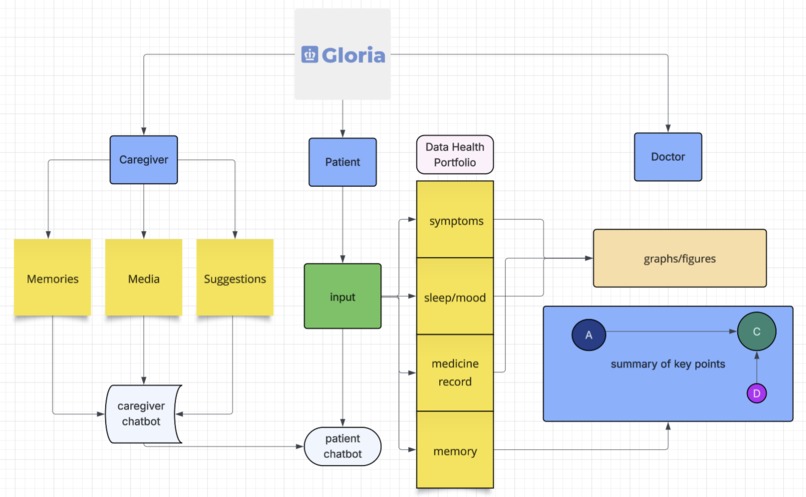
One of our first challenges was identifying the most fundamental problems to solve, since Gloria’s connection to our larger health platform enables it to touch upon many areas. We distilled it down to three core needs: addressing loneliness, providing companionship when caregivers and doctors aren’t present, and restoring patient agency over their identity and data. We initially had too many ideas, so we simplified the essentials, ensuring the experience would remain clear and accessible for older users. We designed three interfaces and mapped them on a whiteboard to align their connections, ultimately centering the patient’s chatbot as the core element. Finally, translating all of this complexity into a clear, compelling pitch was itself a challenge — one that taught us how to refine our vision and communicate it with focus.
What's next for Gloria
We came into this Hackathon with a bigger vision: Gloria is not just a chatbot, but the cognitive health module of a larger, human-centered digital health platform. This platform will unite physiological, mental, and cognitive health — recognizing how deeply they affect one another (for example, loneliness raising the risk of heart disease). At its core is also a secure, decentralized health wallet that gives patients control over their personal and medical data.
Today, Gloria supports Alzheimer’s and mental health. Tomorrow, the same system will expand to diabetes care, chronic illness monitoring, and beyond — all built on one foundation: making healthcare human.


Log in or sign up for Devpost to join the conversation.