Inspiration
Idle games usually ask for a decision every few minutes. We wanted one that asks every few seconds without becoming an action game. The twist: instead of the game escalating the threat on a timer, the player spends their own earnings to escalate it by hand — the only way to win. War is profitable, so you keep turning up the dial that makes it dangerous.
What it does
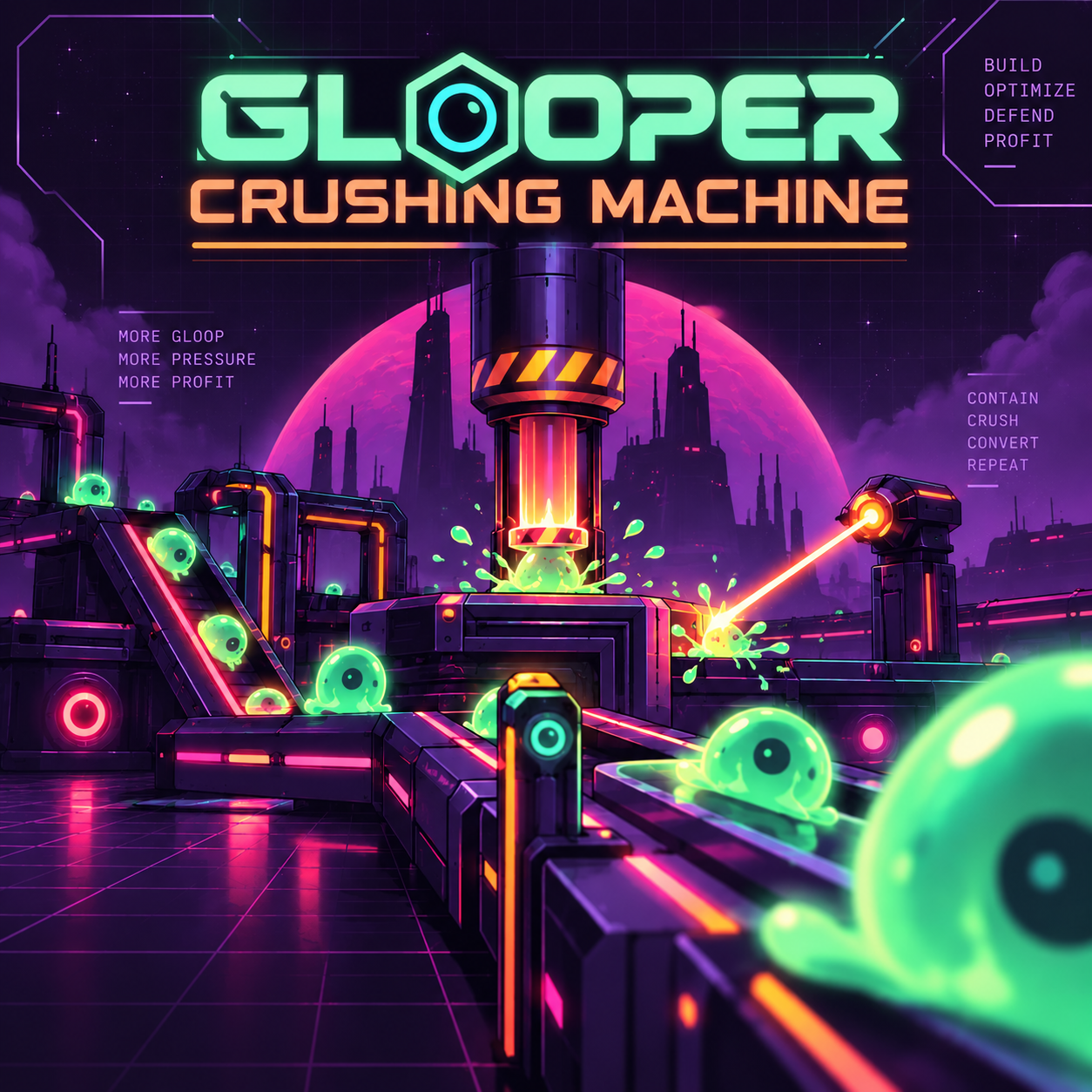
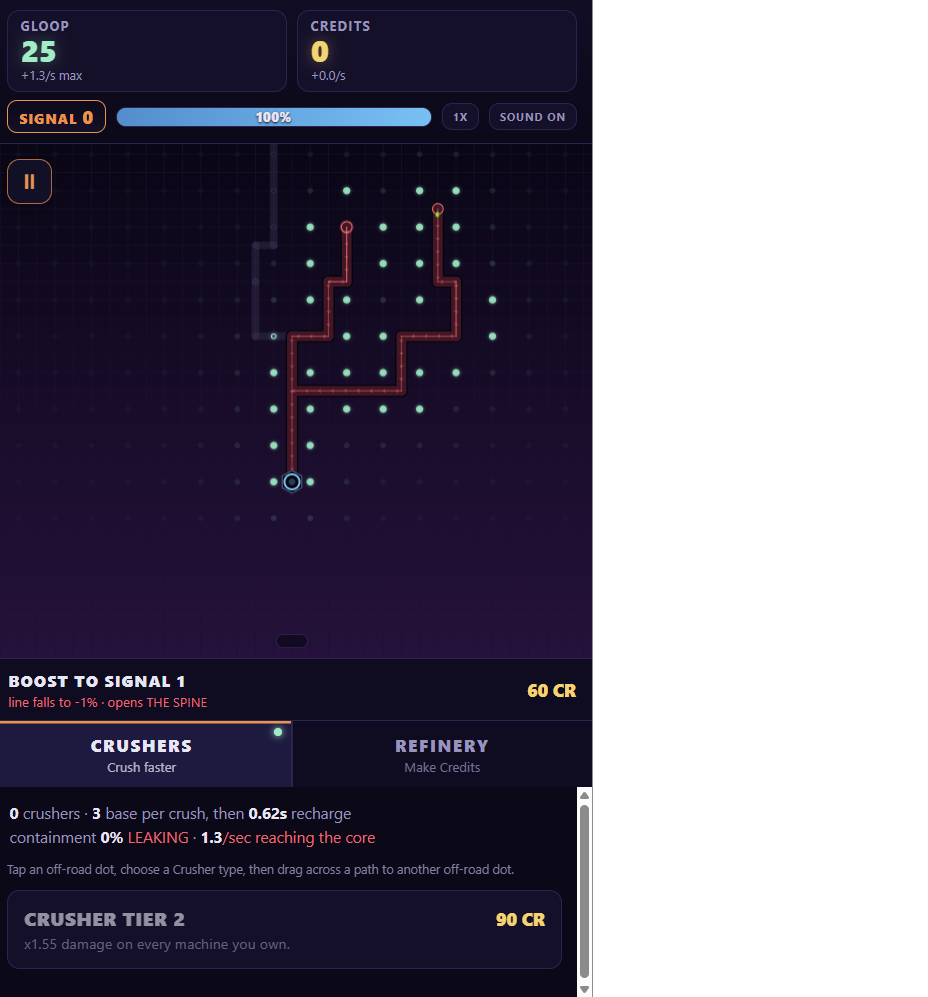
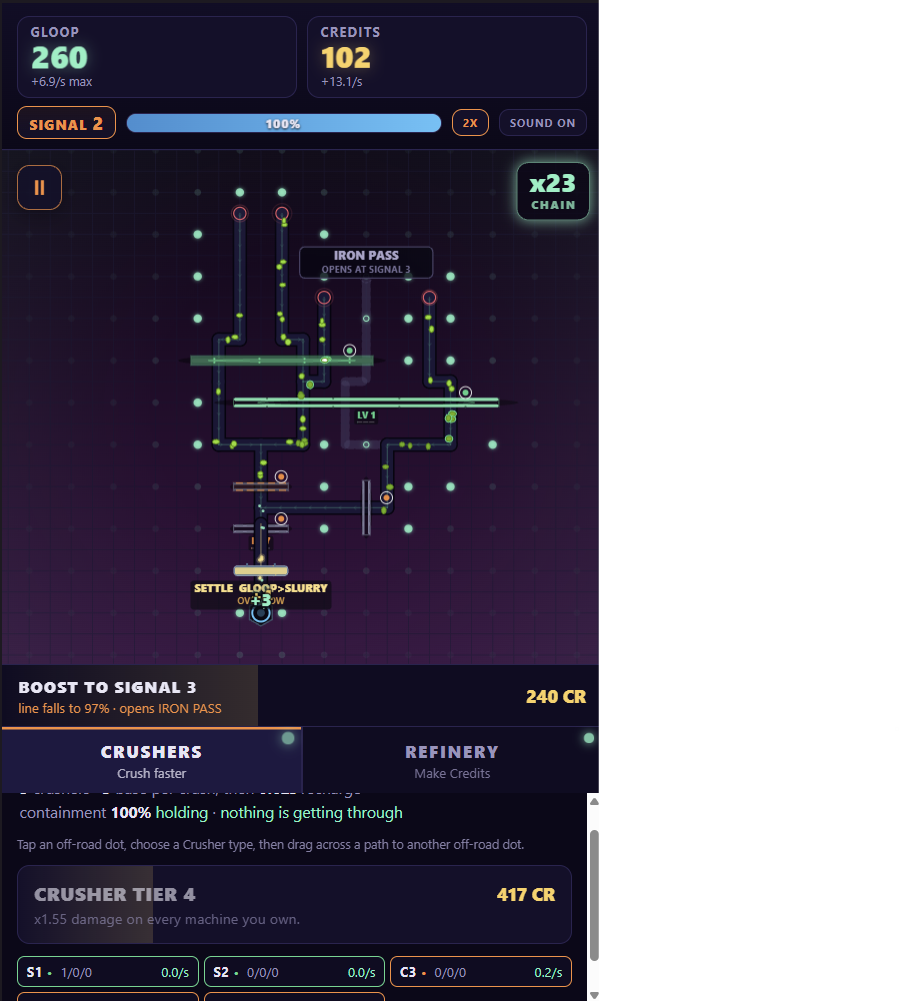
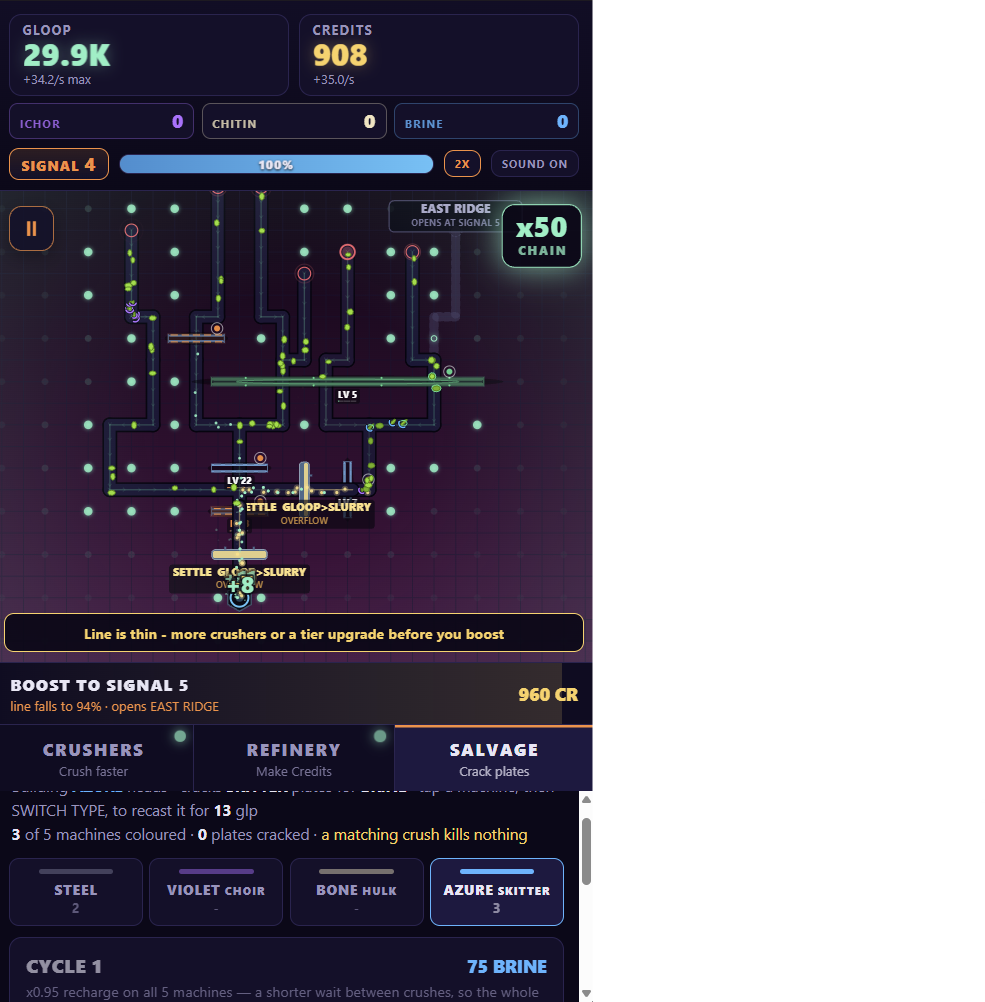
A single-player, portrait simulation-and-management prototype. Gloopers walk a branching network of thirteen roads draining into one Core. You build three machine types along it:
- Crusher — instant, guaranteed kill; drops a Gloop packet.
- Softener — slows its band, kills nothing; the only counter to fast enemies, and purely positional.
- Refinery — lifts Gloop that flows past it up a recipe chain to cash as Credits.
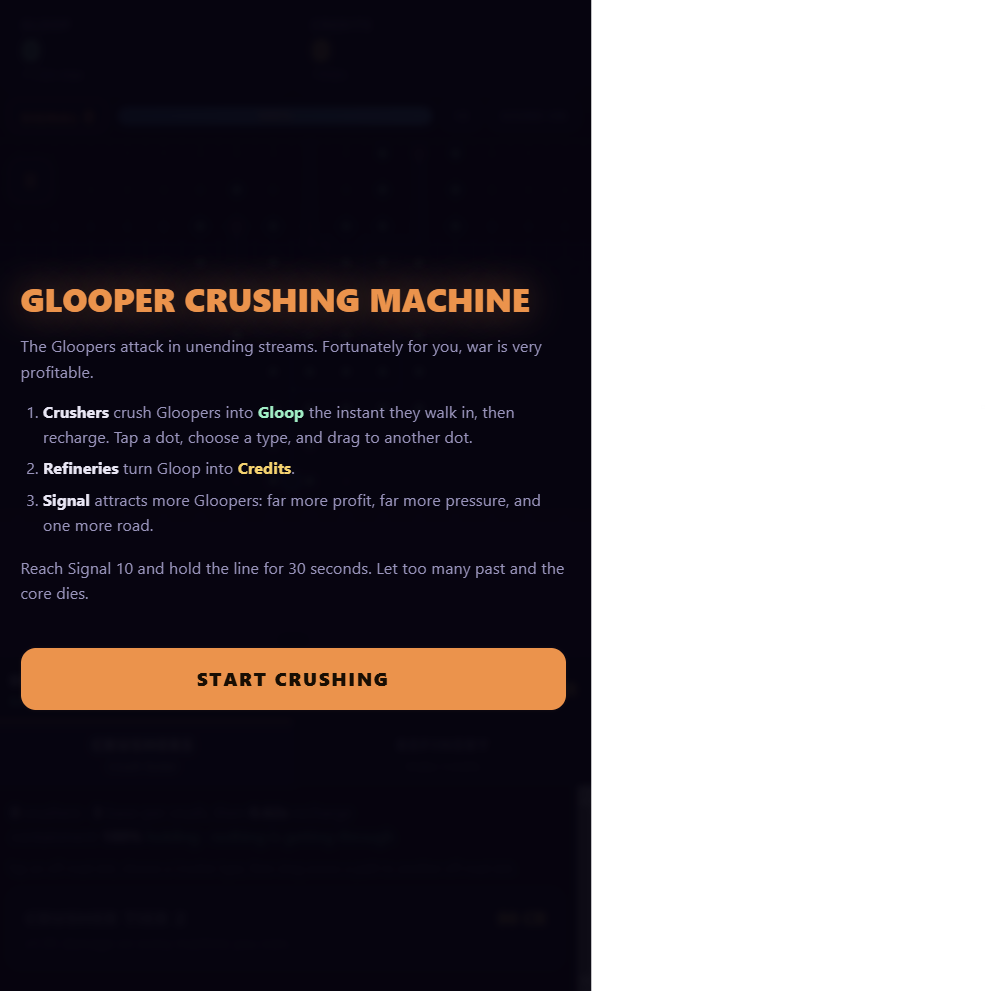
Gloop is cargo that flows downhill to the Core or through a Refinery. Credits buy Signal; each Signal level opens a road, drops a wave, and makes enemies tougher and more numerous. Four enemy archetypes each pose a different problem through their spawn pattern, and each caste drops a salvage resource when a matching Crusher head cracks its plate. Reach Signal 10 and survive a thirty-second Final Surge to win; lose if the Core hits zero. A run lasts twelve to twenty minutes. Because the roads share their downstream segments, where a machine stands matters more than how many you own.
How we built it
Built entirely through prompt-based development with Claude Code. Plain HTML5 Canvas 2D and WebAudio, no framework or engine — the submission is a single readable, unminified index.html of about 83 KB with no libraries, no assets, and no network requests. A build step concatenates numbered source files and fails on any external URL. A headless balance harness drives the real simulation with cautious, greedy, and idle scripted players to tune the difficulty curve.
Challenges we ran into
Placement had to become a decision. The first version used straight lanes where every Crusher was interchangeable; only the shared-segment road tree made position matter. The escalation button was a trap — every readout showed 100% contained until the player pressed it and died. The fix projects containment a level ahead and moves the residual risk into the unpredictable boost wave.
- Bimodal outcomes — a run either sails through or eats a bad wave near 47% core, so reliable balance numbers need thirty-run sweeps. ## Accomplishments that we're proud of
- A complete, genuinely playable loop — invest, harvest, upgrade, escalate — start to finish in one sitting with real win, lose, and reset states.
- A board where position carries the decision: the best crushing and refining ground coincide at the throat, while the harvest runs on the quiet edge roads.
- Player-controlled escalation as the signature mechanic and the only path to a win. ## What we learned
- Structural problems cannot be tuned away — the lane board was rebalanced many times before we accepted it had to be replaced.
- More feedback is not more information — forty payout numbers a second read as noise.
- Building the tooling and testing harnesses were super important for quick iteration. ## What's next for Glooper Crushing Machine
A fuller game where every road is a factory built in a fixed order — softener, crusher, matched head, refiners — and the player chooses which flank to starve to feed it. The refiner chain and salvage tracks would deepen, enemy archetypes would gain later-stage variants, and the Final Surge would get a dedicated tuning pass
Built With
- canvas
- chatgpt
- claude
- html5
- javascript
- webaudio

Log in or sign up for Devpost to join the conversation.