
Globot — Agentic AI for Proactive Supply Chain Defense
Inspiration
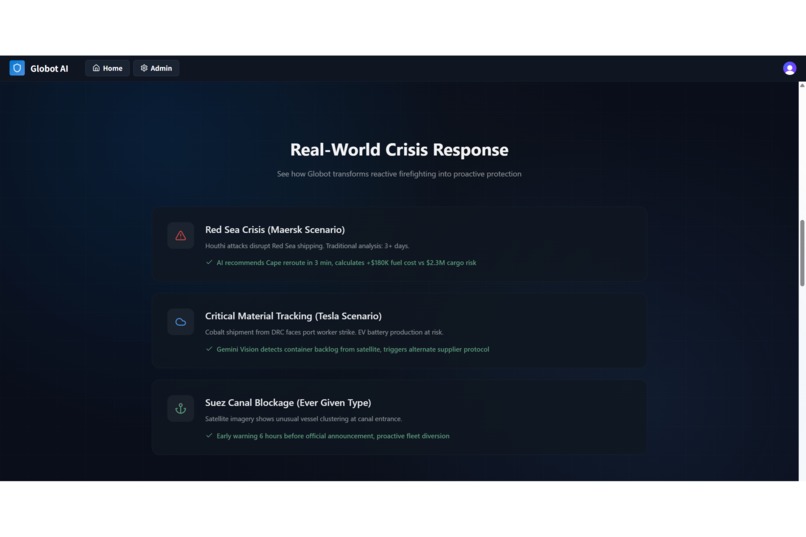
Imagine it is Friday at 4:55 PM. A geopolitical crisis threatens a major shipping route, millions of dollars in cargo are at risk, freight prices are fluctuating, and logistics teams are struggling to make sense of spreadsheets, breaking news, and insurance documents.
Traditional supply chain management often reacts to disruptions after they happen. We wanted to explore a different approach: What if AI could identify risks early, evaluate possible responses, and help logistics teams make informed decisions before a crisis becomes a costly disaster?
That idea inspired Globot, an Agentic AI platform designed to transform reactive logistics management into proactive supply chain defense.
What It Does
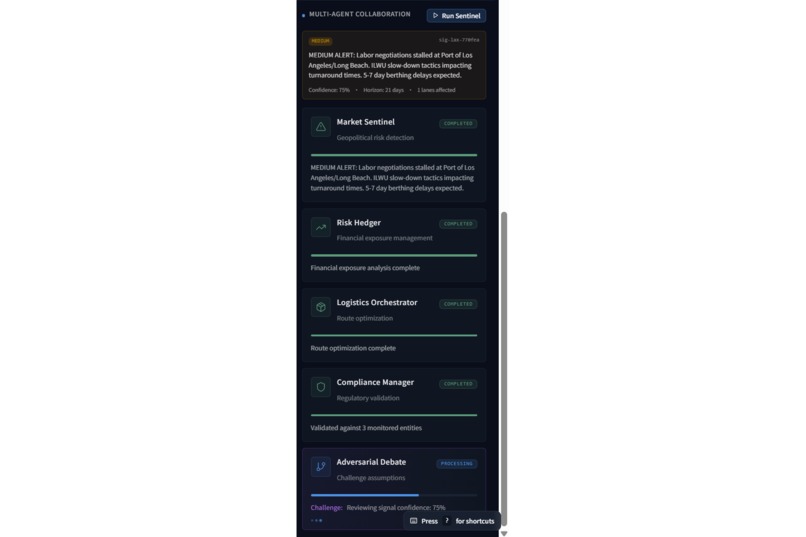
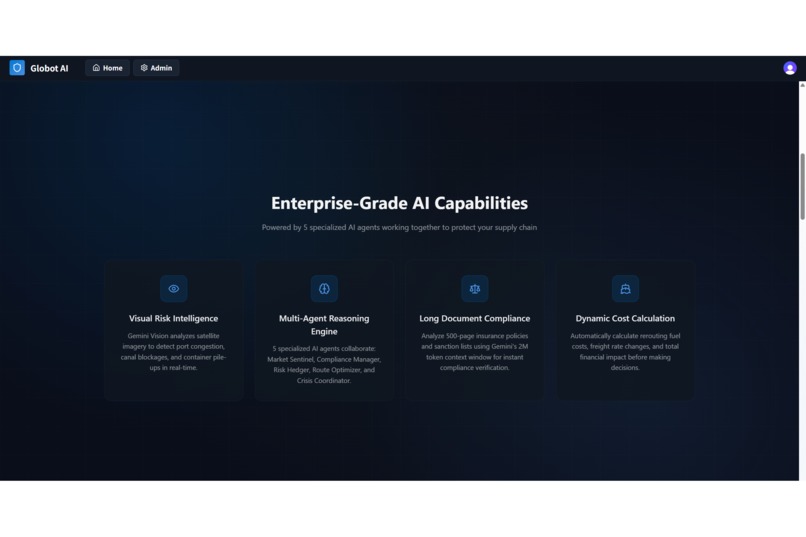
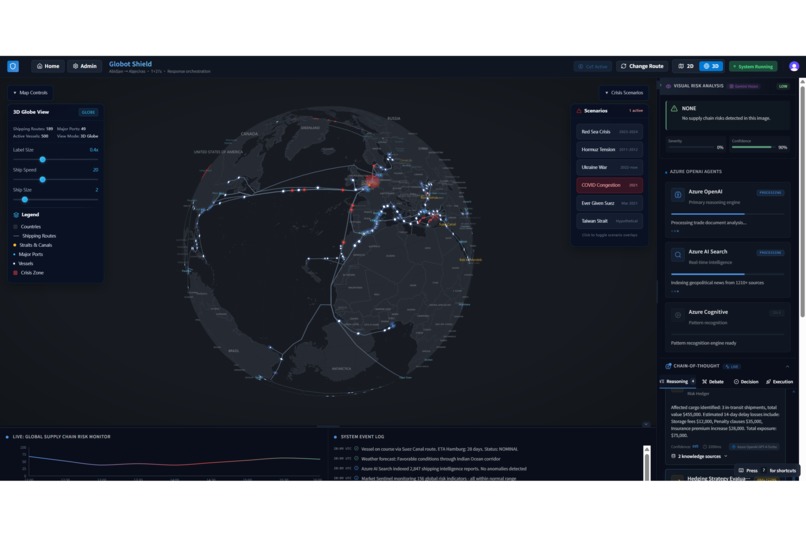
Globot brings together five specialized AI agents that collaborate to analyze supply chain threats and recommend potential responses.
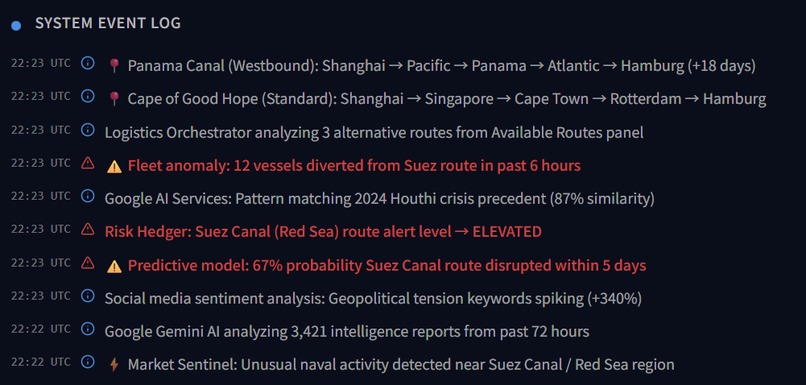
- Market Sentinel: Analyzes geopolitical developments and emerging risk signals.
- Risk Hedger: Estimates financial exposure from fuel price changes, freight volatility, and alternative shipping routes.
- Logistics Orchestrator: Evaluates alternative routes to help avoid disrupted or high-risk shipping corridors.
- Compliance Manager: Processes lengthy insurance policies and identifies relevant coverage conditions, exclusions, and requirements.
- Adversarial Debate Agent: Challenges proposed recommendations to uncover weaknesses and inconsistencies before decisions reach human operators.
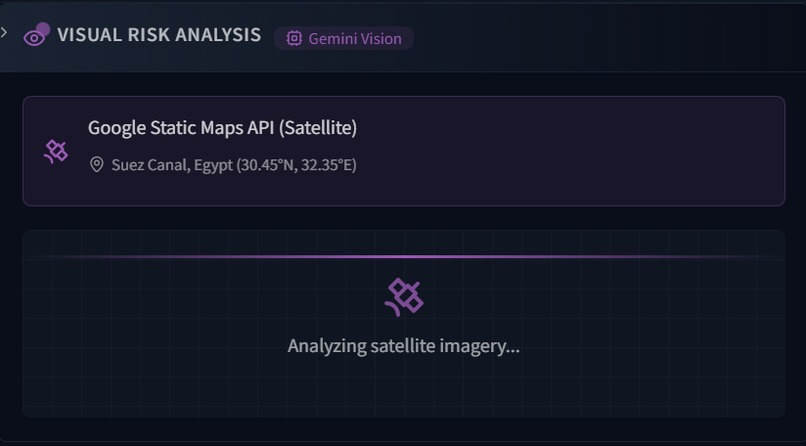
Globot also explores multimodal risk intelligence through satellite imagery analysis, helping identify visual indicators of port congestion and potential infrastructure disruptions.
Rather than leaving users with disconnected reports, the goal is to turn complex information into clear, actionable risk assessments.
How We Built It
We designed Globot around a multi-agent architecture in which each agent specializes in a particular part of the supply chain decision-making process.
Backend and orchestration: Python and FastAPI provide the backend, while CrewAI coordinates the specialized agents.
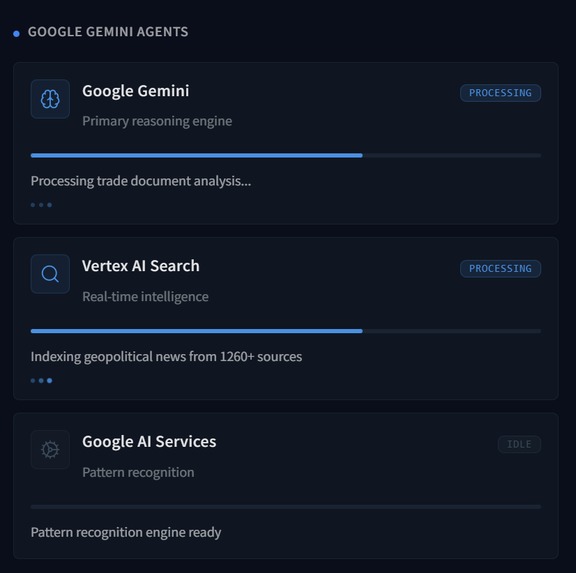
Artificial intelligence: Gemini 3 Flash supports reasoning tasks, Gemini Vision enables image-based analysis, and Gemini Embeddings supports semantic retrieval from relevant information.
Document intelligence: Retrieval-augmented generation (RAG) with ChromaDB helps retrieve relevant information from a vector store, while the language models analyze the retrieved context.
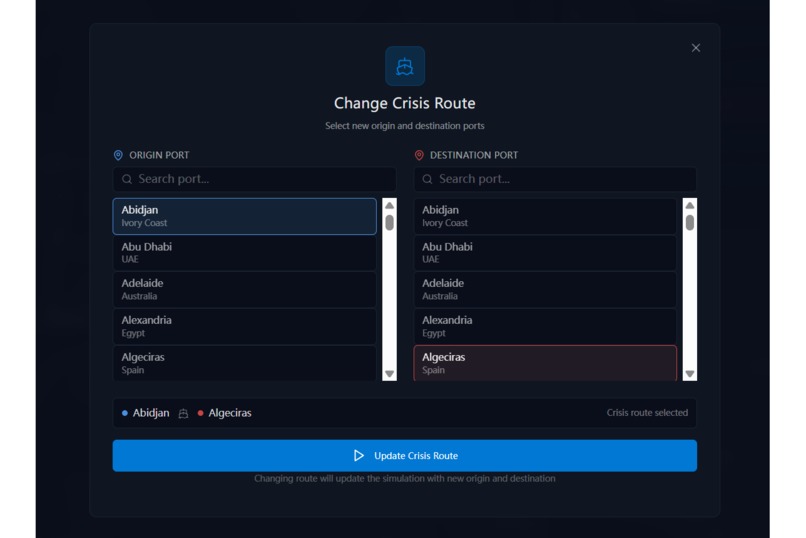
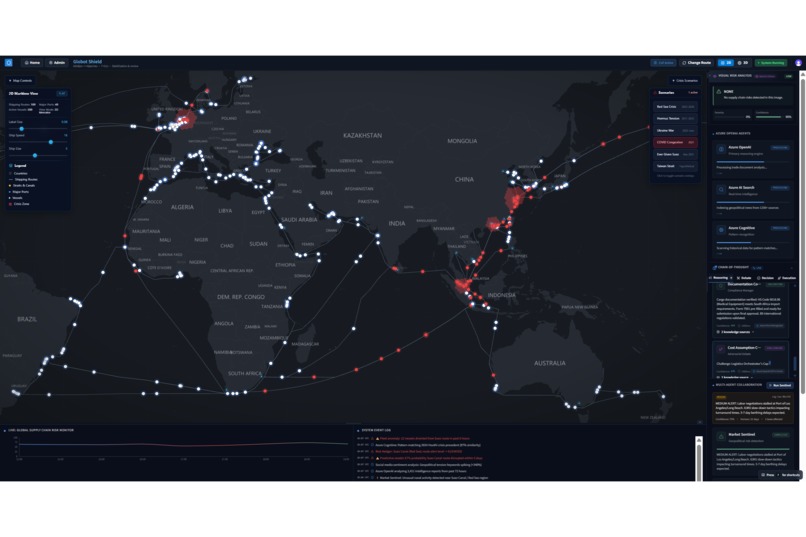
Frontend and visualization: React, TypeScript, and Vite power the user interface. Deck.gl supports interactive geospatial visualization for understanding logistics routes and risk locations.
Authentication and storage: Clerk supports authentication, while SQLite stores application data.
The overall workflow is designed to combine intelligence gathering, financial risk assessment, route evaluation, compliance analysis, and critical review into a unified decision-support experience.
Challenges We Faced
1. Multi-Agent Coordination
Coordinating multiple agents requires more than giving each model a separate prompt. We needed to structure responsibilities, exchange useful findings, and ensure that recommendations from one agent could be evaluated by the others.
2. Python Compatibility
We encountered asynchronous dependency compatibility issues involving aiohttp and Python 3.13 while working with the agent orchestration stack. This highlighted the importance of dependency management, version compatibility, and reproducible environments.
3. Long-Document Analysis
Insurance policies can contain hundreds of pages of complex language. Extracting relevant clauses while preserving their meaning requires careful context management, retrieval strategies, and prompt design.
4. Multimodal Risk Assessment
Converting satellite imagery into structured assessments presents challenges involving image interpretation, uncertainty, and the reliability of model-generated conclusions.
These challenges reinforced an important principle: AI recommendations need supporting evidence, clear limitations, and appropriate human oversight.
What We Learned
Building Globot helped us explore how multiple specialized agents can approach a complex problem from different perspectives.
We learned that:
- Multimodal AI can connect visual information with operational decision-making.
- Retrieval-augmented generation can make large collections of documents more accessible.
- Agent collaboration needs clearly defined responsibilities and validation.
- Adversarial review can help identify weaknesses in proposed solutions.
- Human oversight is essential when recommendations could affect financial commitments, cargo safety, or business continuity.
Responsible AI and Human Oversight
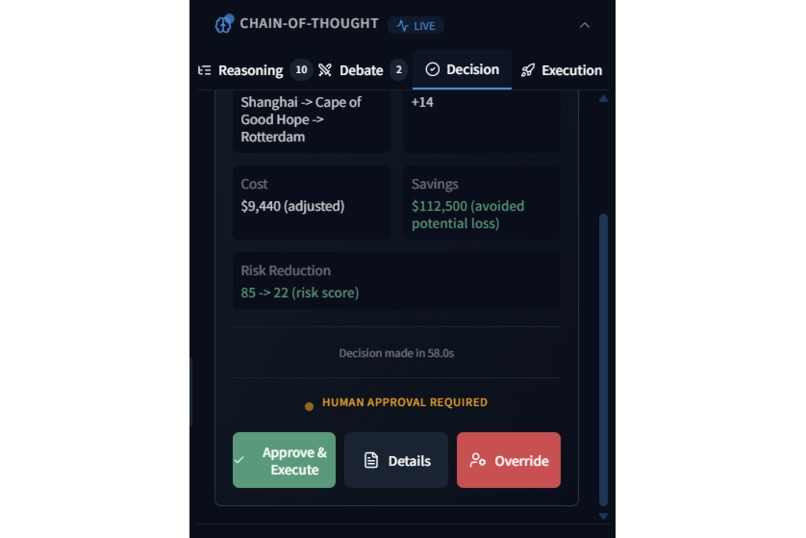
Globot is designed as a decision-support system rather than an unrestricted autonomous operator. Critical actions should require human approval, and risk assessments should communicate uncertainty instead of presenting model-generated conclusions as guaranteed facts.
Financial estimates, route recommendations, insurance interpretations, and satellite-derived signals must be validated against reliable data before being used for real-world decisions.
What's Next?
Our roadmap includes integrations with live financial market data, MarineTraffic vessel tracking, and Sentinel-2 satellite imagery for more comprehensive monitoring. We also envision extending the platform to air freight and rail logistics.
Our long-term goal is to help logistics teams move from reacting to disruptions toward anticipating risks, comparing alternatives, and responding with greater confidence.
Globot is our exploration of a future where AI doesn't just report a supply chain crisis — it helps people understand it, evaluate their options, and prepare for what comes next.
Built With
- 3
- aigenerative
- airetrieval-augmented
- chain
- embeddingspythonfastapicrewaireacttypescriptvitedeck.glclerksqlitechromadbmulti-agent
- flashgemini
- gemini
- generationcomputer
- imagery
- intelligencesatellite
- intelligencesupply
- managementrisk
- systemsagentic
- visiongemini
- visiongeospatial

Log in or sign up for Devpost to join the conversation.