-
-
Sharely, give back to your community.
Inspiration
The environment is important to all of us. With the rise of COVID-19 we have seen a downturn in the greenhouse gasses emitted by transportation vehicles all around the world. However it has also seen the rise of 'retail therapy'. We were inspired by the idea that people may be purchasing more than they need to - maybe because they think they need it, or maybe because they actually need it! That pushed us to our next step - research.
Research
We conducted research on consumer behaviours and found out that 80% of the things in our homes are used less than once a month. [1] The trend of people just buying things (whether that be objects or spaces) just so they can own it, leads to an over-purchasing of these items. People don't need a living room and a dining room, they just want to own both. We also identified that buildings account for 1/3 of GHG emissions around the world. It was clear that there is huge potential in GHG reduction if we use our spaces more wisely.
Enter Sharely
What it does
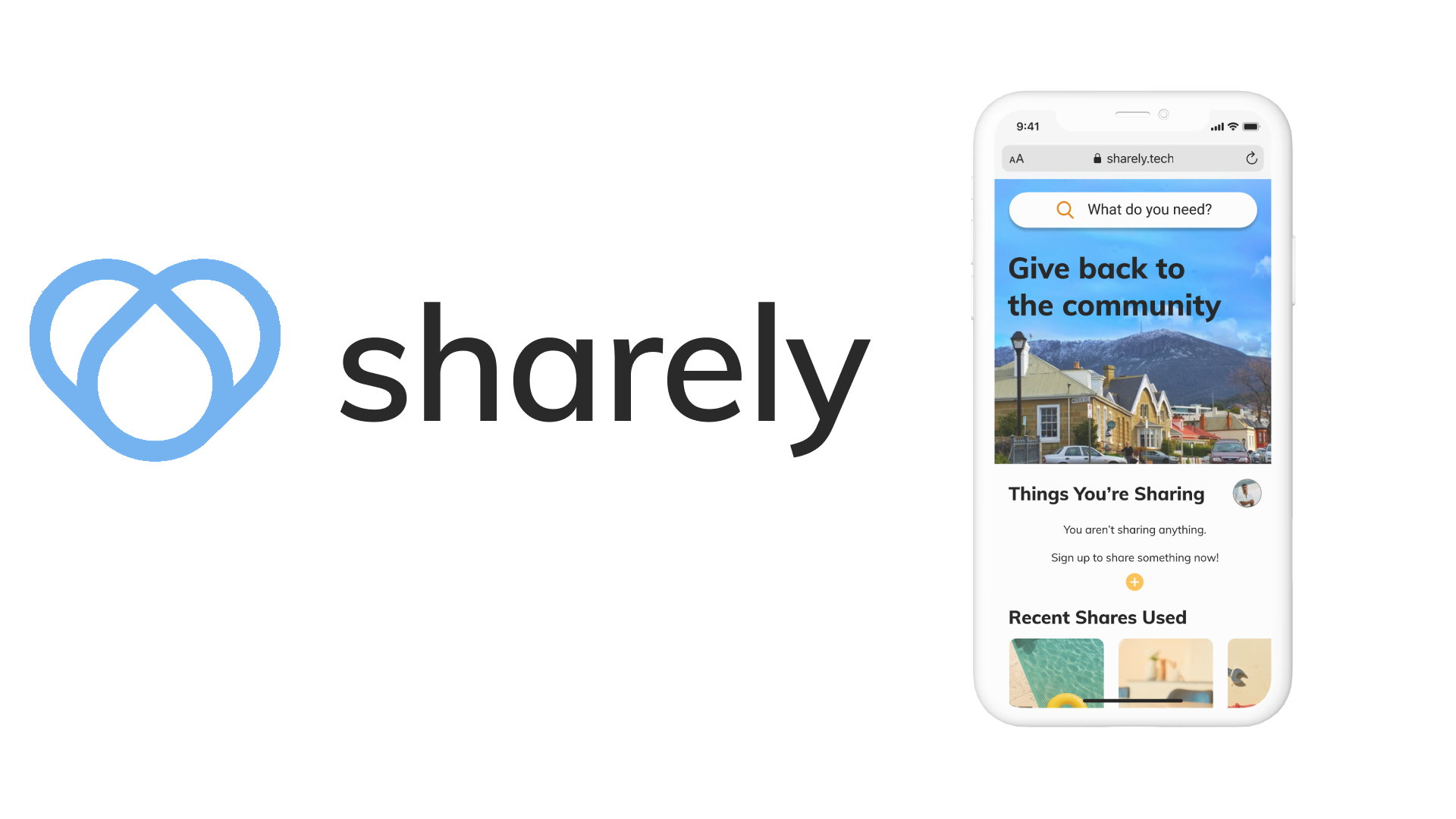
Sharely helps people make better use of their spaces and objects, by giving them the opportunity to share them within their community. The sharing of resources allows for a less consumerist society, thereby reducing the amount of garbage going into the landfill or the amount of space needed to be owned by one person.
For example, what if Max needed a quiet space to study away from his loud family. He can look up study space on Sharely and see that Joan has an empty dining table that she never uses, available for people to book. He can book her space on Sharely and even offer to mow her lawn or shovel her driveway for usage of her space. Joan can then accept Max's booking and be ready for him to come and use her space on the days he needs it.
Max doesn't have to drive all the way to the library. He also doesn't have to purchase another desk and chair to place in a quieter space in the house. And some use comes out of Joan's old table. It's reusing at it's finest.
How we built it
We built Sharely by using the human-centered double diamond design process.
Research & Discovery
We've explained some of our research to you above, but we made sure to conduct research on the highest contributors to climate change to help focus into our problem space. We identified transportation, land-use and
Synthesis
The biggest insights that we drew from our research was that people understand that sharing is beneficial to the environment. From that we developed our How Might We statement, to help direct the rest of our design.
How might we help suburbanites use available resources within their community, allowing them to reduce personal consumption.
We decided to focus our demographic on the suburban population, since city-dwellers have a lot of mixed-used spaces in close quarters already. We know, from experience, that people in the suburbs often have to drive to get the services that they need and so they will benefit the most from community-based service.
To showcase our idea we developed the following task-flow:
Max needs a study space -> He goes onto Sharely and searches for a study space within his community -> He finds one that suits the time that he needs -> He discusses using the space with the owner -> He books the space.
Ideation
Firstly, we decided to develop Sharely as a web application, due to the fact that if we wanted to entire community to make use of it, we had to develop it on a system that seniors and youngesters would both use. Then we decided to built out our MVP on mobile, as majority of the population will be using this app on mobile.
We took inspiration from websites such as Airbnb and Bunz, for a method of showcasing and then book of spaces.
Prototype
We developed our colour scheme by selecting colours that were vivid and bright, to add friendliness to to the brand identity. This is an application that can be used by anyone within the family. We injected the colours with intent, making sure not to overwhelm the user.
Challenges we ran into
We are proposing a behaviour shift with our application. People are slow to adapt to change. It was a challenge to develop an application that was friendly enough that we believe that people will be interested in trying it. The value of this idea will be seen when a person is able to make use of resources that they normally do not have access to. However, to bake in the benefits of the application before usage was a challenge.
Accomplishments that we're proud of
The idea! Our research allowed us to find data on a problem that is not commonly identified as a contributor to climate change. But when looking at the data, it makes sense to approach the problem the way we have. There are so many unused objects or spaces - it makes sense to make use of the existing ones rather than build more.
We are also proud that we came up with a full user flow in 24 hours. We made sure to consider the impacts this application will have on the user at every step. Our discussion while designing was to constantly think about how pages would be interpreted, how they would interact with the product and what would lead to the highest rate of usage.
What we learned
The biggest thing we learned was how much of an effect buildings have on greenhouse gasses and emissions. It is not commonly spoken about as a contributor. It was also the first time any of us had worked with a team of 3 people on an online hackathon.
What's next for Sharely
- To develop the flow for users that want to share their spaces or objects and identify what information or requirements they would have to share.
- Eventually, connect to Google Maps as a plug-in and allow for the in-app search to happen within Google maps in the browser.
- Considerations for monetization
Built With
- figma

Log in or sign up for Devpost to join the conversation.