-
-

GlobeTrail's landing page
-
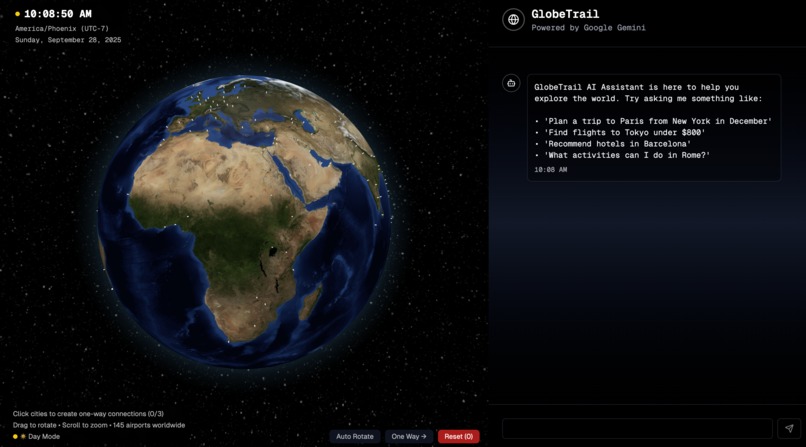
Overview of the Travel AI Agent
-
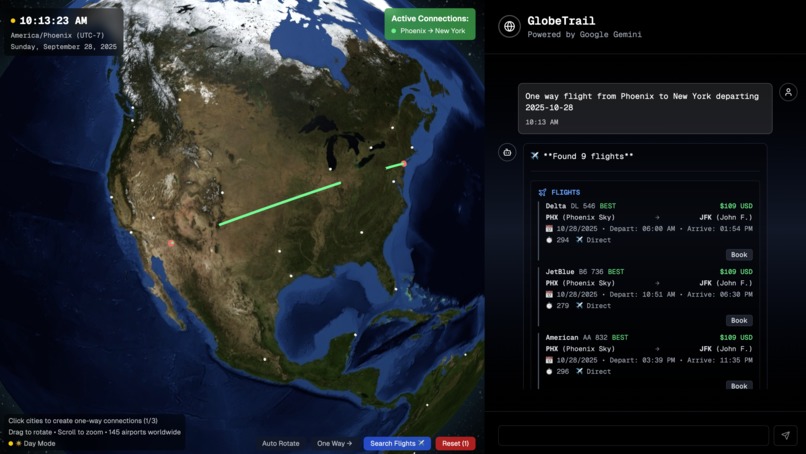
Flight path showcase

Inspiration
Travel planning is stressful. Comparing flights, finding affordable hotels, and deciding what to do in a new city can take hours of research. We wanted to build an agent that makes the process effortless: one place where you can describe your dream trip and instantly get an affordable, fully automated itinerary. Our goal was to combine convenience, cost-savings, and personalization so that anyone can explore the world without the hassle of endless searching.
What it does
Our project is an agentic AI travel planner built with the Gemini API and Model Context Protocol (MCP). Instead of a static flow, the AI autonomously calls MCP tools for flights, hotels, food, and activities, then organizes the results into clustered trip options. The system is fully automated, always cost-conscious, and adaptive, turning a single user request into a complete, optimized itinerary.
How we built it
We built our travel planner using the Gemini API as the reasoning engine and the MCP to expose external tools. Each tool connects directly to real-world APIs for flights, hotels, and activities, returning structured results. Gemini orchestrates these calls agentically, deciding when and how to query each tool, then composes the data into a complete itinerary. Finally, we allow for direct links to bookings, obtained via webscraping.
Challenges we ran into
One major challenge was getting MCP to work smoothly on the JavaScript side. Tool registration and schema handling often broke, and required extra time to debug. We also ran into issues with Selenium automation for hotel sites, since many used dynamic loading and anti-bot protections, making scraping slow and unreliable. These hurdles forced us to adapt quickly and find workarounds to keep our pipeline stable.
Accomplishments that we're proud of
We’re proud that our AI travel agent is fully agentic—it autonomously decides which tools to call and generates complete itineraries with flights, hotels, and activities. Using Gemini API and MCP, our system orchestrates multiple real-world APIs, so every recommendation is based on live, actual data—no mock data or placeholders. In just 24 hours, we built a working end-to-end MVP with live API calls, dynamic itinerary generation, and 3D visualizations that make planning trips effortless and fully automated.
What we learned
-JSON schema validation: Started with clean JSON input (hotel_name, check_in, check_out, travelers) that maps well to MCP function parameters -Type safety: Date parsing and validation becomes crucial when parameters come from external MCP calls -Default values: MCP tools need sensible defaults (travelers: 2) for optional parameters -Clear interfaces: Each tool should have one clear responsibility (search vs. extract vs. navigate)
What's next for Globetrail
Next, we want to expand Globetrail to support more travel APIs, reduce latency for faster itinerary generation, and improve the agent’s ability to optimize trips—all while keeping it fully automated and cost-conscious.
Built With
- agenticai
- ai
- api
- gemini
- googleapi's
- mcp
- ml
- python
- react
- typescript


Log in or sign up for Devpost to join the conversation.