-
-
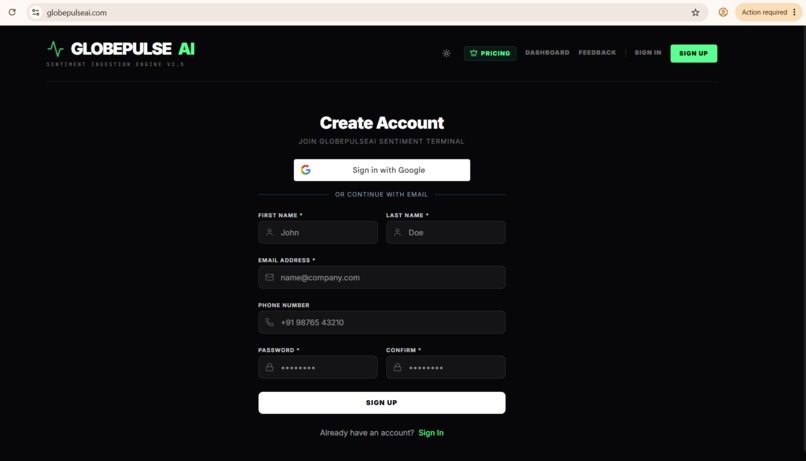
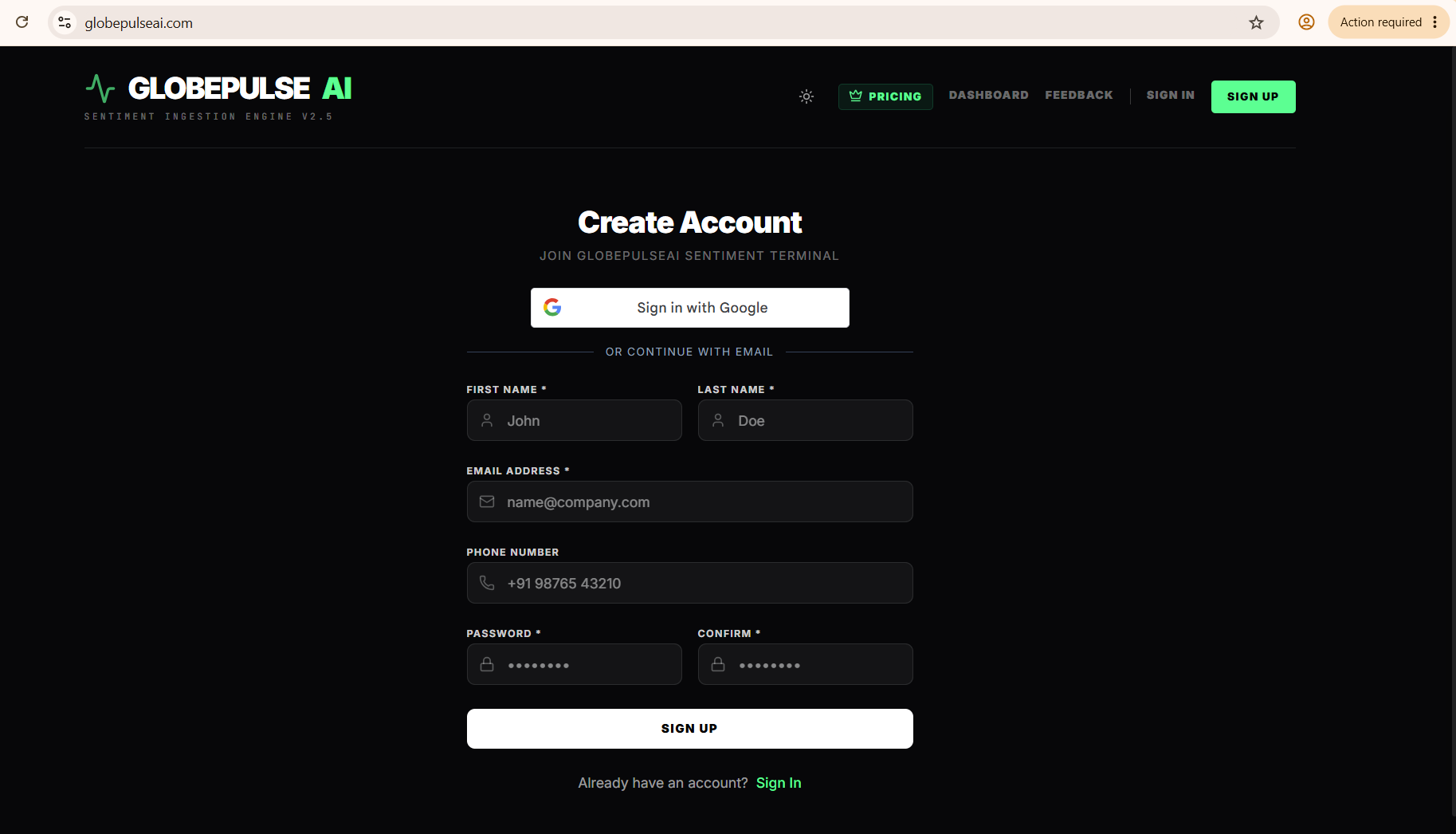
Signup Page
-
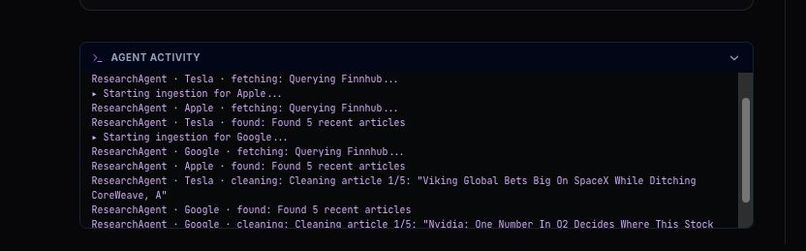
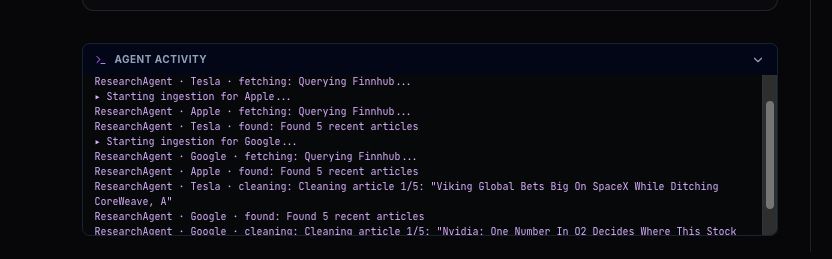
Agent Activity
-
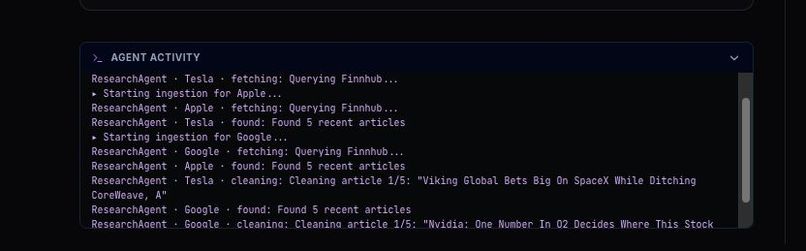
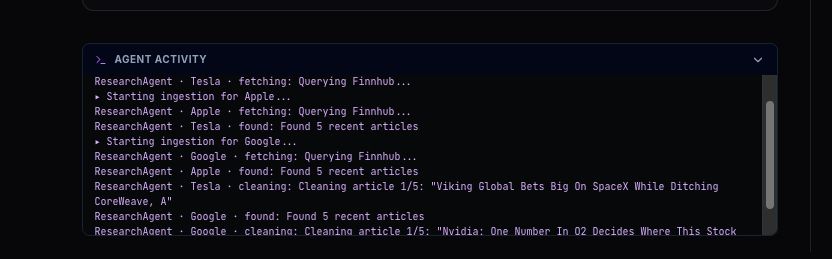
Agent Activity
-
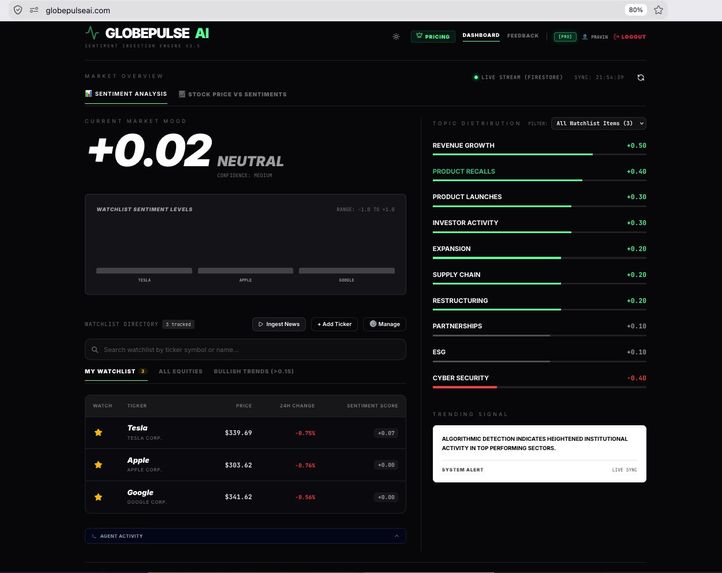
Sentiments
-
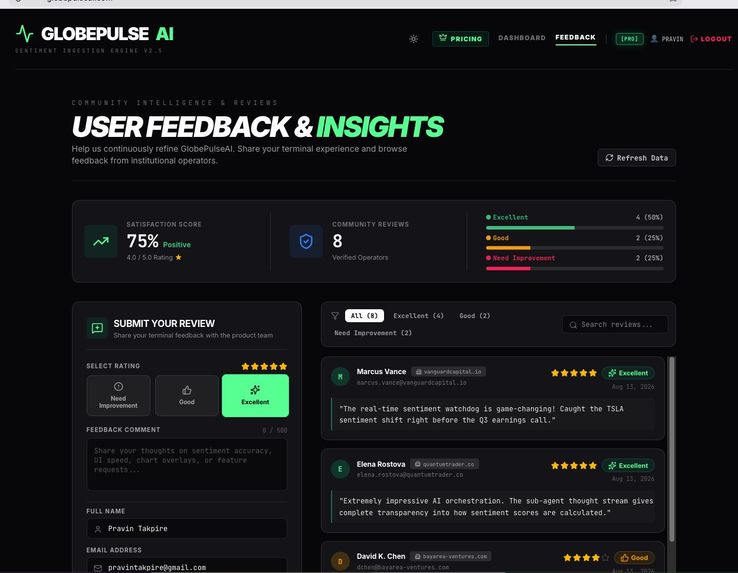
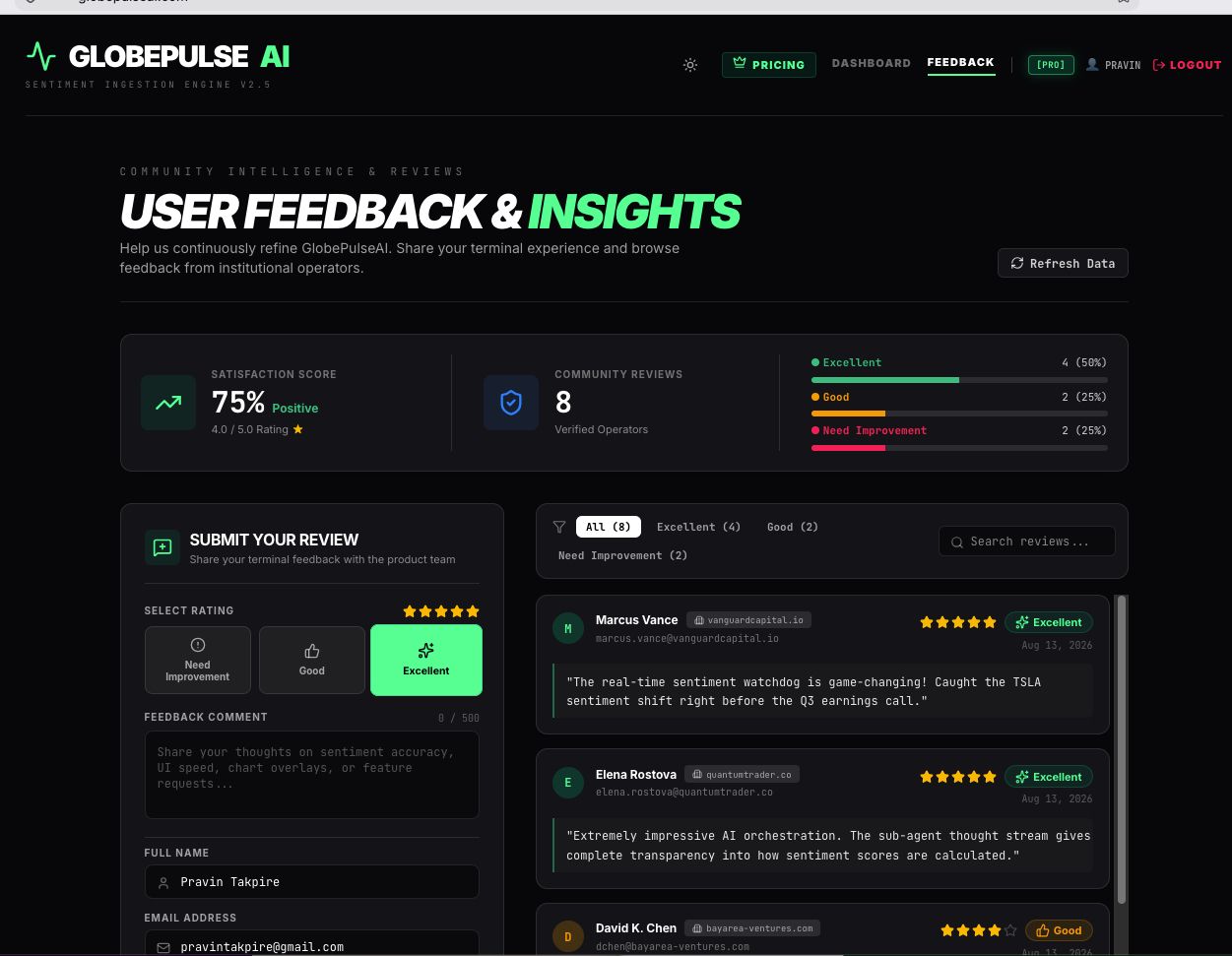
User Feedback
-
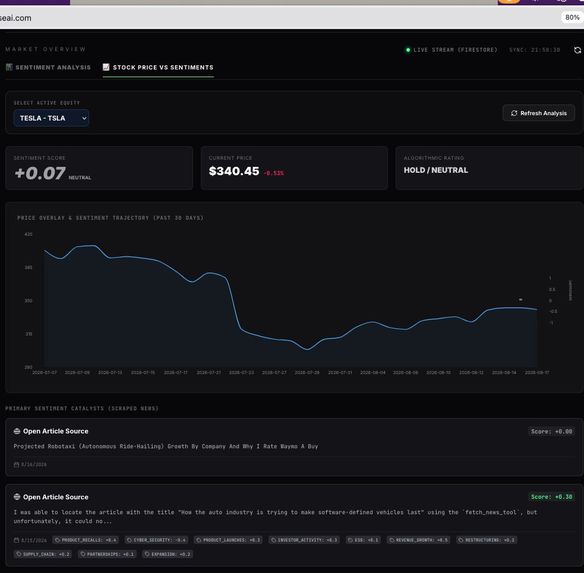
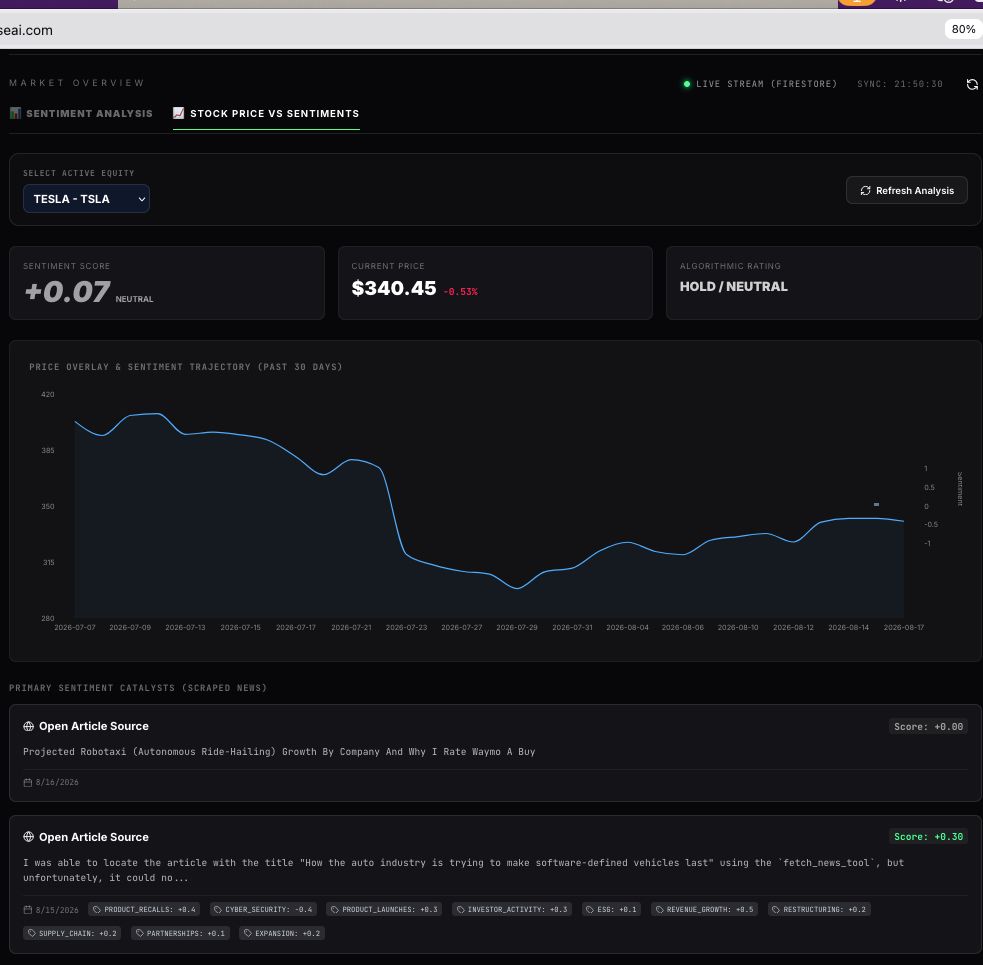
Sentiment Chart
-
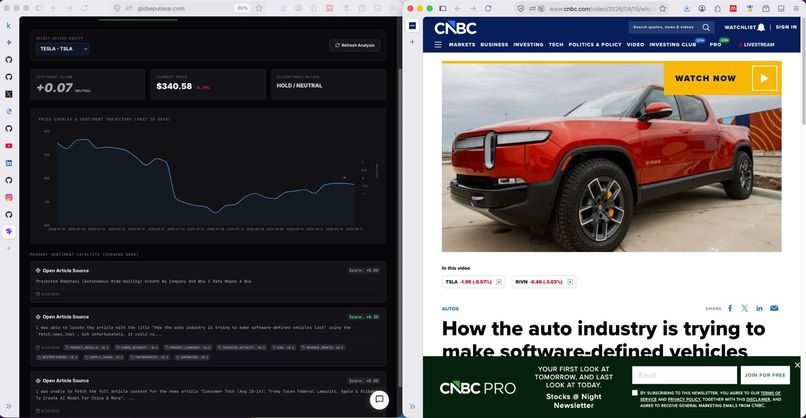
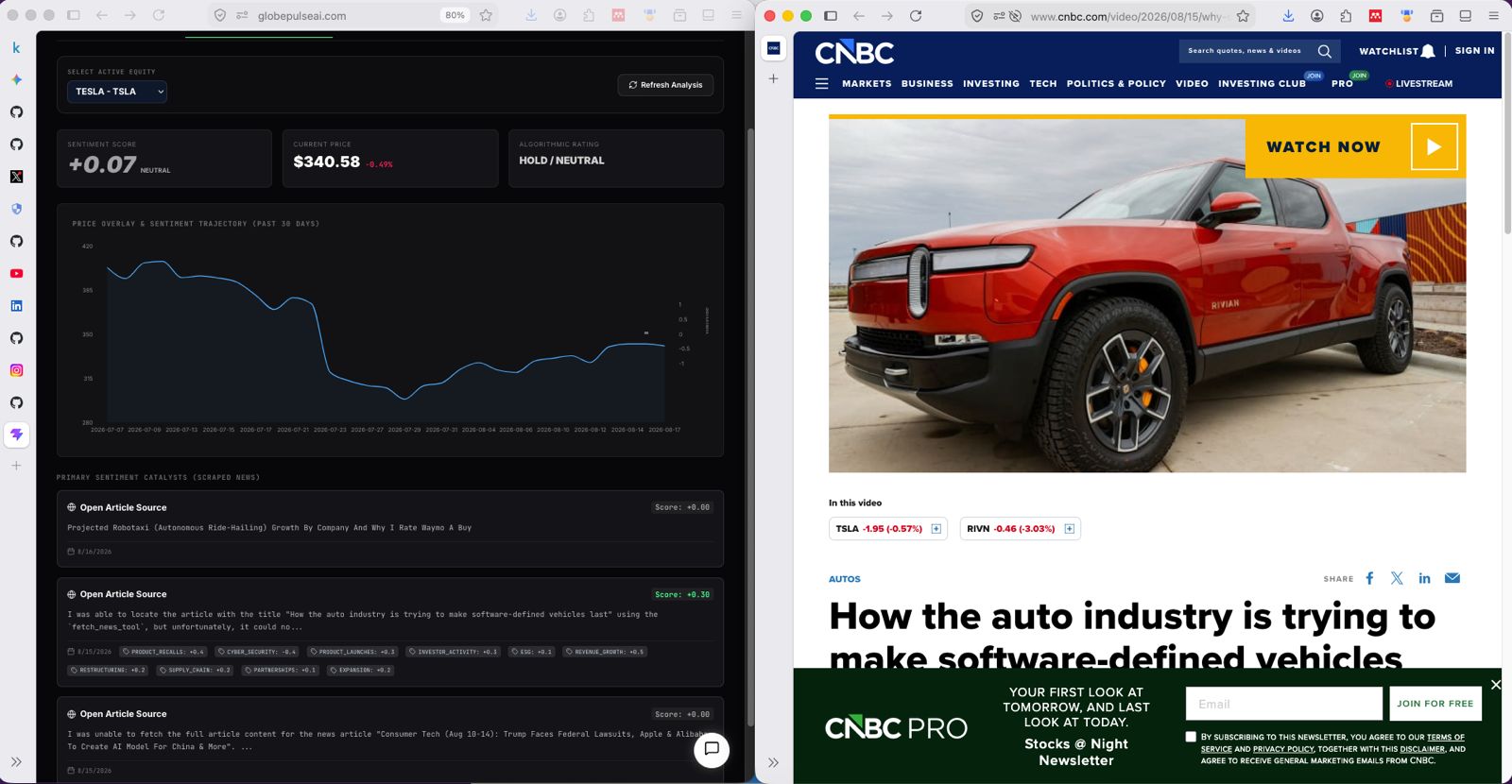
News Page
-
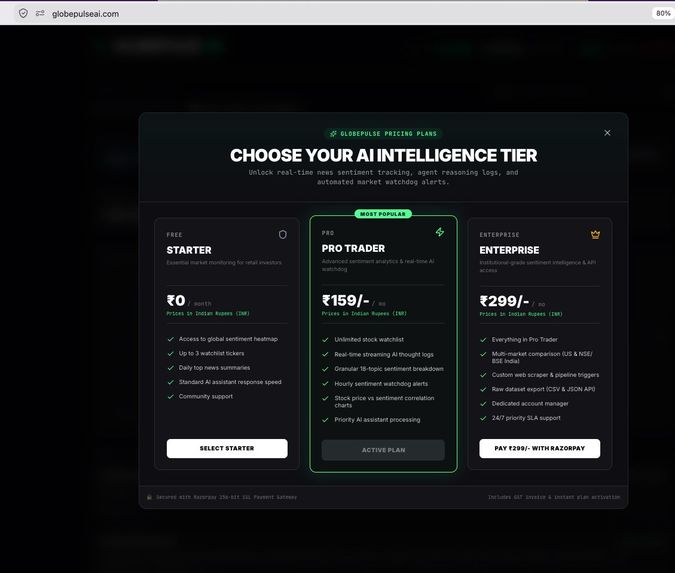
Subscription
-
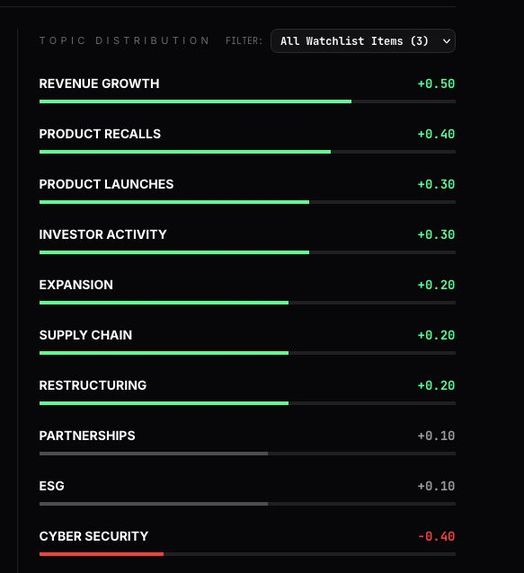
Ticker Score
Inspiration
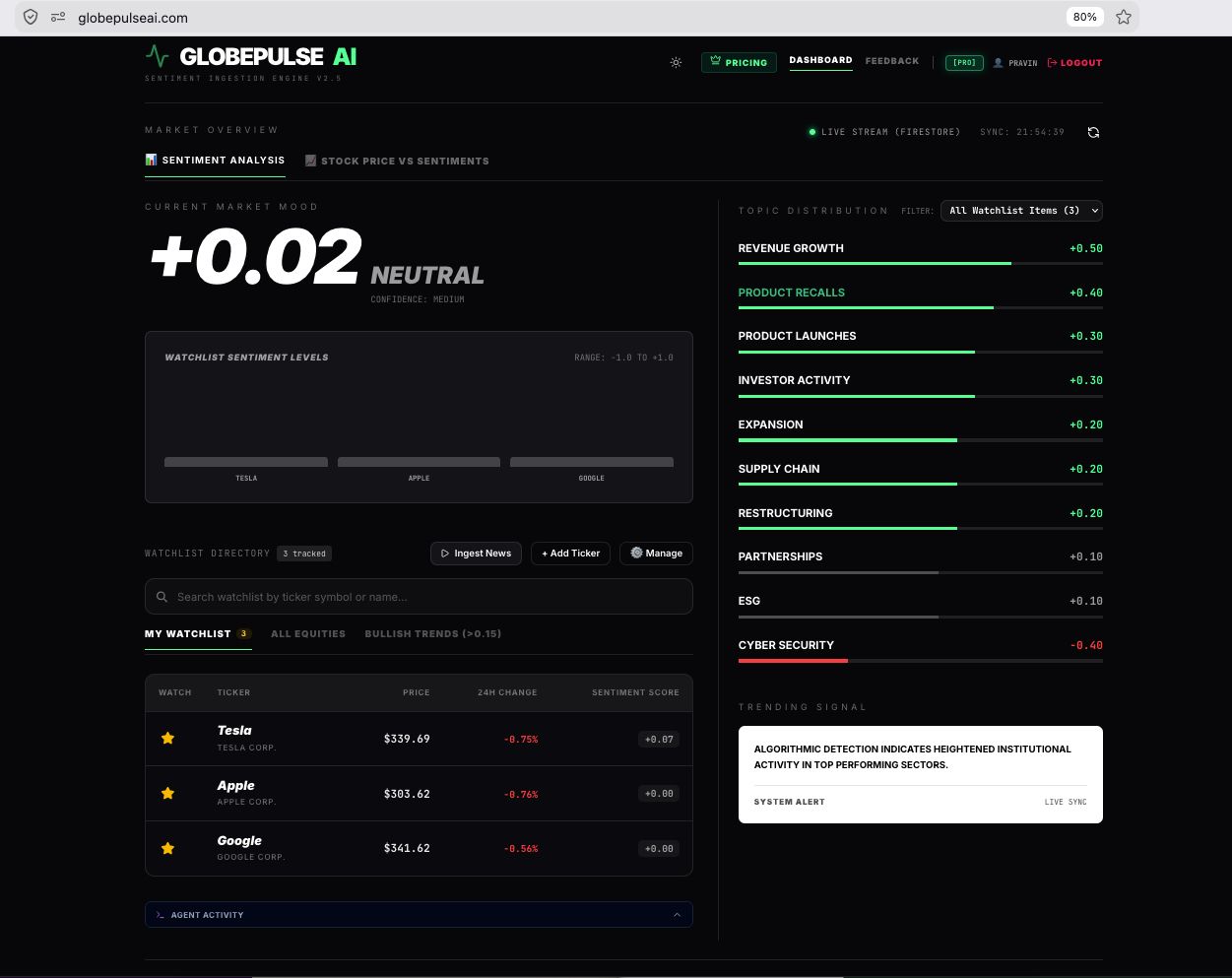
Every investor and trader knows that financial markets move on information long before quarterly earnings hit the press. When news breaks—whether it's an unexpected CEO resignation, an FDA drug approval, or supply chain disruptions—the sentiment embedded in hundreds of news articles drives stock price volatility. Yet, most investors are forced to choose between two painful extremes: drowning in hundreds of unread RSS feeds or relying on simplistic, binary "bullish/bearish" headline aggregators that miss crucial context. Financial news is complex and multi-faceted. A single article about Tesla might contain positive news on vehicle deliveries (product_launches), negative news on worker restructuring (layoffs), and neutral news on battery research (r_and_d). Generic RAG applications and basic LLM wrappers fail because they treat news as flat text and cannot separate distinct financial dimensions or cross-reference sentiment trends directly against market price movements. We wanted an agentic platform that closes this gap in real time. You add a ticker to your watchlist or ask a market question, and GlobePulseAI.com automatically ingests live company news (via Finnhub), extracts structured 18-topic sentiment scores using Gemini, correlates sentiment shifts against stock price series, and orchestrates a multi-agent team to answer complex market queries while streaming its reasoning live to the user.
What it does
You enter a ticker (e.g., TSLA, AAPL, NVDA) or open the GlobePulseAI.com dashboard. In seconds, it executes an end-to-end intelligence cycle across five integrated stages:
- Live News Discovery & Scraping: It queries Finnhub's /company-news endpoint for real-time, per-ticker coverage (Google News RSS is retained as a local-dev fallback, resolved via googlenewsdecoder — Google blocks that feed from cloud IP ranges in production), and scrapes clean article text with BeautifulSoup while deduplicating against existing corpus records.
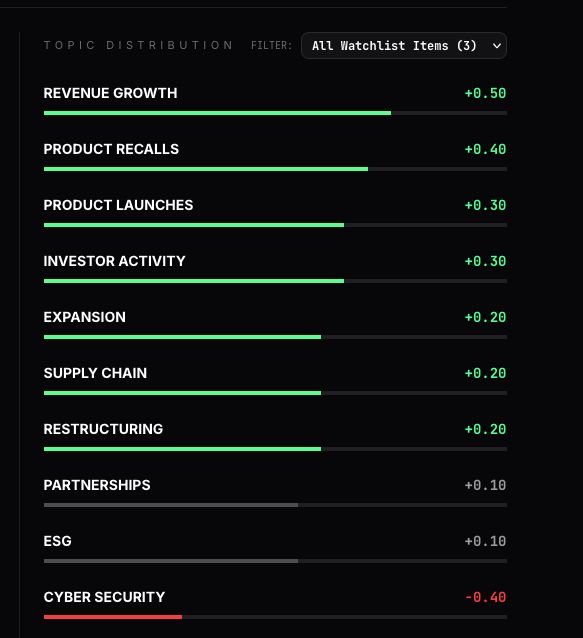
- 18-Topic Structured Sentiment Extraction: It passes scraped articles through Gemini constrained by a strict TopicSentimentSchema (Pydantic model). Gemini scores 18 granular financial topics (layoffs, revenue_growth, product_launches, regulatory_actions, executive_changes, guidance_updates, mergers_acquisitions, etc.) on a normalized [-1.0, 1.0] scale, assigning null to unmentioned topics to eliminate hallucinated zero-scores.
- Price-vs-Sentiment Correlation: It pulls live historical OHLCV price series via yahooquery and overlays daily median topic sentiment scores onto a shared temporal axis, giving users visual and statistical proof of how news signals precede price breakouts or sell-offs.
- Autonomous Multi-Agent Chat Assistant: Powered by the Google SDK (google-antigravity), an OrchestratorAgent dynamically coordinates three specialized sub-agents (ResearchAgent, SentimentAnalyst, and MarketCorrelator). Over a streaming WebSocket connection (/ws/chat), users watch the orchestrator's thought process unfold in real-time before receiving synthesis tokens.
- Proactive Sentiment Watchdog Alerts: An automated hourly watchdog (agents/triggers.py) scans user watchlists for sharp sentiment drops (overall_sentiment < -0.5), automatically persisting high-priority alerts to Google Cloud Firestore (or local JSON fallback) without requiring manual refresh. On our demo dataset and live scans on volatile tickers like TSLA or NVDA, GlobePulseAI.com surfaced critical warnings hours before price pullbacks. For example, during a news cycle involving factory retooling and workforce restructuring, GlobePulseAI.com flagged a spike in negative layoffs (-0.85) and guidance_updates (-0.60) sentiment while product_launches remained positive (+0.40)—giving traders a nuanced breakdown rather than a misleading single binary score. We built this for individual investors, portfolio managers, and market analysts who need institutional-grade market intelligence without paying thousands for proprietary terminals.
The part we are proudest of: multi-agent orchestration and real-time thought streaming via Google Antigravity SDK
The engineering highlight of GlobePulseAI.com was our architectural transition from a standard procedural RAG pipeline (Embedchain) to a full multi-agent system built on the Google Antigravity SDK (google-antigravity).
Instead of a single monolithic prompt attempting to scrape news, calculate statistics, format JSON, and stream text simultaneously, GlobePulseAI.com breaks market intelligence into a clear multi-agent hierarchy:
- ResearchAgent: Dedicated to news discovery and text extraction. Equipped with
fetch_news_tool, it executes targeted Finnhub/company-newsqueries (falling back to RSS + link resolution locally), scrapes raw text, and produces clean article summaries. - SentimentAnalyst: Enforces strict structured output parsing. Using
TopicSentimentSchema, it evaluates raw text against 18 financial categories with mathematical precision. - MarketCorrelator: Armed with
get_stock_history_tool, it fetches OHLCV market series from Yahoo Finance and computes correlations between price volatility spikes and sentiment drops. - OrchestratorAgent: The root coordinator that receives user queries, formulates execution plans, sequentially delegates tasks to sub-agents, and synthesizes final insights with Bloomberg Terminal-grade analytical rigor.
What makes this system remarkable for users is our real-time thought stream. Through our FastAPI WebSocket endpoint (/ws/chat), every agent tool call, sub-agent delegation, and intermediate reasoning step is emitted as a structured {type: "thought"} chunk. The React frontend renders these thoughts in an expandable, real-time log drawer, allowing users to watch the agent analyze news, query Yahoo Finance, and correlate metrics step-by-step before streaming the final response {type: "token"}.
How we built it
| Layer | Technology | Role |
|---|---|---|
| Reasoning & LLM | Google Gemini (gemini-2.5-flash) via google-generativeai & google-antigravity |
Powers multi-topic sentiment extraction, article synthesis, sub-agent reasoning, and market QA |
| Agentic Framework | Google Antigravity SDK (google-antigravity) |
Code-owned agent runtime managing sub-agent delegation (ResearchAgent, SentimentAnalyst, MarketCorrelator), policies, and tools |
| Backend Framework | FastAPI on Uvicorn | Async REST API (/api/*), streaming WebSocket server (/ws/chat), background ingestion tasks |
| Frontend Framework | React 18 + Vite + TypeScript + Tailwind CSS | Interactive dashboard with dark/light themes, TradingView-style price/sentiment charts, sentiment heatmap, expandable agent thought viewer |
| Database & DB | Google Cloud Firestore (emulator) & users.json / alerts.json |
Persists user accounts, watchlists, scraped articles with 18-topic sentiment maps, and watchdog alerts with zero-config local fallbacks |
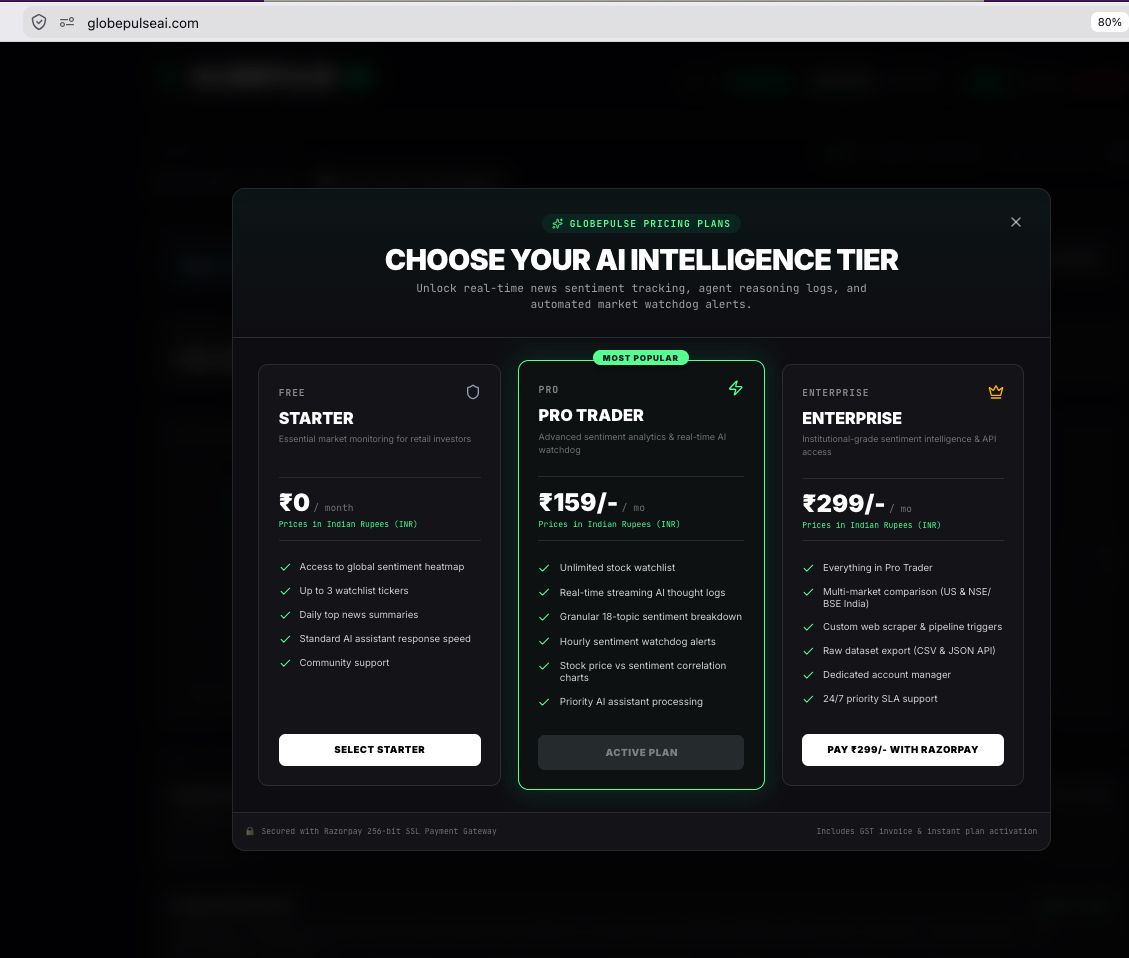
| Payment Gateway | Razorpay Payment API & HMAC SHA256 Verifier | 3-tier subscription management (Free ₹0, Pro ₹159, Enterprise ₹299), Razorpay modal checkout, and server-side signature verification |
| Market Data & Ingestion | yahooquery, Finnhub /company-news (primary), Google News RSS + googlenewsdecoder (local-dev fallback), BeautifulSoup4 |
Pulls historical stock price series, discovers per-ticker news, and scrapes live web articles |
| Alerting Watchdog | Async Background Watchdog (agents/triggers.py) |
Hourly autonomous watchdog evaluating watchlist overall sentiment against critical thresholds (< -0.5) |
Challenges we ran into
Building the multi-agent pipeline was straight-forward, but making it reliable and real-time under live market conditions required overcoming significant hurdles.
Our first challenge was Google News URL obfuscation. Google News RSS feeds return heavily encoded redirect URLs (news.google.com/rss/articles/...) that throw errors when scraped directly with standard HTTP clients. We had to integrate googlenewsdecoder to asynchronously resolve canonical news source URLs before passing text to BeautifulSoup4 for clean DOM parsing.
Our second challenge only surfaced after shipping to production: Google actively bot-blocks its News RSS endpoint from cloud provider IP ranges, returning an HTTP 503 "unusual traffic" page instead of results — invisible from a developer laptop, where the same query works fine. We root-caused it with direct request/response logging on the live service, ruled out a User-Agent fix, and replaced the production news source with Finnhub's /company-news API (keyed off real ticker symbols, no redirect-decoding needed), keeping Google News RSS only as a local-development fallback.
Our second major battle was preventing schema hallucinations on unmentioned topics. When asking an LLM to score 18 granular financial topics for an article that only mentions two, standard prompts tend to return arbitrary 0.0 neutral scores for missing topics. We strictly typed the Pydantic schema fields as Optional[float] with explicit system prompts demanding null for unmentioned categories. This allowed our aggregation functions (aggregate_sentiment()) to compute true median scores across valid mentions without skewing averages.
Two technical challenges are worth highlighting: handling low-latency WebSocket lifecycle events while coordinating sub-agent delegation loops, and aligning sporadic news article timestamps with daily OHLCV stock price candles without introducing time-zone shifts.
Accomplishments that we're proud of
Adding support for new market tickers requires zero custom code. The ingestion pipeline dynamically queries news, resolves URLs, scrapes text, and scores 18 financial topics on the fly.
Every sentiment score is traceable to exact source articles and market price timelines. Users can inspect the raw scraped article URL, publication date, topic breakdown, and corresponding stock price movement.
The system gracefully degrades across all system boundaries: if Firestore is offline, it falls back to local JSON persistence (users.json, alerts.json); if live scraping encounters rate limits, it falls back to seeded demo data; and if Gemini API calls fail, it returns safe neutral defaults without crashing the ingestion worker.
Watchdog sentiment triggers run autonomously in the background without user intervention, alerting investors to critical market shifts before prices react.
What we learned
We learned that financial intelligence requires strict structural guarantees rather than plain conversational prompts. Enforcing Pydantic schemas via response_schema transformed Gemini's output from unpredictable text into a deterministic 18-dimensional financial dataset. We also learned that streaming intermediate agent thoughts ({type: "thought"}) dramatically improves user confidence in automated financial analysis, turning an AI "black box" into a transparent analytical co-pilot.
What's next for GlobePulse AI
Scheduled re-scans and alert webhooks triggered by regulatory filing updates (SEC 10-K, 10-Q). Multi-market expansion, including Indian equity markets (NSE/BSE), European exchanges (LSE), and cryptocurrency pairs. Automated portfolio rebalancing insights based on cumulative multi-topic sentiment shifts. Continuous evaluation benchmarks using Arize Phoenix to score agent groundedness, retrieval recall, and sentiment accuracy against golden financial test datasets.
Built With
- anti-gravity
- fastapi
- finnhub
- firebase
- firestore
- gcp
- gemini-2.5-flash
- gemini-3.5-flash
- google-antigravity
- python
- razorpay
- react
- tailwindcss
- typescript
- vite
- yahooquery


Log in or sign up for Devpost to join the conversation.