Inspiration
Natural disasters such as floods, earthquakes, and wildfires are becoming more frequent and severe. Most alert systems provide technical or delayed information, making it difficult for people to take timely action. We were inspired to build GlobeGuard to bridge this gap — a tool that transforms real-time disaster alerts into clear, location-specific forecasts using artificial intelligence, allowing individuals and communities to better prepare for potential impacts.
What it does
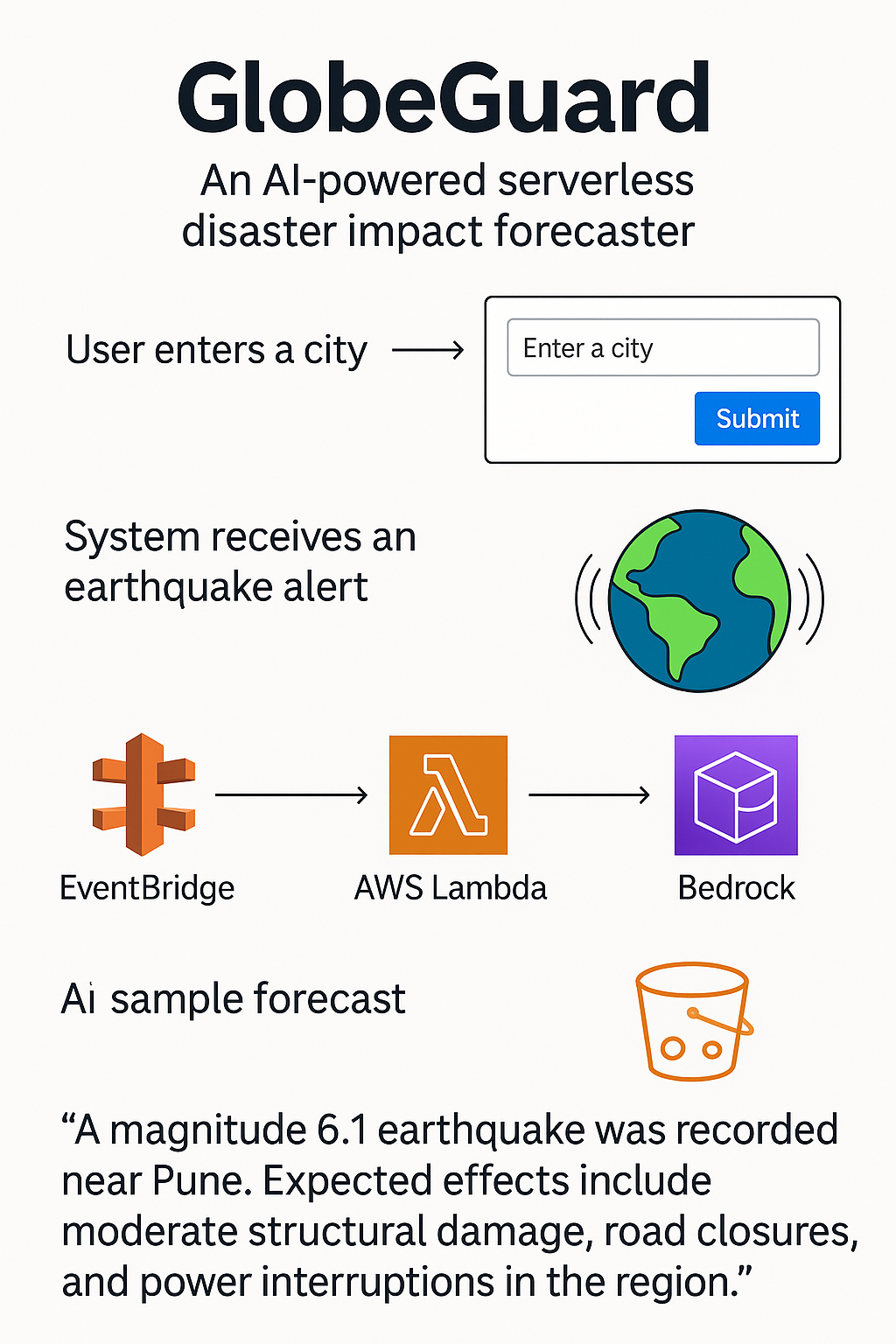
GlobeGuard is a serverless application that generates localized, AI-powered forecasts for disaster events. It does the following: Monitors real-time or simulated disaster alerts. Processes alerts using AWS Lambda triggered by Amazon EventBridge. Uses Amazon Bedrock (Claude) to generate natural-language forecasts based on the user’s location. Sends the forecasts to users via email or stores them for access. Accepts user input (such as city or coordinates) via API Gateway to personalize the output. For example, if a user provides a location and an earthquake alert is received, the system returns a forecast such as:"A magnitude 6.1 earthquake was recorded near Pune. Expected effects include moderate structural damage, road closures, and power interruptions in the region. Emergency services are actively responding."
How we built it
Amazon API Gateway: Used to collect user input such as geolocation. AWS Lambda: Processes the user input or event trigger and handles business logic. Amazon EventBridge: Periodically checks for disaster alerts from simulated or real APIs and triggers Lambda. Amazon Bedrock (Claude): Transforms structured disaster data into human-readable summaries. Amazon S3: Optionally stores reports for access or download. Amazon SES: Sends forecasts to users via email for immediate communication. During development, we used realistic mock disaster data to simulate actual emergency alerts.
Challenges we ran into
Finding reliable, free public disaster data sources was difficult, so we created realistic mock data for testing. Generating consistent and relevant summaries with Amazon Bedrock required prompt refinement and iteration. Coordinating multiple asynchronous AWS services with secure access and proper permissions required careful configuration. Ensuring the entire system remained responsive and scalable without traditional server infrastructure.
Accomplishments that we're proud of
Successfully integrated multiple AWS services to create a fully serverless, event-driven application. Developed a forecasting system that generates meaningful, user-specific insights from complex data. Achieved near real-time response using event triggers and intelligent AI summarization. Designed the system to be globally scalable and adaptable to various types of disasters.
What we learned
How to effectively use Amazon Bedrock for natural language generation based on real-world event data. How to structure a serverless application using event-driven architecture. Best practices for chaining AWS services (API Gateway, Lambda, EventBridge, SES, S3) with minimal latency and maximum security.
What's next for GlobeGuard – AI-Powered Geo-Disaster Impact Forecaster
Integrate live disaster APIs such as the USGS Earthquake API and global weather data sources. Build a mobile-friendly frontend and introduce SMS alerts for users in remote areas. Add multi-language support using translation services for wider accessibility. Incorporate visualizations such as interactive maps using AWS Location Service or Mapbox. Explore partnerships with emergency response teams and disaster management organizations for real-world deployment.
Built With
- amazaonapigateway
- amazon-ses
- amazonbedrock
- amazoneventbridge
- architecture
- awsconsole
- awslambda
- cloudservices
- datasources
- github
- python
- s3


Log in or sign up for Devpost to join the conversation.