Inspiration
Global supply chains are incredibly complex. A single disruption — a geopolitical conflict, port shutdown, compliance issue, commodity-price spike, or dangerous shipping corridor — can affect routes, costs, regulations, and operations at the same time.
The problem is that the information needed to respond is usually scattered across different systems: maps, financial dashboards, shipping documents, compliance databases, market feeds, and AI tools.
I wanted to build something that goes far beyond a chatbot.
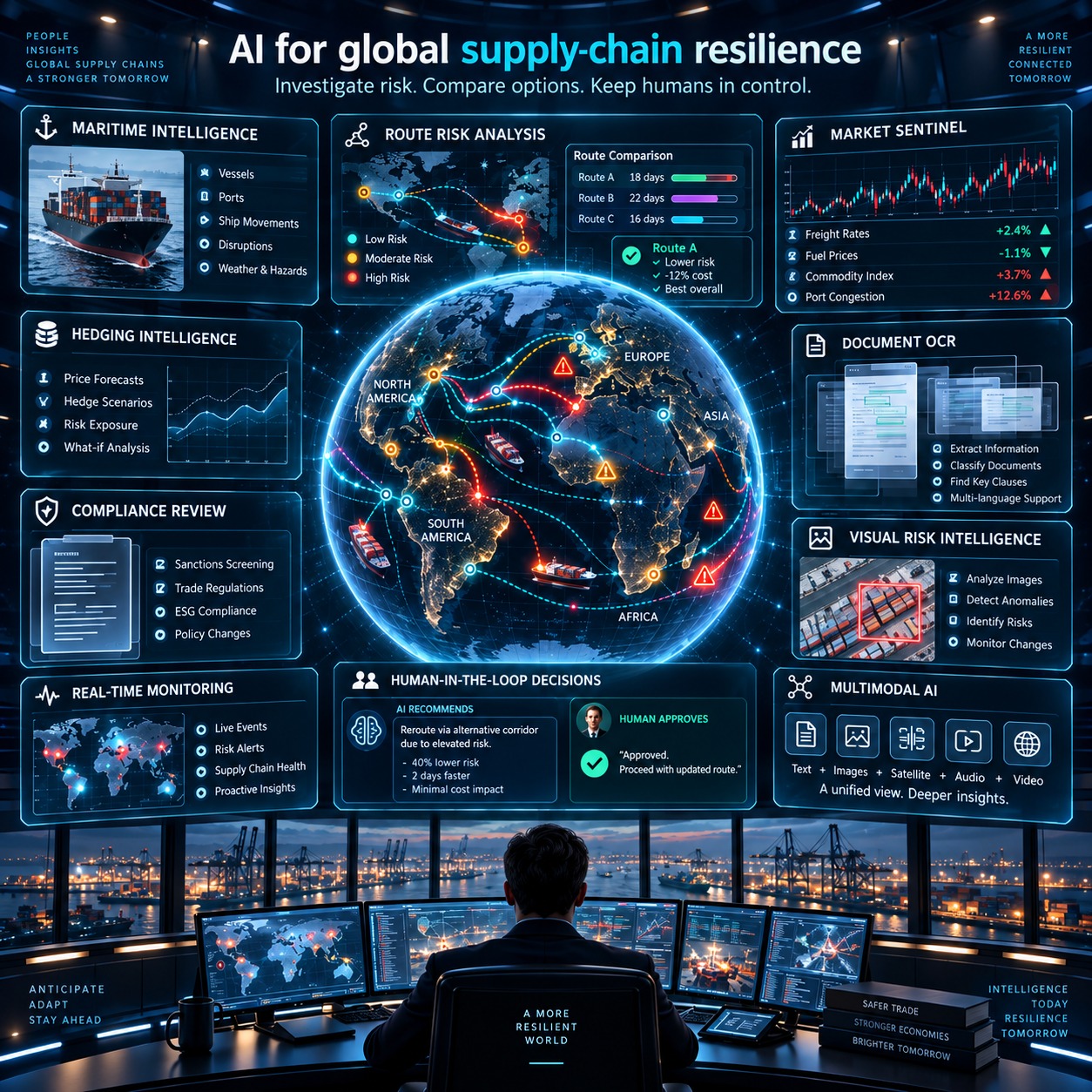
That became Globot Sentinel — an AI-powered global supply-chain command center designed to investigate disruptions, connect evidence from multiple sources, evaluate possible responses, and help a human make better decisions.
The core idea is simple:
AI investigates. AI connects the dots. AI recommends. Humans stay in control.
What it does
Globot Sentinel turns a complex supply-chain disruption into a structured AI investigation.
Instead of relying on one general-purpose AI model, the platform combines multiple specialized intelligence systems inside one operational workspace.
Maritime Intelligence
Globot analyzes maritime operations and shipping disruptions through a dedicated maritime intelligence layer.
The platform can help operators:
- investigate maritime events
- analyze shipping routes
- identify potential risk areas
- understand operational consequences
- compare alternative responses
- connect route information with other forms of risk
The goal is to transform raw maritime information into actionable operational intelligence.
Market Sentinel
A shipping disruption is rarely just a logistics problem.
Globot's Market Sentinel analyzes the broader market implications surrounding an event and connects operational disruptions with potential financial exposure.
This gives the user another perspective on the same incident instead of evaluating the shipment in isolation.
AI Hedging Intelligence
Globot includes a dedicated financial-risk and hedging system.
The platform can analyze exposure created by supply-chain disruptions and produce structured information that helps evaluate potential hedging strategies.
This creates a connection between:
physical supply-chain risk → financial exposure → possible mitigation strategy
Rather than treating finance and logistics as separate problems, Globot brings them into the same decision environment.
Compliance Intelligence
International shipping involves regulations, documentation, restrictions, and compliance requirements that can significantly affect operational decisions.
Globot includes dedicated services for:
- compliance analysis
- document inspection
- compliance report generation
- maritime knowledge retrieval
- structured risk evaluation
This allows regulatory information to become part of the AI investigation instead of remaining a completely separate manual process.
Document Intelligence
Operational information is often hidden inside PDFs, reports, manifests, and other documents.
Globot includes a document-processing pipeline with OCR and AI-powered document analysis so information inside uploaded files can become usable context for the rest of the system.
Instead of simply storing a document, Globot can turn it into another source of evidence.
Visual Risk Intelligence
Not every operational risk can be understood through text.
Globot therefore includes a dedicated Visual Risk Intelligence layer capable of incorporating images into the broader investigation.
This creates a multimodal system where:
documents + maps + structured data + financial information + visual evidence
can contribute to the same decision.
Agentic AI Architecture
Globot is designed as an agentic AI system, not a chatbot with a dashboard around it.
The backend includes CrewAI-based orchestration that allows specialized AI workflows to operate inside the larger application.
The AI architecture supports Google Gemini and can also work with OpenAI-compatible models depending on configuration.
Instead of asking one model to solve everything, the platform separates responsibilities across specialized systems for:
- maritime intelligence
- market analysis
- financial-risk analysis
- compliance
- documents
- visual risk
- knowledge retrieval
- decision support
This makes Globot significantly more modular and extensible than a single-prompt application.
Retrieval-Augmented Intelligence
For specialized domains such as maritime operations and compliance, relying entirely on a language model's internal knowledge is not enough.
Globot therefore includes a retrieval layer built with technologies including:
- LangChain
- ChromaDB
- Sentence Transformers
- domain-specific knowledge bases
- semantic retrieval
- embeddings
Relevant information can be retrieved and supplied to AI workflows when needed.
This allows the model to reason with additional domain context instead of simply generating an answer from memory.
Human-in-the-Loop AI
One of the most important principles behind Globot is that AI should help humans make high-impact decisions — not silently make those decisions for them.
The workflow follows a human-in-the-loop model:
1. Detect the problem 2. Investigate the situation 3. Gather relevant evidence 4. Analyze operational and financial risk 5. Generate recommendations 6. Present the reasoning to the operator 7. Keep the final decision with the human
This is particularly important when decisions involve shipping routes, financial exposure, compliance, or other high-impact actions.
Globot is designed to increase human decision-making capacity rather than remove human accountability.
How I built it
Globot uses a full-stack architecture with specialized services for different parts of the investigation.
Backend
The backend is built with Python and FastAPI.
Instead of putting every capability into one large service, the backend contains separate modules for:
- maritime operations
- Market Sentinel
- hedging intelligence
- visual-risk analysis
- analytics
- compliance
- document processing
- knowledge retrieval
- AI orchestration
This modular design makes the system easier to extend and allows individual intelligence layers to evolve independently.
AI
The AI layer uses CrewAI for orchestration with support for Google Gemini and OpenAI-compatible models.
AI outputs can be integrated into structured application workflows instead of existing only as conversational responses.
Data and Retrieval
The intelligence layer uses tools including:
ChromaDB, LangChain, Sentence Transformers, SQLAlchemy, PostgreSQL, and specialized knowledge-base services.
These components help connect structured application data with retrieved contextual information.
Frontend
The frontend is built with React, TypeScript, and Vite.
I wanted Globot to feel like an actual global operations center rather than another AI chat interface.
The frontend uses technologies including:
- Deck.gl
- Mapbox GL
- H3
- Three.js
- React Globe
- Ant Design
- Material UI
- Radix UI
- Recharts
- Framer Motion
This allows complex operational information to be represented through maps, geographic visualization, dashboards, charts, and interactive interfaces.
Geospatial Intelligence
Location is central to almost every supply-chain decision.
Because of that, geospatial visualization is a major part of Globot.
The application combines Mapbox GL, Deck.gl, H3, Three.js, and React Globe to create interactive geographic views of global operations.
Instead of reading a list of coordinates or risk scores, users can visually understand where events are happening and how they relate to shipping routes and operational assets.
This makes complex global events much easier to understand.
Real-Time Architecture
Agentic workflows often involve several processing steps.
Globot includes support for technologies such as:
- WebSockets
- Server-Sent Events
- asynchronous backend communication
This allows information and AI analysis to appear progressively rather than forcing the entire system to behave like a single request-response chatbot.
Challenges I faced
Connecting completely different forms of intelligence
One of the hardest challenges was combining information that naturally exists in very different formats.
A single investigation might involve:
a map, a document, an image, a market signal, a compliance restriction, a financial calculation, and an AI recommendation.
Designing an architecture where all of these could contribute to the same workflow required much more than simply connecting an LLM API.
Avoiding one giant prompt
The easiest solution would have been to put everything into one enormous AI prompt.
I deliberately avoided that architecture.
Instead, Globot separates responsibilities across services, retrieval systems, APIs, and agentic workflows.
This required more engineering, but creates a system that is easier to understand, debug, test, and extend.
Designing the user experience
Supply-chain systems can quickly become overwhelming.
There can be dozens of:
- routes
- warnings
- documents
- risk indicators
- financial metrics
- AI outputs
- geographic signals
The challenge was turning that information into an interface that feels like a coherent investigation rather than a collection of unrelated dashboards.
Balancing autonomy and control
AI can analyze information extremely quickly, but high-impact operational decisions require accountability.
Designing Globot around human-in-the-loop decision making allowed me to use agentic AI without making complete autonomy the goal.
Accomplishments I'm proud of
The part I'm most proud of is that Globot feels like a complete AI system rather than an AI feature.
It combines:
Agentic AI + maritime intelligence + geospatial visualization + RAG + document intelligence + OCR + compliance analysis + market intelligence + financial-risk analysis + multimodal AI + human oversight
inside one platform.
The project has separate frontend, backend, AI orchestration, retrieval, analytics, document, compliance, maritime, financial, and visual-intelligence layers.
The individual components are powerful, but the most important accomplishment was making them part of one coherent product.
What I learned
Building Globot reinforced an important lesson:
The LLM is only one component of a serious AI product.
A powerful AI application also needs:
- strong application architecture
- specialized tools
- domain knowledge
- retrieval
- structured data
- deterministic logic
- good UX
- authentication
- visualization
- human oversight
I also learned that adding more agents does not automatically create a better agentic system.
The real value comes from giving each component a clear responsibility, useful context, structured outputs, and a way to collaborate with the rest of the application.
What's next
The architecture can eventually connect with additional production-grade data sources such as:
- real-time AIS vessel tracking
- live weather and ocean conditions
- port congestion data
- geopolitical intelligence
- sanctions databases
- customs and trade information
- commodity prices
- freight-rate information
- satellite imagery
- insurance-risk information
I also want to expand the decision engine so Globot can simulate several possible responses to the same disruption and explain the tradeoffs between them.
The longer-term vision is to turn Globot into an AI operating system for global supply-chain risk — one intelligent layer capable of understanding an event across operational, geographic, regulatory, financial, and visual dimensions.
Instead of humans manually connecting information from dozens of disconnected systems, Globot can help connect those signals into one understandable decision.
Responsible AI
Globot is designed as a decision-support platform.
AI-generated analysis and recommendations are intended to assist human operators, especially for high-impact decisions involving financial exposure, compliance, or operational changes.
The goal is not to remove humans from the workflow.
The goal is to give humans better information, faster analysis, and stronger decision-making tools.
Built With
- ant
- chromadb
- clerk
- crewai
- design
- fastapi
- gemini
- globe
- langchain
- openai
- postgresql
- python
- rag
- react
- sentence
- sqlalchemy
- sqlite
- three.js
- transformers
- typescript
- vite

Log in or sign up for Devpost to join the conversation.