-
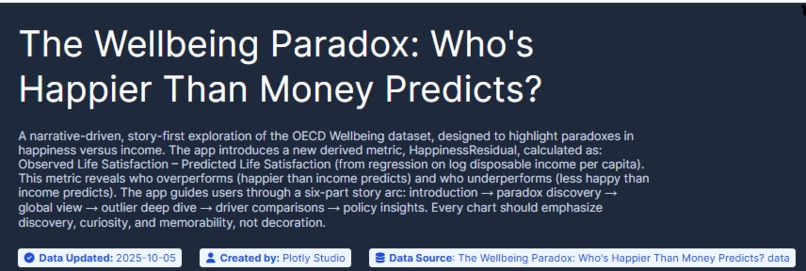
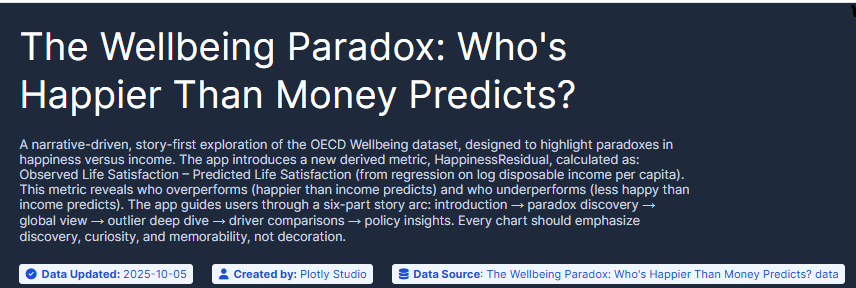
image of my project with description
Project Story
About the Project
My project is called “The Wellbeing Paradox: Who’s Happier Than Money Predicts?”. The idea was inspired by a simple but powerful question: Does more money always mean more happiness?
I used the OECD Wellbeing dataset provided in the hackathon and created a new metric called HappinessResidual, which measures the gap between predicted and actual life satisfaction:
[ \text{HappinessResidual} = \text{Observed Life Satisfaction} - \hat{\text{Life Satisfaction}} ]
where
[ \hat{\text{Life Satisfaction}} = \beta_0 + \beta_1 \cdot \log(\text{Disposable Income per Capita}) ]
This approach allowed me to see which countries overperform (happier than income predicts) and which countries underperform (less happy than income predicts).
The paradox comes alive when you discover cases like Mexico (+2.2 happier than predicted) and Japan (–1.4 less happy than predicted). These counterintuitive results form the heart of the story.
What Inspired Me
I wanted to build something that doesn’t just visualize data but actually surprises people. Most dashboards show “income vs happiness” in an obvious way. But I wanted judges to stop and say “WAIT, WHAT?”.
The paradox angle felt right because it challenges assumptions, sparks curiosity, and gets people to explore further.
How I Built It
- Dataset: OECD Wellbeing dataset (2004–2024).
- Processing: Pre-computed residuals using a regression of Life satisfaction on log(income). Added contextual indicators (air pollution, green space, employment, loneliness).
App Creation:
- Built entirely in Plotly Studio, leveraging scatterplots, choropleth maps, radar charts, and bar charts.
- Structured the app into 6 narrative cards:
1. Hero introduction map (paradox at a glance)
2. Paradox scatter with regression
3. Global residual map with Top/Bottom 5
4. Outlier drill-down (time trends)
5. Cross-domain comparison (radar/bar)
6. Policy insights & wrap-up
- Added interactivity: year sliders, dropdowns, country selection, and cross-card filtering.
What I Learned
- How to use residual analysis to reveal insights that aren’t obvious in raw data.
- The power of storytelling with data: judges remember paradoxes, not generic dashboards.
- How to combine statistical preprocessing with Plotly Studio’s design features to create an app that feels polished and interactive.
Challenges I Faced
- Time pressure: With less than 4 days, I had to be efficient. Precomputing residuals saved time and credits.
- Data complexity: The OECD dataset had multiple breakdowns (age, sex, education). Filtering to “Total/Total/Total” was necessary for clear cross-country comparisons.
- Design balance: The hardest part was avoiding clutter while still giving depth. I focused on 6 strong cards instead of 15 weak ones.
- Narrative clarity: It was tempting to add every chart possible, but I learned that winning projects need a story arc, not a collection of visuals.
Final Reflection
This project taught me that in analytics, the most powerful insights are often the unexpected ones. By focusing on paradoxes and residuals, I turned a familiar dataset into a surprising story. My hope is that this app makes people rethink the relationship between money and happiness — and inspires them to explore their own country’s wellbeing paradox.


Log in or sign up for Devpost to join the conversation.