Inspiration
Across museums and collections worldwide, countless cultural artifacts sit far from where they were created. Some arrived through legal export or long-term loans. Others were removed during colonial or wartime periods.
What stood out to us was that most conversations stop at ownership. In reality, the harder and more urgent question is often:
What can realistically be done — given today’s political, social, and institutional constraints?
We built Global Lost Artifact Tracker to move beyond static documentation and help institutions reason about displacement as a living, real-world decision problem.
What it does
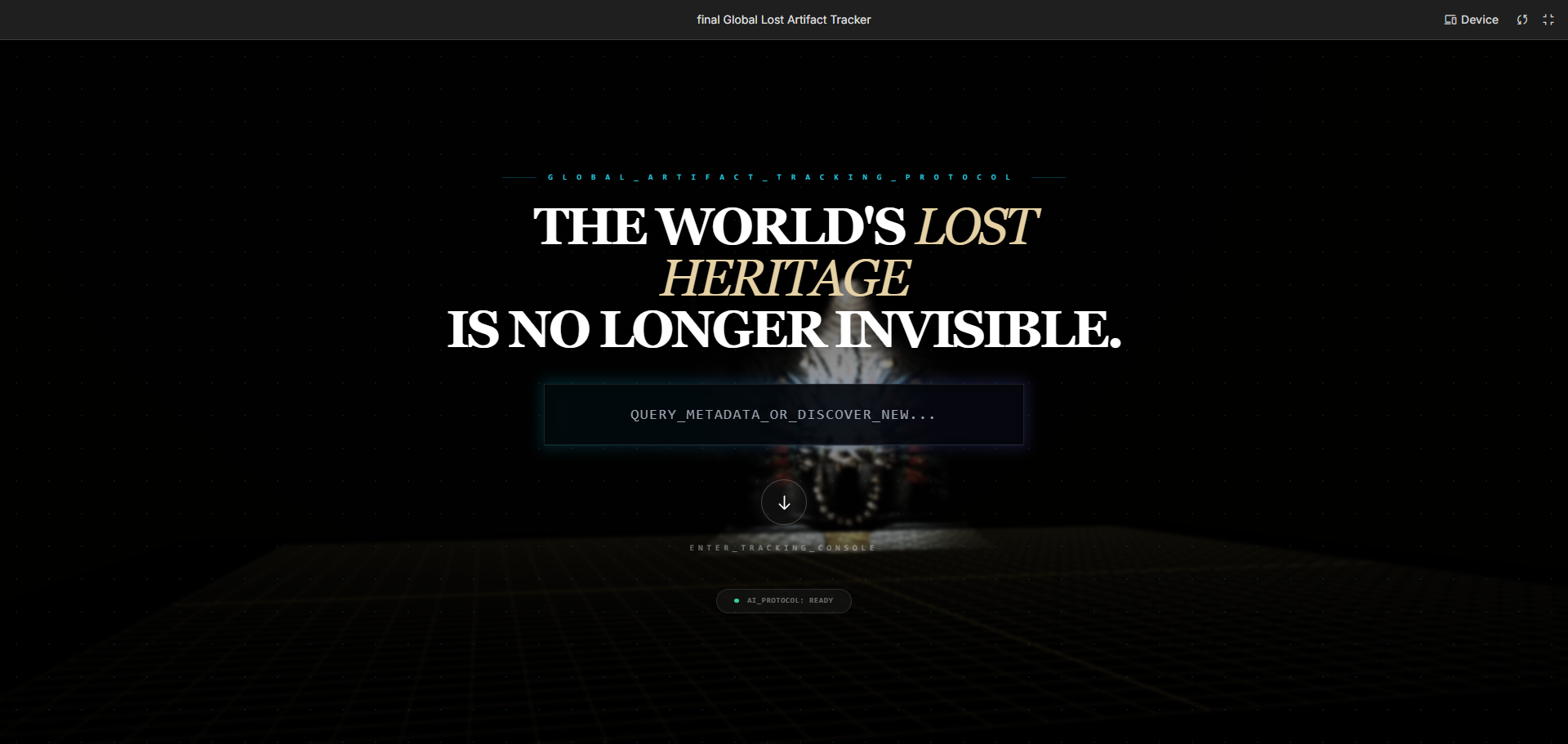
Global Lost Artifact Tracker is a decision-support platform for displaced cultural heritage.
It helps users:
Identify artifacts that are geographically or culturally displaced from their origins
Understand the level of displacement risk, not just location
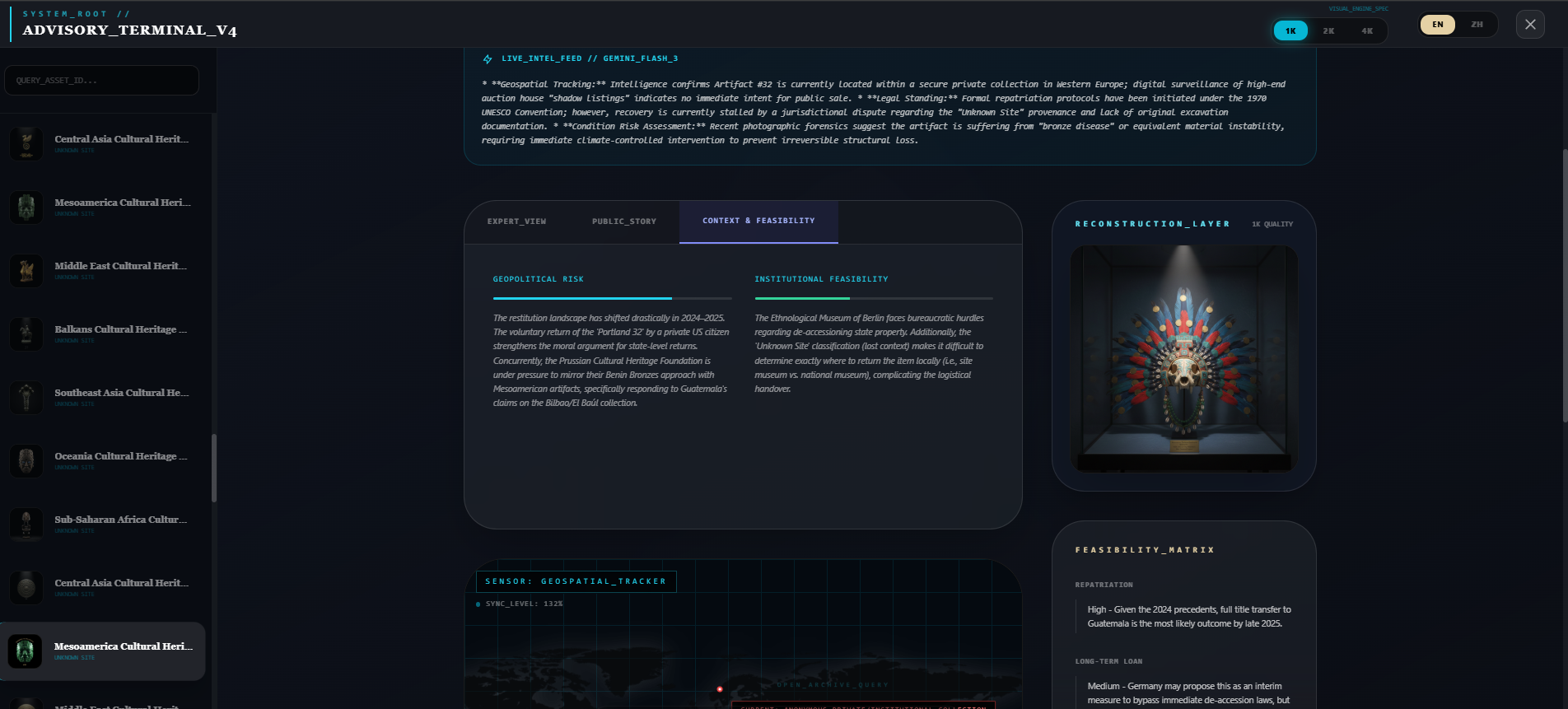
Analyze each case across multiple dimensions:
provenance and ethical context
current geopolitical climate
social and cultural significance
institutional and governance constraints
practical difficulty of transfer or restitution
Explore realistic resolution paths, such as:
repatriation
shared custodianship
joint curation
digital repatriation
Instead of issuing legal judgments, the system provides transparent, explainable feasibility assessments that evolve as new information emerges.
How I built it
The system is built on Google Cloud and integrates real-time data streaming and AI reasoning:
Google Cloud & Vertex AI (Gemini) Gemini performs multi-dimensional analysis for each artifact, generating structured assessments that balance ethics with real-world feasibility.
Confluent (Kafka) Real-time signals — such as changes in public discourse, diplomatic context, or operational risk — are streamed through Kafka topics and automatically trigger reassessment.
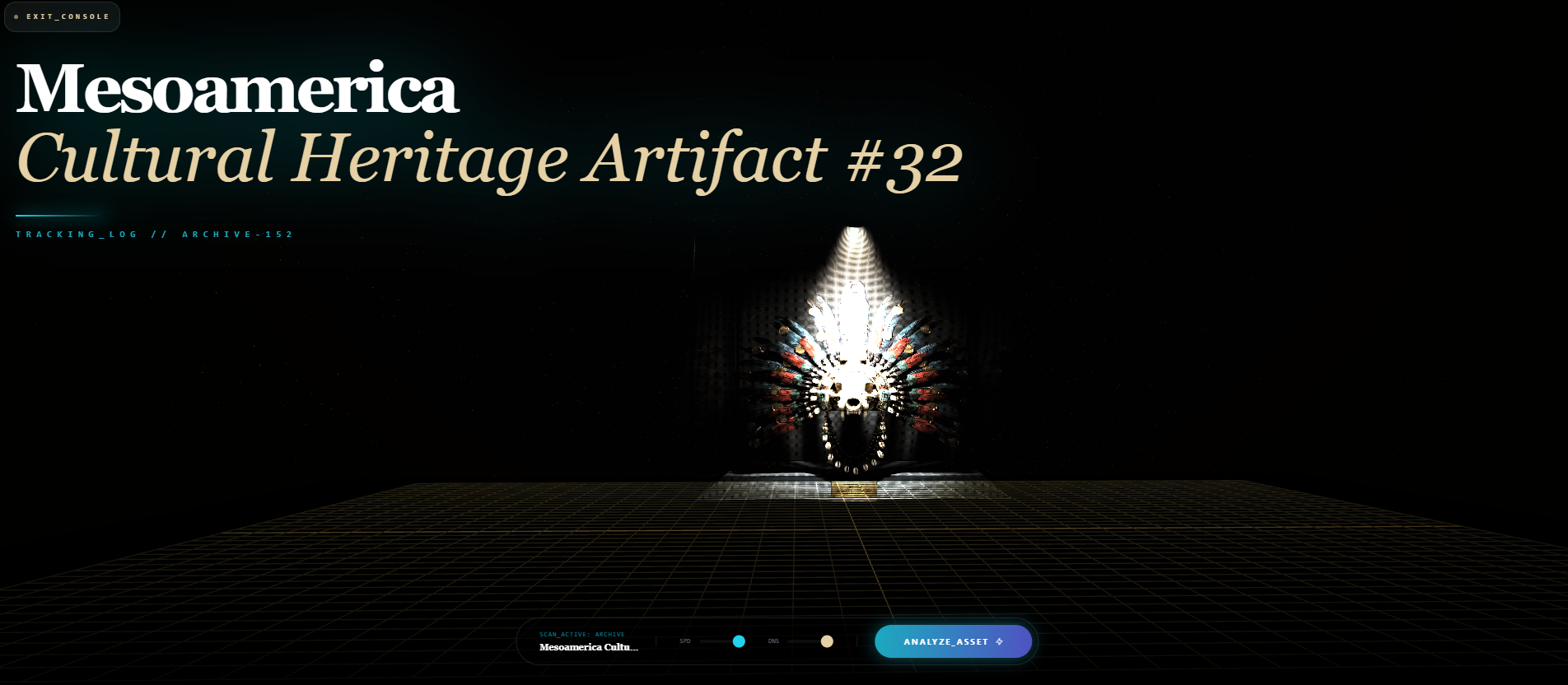
Web Application (Next.js + Three.js) A global map visualizes displacement patterns, while each artifact detail page includes a Three.js particle-based visualization representing cultural stability and risk.
Open Cultural Data Sources The system aggregates publicly available museum and heritage data to establish provenance context and baseline metadata.
This architecture allows assessments to remain dynamic rather than frozen snapshots.
Challenges I ran into
One of the biggest challenges was avoiding oversimplification.
Cultural heritage displacement is rarely binary. Ethical clarity does not always align with political feasibility or operational reality.
Key challenges included:
Designing an AI system that does not overstep into legal judgment
Balancing transparency with uncertainty in incomplete or conflicting data
Modeling “inaction” as a meaningful risk rather than a neutral state
Translating abstract cultural and political concepts into structured, explainable outputs
Building a system that respects nuance while remaining actionable required careful prompt design and constraint modeling.
Accomplishments that I'm proud of
Creating an AI system that reasons about feasibility, not just morality
Demonstrating how real-time data can meaningfully change cultural heritage assessments
Designing a visual language (Three.js particle models) that conveys cultural integrity without sensationalism
Integrating AI into a domain where context, restraint, and explainability matter more than automation
Most importantly, the project reframes cultural heritage debates from static arguments into informed, evolving dialogues.
What I learned
This project reinforced that:
AI is most valuable when it supports judgment, not when it replaces it
Transparency and uncertainty are strengths, not weaknesses
Cultural heritage problems are socio-technical systems, not just data problems
Real-time context can fundamentally change what responsible action looks like
I also gained hands-on experience designing AI systems that must operate under ethical, political, and institutional constraints.
What's next for Global Lost Artifact Tracker
Next steps include:
Expanding real-time signal sources and partner integrations
Collaborating with museums and researchers to refine feasibility models
Supporting comparative analysis across collections and regions
Adding scenario simulation tools for long-term policy planning
Ultimately, the goal is not to prescribe outcomes — but to help stakeholders make better-informed, context-aware decisions about our shared cultural heritage.


Log in or sign up for Devpost to join the conversation.