-
-
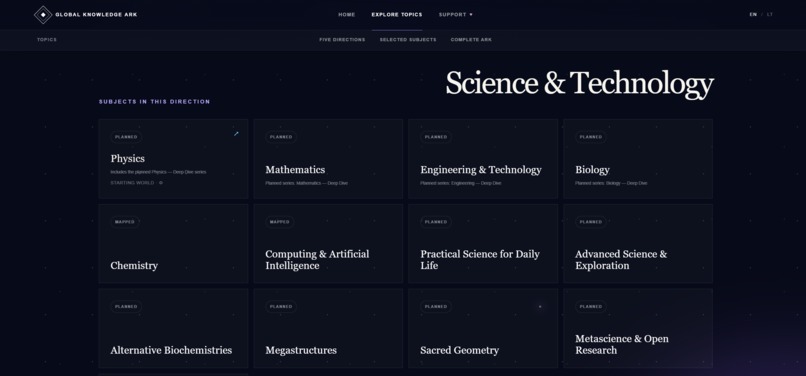
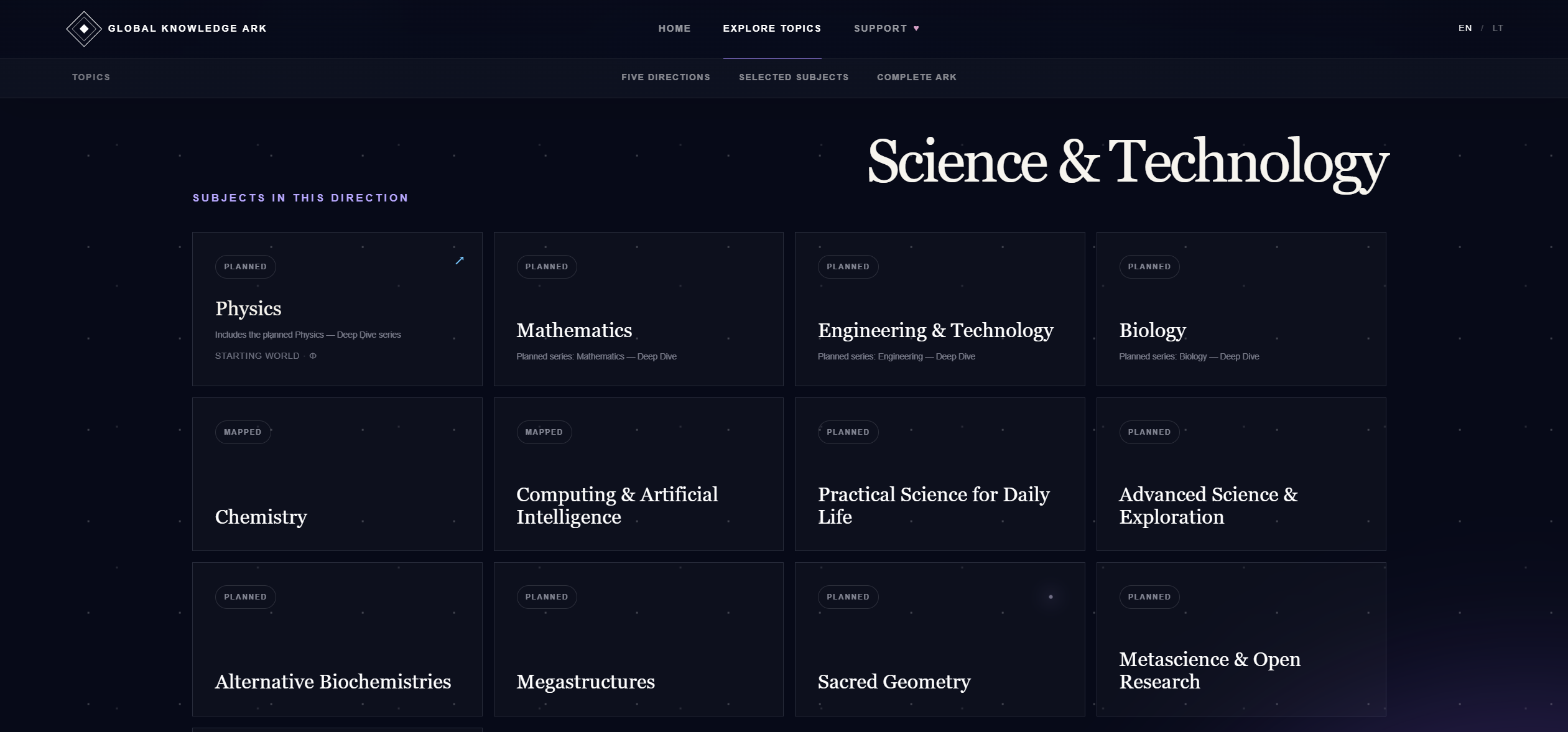
Science & Technology topic map, organising complex subjects into clear and expandable learning paths.
-
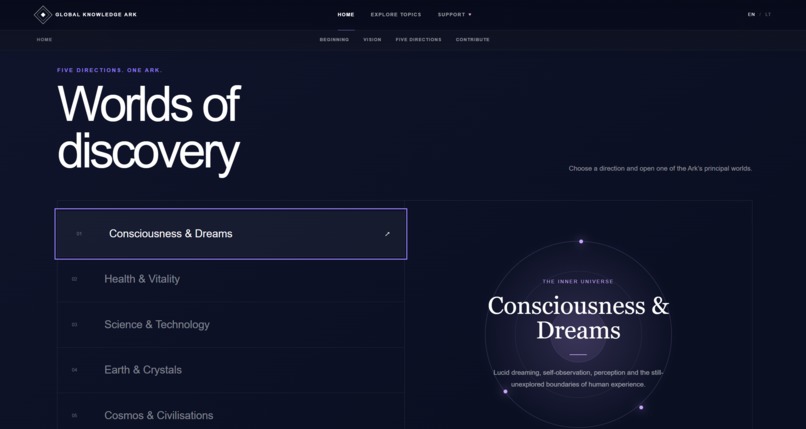
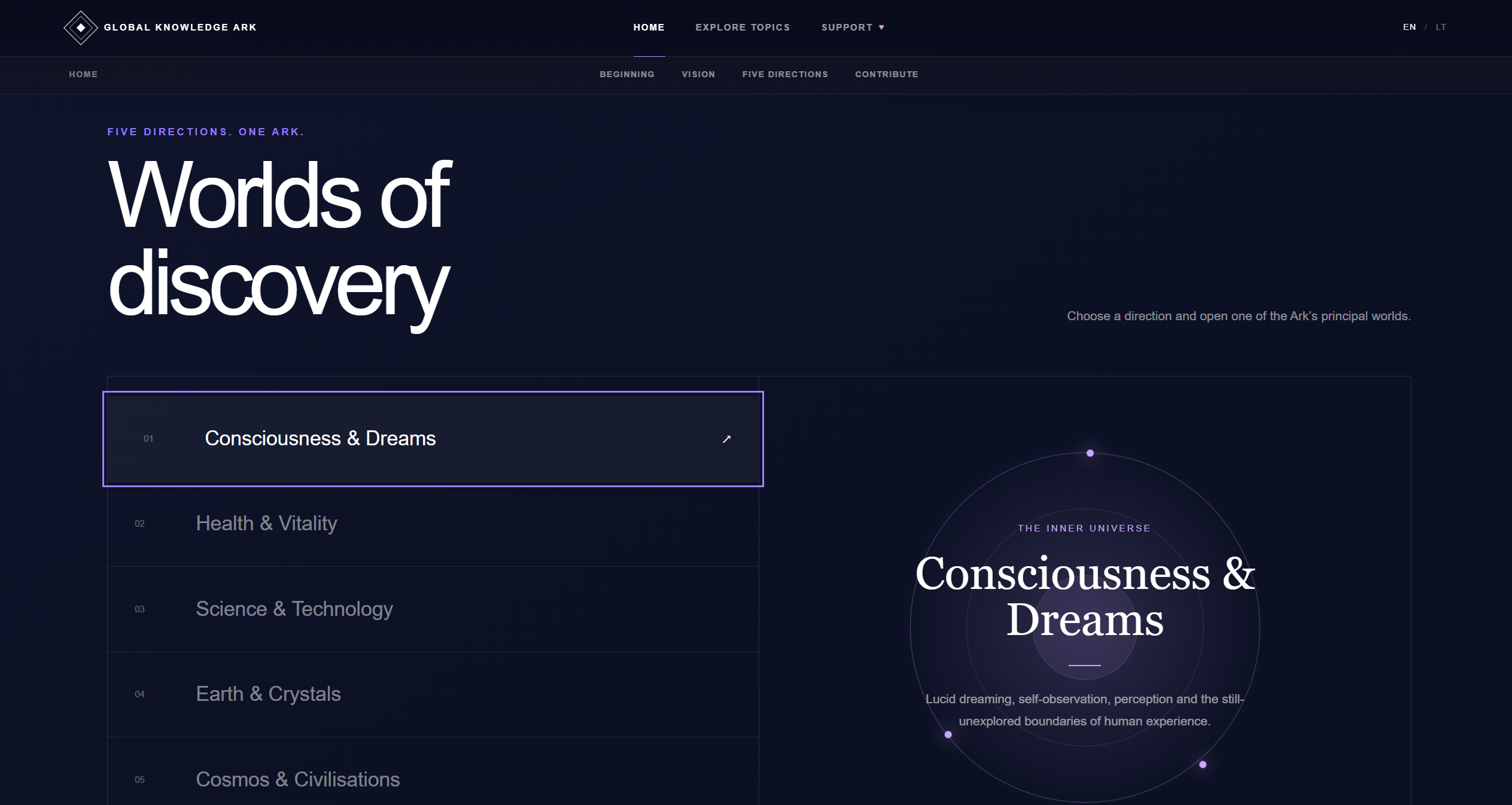
ive connected worlds of discovery guide learners through consciousness, health, science, Earth, and the cosmos.
-
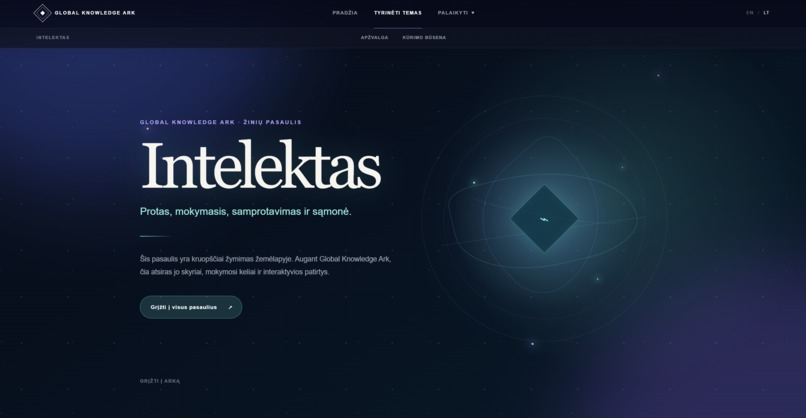
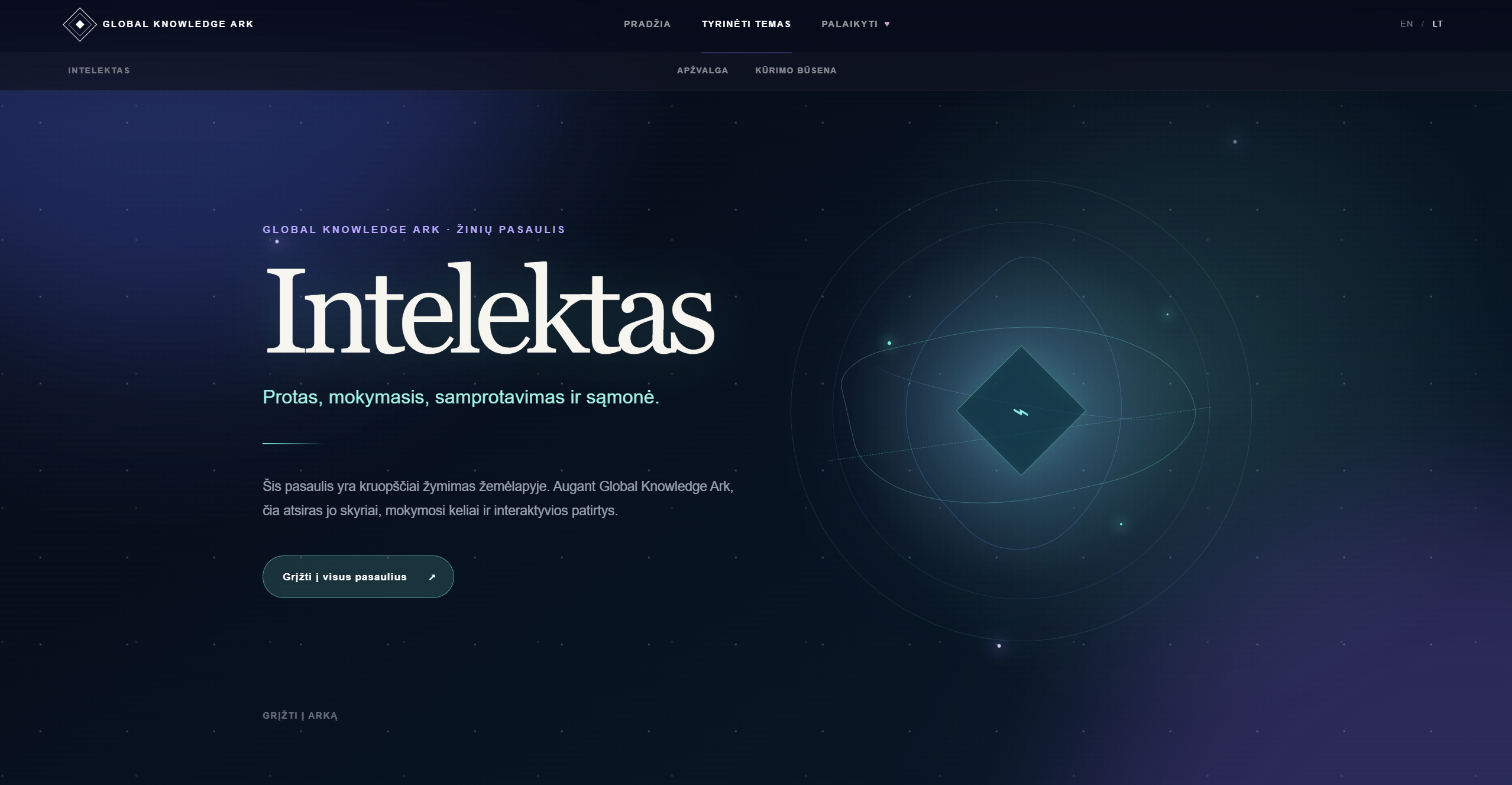
Lithuanian-language experience demonstrating the Ark’s multilingual vision and accessible local learning.
-
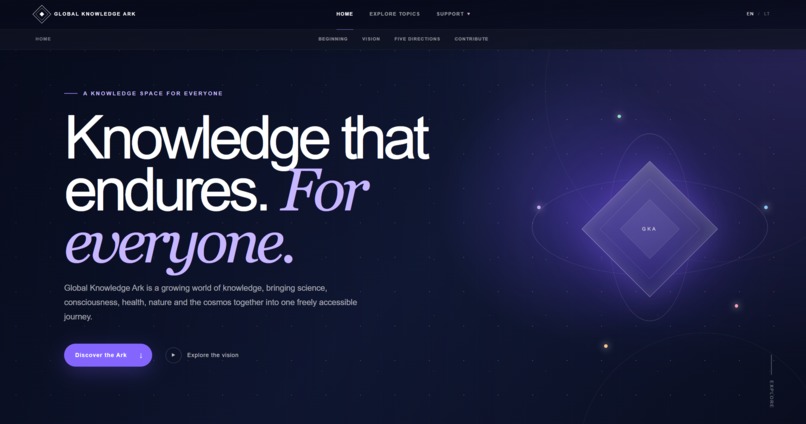
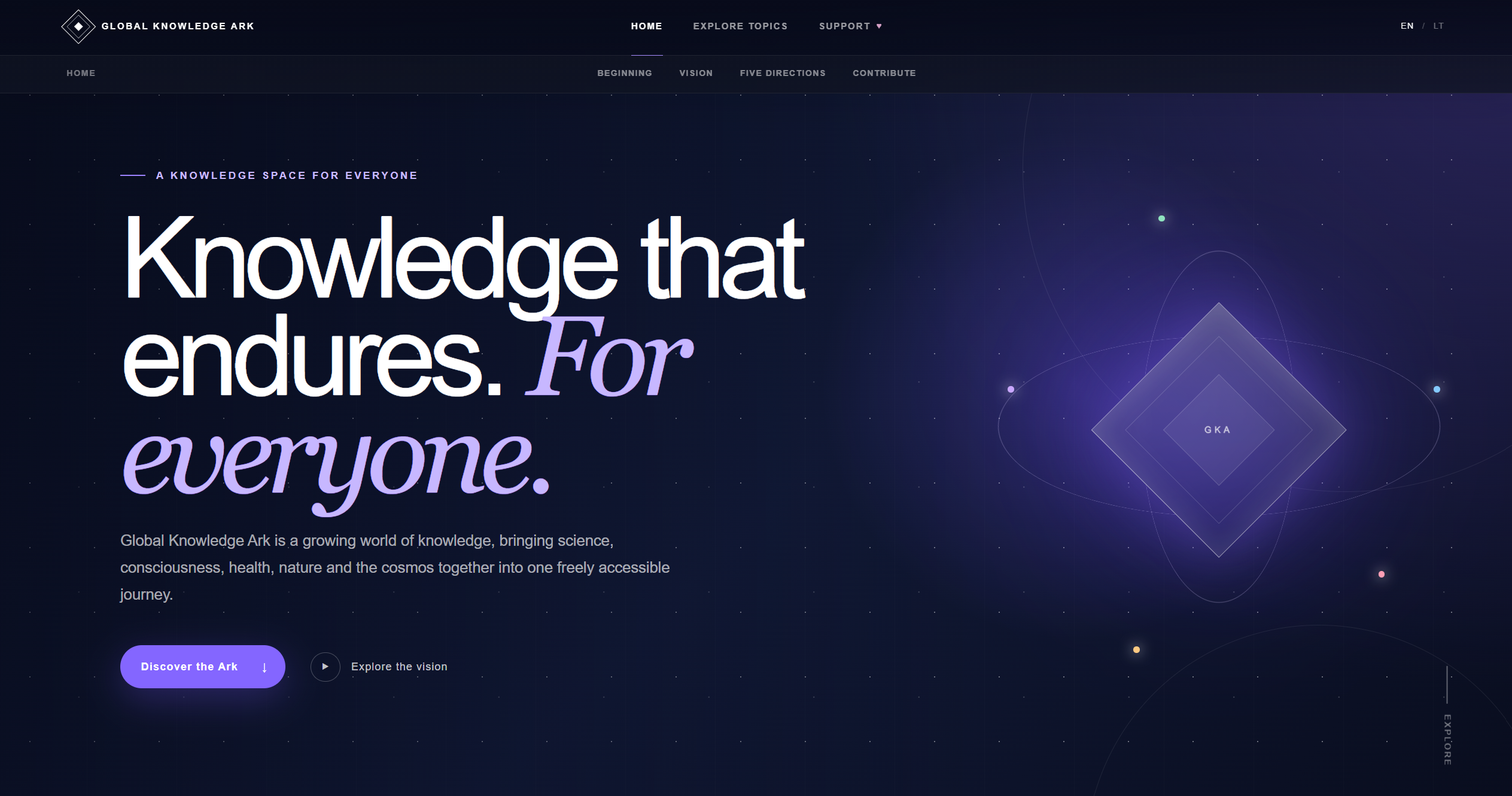
Global Knowledge Ark homepage—a living, multilingual platform designed to preserve and connect knowledge for everyone.
-
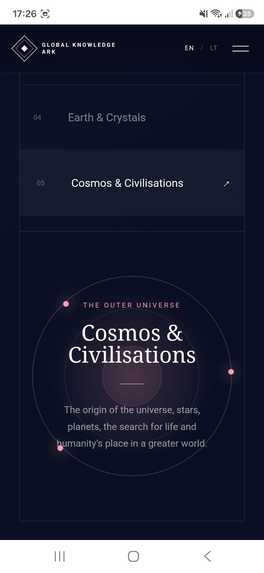
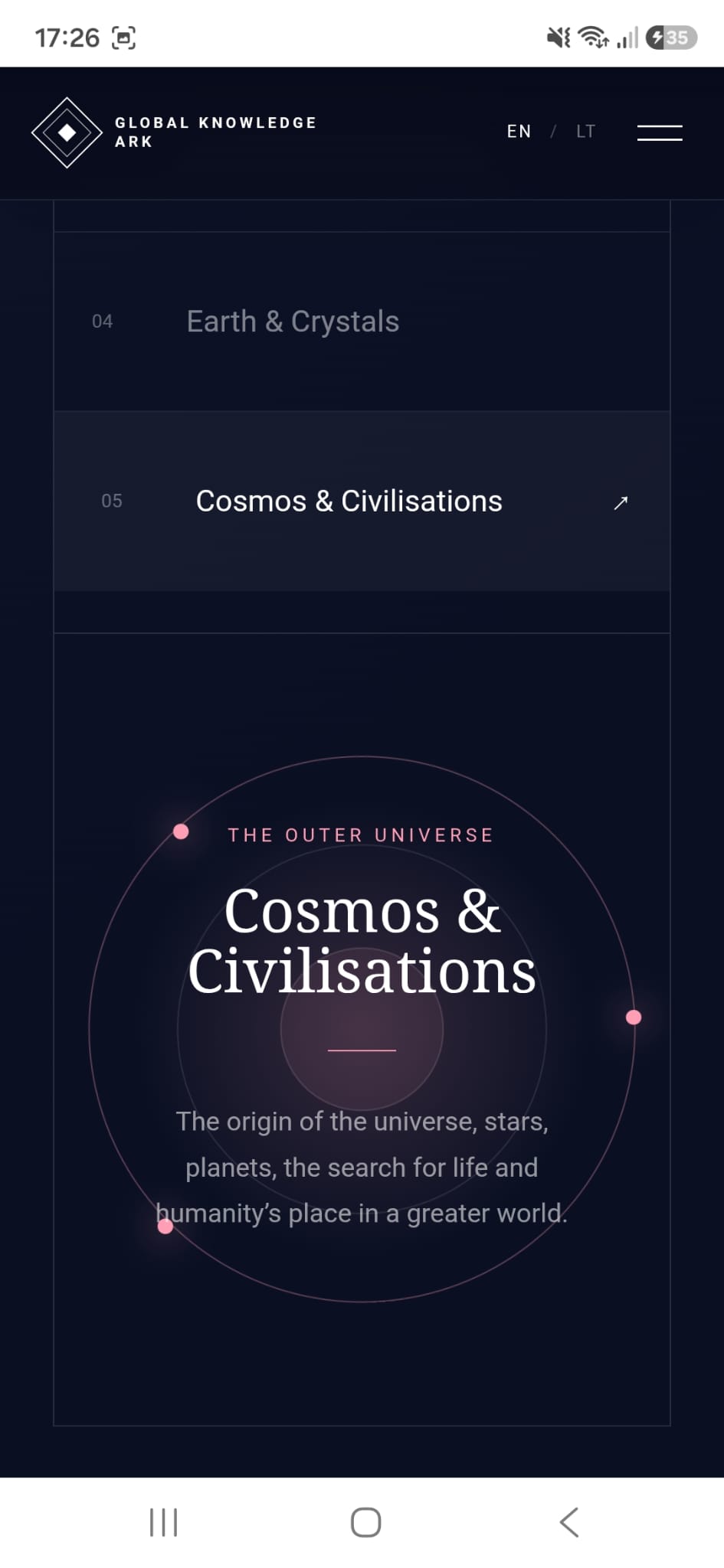
Mobile view of Cosmos & Civilisations, designed to make connected learning accessible on any screen.
-
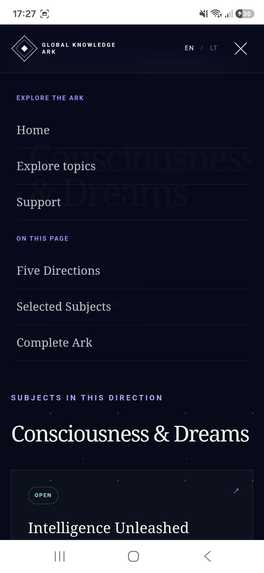
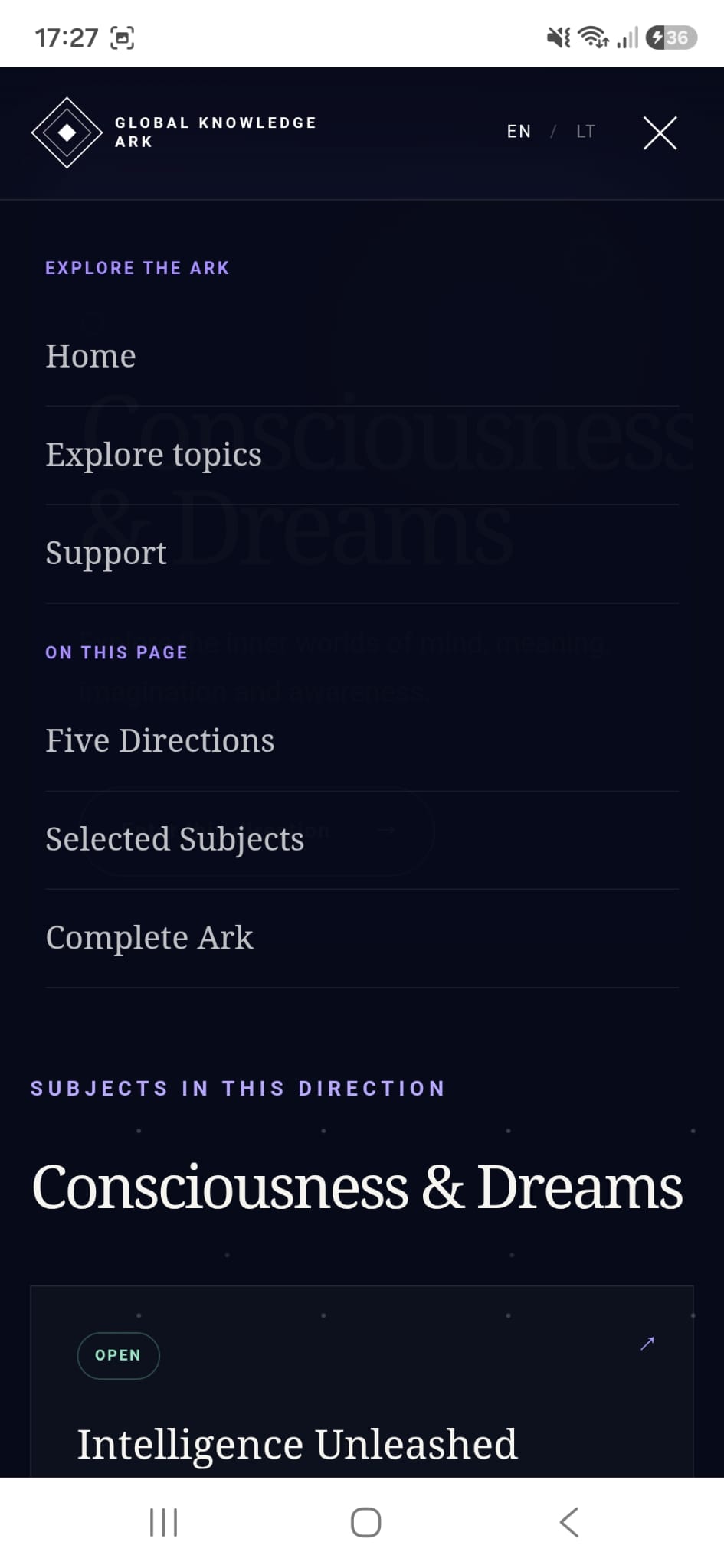
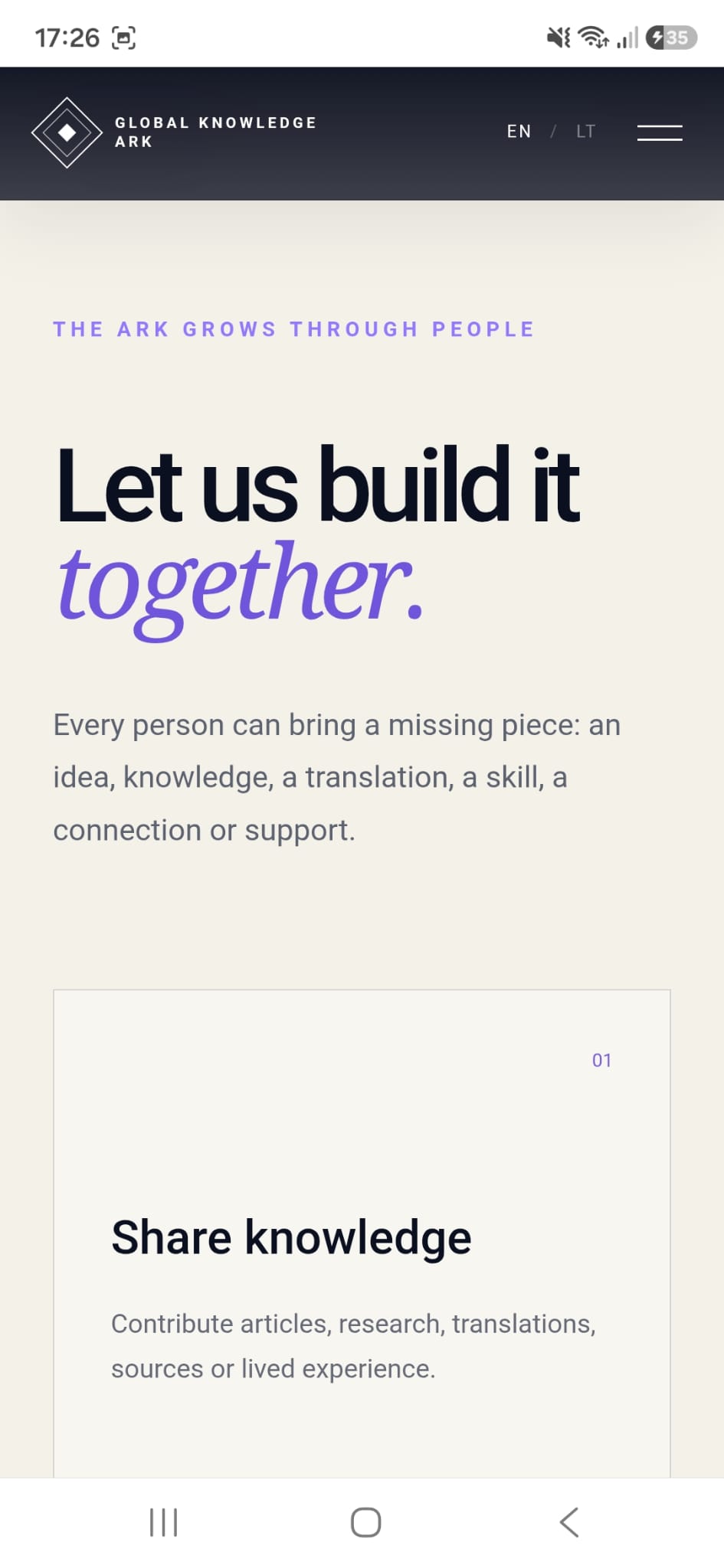
Responsive mobile navigation providing quick access to the Ark’s knowledge directions and project pages.
-
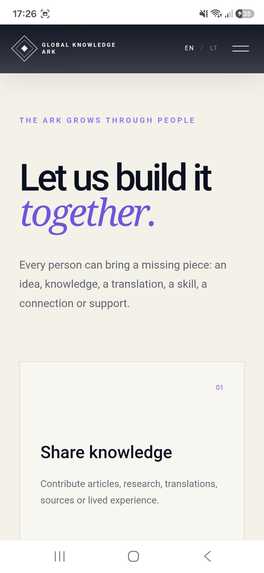
Contribution page inviting educators, researchers, creators, and supporters to help build the Ark together.
-
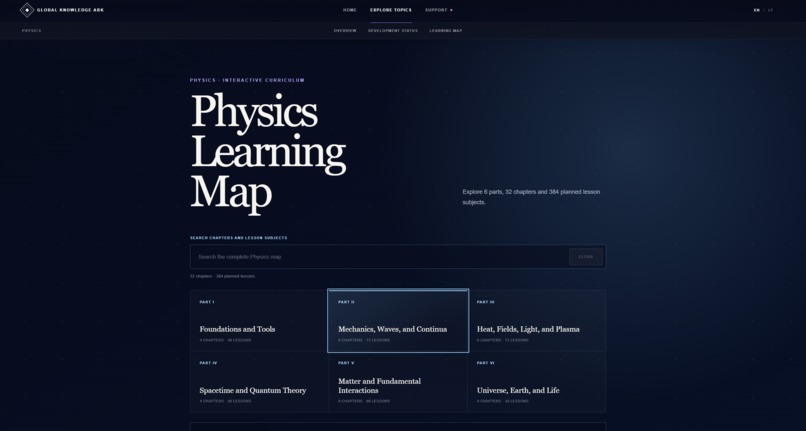
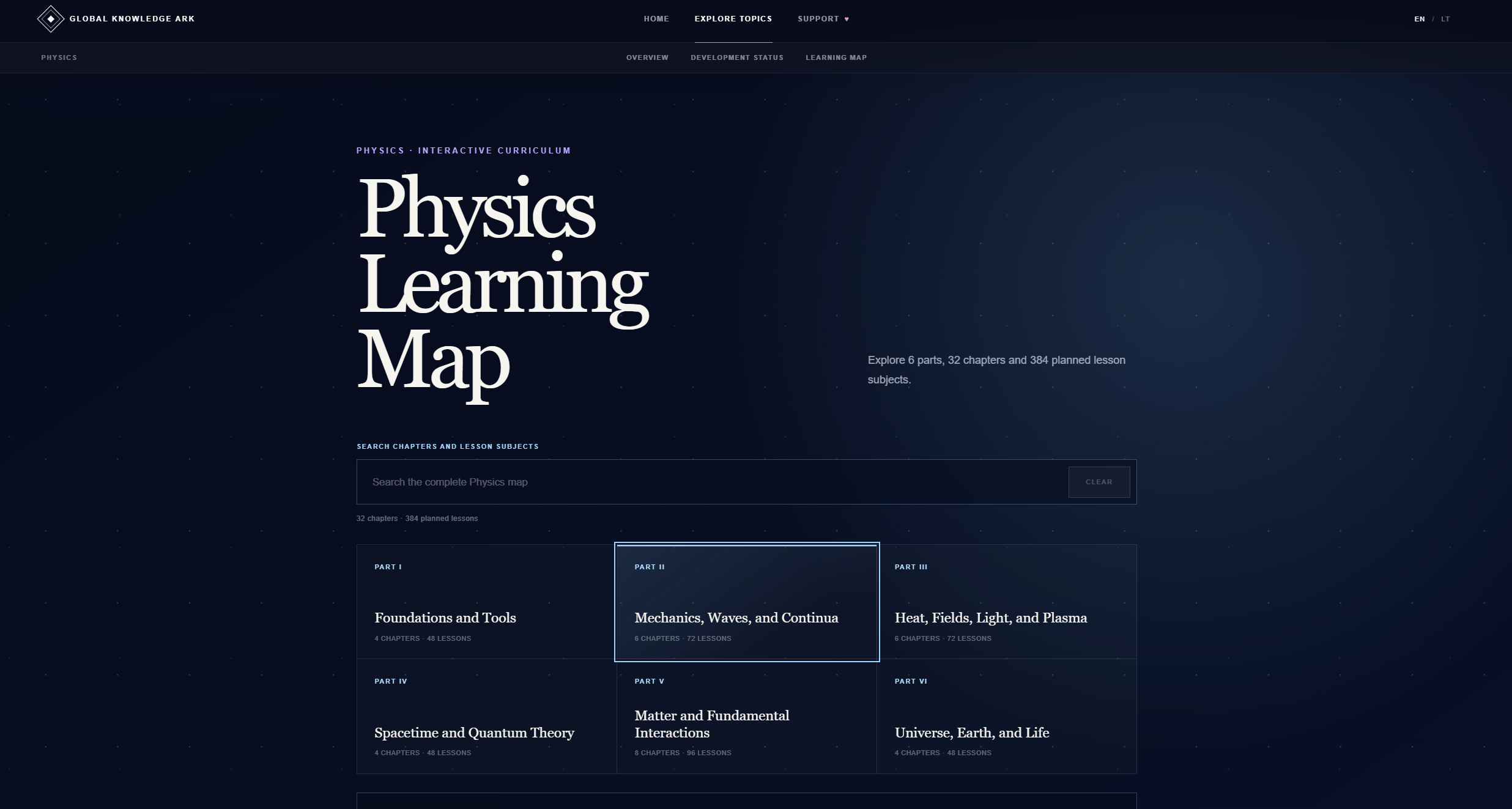
Interactive Physics Learning Map with six curriculum Parts, chapter controls, search, and 384 planned lessons.
-
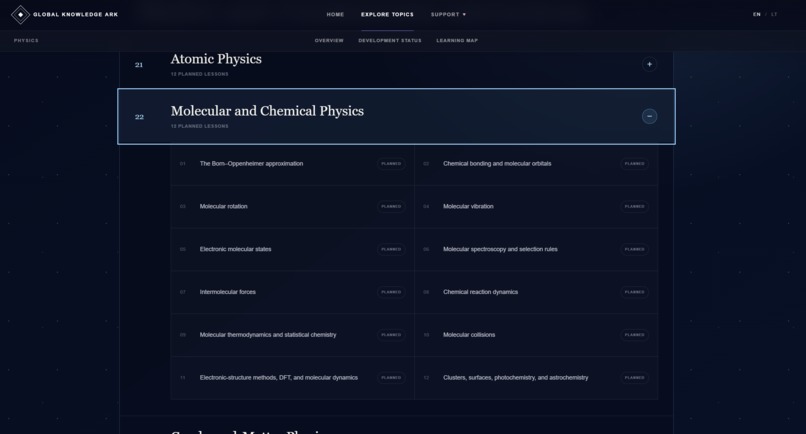
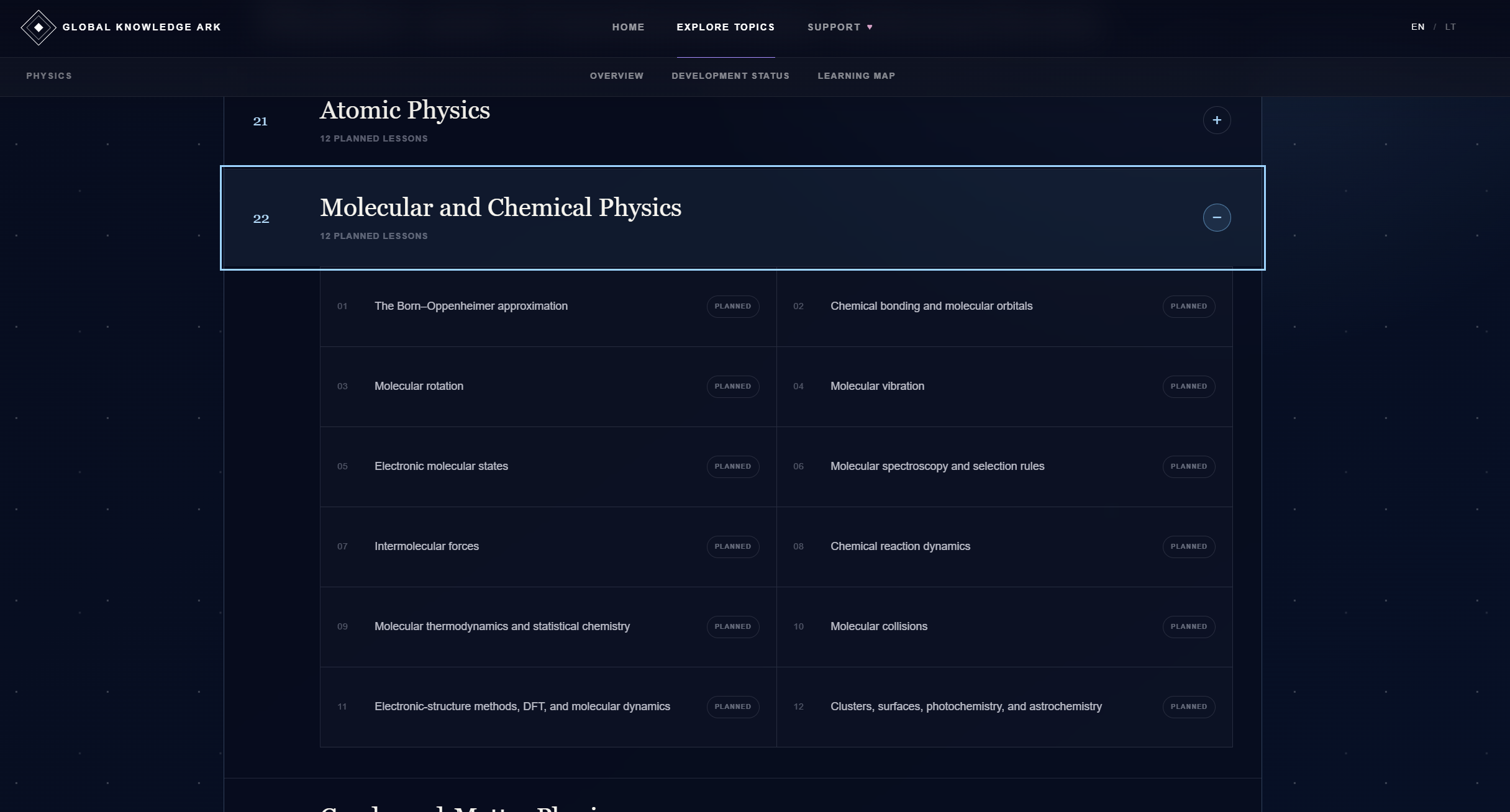
Responsive chapter accordion with planned lesson subjects clearly organised and no broken or invented links.
-
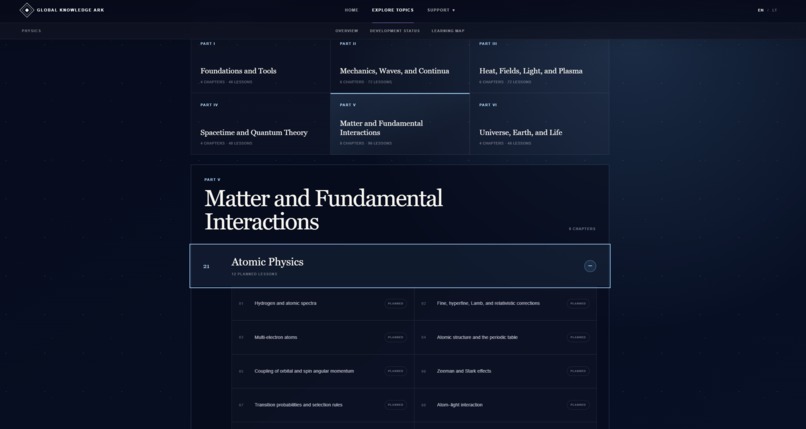
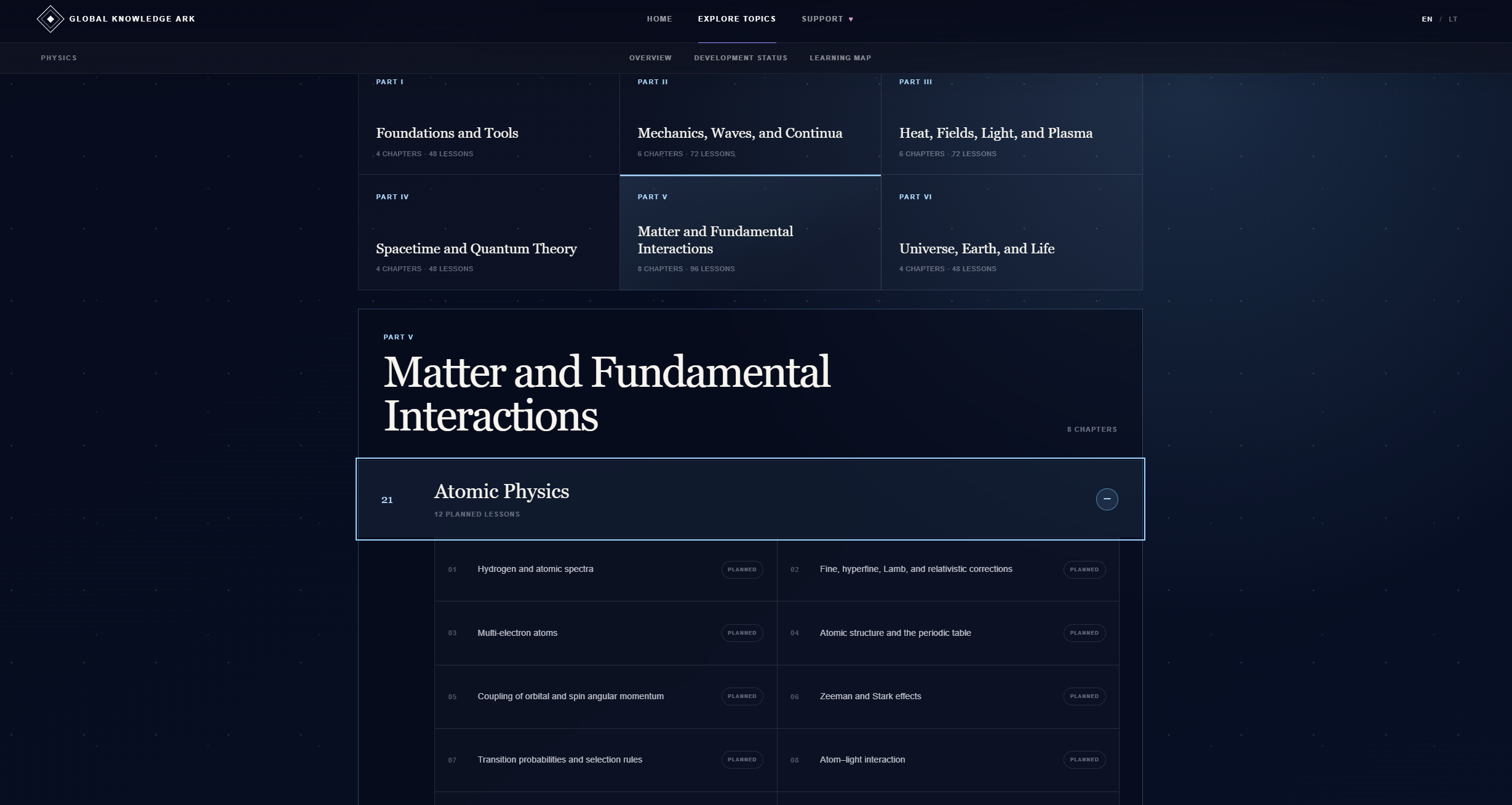
Expanded Matter and Fundamental Interactions section showing its chapters and structured planned lesson list.
Inspiration
The Global Knowledge Ark did not begin as a hackathon project. Its roots began years earlier on Crystals.eu, where my passion for crystals naturally expanded into a much wider passion for understanding the world.
I began writing not only about minerals, but also about science, nature, health, consciousness, psychology, technology, the universe and humanity’s search for meaning. Every article opened new questions, and every subject revealed connections to many others.
Over time, the growing body of knowledge became too broad to remain only part of an online crystal shop. I realised that these ideas needed a home of their own: a place where knowledge from different fields could be preserved, connected and made easier to explore.
That evolving vision became the Global Knowledge Ark.
The project grew from a simple question:
What if we could build a living map of knowledge that helps people learn today while preserving useful understanding for future generations?
The Ark is not intended to be completed once and then left unchanged. It is designed to continue learning, growing and evolving for decades as new discoveries are made, explanations improve, more languages are added and new technologies create better ways to learn.
What began as my own passion for understanding may eventually become a shared resource for students, families, educators, researchers, curious individuals and generations we may never meet.
What it does
The Global Knowledge Ark is an evolving, currently bilingual learning platform with a long-term multilingual vision.
It transforms complex subjects into approachable introductions, topic collections and connected learning paths. The project is organised through five broad knowledge directions:
- Consciousness & Dreams
- Health & Vitality
- Science & Technology
- Earth & Crystals
- Cosmos & Civilisations
Visitors can explore areas such as:
- Science and the universe
- Intelligence and critical thinking
- Health and the human body
- Emotional resilience and self-defence
- Addiction, liberation and digital well-being
- Engineering and technology
- Agriculture and food systems
- Nature and interspecies communication
- Philosophy, society and governance
- Peace engineering
- Advanced exploration and possible futures
The goal is not simply to collect separate articles. The Ark is designed to help people understand how different areas of knowledge connect.
A learner might begin with astronomy, continue into physics and engineering, and later explore biology, philosophy, social systems or the future of civilisation. Another person may begin with health, emotional resilience or addiction recovery and gradually discover the science behind behaviour, cognition and society.
The Ark aims to make knowledge feel less like an isolated library and more like a connected landscape that people can explore in their own way.
How I built it
The project began by organising knowledge already developed through Crystals.eu and identifying the larger subjects that had naturally emerged from it.
From there, I designed an expanding information architecture made of five major knowledge directions, topic collections, introductory knowledge-world pages and future learning paths.
During OpenAI Build Week, I used GPT-5.6 and Codex as collaborative tools rather than unquestioned authorities.
GPT-5.6 supported:
- Planning and information architecture
- Design decisions
- Organising a large Physics curriculum
- Reviewing wording and interaction structure
- Deciding how unfinished material should be presented honestly
- Refining the project story, documentation and submission
Codex supported:
- Inspecting the existing codebase before proposing changes
- Creating a focused implementation plan
- Building and styling the new interactive features
- Adding keyboard accessibility and reduced-motion behaviour
- Running lint checks, production builds and rendered-route tests
- Comparing the imported curriculum with the supplied source
- Reviewing exactly which files were included in each commit
- Pushing approved changes to GitHub
- Deploying the reviewed version to the existing live Site
Human review remained essential throughout. I selected the direction of the project, reviewed the proposed file plan, inspected the local previews and explicitly approved the work before it was committed, pushed or deployed.
Challenges I faced
The greatest challenge was not simply producing more content. It was designing a structure that could expand for decades without becoming another confusing collection of disconnected information.
During Build Week, one of the most difficult tasks was presenting a Physics curriculum containing six Parts, 32 chapters and 384 lesson subjects without overwhelming the reader.
The implementation needed to:
- Preserve the complete curriculum exactly as supplied
- Avoid inventing lesson routes that did not yet exist
- Clearly mark future lessons as Planned
- Keep the interface calm despite the amount of information
- Make search work across all six Parts
- Display match counts for each Part
- Allow only one chapter to remain expanded at a time
- Support keyboard navigation and assistive technologies
- Remain usable on desktop, tablet and mobile screens
- Preserve the existing Physics introduction and visual identity
- Keep the English curriculum out of the Lithuanian page until a reviewed translation exists
- Deploy to the existing Site without replacing its project identity or custom domain
Another challenge was adding movement without making the interface distracting.
The final orbital animation affects only the decorative geometry within the active direction panel. The outer circle rotates very slowly, the inner ellipses counter-rotate and the central symbol gently breathes, while the title, description, button, panel and page background remain stationary.
The animation also respects reduced-motion preferences.
The project has so far been developed independently with very limited time, funding and technical resources. This has required careful prioritisation and gradual progress, but it has also demonstrated how much can already be achieved with a clear vision and modern AI-assisted tools.
Greater resources would allow me to dedicate myself to the Ark full-time, accelerate the creation and careful review of educational material, involve additional specialists and develop the interactive learning experiences envisioned for its future.
Accomplishments
The project has grown from an idea developed through Crystals.eu into a dedicated public platform with its own identity, structure and long-term purpose.
The Global Knowledge Ark now includes:
- A public website at
ark.crystals.eu - English and Lithuanian experiences
- Five interconnected knowledge directions
- A structured catalogue of existing and planned subjects
- Dedicated knowledge-world introduction pages
- Responsive desktop, tablet and mobile layouts
- Accessible navigation and interaction patterns
- Subtle orbital motion within every active direction panel
- An interactive English Physics Learning Map
- Six Physics curriculum Parts
- 32 numbered Physics chapters
- 384 planned lesson subjects
- Search across all Parts
- Result counts on every Part control
- Keyboard-accessible Part and chapter navigation
- A Clear action for returning to the full curriculum
- Honest Planned states instead of broken or invented links
- Automated route, curriculum and build validation
- A framework that can later expand into complete courses, simulations and visual knowledge maps
Most importantly, the Ark is no longer only an idea.
People can already visit it, explore its structure and interact with the first large-scale learning map.
OpenAI Build Week did not create the original vision. It helped turn meaningful parts of that vision into tested, interactive and publicly deployed features.
What I learned
I learned that the organisation of knowledge can be as important as the knowledge itself.
People do not only need more information. They need context, connections, understandable explanations and honest indications of what is complete, planned or uncertain.
The Physics Learning Map demonstrated the value of progressive disclosure. A curriculum containing hundreds of lessons became manageable when only one Part was displayed at a time and only one chapter could remain open.
I also learned that unfinished material should not pretend to be finished. Marking future lessons as Planned was better than creating empty pages, placeholder routes or broken links.
Subjects that appear separate are often deeply connected. Health connects to psychology, psychology connects to social systems, technology connects to philosophy, and astronomy connects to questions about humanity’s future.
Another major lesson was that AI works best as a collaborator rather than a replacement for human judgement.
GPT-5.6 and Codex accelerated planning, implementation, testing and refinement, but human review remained necessary for purpose, accuracy, priorities, visual judgement and final approval.
The Build Week process also demonstrated the value of a review-first development workflow:
Inspect → propose → implement → test → preview → approve → commit → deploy
This allowed me to use AI quickly while retaining control over the project and every published change.
What's next
The next stage is to transform the Ark from a structured knowledge platform into a more complete interactive learning system.
Future development may include:
- Full articles for the 384 planned Physics lessons
- A reviewed Lithuanian Physics curriculum
- Visual maps showing how subjects connect
- Personalised learning paths
- More languages
- Stronger source and evidence layers
- Expert review and community contributions
- Interactive scientific models
- Simulations and educational tools
- Courses for children, adults and lifelong learners
- Progress tracking
- Accessible archives for long-term preservation
- Audio and visual learning formats
- Virtual and immersive learning environments
- Collaborative spaces for researchers, educators and creators
I also plan to continue expanding the subject library while improving the clarity, reliability and accessibility of the material already published.
The speed and scale of this development will depend on the resources and collaborators available. With sufficient support, I would be able to work on the Global Knowledge Ark full-time, involve specialists where their expertise is needed and bring these plans forward much sooner.
This is a long-term project that I intend to develop for decades, allowing it to grow alongside human knowledge, new technologies and the people who contribute to it.
The ultimate goal is not to claim ownership of knowledge.
It is to help preserve it, connect it, explain it and make it useful.
Knowledge for people today—and for generations we may never meet.


Log in or sign up for Devpost to join the conversation.