-
-
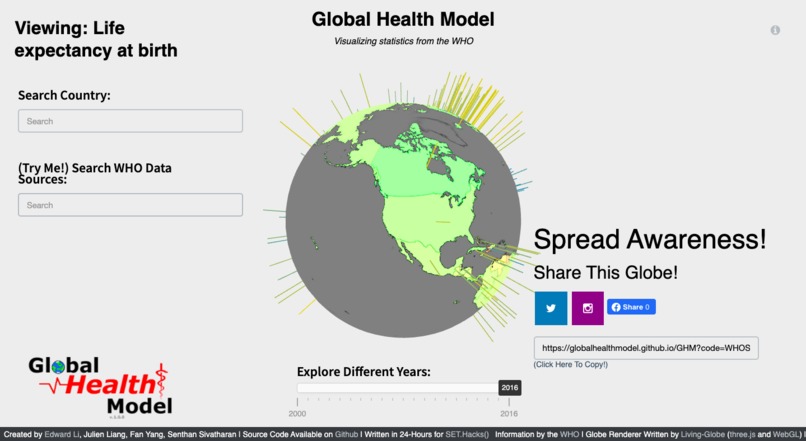
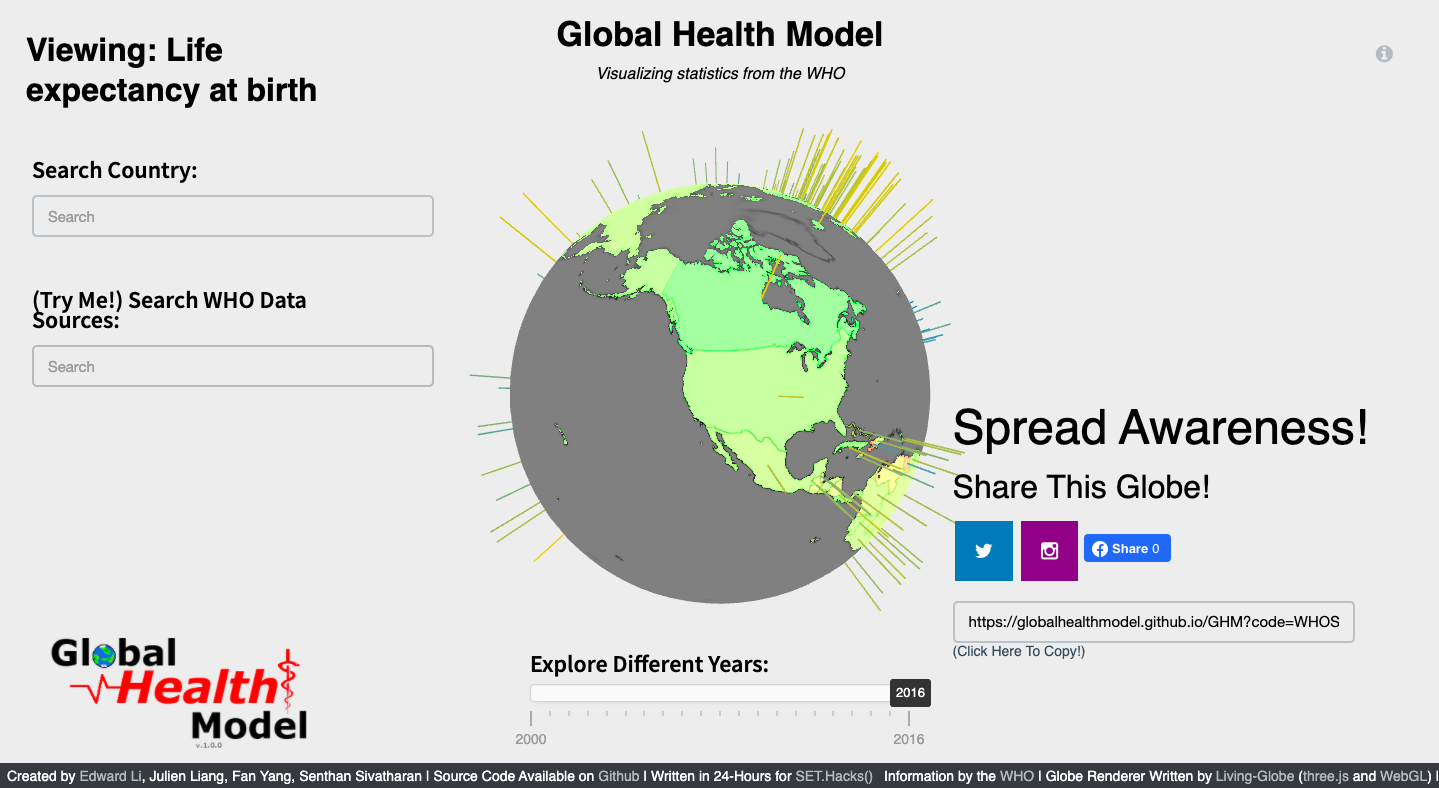
A photo of the Global Health Model page
Inspiration
Our project was inspired by the substantial lack of effective health statistic visualization programs available to the public. A vast majority of the information on the internet is encoded in boring graphs or other barely readable forms, which greatly inhibits peoples' abilities to get a clear picture of the health conditions around the world. With our model, we seek to provide anyone with quick and convenient access to global health information without the need to search through numerous sites. We seek to forward the basic human needs of third world countries by providing well-rounded data that will ultimately work towards the improvement of good health and well-being of those in need.
What it does
The Global Health Model offers an easy way for more people to get access to usable health statistics. It offers an aesthetically pleasing and interactive 3D globe combined with multiple datasets from the World Health Organization's public API to help the user "see" what's going on around the world. A timeline function is also present so people can compare past health statistics and predict potential trends.
How I built it
We employed many cutting-edge technologies to bring our creation to life. By adapting around a popular open-source webGL globe rendering engine, we were able to use HTML, CSS, and Javascript to create our product. We implemented our own proprietary JSON-database parser/analyzer to fully employ the capabilities of the WHO's Athena API. We also created proprietary python web crawlers to help create our site, which drastically decreased our production time. With these tools, we were able to build a fully interactive 3d-globe to help visualize the modern health crises around the world.
Challenges I ran into
Throughout the development of GHM, we ran into many challenges. For many of our members, this was the first experience with Javascript. Despite this, we were able to adapt to each member's needs and create a dynamic and welcoming environment. In addition, because of chrome limitations, it was difficult to test the site locally. To combat this issue, we created custom WSGI development servers for our members to use and develop. Overall, we faced and persevered through many hurdles throughout the development of GHM.
Accomplishments that I'm proud of
We're proud to have managed to decode and reverse engineer the globe-rendering engine used; a complex yet necessary task that took a great deal of effort and laborious hours sifting through thousands of lines of code. Another accomplishment was the feat of making the website visually appealing. It took many stages of revision and lots of work to create the polished-looking product we now have.
What I learned
Throughout the development of the Global Health Model, we learned the value of communication in group coding projects. Communication is important in order to split up tasks among the group to maximize efficiency and to get everyone's opinions for improvement. We also learned about the importance of readable and concise code to ensure that it is understandable to groupmates.
What's next for Global Health Model
The most obvious way to advance the Global Health Model is to expand its dataset by taking more statistics from WHO and other sources. Another improvement could be the implementation of a country compare feature, where you can compare a list of statistics from one country with a list from another in different categories.
Built With
- 3d
- api
- css
- html
- javascript
- jquery
- python
- rest
- statistics
- visualization
- who





Log in or sign up for Devpost to join the conversation.