-
-
Thumbnail
Inspiration
Environmental campaigns inform but don't transform. News articles reach about 10,000 people and are forgotten in 24 hours. Protests reach about 50,000 people but fade from memory. But games? Games reach over 3 billion people worldwide and create lasting emotional connections. Most people don't act on environmental issues, not because they don't care, but because they don't feel it. We built Glint and Grime to make pollution awareness unforgettable and to help people feel the weight of environmental destruction and the power they have to change it.
What it does
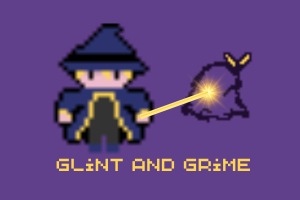
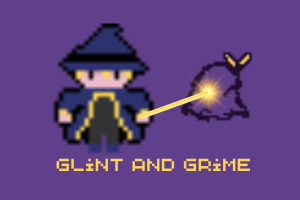
Glint and Grime follows the journey of Lyra, a witch who accidentally time-traveled to where Earth is nearly dead due to over-pollution and the greed of our antagonist Midas, a billionaire who profits from destruction. She must defeat Midas to reverse the pollution hurting the planet. Inspired by Sky Shooter mechanics, Lyra stays at the bottom of the screen while obstacles fall from the sky. Players use a custom touchpad controller to draw magic glyphs that destroy trash obstacles, while physical buttons move Lyra left and right to dodge hazards. At the end of each level, she receives a potion that enhances her abilities, and difficulty scales up to match her growing power. As you progress through levels, watch the world transform the world as the skies clear, trees regrow, and the sun shines again. This isn't just gameplay; it's impact visualized to motivate real-world action.
When designing the graphics, we chose a pixel art style to maintain the post-apocalyptic feeling while bringing in the aspect of magic through color palettes and art style. The music reflects this same balance, using a combination of fantastical elements and retro chiptunes. All music and art were created without AI generation by our team from scratch during the 36-hour hackathon. Please do not repost or use any of our art and music without permission.
How we built it
Software: We developed the game in Unity, learning C# scripting, sprite animation, and collision detection during the hackathon.
Art: Every sprite, background, and animation was hand-drawn pixel by pixel in Pixilart and Figma.
Music: We composed original chiptune soundtracks in Noteflight, exported MIDI files, and produced final tracks in Soundtrap, which were all while coding and debugging.
Intended Hardware: We tried building a custom controller using an ESP32-2432S028 touchpad for drawing magic glyphs, two button switches for character movement, six Dupont wires, and a micro-USB cable, which were all mounted on a standard breadboard. We used the LovyanGFX graphics library for ESP32 rendering.
Challenges we ran into
The Hardware Dream We Didn't Fully Achieve: Initially, we didn't just want a game; we wanted a physical experience. Our vision was a custom touchpad controller where you'd draw spells with your finger and watch them materialize in-game. The ESP32 calibration was difficult, and detecting hand-drawn shapes in real-time without machine learning meant building geometric pattern-matching from scratch. We continued working through the night until solutions were found, though we couldn't fully implement our initial touchpad vision by the deadline.
The First-Timer's Gauntlet: None of us had used Unity before, so we learned game development from scratch during the hackathon. We encountered bugs everywhere, and since we were new to the software, we didn't store and organise the code correctly, which really slowed us down. Because we had people with different strengths and interests, deciding on a game concept proved difficult. We brainstormed multiple ideas and continuously refined them until we agreed on the best option and the differences in the strength of each team member actually helped put together an all-encompassing project.
Accomplishments that we're proud of
We are proud of building a game for the first time as all first-time hackers and first-time game developers. We are super proud of creating all our assets from scratch, from every pixel of art, every note of music, and every line of code was made by our team during the 36-hour hackathon. We're proud of attempting hardware integration even though it pushed us to our limits, and we're proud of never giving up despite countless bugs and calibration nightmares. We're proud of learning Unity, C# scripting, pixel art animation, and chiptune composition all in one weekend. Most of all, we're proud of building something that makes environmental awareness feel powerful and unforgettable, and not just informative.
What we learned
We all learned game development and Unity as first-time game developers. We learned the challenges of connecting software and hardware, especially syncing real-time touchpad input with game mechanics. We learned that teamwork means leaning on each other's strengths and trusting one another. We learned to ask "dumb" questions, use every available resource, fail fast, and iterate faster. We learned that the most important part of a hackathon is learning and having fun.
What's next for Glint and Grime
We want to fully realize our hardware vision by building a custom arcade-style controller with complete gesture recognition with circles for fire spells, zigzags for lightning, and more complex glyph patterns. We plan to add a deeper story that reveals Lyra's backstory and motivations as players progress, explaining how she gains potions and grows stronger to ultimately defeat Midas. We want to add more obstacle types like plastic oceans, smog clouds, e-waste mountains, and increase difficulty scaling. We're planning to integrate AI-generated environmental tips that appear between levels, teaching players real-world sustainability actions they can take. Most importantly, we want to partner with schools and environmental organizations to use Glint and Grime as an educational tool, turning education into fun while connecting it to real-world impact.
Built With
- c#
- figma
- lovyangfx.hpp
- noteflight
- pixelart
- soundtrap
- unity

Log in or sign up for Devpost to join the conversation.