
Inspiration
As a veteran, my journey with mental wellness has been a meaningful part of my life. For the past few years, my therapist has strongly encouraged me to keep a simple gratitude journal, a practice proven to improve sleep and overall well-being. But I struggled. No matter what I tried—a fancy pen and notebook, or a complicated app with a million features—I couldn't get into the habit.
I realized the problem wasn't the practice; it was the friction. I dislike having dozens of apps on my phone, each one a potential gateway to endless doomscrolling. I wanted something simple, private, and seamlessly integrated into how I already communicate. I needed a tool that would meet me where I was, not demand that I change my behavior to use it.
Glimmers was born from that need. It's a gratitude journal that lives in your text messages. It doesn't take up real estate on your phone, and it doesn't try to be anything more than a quiet, consistent companion. I built the tool that I personally needed, hoping it could help others like me.
What it does
Glimmers is an intelligent SMS-based journal that makes gratitude a simple, daily habit. Users text their positive moments—including photos—and Glimmers securely saves them. But behind this simplicity is a powerful AI agent that provides a truly personal experience. It learns each user’s unique ‘golden hour’ for reflection, making prompts feel natural, not intrusive. It understands entries in multiple languages and uses AI to find themes in a user's week, offering a short, thoughtful reflection with their weekly summary and a beautiful collage of their photos.
Glimmers is a complete subscription service, featuring an automated 30-day trial, a secure Stripe payment flow, and a suite of Slack-based admin commands for robust user support. Most importantly, it uses a nuanced AI safety system to create a truly private and safe space, blocking platform abuse while understanding that personal expression is a valid part of journaling.
How I built it
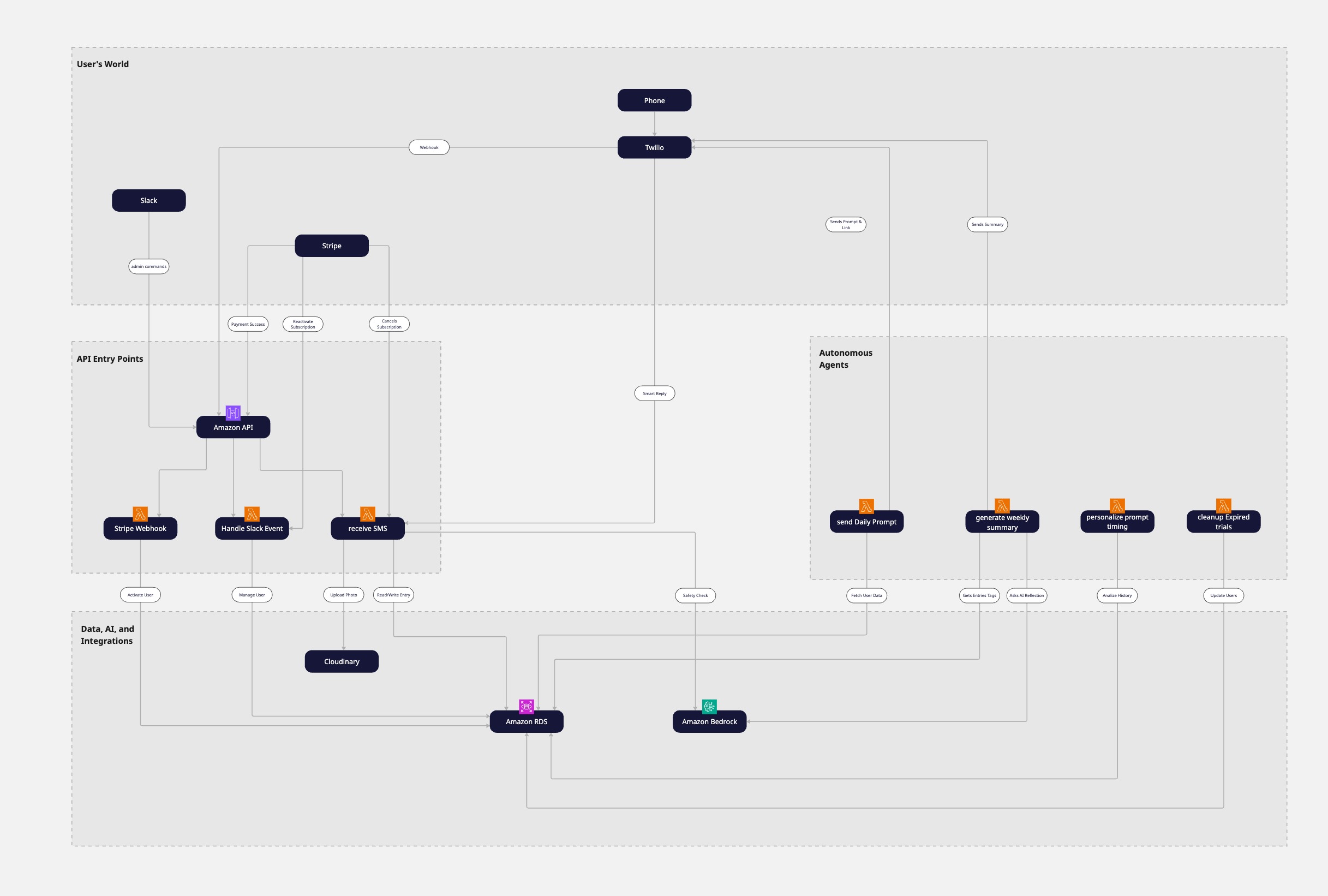
I knew the journal had to be more than just a place to store text messages. It had to be intelligent. I chose to build a custom "DIY agent" on a serverless AWS architecture, giving me the flexibility to create a truly personalized and secure experience.
The core of Glimmers is a Bedrock-powered orchestrator that coordinates three sub-agents — Safety, Personalization, and Insight — each running as its own Lambda microservice. This agent is responsible for the entire user experience:
- A Safety Agent: The first priority was creating a truly private space. I engineered a sophisticated AI prompt for a Claude 3.5 Sonnet model. It's trained to understand the difference between personal expression (even anger or profanity, which are valid parts of life) and genuine platform threats like spam or hate speech. It ensures the journal is a safe space without being a judgmental one.
- A Personalization Agent: To solve my own problem of not knowing my "golden hour" for reflection, I built an autonomous Lambda function that runs weekly. It analyzes a user's journaling habits and learns their unique, optimal time to send the daily prompt. The app adapts to the user, not the other way around.
- An Insight Agent: To make the practice more rewarding, I created another AI agent that reads the themes of a user's week (based on AI-generated tags) and writes a short, grounded, non-cheesy reflection for their weekly summary. It helps the user see the patterns in their own joy.
All data is stored securely in Amazon RDS within a private VPC, with triggers managed via EventBridge and notifications through SNS. The entire system is tied together with a robust subscription engine using Stripe, administrative tools via Slack, and a multi-signal abuse scorer to protect the platform.
Challenges I ran into
The hardest engineering challenge was implementing least-privilege IAM policies for a multi-service deployment. I failed dozens of times before getting it right.
Equally challenging was teaching the AI empathy, distinguishing expressive language from abuse. My initial safety agent was too aggressive and flagged legitimate, emotional entries. It took many rounds of prompt engineering and testing to teach the AI the nuance required for a private, empathetic tool—to understand that "my day was fucking amazing" is a moment of pure joy, not a violation of terms. This journey of refining the AI's "personality" was the most difficult and rewarding part of the process.
Accomplishments that I'm proud of
I'm incredibly proud of building a complete, production-ready, and commercially viable application from the ground up. This isn't just a prototype; it's a fully-fledged subscription service with a secure payment flow, robust anti-abuse systems, and a multi-stage dev/prod environment.
My biggest accomplishment was engineering the "personality" of the AI agents. Moving beyond a simple filter to create a nuanced safety agent that understands intent—allowing a user to say "making it through a really shitty day" while still blocking real threats—was a huge breakthrough. I'm also proud of the personalization agent that learns a user's habits, which was a core problem I wanted to solve for myself. Finally, successfully building and debugging the entire secure serverless infrastructure on a new platform was a massive personal achievement. All agents run on AWS Lambda in production, orchestrated through EventBridge with RDS persistence.
What I learned
This project was a huge personal and technical learning journey. As an ex-Googler who worked with the Google Cloud serverless team, I had never deployed a major project on AWS. Frankly, it felt a bit like being a traitor at first! But this hackathon gave me the perfect reason to dive in.
I learned the intricacies of the AWS ecosystem, from crafting a least-privilege IAM policy from scratch to orchestrating multiple services like Lambda, Bedrock, RDS, and EventBridge. I was pleasantly surprised by how powerful and mature the AWS platform is for building complex, event-driven applications.
More importantly, I learned that the true power of an AI agent isn't just in its technical capabilities, but in its ability to facilitate a human experience. I learned how to engineer an AI's instructions to be not just "correct," but empathetic, nuanced, and aligned with the core values of the product. I started by trying to build a tool for myself, and in the process, I learned how to build a companion.
What's next for Glimmers
Glimmers is built on a solid foundation, and the roadmap is exciting. The immediate next step is to launch it to a broader audience and gather user feedback (currently has five active beta users).
From a feature perspective, the next evolution is to make the experience even more reflective and personalized. I plan to use the rich, tagged data we're collecting to:
- Create "On This Day" Throwbacks: An autonomous agent could find a user's entry from exactly one year ago and send it to them, creating a powerful moment of personal nostalgia.
- Develop Thematic Summaries: Instead of just weekly summaries, the AI could generate monthly or quarterly reflections based on the most prominent themes (e.g., "It looks like the last three months were really focused on family and new hobbies.").
- Build a Web-Based Journal Viewer: A secure web portal where users could log in to view, search, and export their entire journal history, beautifully organized by their AI-generated tags.
Built With
- amazon-api-gateway
- amazon-bedrock
- amazon-cloudwatch
- aws-iam
- aws-secrets-manager
- axios
- cloudinary
- eventbridge
- javascript
- lambda
- postgresql
- rds
- s3
- segment
- slack
- sql
- storage
- stripe
- twilio

Log in or sign up for Devpost to join the conversation.