-
-
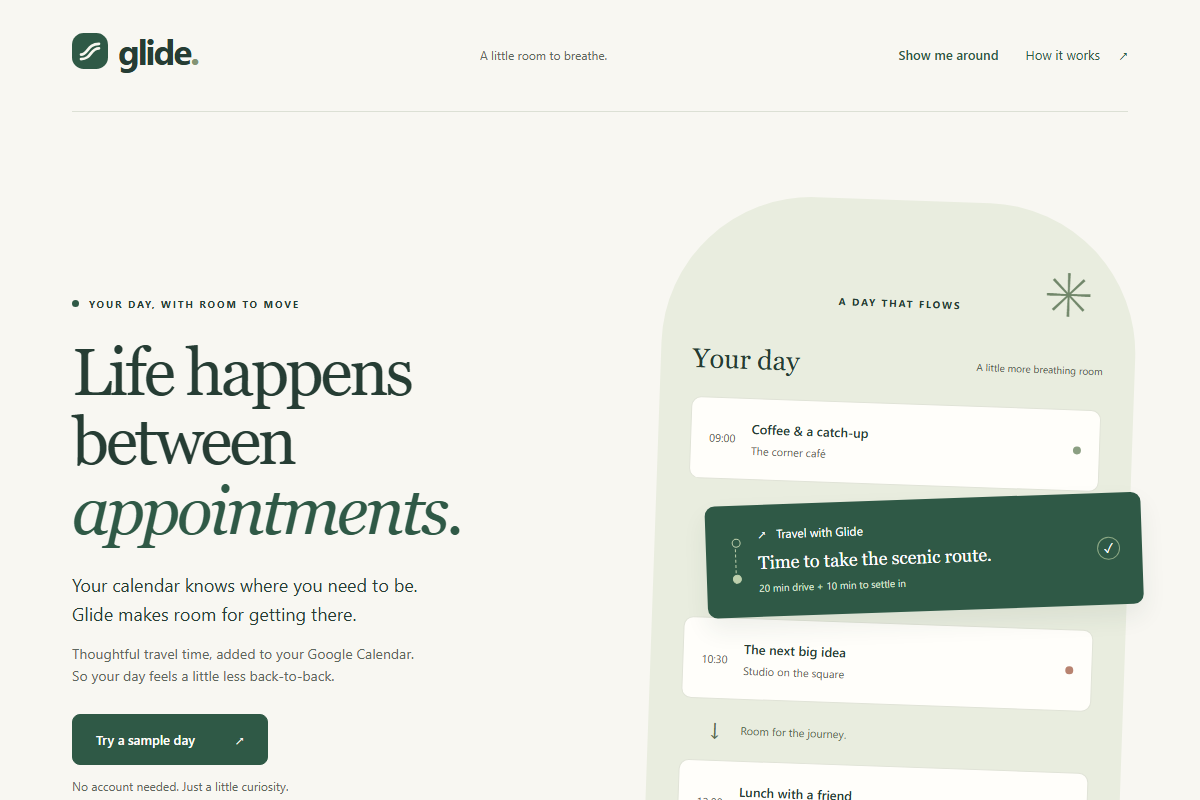
Landing Page
-
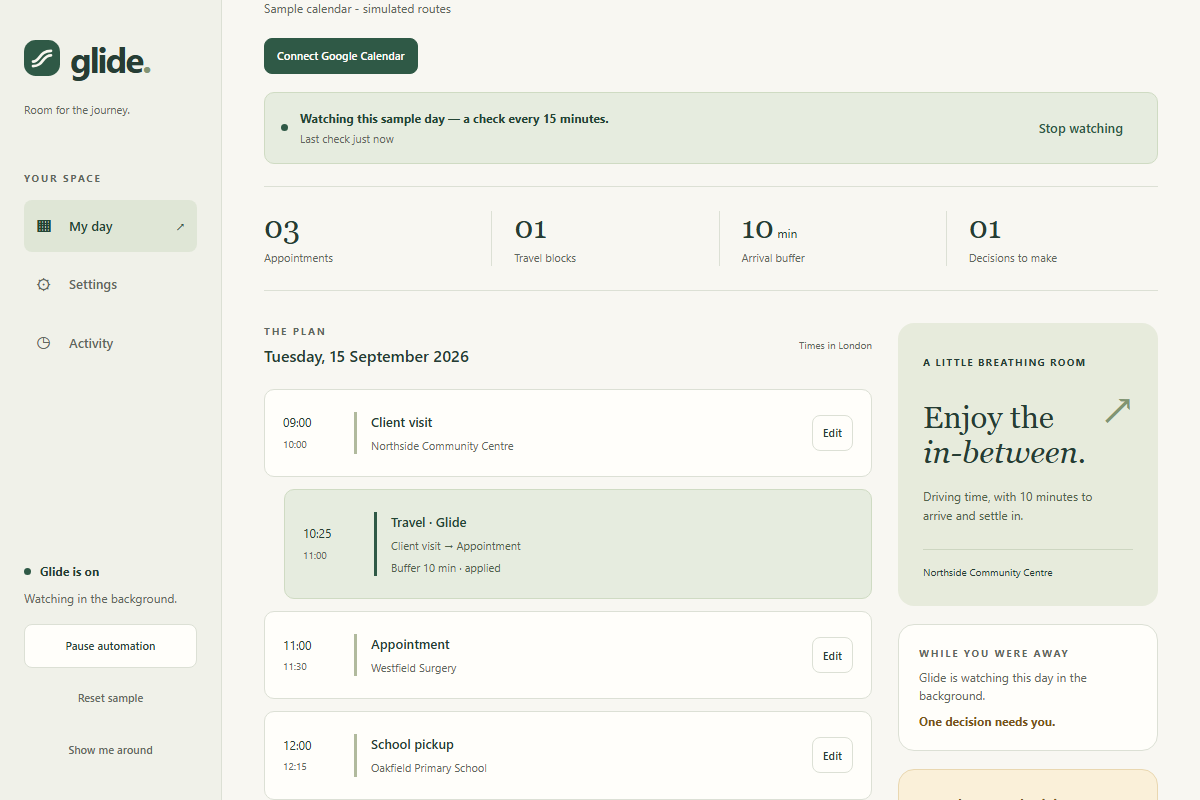
Timeline
-
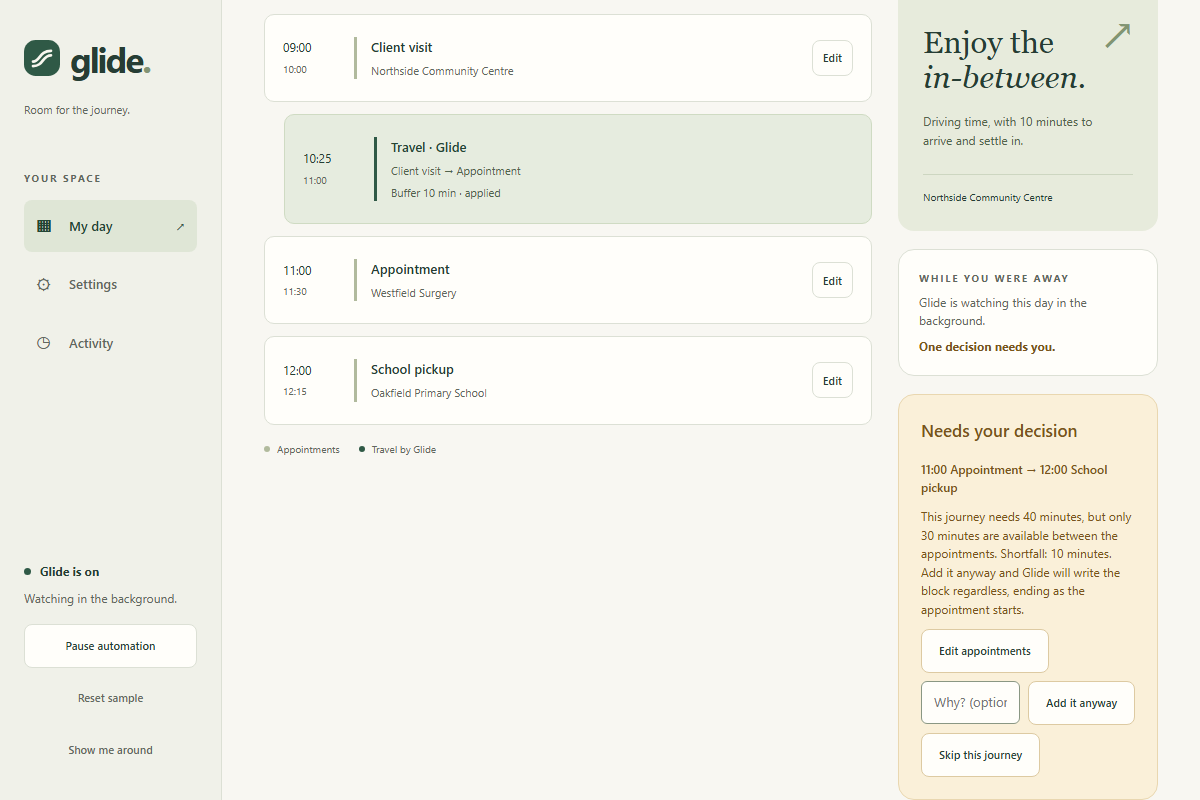
Decision
-
Activity
-
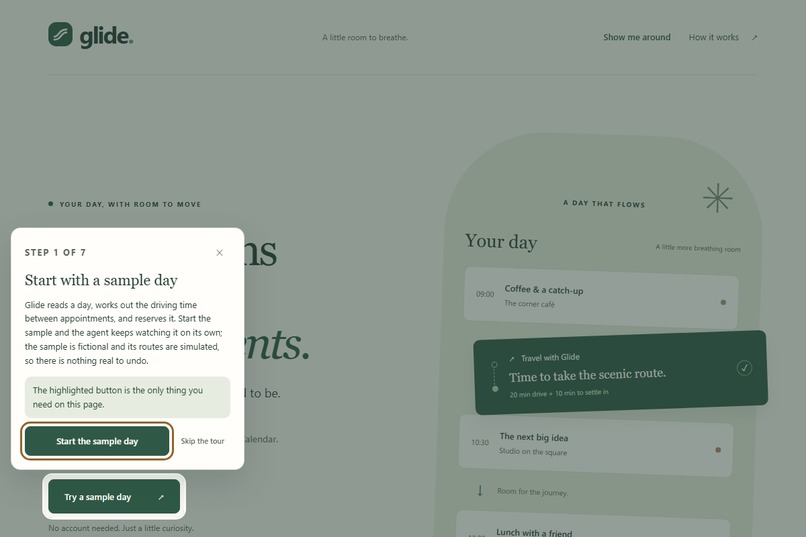
Guided Tour
Inspiration
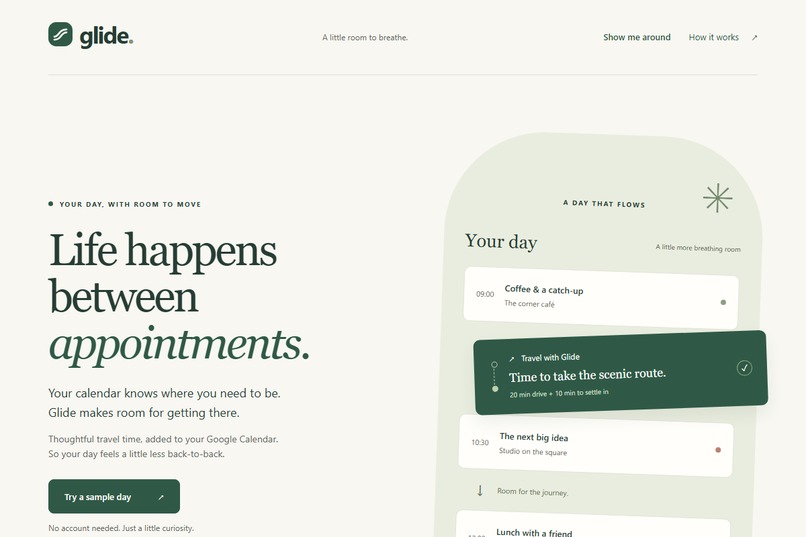
Calendars record when commitments happen, but the journey between them often remains a mental calculation. On a day with client visits, an appointment, and a school pickup, an empty gap can look available even when it is needed for driving. A change to one appointment means checking the whole day again.
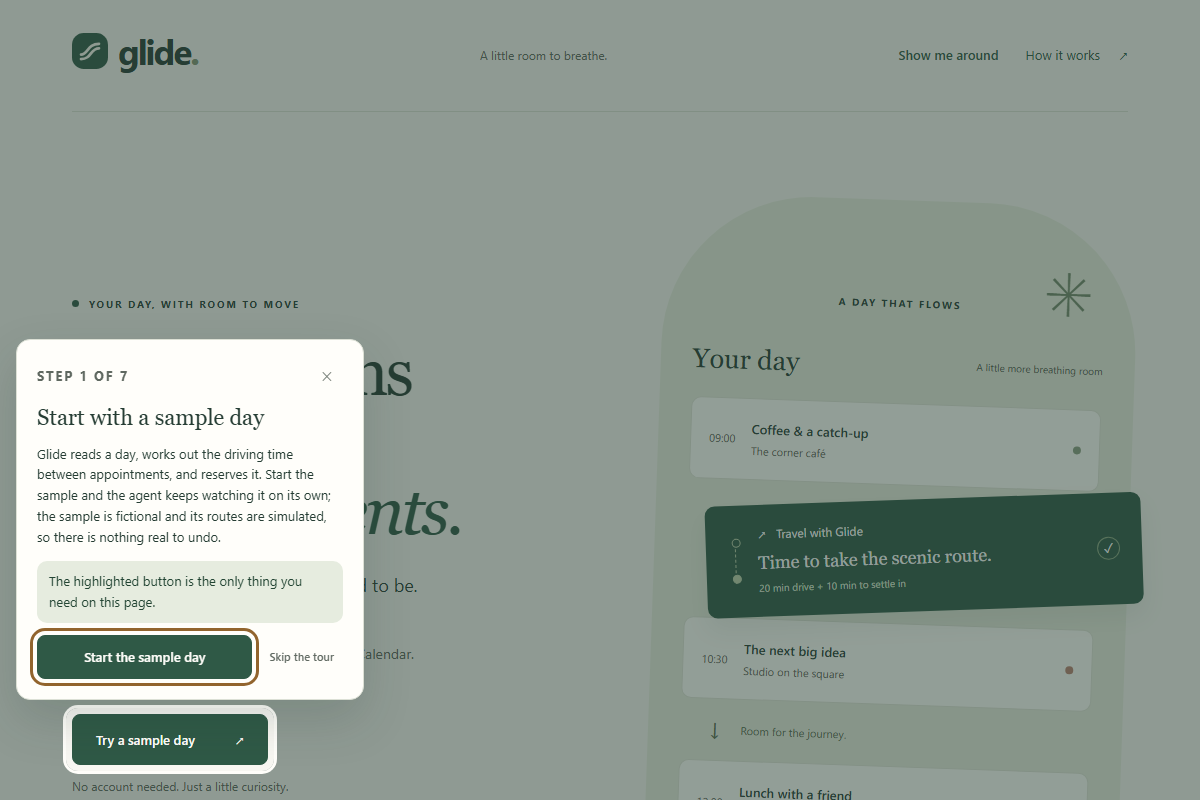
Glide is built around a simple idea: the calendar should include the time needed to get there. It is for anyone whose day is appointments in different places - a rep doing client visits, a carer, a parent who has to be back at the school gate at twelve - where the gaps look free but are exactly the time they spend driving. Re-checking that day is the work nobody counts.
What it does
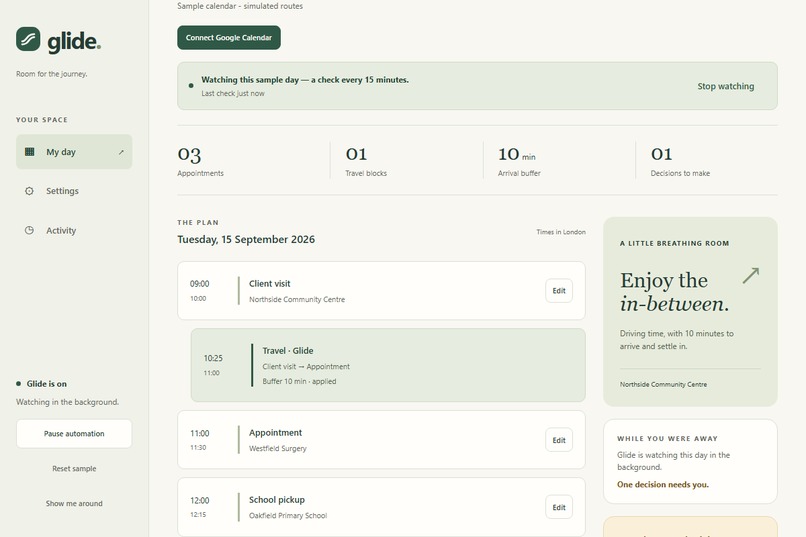
Glide connects to Google Calendar, reads upcoming appointments, and creates driving-time blocks directly in the user's primary calendar. It combines route estimates with the user's arrival buffer and checks each journey against the commitments around it.
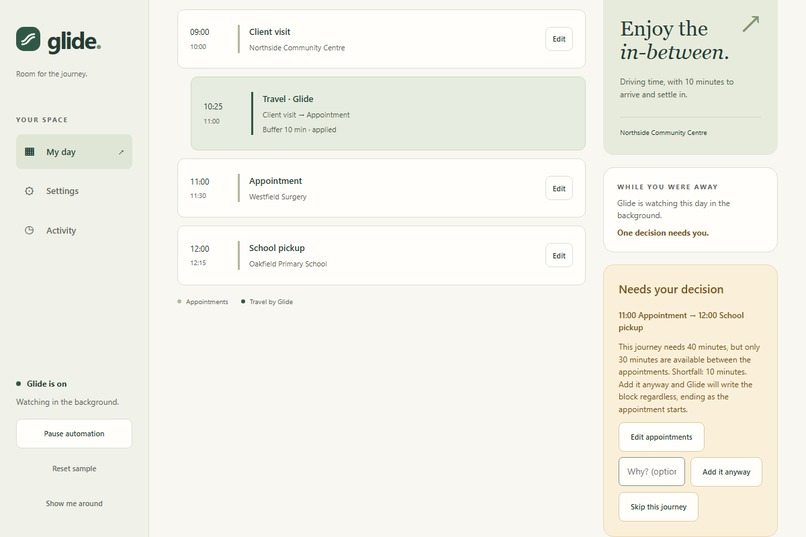
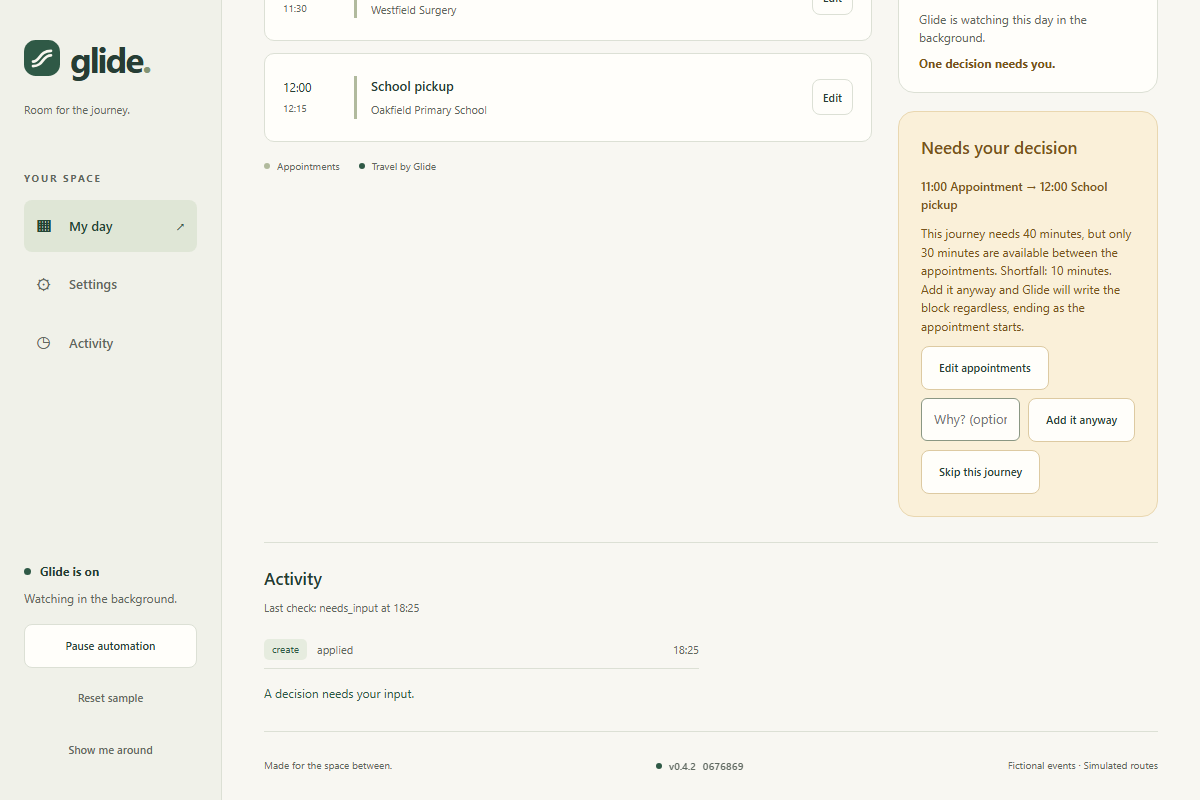
When an appointment moves or disappears, Glide updates its blocks. When travel cannot fit, it explains the shortfall and lets the person correct a location, skip the journey, edit the appointment and recheck, or add the journey anyway with a note. Users can pause automation and stay in control of their original appointments.
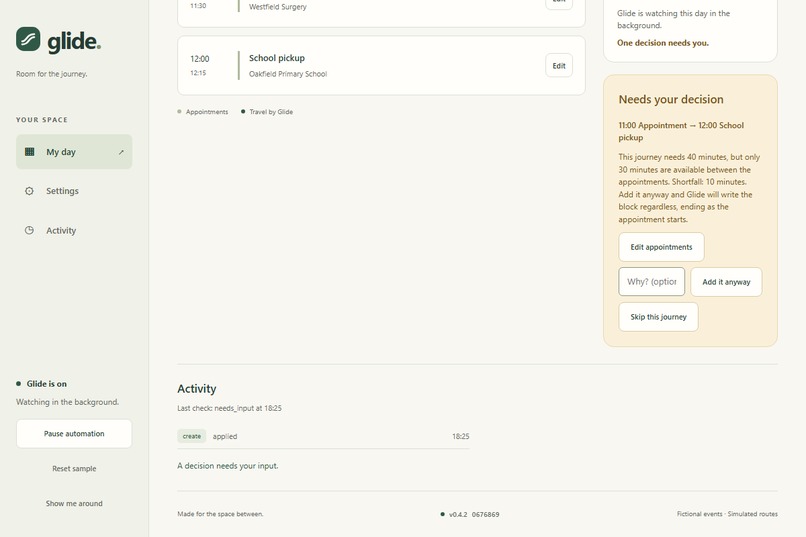
Glide watches in the background on its own schedule - every 15 minutes by default - and the day view shows what it has been doing: the last check, the next one, and how many ran while the tab was closed. The page refreshes itself, so a decision the agent raised while nobody was looking is waiting when the person returns. Glide stays quiet otherwise, but it reaches the person when a decision is waiting: a short transactional email names the shortfall and links straight back to the highlighted decision card. Each decision is announced exactly once, however many scheduled checks re-observe it.
The first version covers driving and one source calendar. The hosted sample at https://d3tvxy281s2u11.cloudfront.net lets judges walk the whole workflow with fictional appointments and simulated routes: no account, no fees, and no model spend. It starts watching on creation and completes its first background check with no browser action. The entry video covers the real Google and AWS integrations.
How we built it
The Strands Agents SDK connects calendar context, place lookup, route estimation, and structured journey proposals through six typed tools. Amazon Bedrock (eu.amazon.nova-2-lite-v1:0 in eu-west-1) provides the model, and Amazon Location Service provides place and driving-route information. Deterministic application code validates time constraints and limits writes to Glide's own calendar events.
An AWS scheduler and FIFO queue keep the application checking while the browser is closed. A tenant is only queued while it is watching and due, with a per-tenant interval pointer; anonymous samples carry a 15-minute floor and a three-per-tick cap, and sample runs use the deterministic planner, so the public demo cannot generate model spend. Persistent state connects appointments to their travel blocks, so retries and schedule changes reconcile without duplicates, and user-edited or deleted blocks are respected rather than overwritten.
Amazon SES delivers the "needs your decision" email from a verified sending identity, and the once-only mark is persisted with the decision so a rerun, retry, or cold worker never repeats a message. Every page also reports the build it is running and compares it with the deployed manifest and the API's version, so a stale tab offers a reload instead of quietly running old code.

Accomplishments
Verified against the deployed stack between 11 and 14 September 2026, including the owner's live Google account:
- The browser workflow passes the full judge path end to end: sample day, a quantified ten-minute shortfall, resolve, recheck with two updated blocks and no duplicates, reset, a skip that persists across checks, and an add-anyway override with an optional note. - Against the owner's real Google account the deployed agent wrote two
Travel / Glideblocks in 20.7 seconds, then completed ten consecutive maintenance runs in 10.3-15.5 seconds each with no failures. Moving a Glide block raised amanual_editdecision instead of overwriting it, deleting one raised amanually_deleteddecision instead of recreating it, and a run scheduled with the browser closed finished on its own. - 393 automated tests pass alongside lint, typecheck, a production build, and 24 Playwright browser checks, including the full judge path. - The hosted sample is verified on the deployed build (0.4.2): a fresh sample starts watching on creation, its first scheduled check arrived 56-123 seconds after session creation with no browser open, its travel blocks survived that check, and the bundle,/version.json, and/api/healthall report the same version. - The background agent is visible, not implied: the day response carries its watching state, interval, last and next check, and a "while you were away" count read from the dispatcher's durable pointer, and the page polls while visible and refetches on focus. A fresh sample starts watching on creation; a connected Google account starts paused and watches only after the owner presses Start watching. The dispatcher enforces the interval ceiling, the sample floor and per-tick cap, and the 24-hour snapshot lifetime. - Google sign-in is wired to the workflow end to end: PKCE plus a browser-bound, single-use state, stored and refreshed tokens, and one API surface serving both signed-in users and isolated sample sessions. Tests prove a second user cannot read or change the first user's settings, runs, decisions, or activity. - Calendar writes are conditional (If-Match), use deterministic revision-scoped event ids with 409 recovery, and never edit source appointments. User-edited blocks are preserved on every removal path, and a manually deleted block stays deleted until its source revision changes. - Scheduled background processing works across instances: the dispatcher writes a queued run row before enqueueing, cold workers restore durable sample sessions, expired tenants stop generating work, and a settings change during a run discards the stale result instead of committing it. - Decision notifications are once-only by construction: a decision is marked when Amazon SES accepts the message, the mark is carried across the fresh decision objects every run rebuilds, and a transport failure leaves the decision unmarked so the next scheduled check retries it. Email is opt-in per user, defaults to the address used at Google sign-in, and can be paused or cleared in Settings. The SES account is still in the sandbox, so mail currently reaches verified recipients only; the provider-free sample never sends mail.
Challenges we ran into
An implementation review reproduced fourteen defects before any live account was used, each now fixed with a regression test:
- The installed Google client's
execute()does not accept a headers argument, so the original conditional-write calls failed before reaching Google.If-Matchis now set on the request headers beforeexecute(), checked against the official Calendar guide. - The OAuth transaction lost its PKCE verifier and its initiating browser. Transactions are now encrypted, path-scoped, single-use cookies, and event writes target the user's primary calendar with consent, identifying Glide-owned blocks by private extension properties. - A worker instance could not rebuild a sample session, discard scheduled results, or ignore newer persisted state; the deployed API also initialized local SQLite at import. Session state is now restored from DynamoDB on every access, scheduled jobs persist a run row first, and production imports build no local database. - Manually edited blocks could be deleted and manually deleted blocks could be recreated on the next run. Ownership checks, manual-override guards, and revision-scoped skips now make those choices durable.
The live planner took four real defects to stabilize, each found by running the deployed worker against the real calendar rather than a fixture: the proposal schema advertised actions the validator always rejects, places resolved through lookup_place were not acceptable to estimate_journey, the model was asked to decide a start-address journey that had no start address, and the repair pass tried to continue a conversation Bedrock refuses after a turn-cap stop. With those fixed, the first live run completed in 20.7 seconds and wrote two travel blocks; ten consecutive live runs then completed in 10.3-15.5 seconds each, repeats were idempotent, manually edited and manually deleted blocks were respected, and a scheduled run finished with the browser closed. A separate timezone bug made Glide's own blocks look hand-edited on every repeat, because the content hash compared a UTC write with a London-offset read.
Live verification then caught a scheduling defect of its own: the dispatcher's per-tick scan budget covered only a quarter of the tenant table, so a freshly created sample could wait twenty minutes for its first background check even though every tick had run without error and the queues were empty. The scan now covers a full pass per tick, and a regression test pins a 1,200-item table against the old budget.
What we learned
Provider SDK contracts cannot be proven by permissive fakes: a test that accepts unsupported keyword arguments passed while the real library would have failed. The adapter tests now exercise the actual request-object behavior and the documented error codes.
Idempotency is a provider-level problem, not just a database one. Google keeps the ids of deleted events reserved, so deterministic ids become a tombstone; scoping those ids to the source revision is what allows a deliberate reopen. Much of the reliable behavior came from keeping deterministic code in control of identity, arithmetic, and writes, and from re-reading durable state at every job boundary instead of trusting warm caches.
What's next for Glide
Extend the tested driving workflow to walking and public transport, add per-journey preferences where coverage supports them, include additional calendars, and improve departure alerts after delivery testing.
With more time we would meet people where they already are: a Slack MCP server that delivers the same "needs your decision" card as a direct message with the approve/skip actions inline, so the notification is seamless - it arrives in a conversation that is already open, and the decision never requires opening the web app. The notification policy is already transport-agnostic - one once-only decision mark, one adapter interface - so the Slack adapter sits beside the SES adapter rather than changing the workflow. The same seam covers quiet hours and per-channel preferences.
Try it
- Hosted sample, no account needed: https://d3tvxy281s2u11.cloudfront.net - fictional appointments and simulated driving times. - Source and setup instructions: https://github.com/harveybellini/glide - The live Google Calendar and Amazon Bedrock/Amazon Location path runs against the owner's test account and is shown in the entry video.
Built With
strands-agents-sdk, python, amazon-bedrock, amazon-location-service, google-calendar-api, amazon-ses, aws-lambda, amazon-eventbridge, amazon-sqs, amazon-dynamodb, amazon-s3, amazon-cloudfront, amazon-api-gateway, react, typescript, fastapi, aws-sam.
Built With
- amazon-api-gateway
- amazon-bedrock
- amazon-cloudfront
- amazon-dynamodb
- amazon-eventbridge
- amazon-location-service
- amazon-ses
- amazon-sqs
- amazon-web-services
- aws-lambda
- aws-sam
- fastapi
- google-calendar-api
- python
- react
- strands-agents-sdk
- typescript


Log in or sign up for Devpost to join the conversation.