-
-
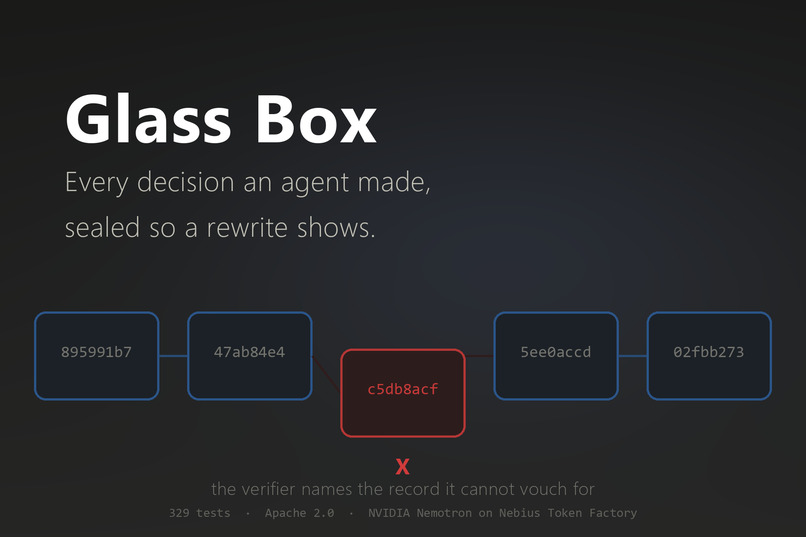
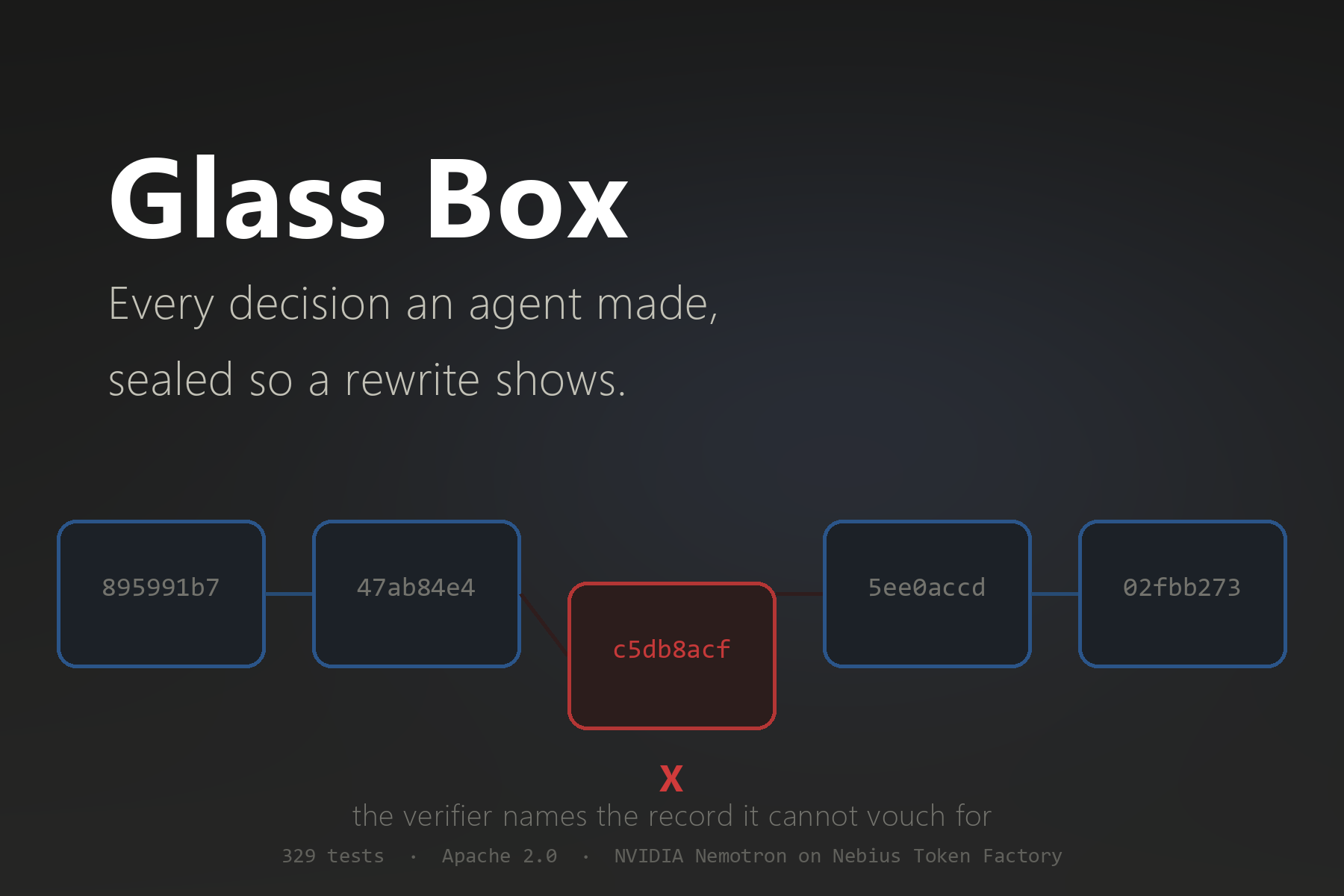
Glass Box: an agent's decisions, sealed. Edit one record and the verifier names it
Inspiration
Everyone is deploying agents. Nobody can say why their agent did what it did.
The tools we had traced model calls — the prompt, the response, the latency, the cost. That is useful for debugging a phrasing and useless the day an agent wrote to a file it should not have touched, sent a message it should not have sent, or spent a thousand dollars in an afternoon. The three questions you ask then have no answer:
- What information was this decision standing on? Not which prompt — which document, fetched when, from what address.
- Would it do the same thing today? Without a deterministic replay you cannot tell a bug from a sampling accident.
- Is this log telling the truth? A log that can be edited afterwards is not evidence, it is testimony.
What it does
A Python library you attach to an existing agent in three lines, plus a read-only viewer.
- Records decisions, not calls. A decision carries what it read (the bytes, by hash), that it asked a model and at which tier, what it did, and what it cost. Deliberately not the prompt: the information a decision stood on is the evidence, addressed by content, and a prompt log is the thing every other tool already keeps.
- Chains them. Each record commits to the previous one, so removing or
editing an entry breaks the chain and
glassbox verifynames the first record that does not hold — "something is wrong somewhere" is not a finding. - States what the chain does not prove. An adversarial bench
(
scripts/adversarial.py) runs thirteen attacks against a real ledger and publishes the four that get through: truncation, rollback, a forged append, and a full rewrite by whoever holds the writer. They share one cause — a chain proves that the records it holds follow one another, and nothing about records it does not hold.glassbox headprints the count and head hash for someone else to record, andverify --expect-count/--expect-headcatches all four. The condition is stated rather than implied: that commitment is worth something only if the party holding it is not the adversary. - Replays.
glassbox replayre-runs the rule over the evidence each decision cited, and says plainly when that proves nothing. - Traces an action back to a byte.
glassbox tracewalks from "the agent did X" to the document that caused it. - Measures what tiering costs and buys. The router tries the cheap model first and escalates on a signal that means something — two samples disagreeing — and the ledger records which asks escalated and whether the answer changed.
Nothing in the viewer computes anything of its own: the chain banner is
Ledger.verify(), the totals are Ledger.stats(). The page cannot claim
something the command line would deny.
How we built it
Python, no runtime dependencies at all — json, hashlib, http.server,
urllib. That is a decision and not an accident: an auditing tool whose own
supply chain is a dozen packages is arguing against itself, and anyone can read
in full what this one sends.
The model side is glassbox/nebius.py, 40 lines of urllib against Nebius
Token Factory, calling three NVIDIA Nemotron 3 tiers — Nano 30B, Super
120B, Ultra 550B — on their public endpoints. Cost is computed from the usage
block the API returns, never estimated over the prompt: a recorded number that
drifts from the bill is worse than no number.
The viewer binds to 127.0.0.1. A decision ledger is an agent's most sensitive
artifact, and the hosted demo for this submission is one published snapshot
that says so on its own page.
Challenges we ran into
The two worst defects in this project were found by using it, not by reading it, and neither was visible to the suite. Both were in the product's own thesis.
- Our auditing tool wrote credentials into a ledger its design makes
unerasable.
redact.pyopens by explaining that an append-only, hash-chained journal cannot be scrubbed afterwards without breaking the chain, so a secret must be redacted before it is written. The recorder then wrote an action's parameters in raw —act("call-api", token=...)landed verbatim and sealed. The line immediately below it redacted the same dictionary for the outcome text: the copy was protected and the original was not. Found by pushing one secret through every channel into the ledger and grepping for it; evidence, refusals, outcomes and the error path were all clean. 186 tests were not, because not one of them put a secret in an action. Redaction now walks the structure — keys as well as values, nested dictionaries and lists — whileretries=3stays the integer 3, becausestr(fields)would have fixed the leak and turned every number into text. - "The chain holds" was true of nine fields and nothing else. The chain
hashes an allowlist, so that adding an optional field would not invalidate
every ledger already on disk. The cost of that choice is that a key outside
the list is hashed by nothing: appending
"severity": "benign"to a sealed record leftverifyreporting a chain that holds. Every test mutated a field the chain already knew about, so the gate could only fail in the direction it was built to fail in.verifynow names the record and the unhashed fields and exits non-zero — without calling it an edit, because a newer writer may simply know a field this reader does not. It does not call the record intact either: a verifier that cannot account for part of a record has no business doing so. - The first real run found a bug in the escalation signal. "Yellow" and "yellow" counted as a disagreement, and sent a question about the colour of a banana to a model that costs twelve times more, which confirmed the same answer. Comparison is normalised now — the comparison only; the recorded answer is always what the model actually wrote. Escalations fell from 5 to 2 and cost from $0.0048 to $0.0029 on the same twelve questions.
- Two runs at a non-zero temperature are not a controlled experiment. The banana case is certain; the size of the saving is not, because part of that gap is sampling noise. Both numbers are published as measured, with that sentence next to them.
- Nemotron reasons before it answers, and when
max_tokensruns out inside the thinking the API returns a well-formed response withcontent: null. Our client crashed there on the first attempt; a fourteen-day run would have died on one truncated answer. The text is inreasoning_content. - A model id copied from a product page is a 404. Two of our three tiers
differ between the displayed id and what
GET /v1/modelsreturns. We only got it right by calling the endpoint and comparing. - Temperature zero would have made the whole measurement meaningless. The escalation signal is two samples disagreeing; at zero they never disagree, the check never fires, and a check that cannot fail proves nothing. The library refuses the setting rather than reporting a perfect agreement rate.
Accomplishments that we're proud of
The numbers are measured on real models and read off the ledger afterwards with
glassbox stats, not printed at the time — which is the same discipline the
product asks of its users. Twelve asks, $0.0029, two escalations, and the answer
changed in half of them. The 30B model answered Paris, 17 is prime and
seven continents alone; only is a hot dog a sandwich went to the 550B. That
is the whole idea working.
329 tests, no runtime dependencies, and every command that reads a ledger exits non-zero when there is none — printing an empty table would read as "nothing happened" rather than "nothing was recorded", which is the one confusion this project exists to prevent.
What we learned
A record nobody can check is a story. The hash chain was the easy part; the
hard part was making every surface refuse to overstate. The viewer recomputes
instead of caching. replay says when it proves nothing. The published snapshot
names what it is. Each of those started as a place where the tool would have
sounded more confident than it was entitled to be.
And one about measurement: our own escalation number was wrong the first time, and it was wrong in the flattering direction — it made the expensive tier look necessary. A project that publishes a saving has to be most suspicious of the run that makes it look good.
And the one we will carry into the next project: a suite proves the rules it was written from, and only those. Ours was green through both defects above, and green for the same reason in each — every test mutated something the code already knew to look at. The two holes were in what the code did not know to look at, and the only way we found them was to behave like a user: push a secret down every path that reaches the ledger, and edit a sealed record the way someone covering their tracks would. Neither took an hour. Both were invisible from inside the test suite that had grown to 186 cases around them.
What's next for Glass Box
External anchoring is now the first item rather than a nice-to-have, and the
adversarial bench is why. head closes the four attacks the chain misses, but
only for a reader who recorded the commitment beforehand; anchoring a head to a
timestamping authority removes that precondition and adds the one thing nothing
in the file can give — proof of when a record was written.
Then: recording a real agent in production rather than a measurement harness, and the dedicated-endpoint Nemotron models, which need a deployment rather than a public endpoint.


Log in or sign up for Devpost to join the conversation.