-
-
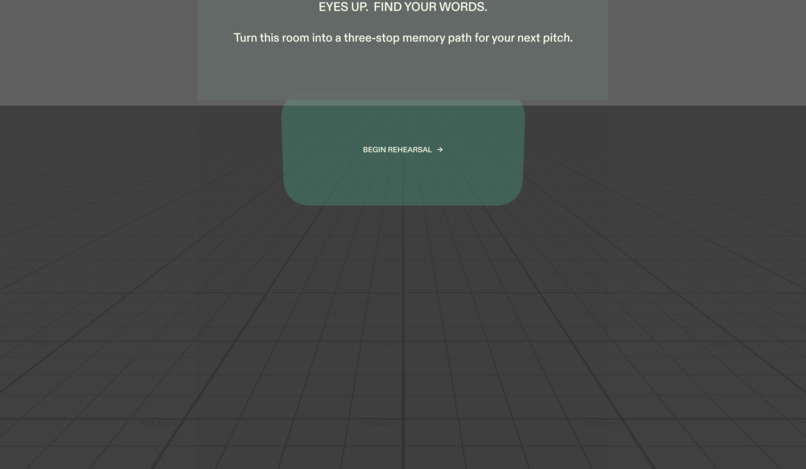
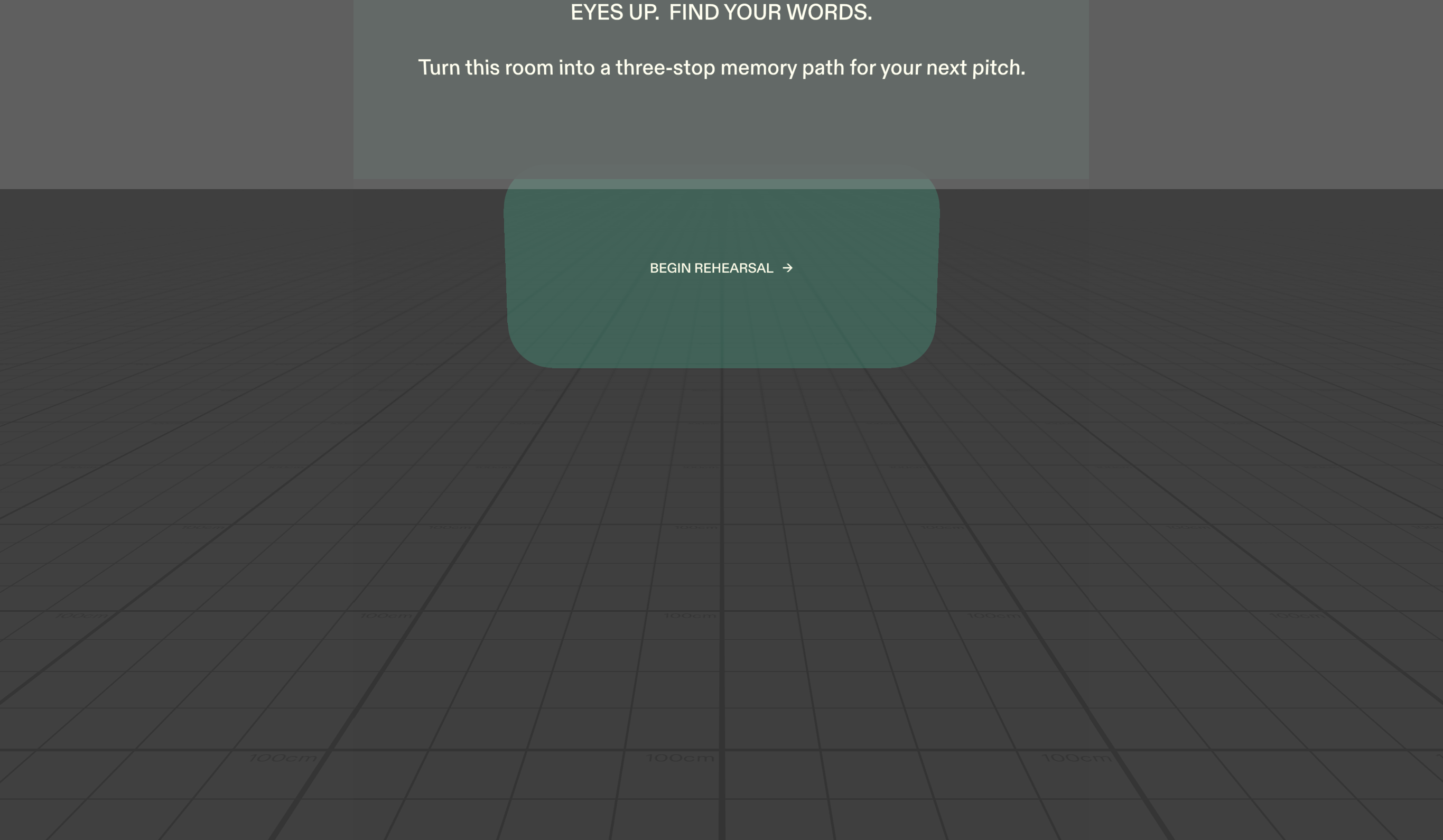
Native SPECS 27 Lens Studio Interactive Preview — GlanceTrail Welcome
Inspiration
Presentation notes help speakers remember their words, but they pull attention toward a phone or laptop and away from the audience. GlanceTrail uses something a flat screen cannot: physical location as part of memory. Ideas become places in the room instead of paragraphs to read.
What it does
GlanceTrail is a spatial rehearsal coach for SPECS. It places three luminous pitch anchors—Problem, Proof, and Ask—across a comfortable arc at eye level.
During the guided first run, only the active idea expands into a concise cue ribbon. A pinch reveals optional detail or advances to the next beat. Completing Ask connects all three anchors into a visible memory trail.
The second run removes persistent sentences and leaves only spatial symbols. If the speaker hesitates, a rescue hint reveals the short cue for about two seconds. A directional indicator guides the speaker back when the active cue moves out of view. The final completion state can reset the whole experience cleanly.
How we built it
The Lens was planned with the Devpost Learn design workflow and implemented as a native SPECS 27 Lens Studio 5.24.1 project. The TypeScript architecture separates content, UI composition, audio behavior, and a deterministic state controller. Spectacles Interaction Kit interactables handle pinch targets, while native preview-tap fallbacks make the flow testable without hardware. A 120 ms deduplication seam prevents SIK and native preview input from advancing twice.
The visual system uses translucent milk-glass panels, porcelain text, warm champagne highlights, coral, cobalt, and mint. The layout stays inside a compact field of view and avoids black fills that disappear on additive optical displays.
Verification includes seven passing Node tests covering every done criterion plus duplicate-input regression. The packaged Lens compiled successfully in Lens Studio, and the full Welcome → guided rehearsal → connected trail → symbol-only rehearsal → timed hint → completion → reset flow was exercised in native Interactive Preview.
Challenges
The largest design challenge was avoiding a floating teleprompter. We reduced persistent text, showed one decision at a time, and made the second rehearsal depend on spatial recall. Engineering challenges included additive-display contrast, reliable pinch targets, and preventing two preview input sources from firing the same transition twice.
What we learned
Good glasses experiences depend on subtraction. Every object must earn its place in the field of view. A stable spatial path can support memory while keeping the speaker's hands free, posture natural, and eyes connected with the room.
Honest limitations
The controller behavior and native preview flow are verified, but long-duration comfort, outdoor tracking, and spatial audio in noisy rooms require physical SPECS hardware. LEAF automation is preserved as a deferred draft and is not claimed as executed.
Built With
- ar
- lens-studio
- node.js
- sik
- specs
- spectacles-interaction-kit
- typescript
- uikit
