-
Glacier
The Ghost in the Chain: Why Construction Delays Are Non-Linear (And How We Built Glacier to Fix Them)
Every project brief starts with five seemingly simple questions: What's approved? What's being fabricated? What's delayed? Where is it now?
And finally, the trillion-rupee question: Will it arrive when we actually need it?
If you've ever worked on an Indian construction project, you know that last question is a trap. Nobody can answer it.
When we mapped out the journey of a single structural steel order, we discovered a labyrinth of nine distinct handoffs:
site indent → GM approval → finance advance → purchase order → drawing approvals → fabrication → payment milestone → dispatch paperwork → transport → site gate
The real tragedy? Each stage lives in its own isolated universe. The site engineer only sees the indent. Finance only looks at the payment queue. The vendor is staring at the shop floor, and the transporter is looking at the highway. Communication happens via frantic phone calls, messy WhatsApp forwards, scribbled paper registers, or someone's pure memory.
Nobody can see the whole chain.
The Epiphany: Delays Don't Add Up, They "Snap"
While staring at this broken chain, we realized why traditional project management software fails so spectacularly in the real world. Delays in construction don't just add up linearly (2 + 2 = 4). They snap to the next available batch (2 + 2 = 21).
Think about how a project actually breathes:
- Finance runs payments on specific days. Miss the Friday cutoff by two hours? You wait seven days.
- Fabricators schedule production slots weeks in advance. Miss yours by a day? Your order gets pushed back two weeks.
- Festivals like Diwali completely freeze the entire logistics and labor industry for a fortnight.
Because of this, a minor 2-day administrative delay at the GM's desk quietly morphs into a devastating 21-day delivery slip at the site gate — without a single person technically making a "mistake." No standard tracking dashboard models this butterfly effect. That's why construction delays always feel so sudden, unpredictable, and punishing.
What Glacier Does: The Material Control Tower
We built Glacier to act as an intelligent control tower for construction materials. At its core, every single PO line-item gets a Material Passport — a digital, stamped timeline tracking all ten stages with clear ownership, planned vs. actual dates, hard evidence, and root-cause delay tagging.
We built three intelligent layers on top of this data:
1. Sense: Translating Chaos into Data
Construction sites are messy, and you can't force a truck driver or a vendor to log into a complex ERP. Glacier ingests the chaos as it is. We built a pipeline that takes Hindi voice notes and WhatsApp photos from vendors, passing them through speech recognition and LLMs. Formal documents like POs, e-way bills, and test certificates go through OCR.
"GM sahab kal tak approve karenge" (The GM will approve it by tomorrow) automatically transforms into a structured data event, with the original voice note pinned right next to it as unarguable evidence.
2. Predict: Factoring in the Friction
Glacier learns the specific "rhythm" of your project ecosystems — the payment cadences, review batches, production slots, and holiday calendars. Instead of just adding days together, it rolls any minor slip through every downstream batch boundary to calculate the real arrival date.
It also calculates a PO Health Score by cross-referencing your PO price against the live JPC TMT steel index. If a vendor is losing money on your order due to market shifts, Glacier flags them as a flight risk long before they go radio silent.
3. Decide: Calculating the Financial Exposure
Glacier treats your project schedule as a live dependency graph. The moment a delay is predicted, it recomputes the critical path to show you exactly how many days will be lost and your total financial exposure.
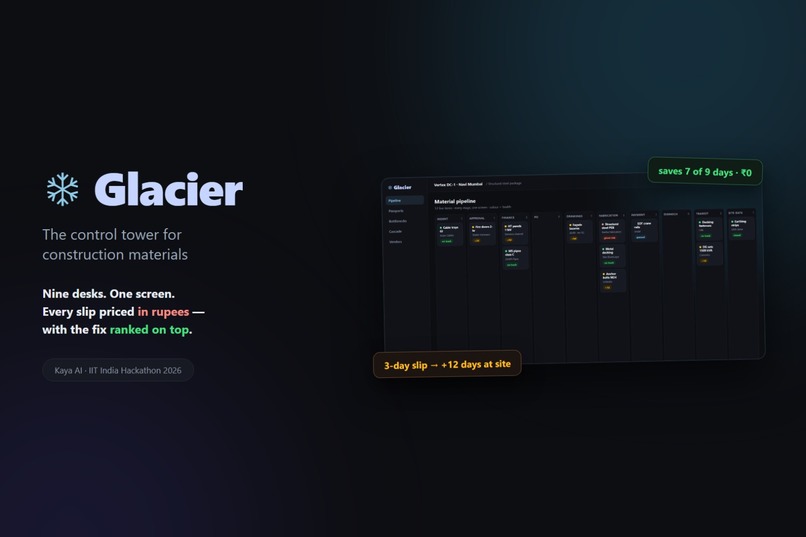
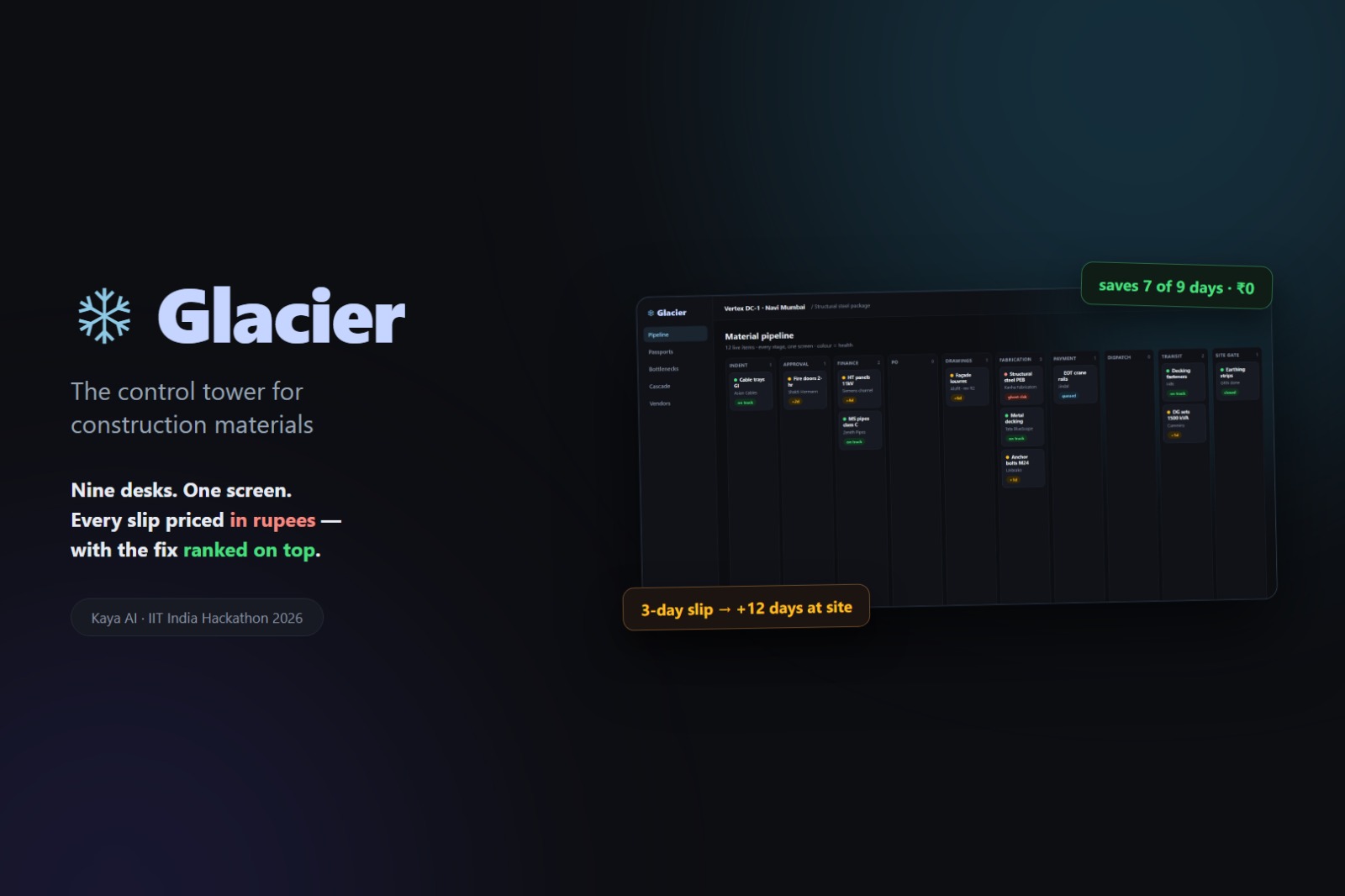
More importantly, it ranks fixes. For example, our demo highlights a minor 3-day quality control slip that quietly compounds into a 12-day delay on-site, threatening a ₹42 lakh exposure. Glacier's top recommendation? An internal, zero-cost fix: pre-release the dispatch payment today, bypass the weekly finance bottleneck, and claw back 7 of those 9 lost days.
How We Built It (And the Scars to Prove It)
We built Glacier in a grueling 36-hour sprint using Next.js and Recharts for the front-end dashboard, backed by a FastAPI service where Python handles the speech processing and the complex critical-path math (networkx). To prove the concept, we generated a hyper-realistic seed project: structural steel moving through all ten stages for an Indian data center build.
[Messy Inputs] -> (WhatsApp / Voice / OCR) -> [Sense Layer]
                                                    |
[Batch Calendars] -> (Holidays / Finance Runs) -> [Predict Layer] -> [Decide (Live Graph)]
The Challenges We Faced
- Keeping the Math Honest: It was incredibly tempting to tweak the batch-alignment math to make the downstream delays look wildly dramatic for the sake of a good demo. We resisted that. We kept the math boring, transparent, and completely verifiable.
- The Accents of the Supply Chain: Getting speech recognition to accurately parse raw, noisy, vendor-style Hindi voice notes was an uphill battle. We pushed IndicASR to its limits and kept a Whisper fallback ready just in case.
We also held ourselves to a strict discipline: label everything. If a feature runs live in the demo (like the voice pipeline or the waterfall cascade), it's real. If it's simulated for the hackathon (like live FASTag pings or ERP feeds), it says "simulated" right on the screen.
The Big Takeaway
Building Glacier taught us a massive lesson about heavy industry: on most construction projects, the biggest bottleneck isn't the highway; it's an internal approval desk.
Furthermore, supplier behavior is entirely modelable. If you pay a vendor's bill late this month, they won't yell at you — they will simply, quietly push your next order to the back of their production floor. Because of this, Glacier's reliability score doesn't just grade the vendor; it grades our own bill-passing history.
Traditional tracking tells you where the truck is right now. Behavioral intelligence tells you whether the truck was ever going to leave the factory on time in the first place.
What's Next?
We are moving toward a live pilot project. The next step is integrating directly into India's national logistics rails via ULIP. Once we link up with e-way bills and FASTag pings, Glacier will get passive, absolute ground truth with zero friction or adoption required from suppliers.
The rails we are building on are uniquely Indian. The brain behind it is entirely universal.
Developed by: Aarin Sheth & Tanvi Manhas | IIT Kanpur
Built With
- ai
- apis
- data-ingestion
- data-visualization
- edi
- eld
- erp
- eway-bills
- fastag
- fastapi
- llm
- logistics
- natural-language-processing
- networksx
- next.js
- ocr
- python
- recharts
- speech-recognition
- supply-chain
- ulip

Log in or sign up for Devpost to join the conversation.