-
-
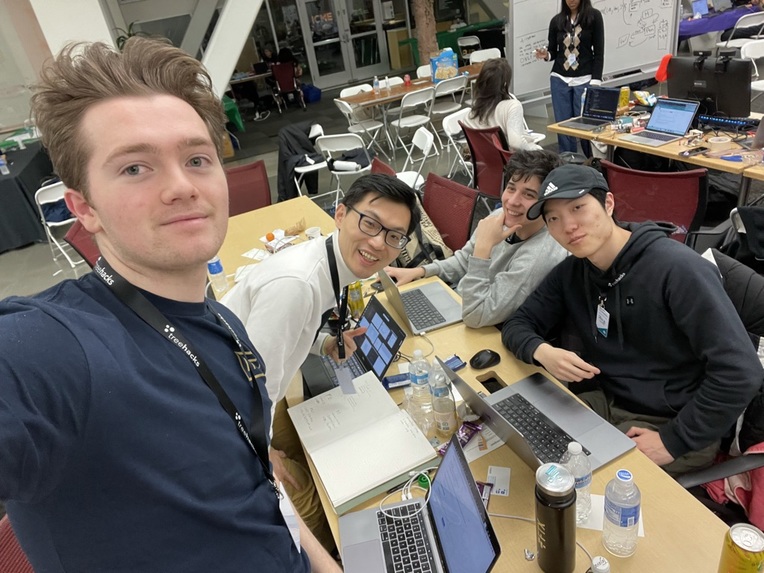
The 3 am grind!
Inspiration
America's unhoused have been underserved by financial technology developments and are in an increasingly difficult situation as the world transitions to electronic payments. We wanted to build the financial infrastructure to support our homeless populations and meet them at their tech level. That's why we focused on a solution that does not require the use of a phone or the ownership of any technology to function.
What it does
Our banking infrastructure enables the unhoused to receive electronic donations stigma-free (without having to use square or a phone). We provide free banking services to people who traditionally have high difficulty levels getting a bank account. Additionally, we provide great benefits for donators who use our platform by providing them tax write-offs for donations that were previously unrecognizable for tax purposes. For unhoused populations who use our web-app when checking their account status, we have built NLP-powered financial literacy education materials for them to learn and earn financial rewards. The local government interface we built using Palantir Foundry enables municipal clerks to go directly to those who are the most in need with tax distributions.
How we built it
We built Givn using Palantir Foundry and Next.js for front-end, Firebase (NoSQL) and Express/Vercel for backend, and Unit APi and GPT-3 API. We piped in transaction data that we tracked and created through our Unit banking system into Palantir Foundry to display for local government managers. We used GPT-3 to create financial literacy content and we used Next.js and firebase to run the transaction system by which donators can donate and unhoused populations can make purchases.
Challenges we ran into
We had significant challenges with Foundry because Foundry is not a publicly available software and it had a steep learning curve. Cleaning and piping in census data and building our own API to transfer transaction data from our core product to Foundry for local government operators to take action on was the most difficult part of our Foundry integration. We eventually solved these issues with some creative PySpark and data-processing skills.
Accomplishments that we're proud of
We are proudest of our core product--a debit card that enables electronic payments for the unhoused. We believe that the financial infrastructure supporting unhoused populations has been lacking for a long time and we are excited to build in a space that can make such a large impact on people's financial well-being. From a technical perspective, we are the proudest of the API and integrations we built between Foundry and our core product to enable municipalities to understand and support those who are in need in their community. Specifically, municipal clerks can monitor poverty levels, donation levels, average bank account savings, and spending of the unhoused--all while protecting the identity and anonymity of unhoused populations.
What we learned
We learned so much! Our proficiency with Foundry is quite strong after this weekend--pushing out a functional product with technology you had never worked with before will do that to you. We also learned how to build embedded banking systems with the Unit API and their affiliated banks--Piermont Bank, Thread Bank, Blue Ridge Bank, and Choice Bank. A few members of our team became more familiar with some areas of the stack they hadn't worked with before--front-end, back-end, and the OpenAI API were all refreshed for a few of our members, respectively.
What's next for GIV
We plan to continue building Givn until it is ready for deployment with a local government and a go-to-market apparatus can be spun up.
Built With
- express.js
- firebase
- foundry
- gpt
- next.js
- react.js
- tailwind
- unit
- vercel


Log in or sign up for Devpost to join the conversation.