GiveFive
Kindness, one swipe at a time.
1. Project Title
GiveFive — Kindness, one swipe at a time.
2. Select Your Theme
Primary theme: Social Impact & Community Innovation
Interdisciplinary note: GiveFive also touches Product & Industrial Design (the swipe-based interaction model that removes commitment friction) and Marketing & Brand Innovation (gamified impact tracking as a retention mechanism). But its core purpose is social — mobilizing help that otherwise never happens — so Social Impact is the right primary category.
3. Problem Statement
Most people want to help others, but "volunteering" as a category almost always implies a real commitment: showing up somewhere, signing up weeks in advance, blocking out hours. That threshold quietly filters out the vast majority of people who would help if it cost them five minutes, but won't organize their week around it.
Meanwhile, a huge number of real needs are small, not large: someone needs a confusing form explained, a paragraph proofread, five minutes of company on a call, a quick mock interview before a job application. These needs are too small to justify a formal volunteer program, but too real to ignore — and they currently fall through the cracks entirely.
Who's affected: people with small, immediate needs who have nowhere to turn (students, elderly people navigating bureaucracy, non-native speakers, first-time job seekers) — and, on the other side, the much larger pool of would-be helpers who are excluded by the size of the ask.
Why current approaches fail: existing volunteering platforms (Idealist, VolunteerMatch, local nonprofit sign-up sheets) are built around scheduled, multi-hour commitments. They're designed for the "big ask" — a shift, an event, a recurring role. None of them are built for the small ask, so the small asks simply never get made, and a large amount of low-effort, high-impact goodwill goes untapped.
4. Proposed Solution
GiveFive turns micro-volunteering into a swipe-based app, similar in feel to a dating app, but for five-minute acts of help instead of matches.
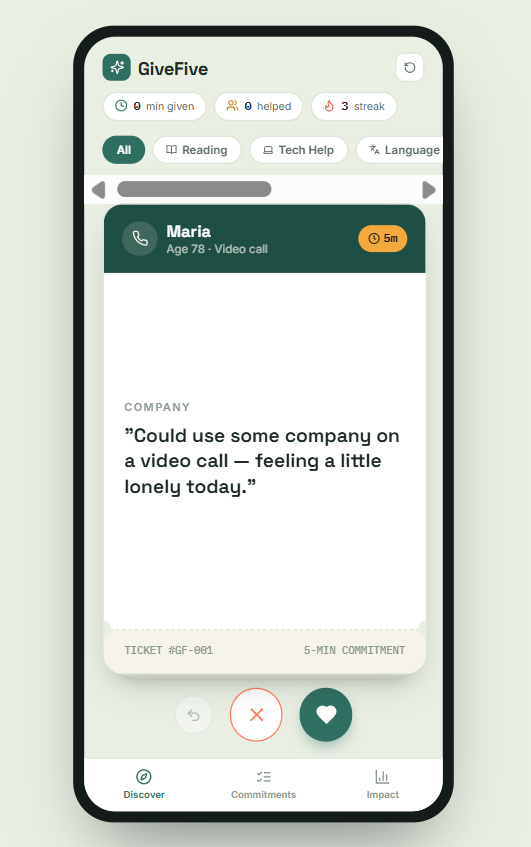
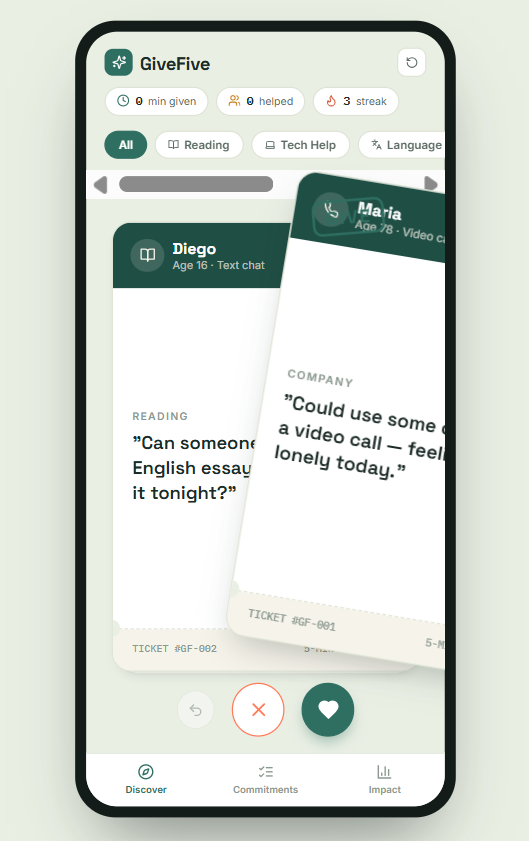
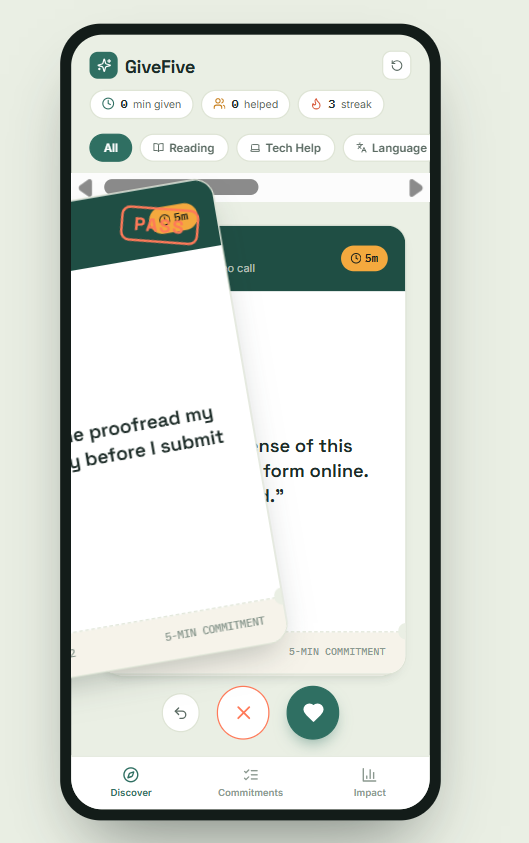
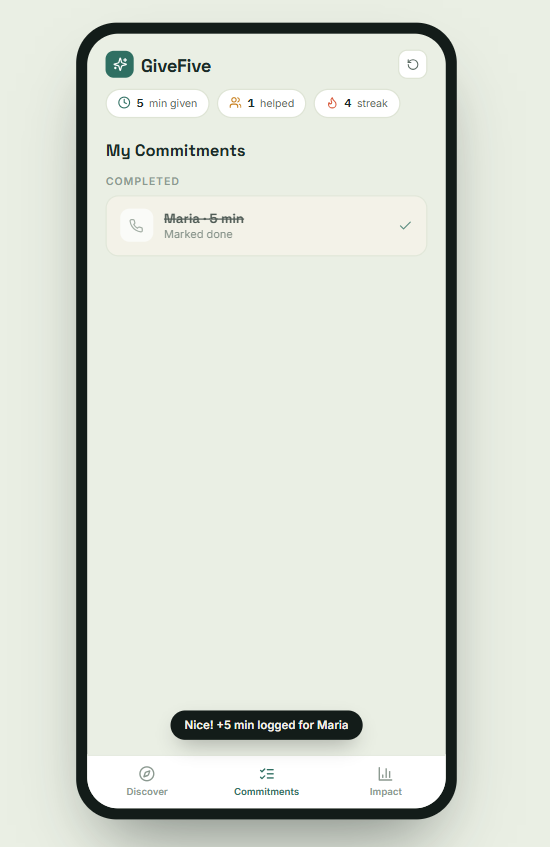
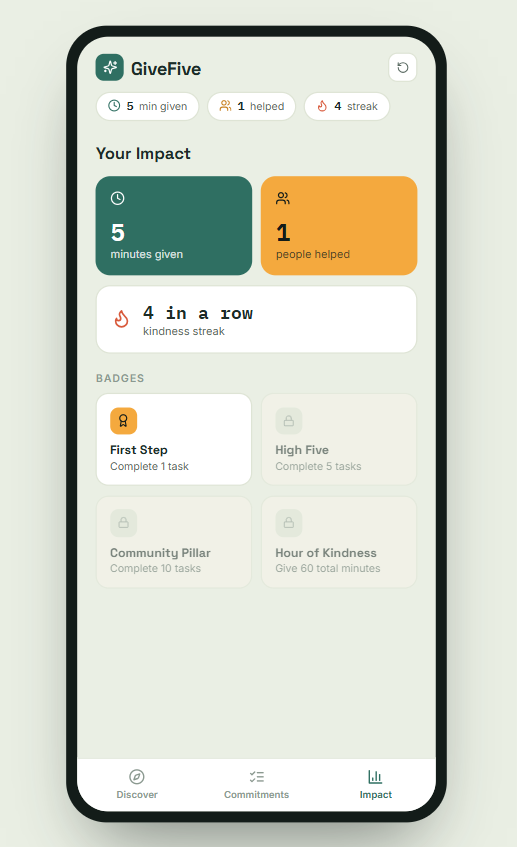
Every task is posted as a card: a short, specific, time-boxed request — "Proofread this cover letter paragraph," "Explain this insurance form," "Do a 5-minute mock interview," "Keep me company on a call while I wait for test results." Helpers swipe right to commit, left to pass, and can filter by category (writing, tech help, conversation, forms, etc.). Once committed, the loop is intentionally short: see the task, do the task, mark it done. Over time, users build a visible impact record — total minutes given, people helped, a streak, and unlockable badges — turning small acts into a sense of accumulated contribution.
Who uses it: on one side, anyone with a small, real need they don't want to ask a stranger on the street for (or don't have anyone nearby to ask). On the other, anyone willing to give five minutes between other things — waiting for a bus, on a coffee break — without signing up for anything bigger.
What makes it different from existing alternatives: existing platforms optimize for matching people to roles. GiveFive optimizes for matching people to moments — it treats five spare minutes as a resource worth capturing, the same way a swipe app treats five spare minutes of attention as a resource worth capturing.
5. Innovation & Uniqueness
The innovation isn't a new category of help — proofreading, explaining forms, and quick conversations aren't novel acts. It's a new unit of commitment. By shrinking the atomic unit of volunteering from "a shift" or "an event" down to "five minutes," GiveFive unlocks a pool of willingness that no existing platform is designed to capture.
This comes from combining a few ideas that don't normally sit together:
- A dating-app interaction model applied to altruism — swipe-to-commit borrows a mechanic optimized for fast, low-friction decisions and repurposes it for good instead of matchmaking.
- A gamified impact ledger (minutes given, streaks, badges) as the retention mechanism, replacing the guilt-based or duty-based motivation that traditional volunteering relies on.
- Radical task-size discipline as a design principle, not just a technical constraint — the product deliberately refuses to host anything that can't be done in five minutes, which keeps the trust and effort bar low enough that "yes" becomes the default answer instead of something people have to talk themselves into.
The result is a new service model for volunteering: instead of asking "how do we get people to commit more time," GiveFive asks "how do we need less time from more people, more often."
6. Supporting Materials
- Working prototype: github.com/akaneme/GiveFive — a functional swipe interface demoing the full commit → complete loop, installable as a home-screen PWA
- Demo video: a short screen recording walking through the discover screen, swipe interaction, commitments tab, and impact dashboard
- Product screenshots: discover screen, commitments tab, and impact dashboard, showing the visual design system (ticket-style task cards)
7. Project Presentation
Expected users: two sides of a lightweight marketplace — "requesters" with a small, specific need, and "helpers" willing to give five minutes. No specialized skills or credentials required to help with most task categories.
Implementation process:
- Validate task categories and demand with a pilot community (see below).
- Build the trust/safety layer needed before opening this to strangers at scale.
- Launch as a PWA to avoid app-store friction for a first cohort.
- Partner with an anchor community to seed the first wave of real tasks and helpers.
Resources required: a lightweight identity/verification layer, and community partnerships to seed initial demand and supply (schools, libraries, community centers, immigrant-support organizations — places where small-need, low-trust-barrier requests are already common).
Potential challenges:
- Trust and safety at scale — the platform currently has no verification layer; this has to exist before opening beyond a trusted community.
- Cold-start problem — a marketplace needs both requesters and helpers present at once; solved by seeding through a single anchor community first rather than launching broadly.
- Task quality control — keeping every task genuinely doable in five minutes as the categories expand.
Expected outcomes: a measurable increase in small acts of help completed per willing helper (since the ask is smaller), and, longer term, a shift in how people think about "being helpful" — from an occasional, scheduled activity to something that fits into spare minutes of an ordinary day.

Log in or sign up for Devpost to join the conversation.