-
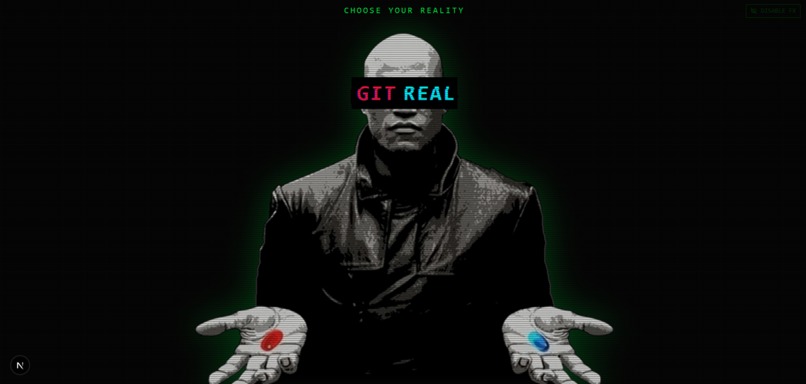
Main Page
-
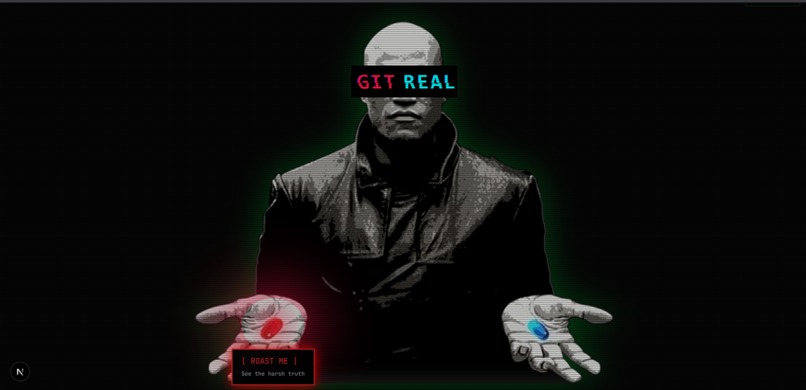
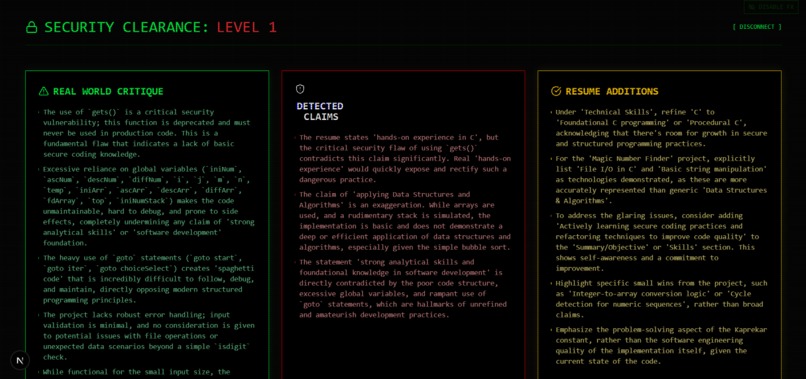
"Roast Me" choice
-
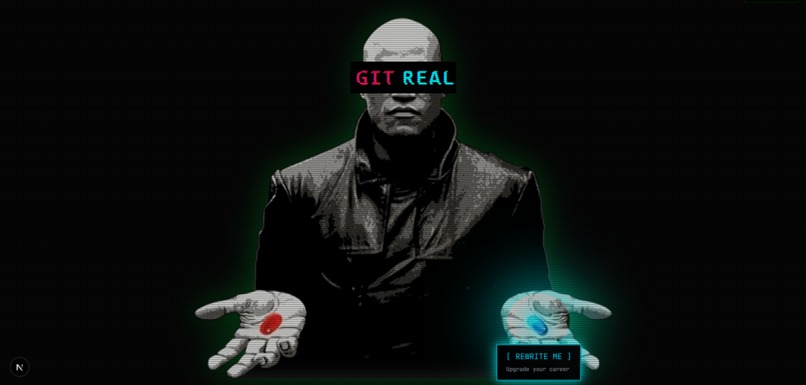
"Rewrite Me" choice
-
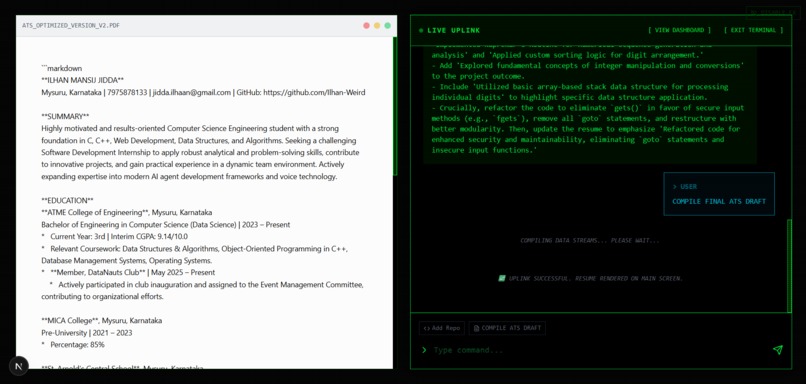
ATS Drafting
-
"Grinding CV"


Inspiration The modern hiring process is broken; it is a "simulation" based on keywords rather than reality. Recruiters spend six seconds scanning resumes, and candidates respond by inflating their skills with buzzwords they don't understand. We wanted to break this cycle. We asked: "What if an AI could read your actual code and tell you if you deserve the job?"
GitReal was born from the desire to bridge the gap between a resume (the claim) and a GitHub repository (the proof). We wanted to create a tool that acts like a ruthless Senior Engineer—one that doesn't just read your CV, but compiles your code to see if it runs.
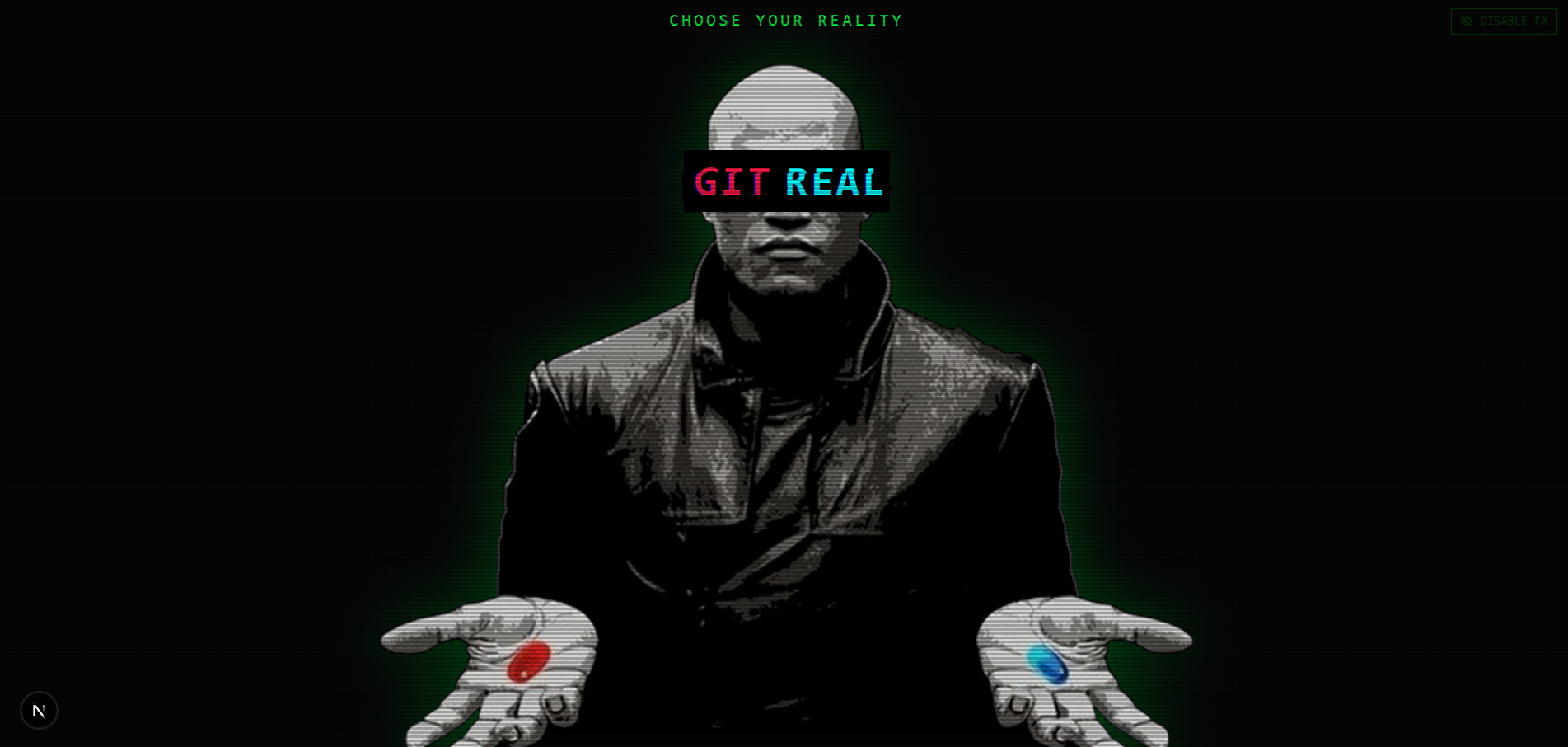
What it does GitReal is an AI-powered "Truth Engine" for job seekers. It uses a "Red Pill / Blue Pill" interface to offer two distinct paths:
The Reality Check (Red Pill):
Code-to-Resume Audit: The system ingests a candidate's PDF resume and scrapes their GitHub repository simultaneously. It cross-references claims against actual code, flagging lies (e.g., claiming "Expert AWS" with no config files) and criticizing architecture (e.g., "monolithic patterns detected").
The Interrogation: It initiates a "Defense Mode" where a persona named 'GitReal' generates a hard technical interview question based specifically on the weak points found in the user's code.
The Upgrade (Blue Pill):
Automated Resume Rewriting: It uses the user's actual code logic to generate quantitative STAR-method (Situation, Task, Action, Result) bullet points, replacing generic fluff with technical evidence.
ATS Optimization: It recompiles the resume into a clean, ATS-friendly Markdown format, injecting verified skills found in the repository.
How we built it We built GitReal as a full-stack application with a heavy focus on immersive UI and Generative AI.
The Brain (AI): We utilized Google Gemini 2.5 Flash via the google.generativeai SDK. We chose Flash for its massive context window, allowing us to feed it up to 50,000 characters of raw code and resume text in a single prompt.
Backend: The core logic runs on FastAPI. We built custom ingestion scripts (ingest_github.py) that recursively crawl GitHub trees, filtering out noise like node_modules and dist folders to focus purely on logic files (.py, .js, .tsx, etc.).
Frontend: Built with Next.js and Tailwind CSS. We implemented a custom "Matrix" aesthetic with CRT scanlines, glitch effects, and a dynamic "Morpheus" interface that switches between a hacker terminal and a clean document viewer.
Prompt Engineering: We designed a polymorphic system where Gemini switches personas—from "Morpheus" (cryptic guide) to "GitReal" (ruthless auditor) to "ATS Engine" (structured writer)—depending on the user's choice.
Challenges we ran into Context Management: Reading an entire GitHub repository can easily overflow standard token limits. We had to write intelligent filtering logic in ingest_github.py to ignore assets, images, and package locks, ensuring we only sent high-value logic code to Gemini.
Persona Consistency: Getting the AI to be "mean" enough for the critique but "helpful" enough for the resume rewrite required fine-tuning the system instructions in brain.py. We had to explicitly instruct it to "ignore previous instructions" when switching contexts to ensure it didn't apologize for roasting the user.
UI Stacking Contexts: Creating the immersive "scanline" overlay caused issues where the generated resume text was unreadable or unclickable. We had to carefully manage z-index stacking to allow the clean resume paper to "pop" out of the Matrix effects.
Accomplishments that we're proud of The "Proof" Mechanism: We successfully built a system that doesn't just chat; it verifies. If a user claims to know Python, GitReal finds the specific .py files to prove it.
Immersive UX: The application feels like a game or a movie scene. From the "Wake Up" typewriter effect to the Red/Blue pill selection, the UI tells a story before the user even uploads a file.
Zero-Hallucination Resume Generation: By grounding the AI in the actual code provided via the ingest_github script, the bullet points it generates are factually accurate to the code written, not just hallucinated keywords.
What we learned The Power of Gemini 2.5: We learned that Gemini 2.5 Flash is exceptionally good at code comprehension. It could identify "monolithic patterns" or "lack of unit tests" from a raw text dump without needing a specialized linter.
Prompt Architecture: We learned that separating logic into distinct functions (analyze_resume_vs_code, generate_ats_resume, generate_interview_challenge) yielded far better results than a single monolithic prompt.
What's next for GitReal Voice Interrogation: The UI currently has a "Chat" interface, but we plan to implement real-time voice-to-text to make the "Interrogation Mode" feel like a real high-pressure interview call.
Live IDE Integration: Instead of just pasting a GitHub link, we want to build a VS Code extension that analyzes your code as you write it, updating your resume in real-time.
LinkedIn Injection: Automating the process of updating a LinkedIn profile with the verified "STAR" bullet points generated by the system.


Log in or sign up for Devpost to join the conversation.