-
-
01-boot.png
-
02-select.png
-
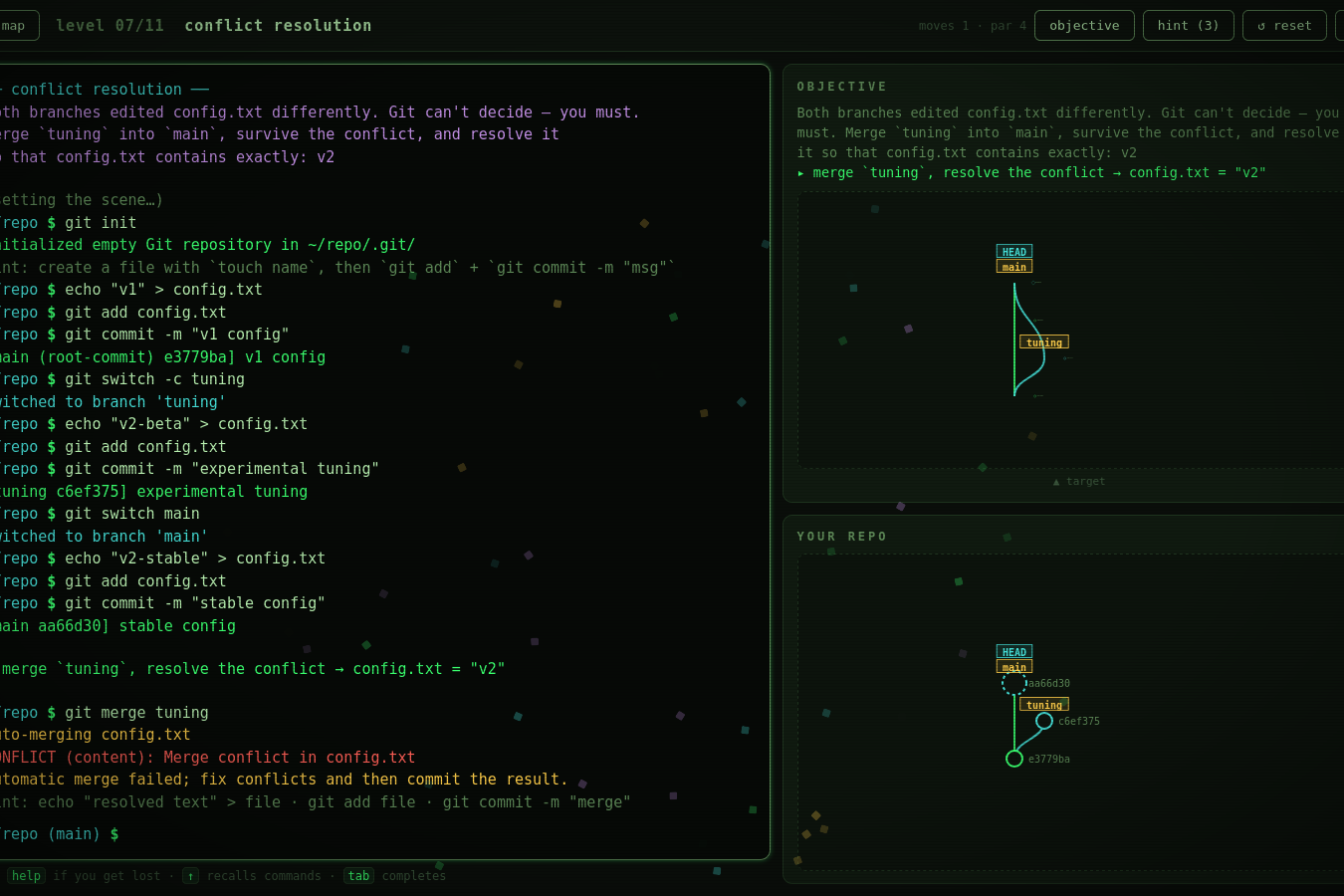
06-conflict.png
-
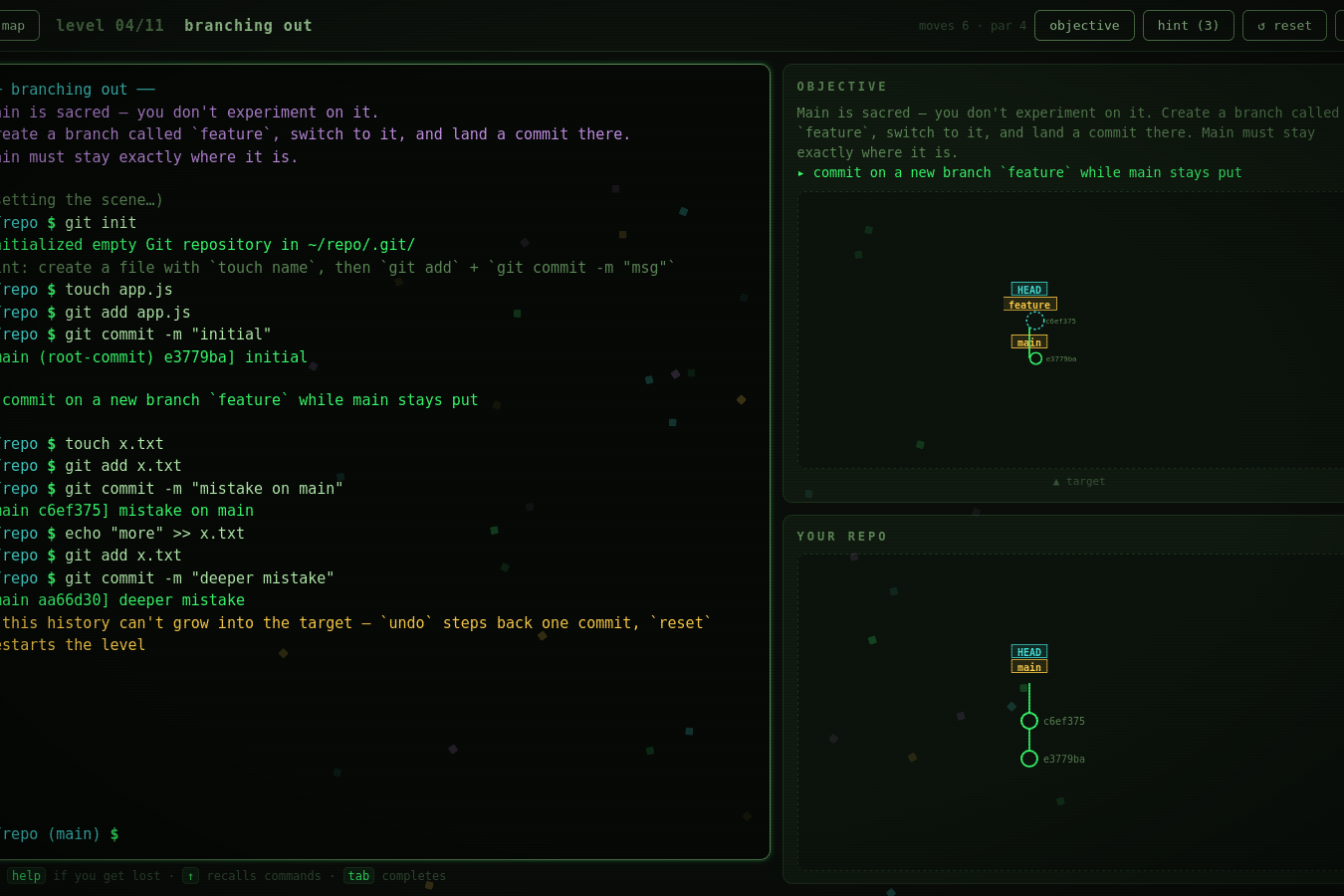
05-diverge.png
-
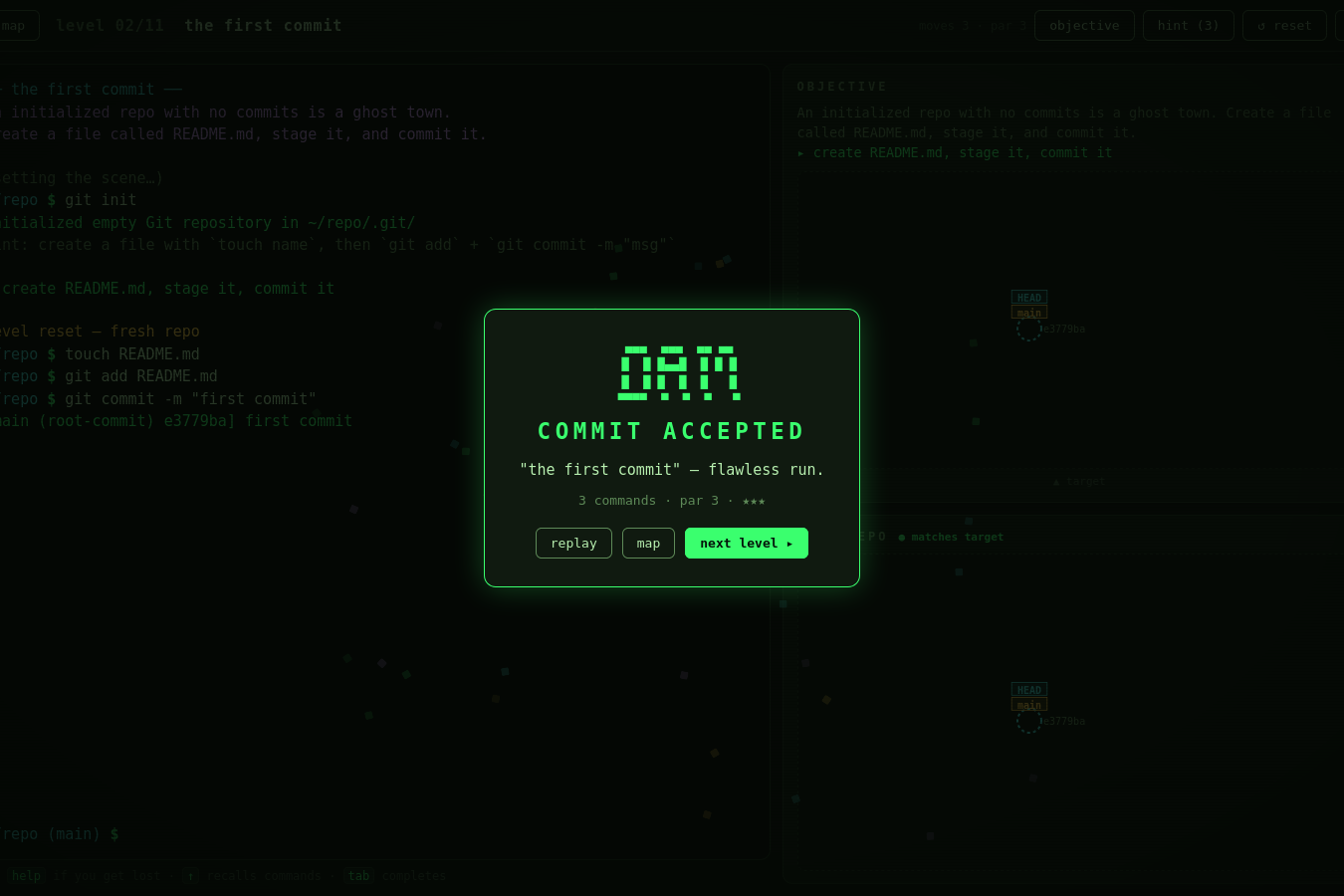
04-win.png
-
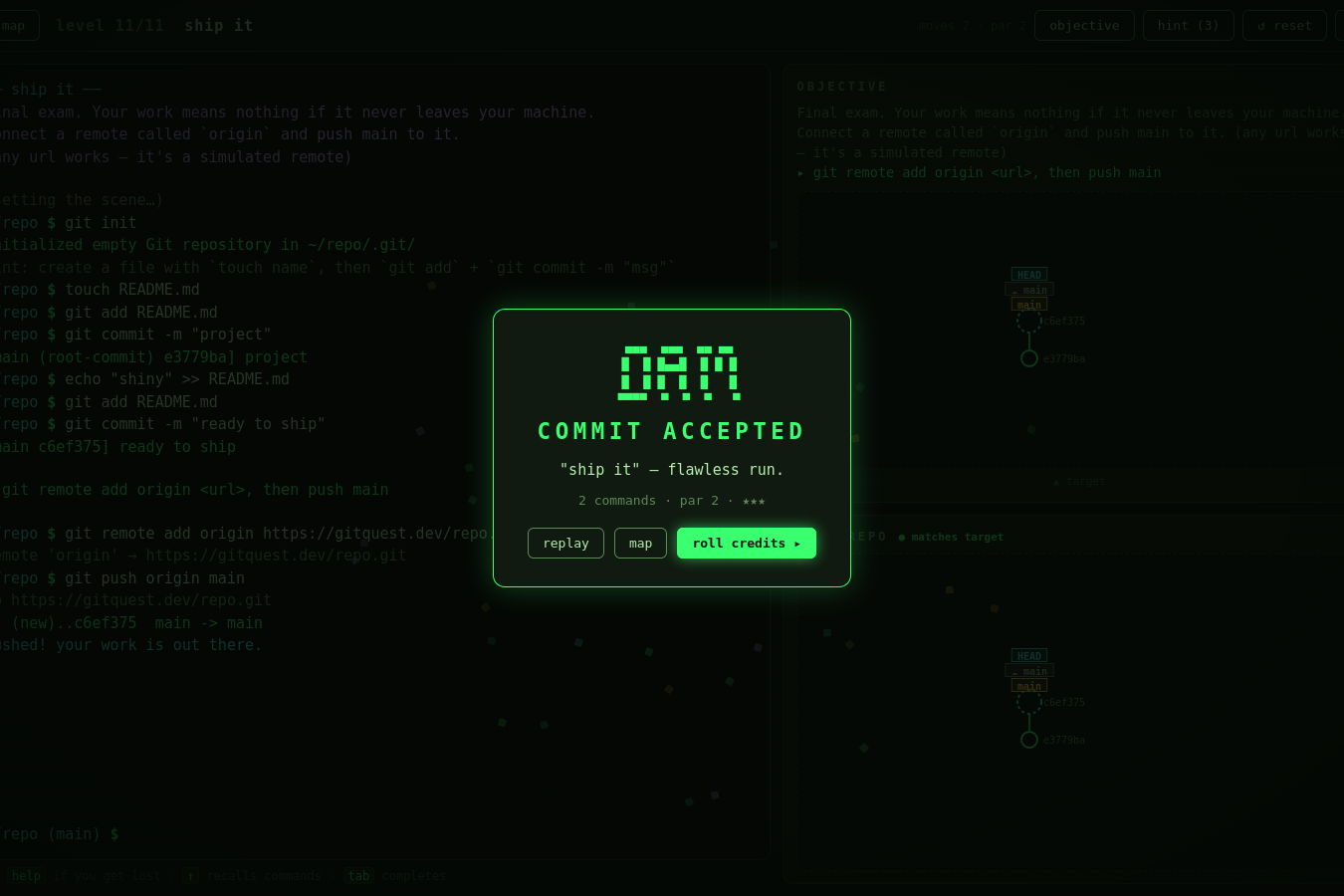
07-final-win.png
Inspiration
Every developer remembers their first week with Git — the wall-of-red errors, the cryptic man pages, the fear of typing the wrong flag into a repo you care about. Tutorials hand you commands to memorize, not a mental model to build. For a hackathon called FirstCommit, we wanted to build the thing we wish we'd had on day one: a game where your first commit is literally the first level, and where breaking things is not only safe — it's the point.
What it does
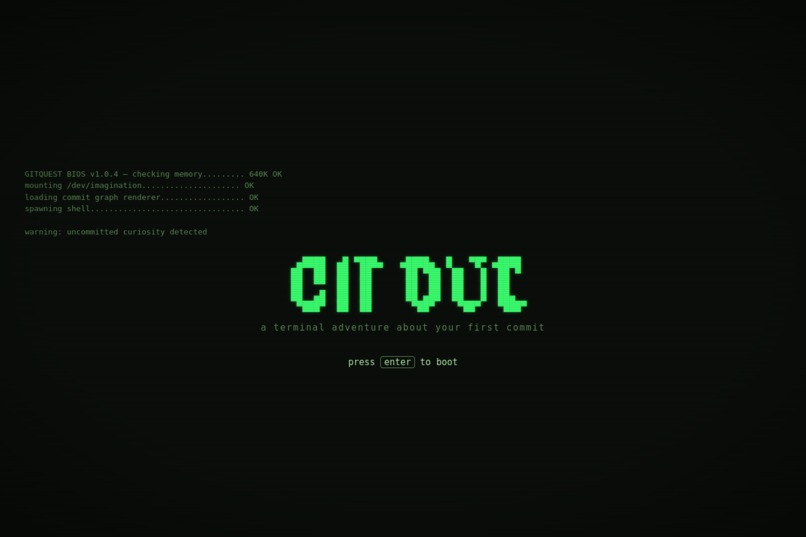
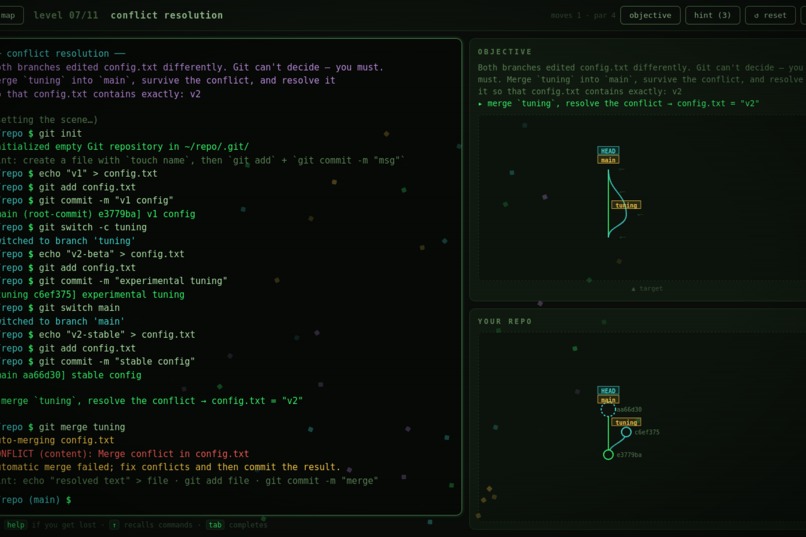
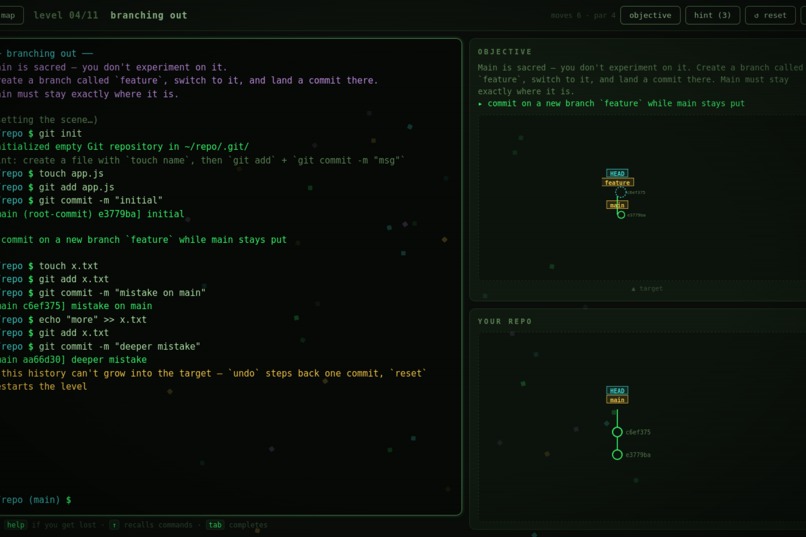
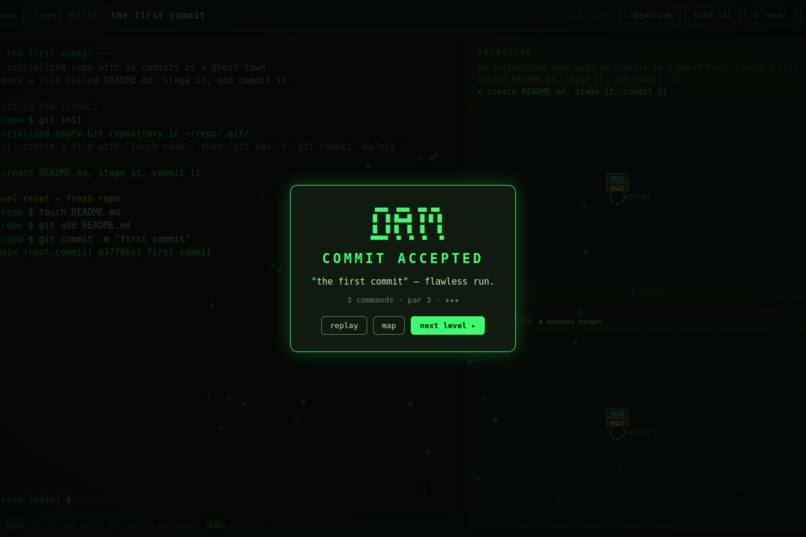
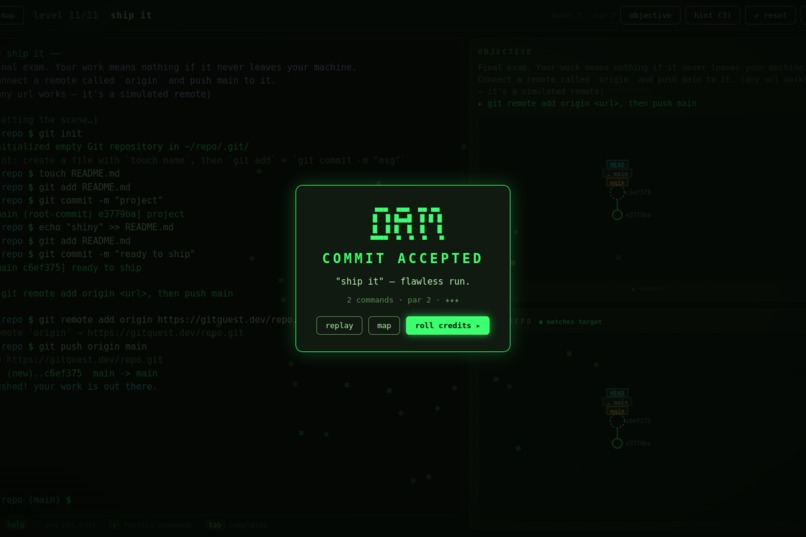
GitQuest is a terminal-styled browser game that teaches Git by letting you
play it. You type real git commands into a mock terminal — git add,
git commit, git switch, git merge, git rebase, git push — and a live
SVG commit graph draws itself beside you in real time.
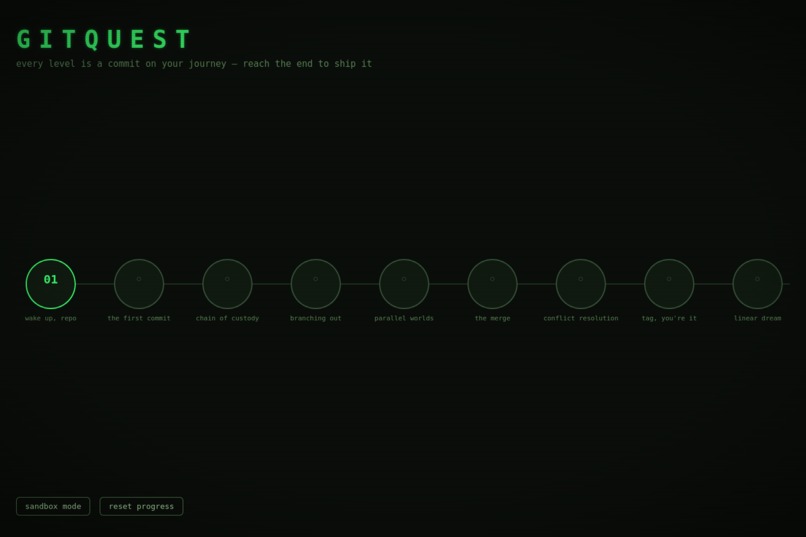
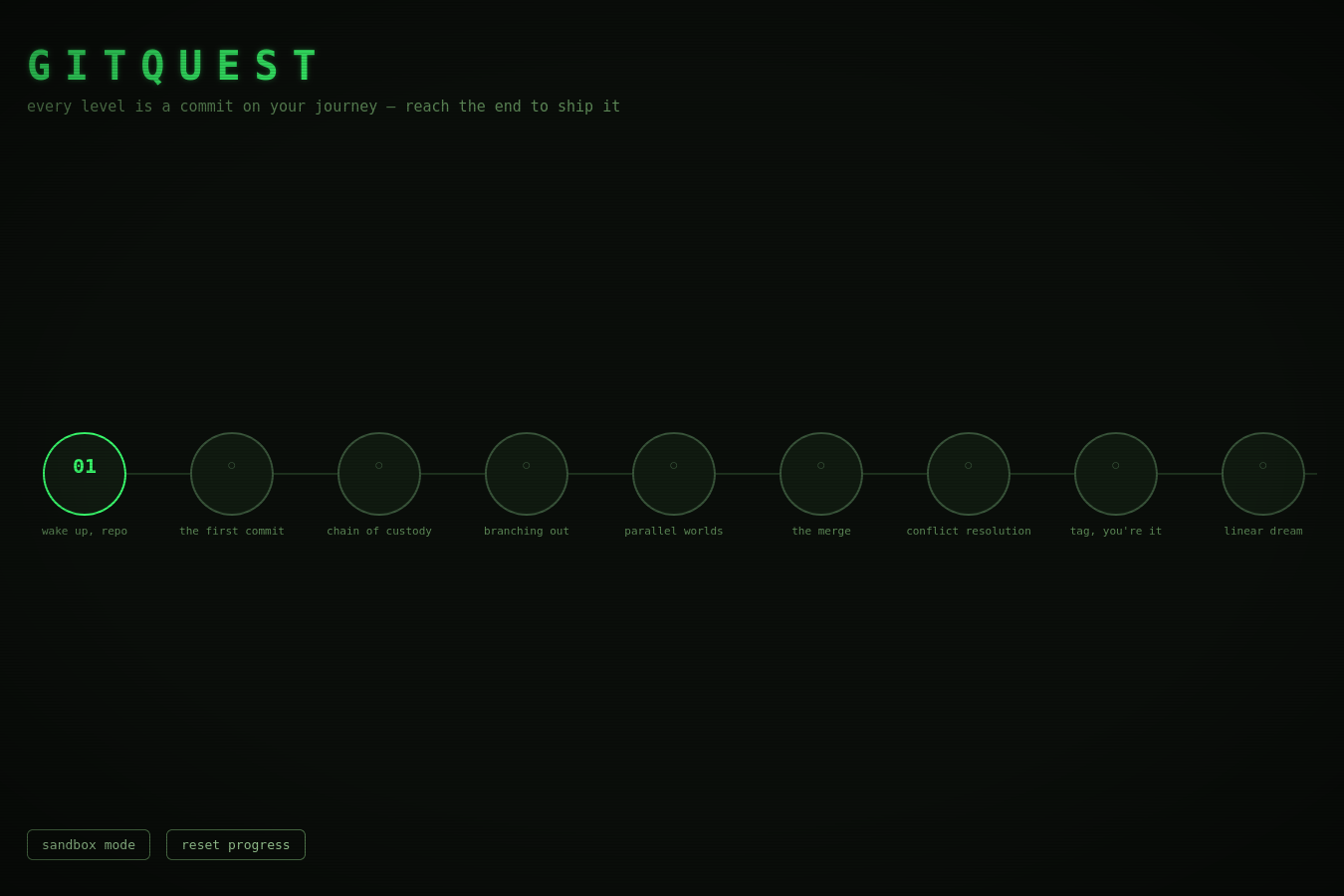
- 11 levels: from
git initthrough branching, merging, resolving a real merge conflict with markers, tagging, rebasing,reset --hardtime travel, and pushing to a fake remote. - Target graph per level — win when your repo's structure matches, not when you type the magic keystrokes. Any valid history wins.
- Safety nets for beginners: a
undometa-command that pops your last commit (even the root), automatic unreachable-commit garbage collection, and a warning the moment your history can no longer grow into the target. - Git-golf star ratings: finish under par for ★★★ — but peeking at
solutioncaps you at ★, because understanding beats copying. - Sandbox mode, tab-completion, command history, hints, WebAudio bleeps, scanlines — the whole phosphor-terminal fantasy.
How we built it
Zero dependencies, no build step — vanilla HTML/CSS/JS with ES modules, deployed as a static site on GitHub Pages.
The heart is js/engine/git.js: a real Git state machine, not a scripted
toy. It models commits, branches, HEAD (including detached), a staging area,
merge bases, fast-forward vs. true merges, conflict markers, rebases, tags,
and a fake remote — so everything you learn transfers to the real tool.
js/ui/graph.js renders the DAG with a hand-rolled lane-assignment layout
like git log --graph. js/engine/check.js decides wins by structural graph
equality (DAG isomorphism over commit topology, branches, HEAD, tags and
remote state), with a strict file-content mode only for the level where
content is the lesson.
It also tests itself: npm test runs 51 engine/level assertions in node —
including a proof that every level is solvable — and npm run playtest
drives headless Firefox through all 11 levels and every button: 31 checks,
plus screenshots. The demo video was produced the same way — a scripted
headless-browser pipeline (demo-recorder) with generated slides and TTS
narration.
Challenges we ran into
- The win condition was wrong twice. First, exact file matching punished
players for using
notes.txtinstead ofREADME.md— the history was structurally right and we still said "no." We split checking into topology (always) vs. strict content (only where it matters). Lesson: be strict where the pedagogy demands it, flexible everywhere else. - Beginners got stuck permanently. A stray commit before
git init'd correctly could make a level unwinnable with no way back. We added commit GC,undothat works on the root commit, and a divergence detector that warns the moment recovery becomes impossible — so a mistake costs you one keystroke, not the level. - Merge conflicts had to be real but fair. Simulating
merge, conflict markers, and resolution staging correctly enough to teach — while keeping it forgiving — took the most iterations (and a regression test for the "staged but markers still in the file" edge case).
Accomplishments that we're proud of
- A real merge conflict, resolved by you, in a tutorial that fits in a browser tab.
- 82 automated checks — every level provably solvable, plus a headless browser that plays the whole game itself and screenshots it.
- The diverge-warning + undo system: the game doesn't just let you fail, it notices when you've wandered somewhere unrecoverable and hands you the rope back.
- Zero dependencies.
git clone,python3 -m http.server, done.
What we learned
- How Git actually works under the hood — you can't fake merge bases, detached HEAD, or conflict resolution without understanding them first.
- That forgiveness mechanics are the pedagogy: the ability to safely undo is what turns fear of the terminal into willingness to experiment.
- Topological equivalence checking vs. literal matching — and when each is the honest answer.
What's next for GitQuest
- More levels:
stash,cherry-pick,revert, interactive rebase, remotes that push back (fetch/pullwith divergence). - Custom level sharing — the engine already supports arbitrary start/goal graphs; a URL-encoded level format would make every level a puzzle you can send to a friend.
- Localization and a proper mobile layout.
- Smarter hints that read your actual repo state, not just the level number.
Built With
- css3
- education
- game
- git
- html5
- javascript
- playwright
- svg
- web-audio-api

Log in or sign up for Devpost to join the conversation.