Inspiration
The hardest part of a hackathon is no longer writing the code. It is getting teams of AI agents to actually work together without tearing the repository apart.
Traveling to hackathons across the UK and Europe with large teams, I kept hitting the exact same wall. Everyone on the team was firing up autonomous coding agents across separate laptops on the same repo, but the agents had zero awareness of each other. They could not tap each other on the shoulder to say "hands off this function, I am refactoring it." Instead, they constantly blindsided each other, triggered ugly merge conflicts, and spammed dozens of broken pull requests.
This became even more painful during my software engineering internship this past summer. Frequent GitHub outages and CI backlogs brought entire engineering teams to a dead stop. Centralized platforms were built for humans making a few commits a day, not swarms of AI agents pushing code at machine speed. We built GitPulse to give autonomous agents a direct peer-to-peer communication layer so they can sync context, prevent collisions, and ship faster.
What it does
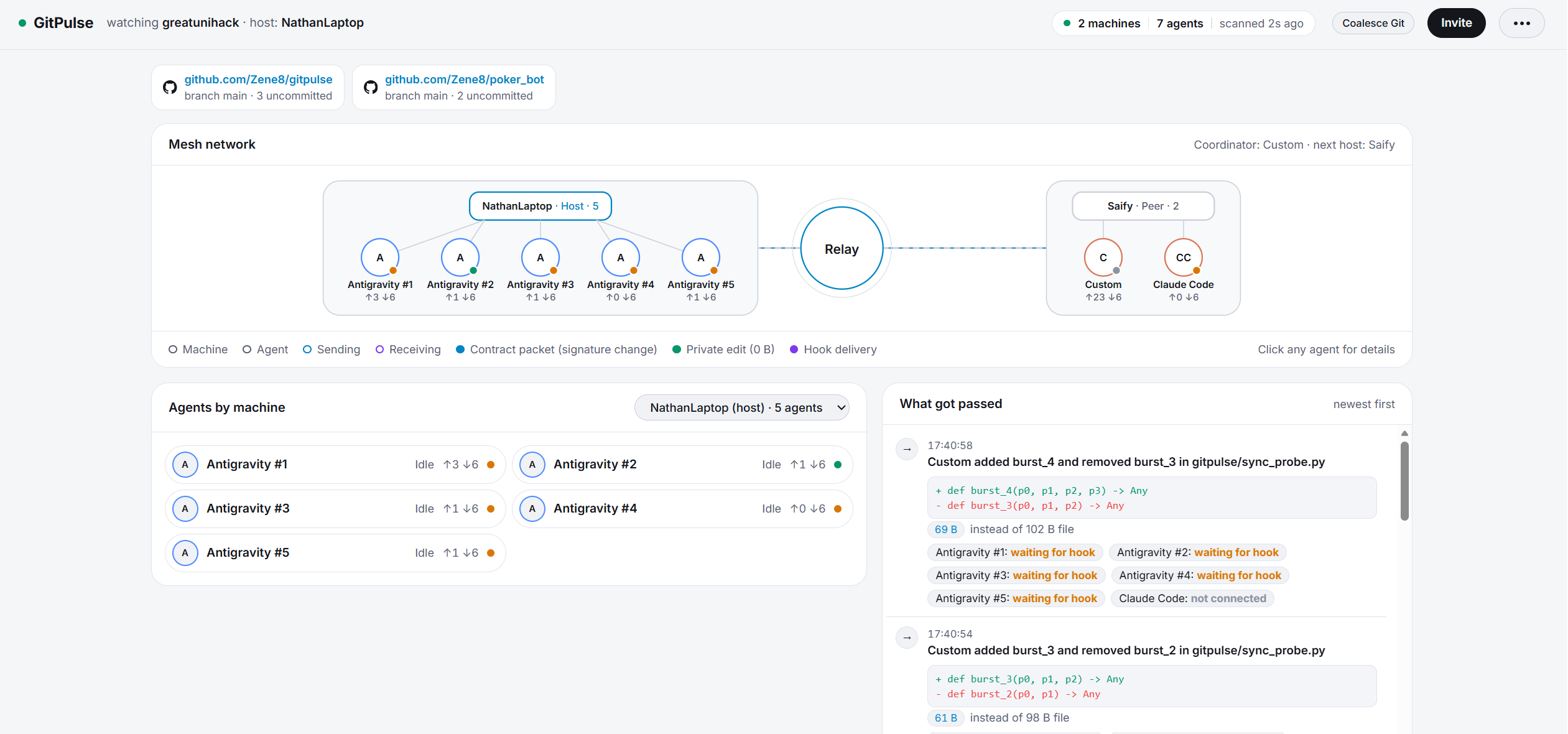
GitPulse sits between coding agents and GitHub as a shared coordination layer.
Shared Context: Agents broadcast what files and functions they are touching in real time, locking boundaries so they never overwrite each other's work.
Smart Syncing: Only essential interface changes are shared across the team, keeping private edits local and cutting out network clutter.
Works Offline: If the venue Wi-Fi drops or a service goes down, agents keep coding locally and merge cleanly once reconnected.
Clean Commits: Instead of flooding GitHub with a hundred messy micro-commits, GitPulse bundles everything into one clean, working update.
How we built it
Wrote a lightweight Python engine to inspect code structure and track real function changes instead of raw text diffs.
Set up a direct peer-to-peer messaging system so agents coordinate without relying on a central server.
Built a live dashboard to monitor agent activity, simulate network cuts, and trigger clean pushes to GitHub.
Challenges we ran into
Teaching agents how to stay productive during a network drop and automatically reconcile when brought back online.
Putting together a stable, live multi-agent demo from scratch in just 6 hours.
Accomplishments that we're proud of
Watching multiple agents work side by side on dependent features without a single merge conflict.
Proving live that an agent can be cut off from the network, keep working independently, and self-heal its changes upon reconnection.
Shipping a complete, working prototype before the 6-hour deadline.
What we learned
The primary roadblock for multi-agent software engineering is communication, not model intelligence.
Offline-first coordination makes agentic workflows faster, cheaper, and far more dependable.
What's next for GitPulse
Out-of-the-box integration with tools like Cursor, Claude Code, and custom agent runtimes via standard agent protocols.
In-memory test validation so agents catch contract breaks before anything is committed.
