Inspiration
AI coding agents are becoming extremely capable, but they still struggle with one fundamental problem: understanding the entire codebase before making changes. Traditional search and RAG retrieve pieces of code, but they often miss dependencies, call chains, execution flows, and architectural relationships. We built GitNexus (SecureGraph-AI) around a simple idea: AI agents don't just need more code—they need a map of the code. By transforming a repository into a knowledge graph, GitNexus gives agents architectural context before they explore, debug, refactor, or modify a system.
What it does
GitNexus turns any codebase into an AI-readable knowledge graph. It analyzes source code to discover:
- Functions, classes, methods, interfaces, and dependencies
- Imports, calls, inheritance, and implementation relationships
- Functional communities and architectural clusters
- End-to-end execution processes and call chains
- Semantic and keyword-based code relationships It then exposes this intelligence through MCP tools and agent integrations for tools such as Claude Code, Cursor, Windsurf, and OpenCode. Agents can perform:
- Context analysis — understand a symbol from every direction
- Impact analysis — identify what could break before changing code
- Process-aware search — retrieve related code as execution flows rather than isolated snippets
- Change detection — map Git changes to affected components and processes
- Safe renaming — coordinate high-confidence multi-file refactoring
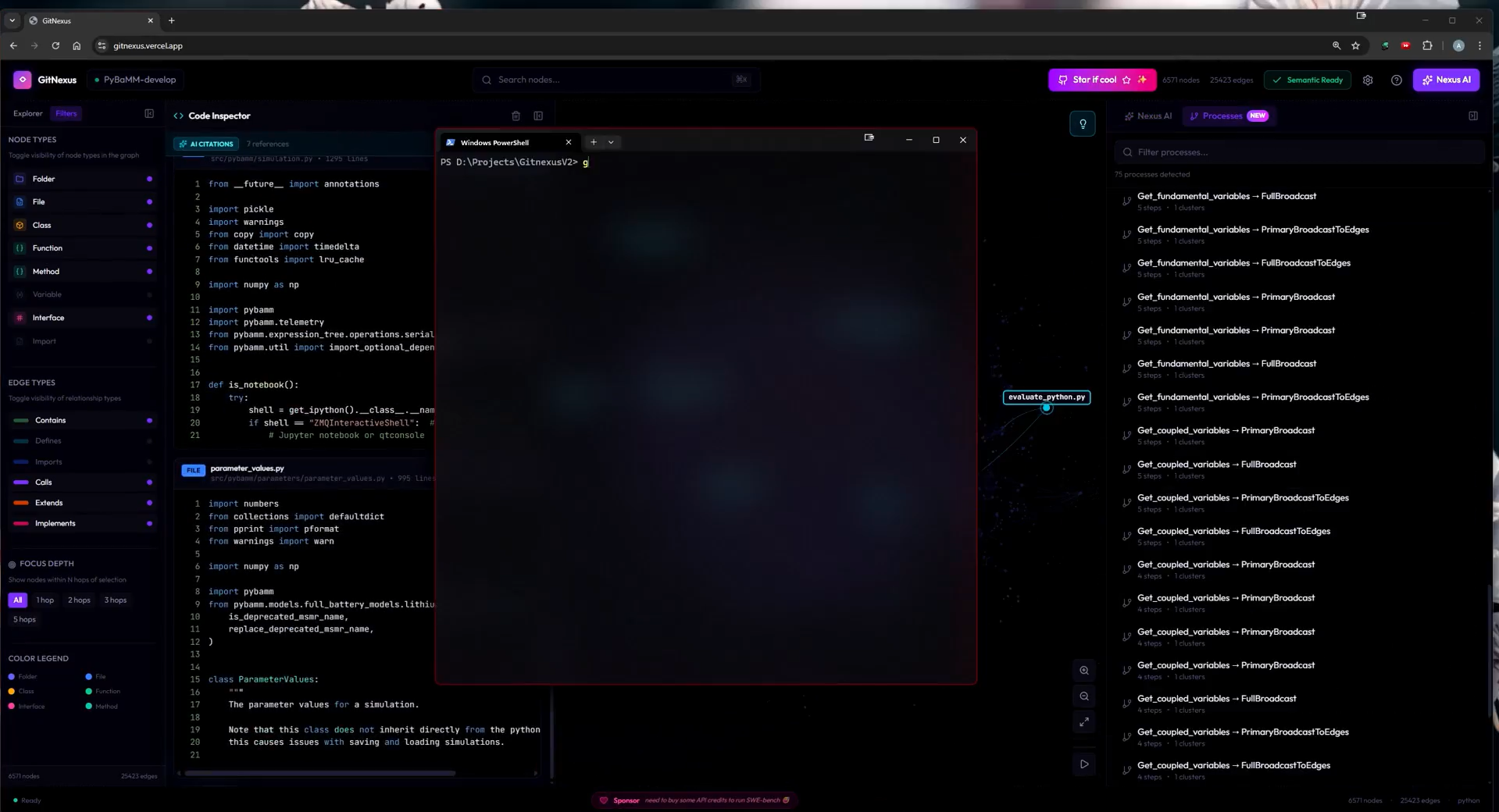
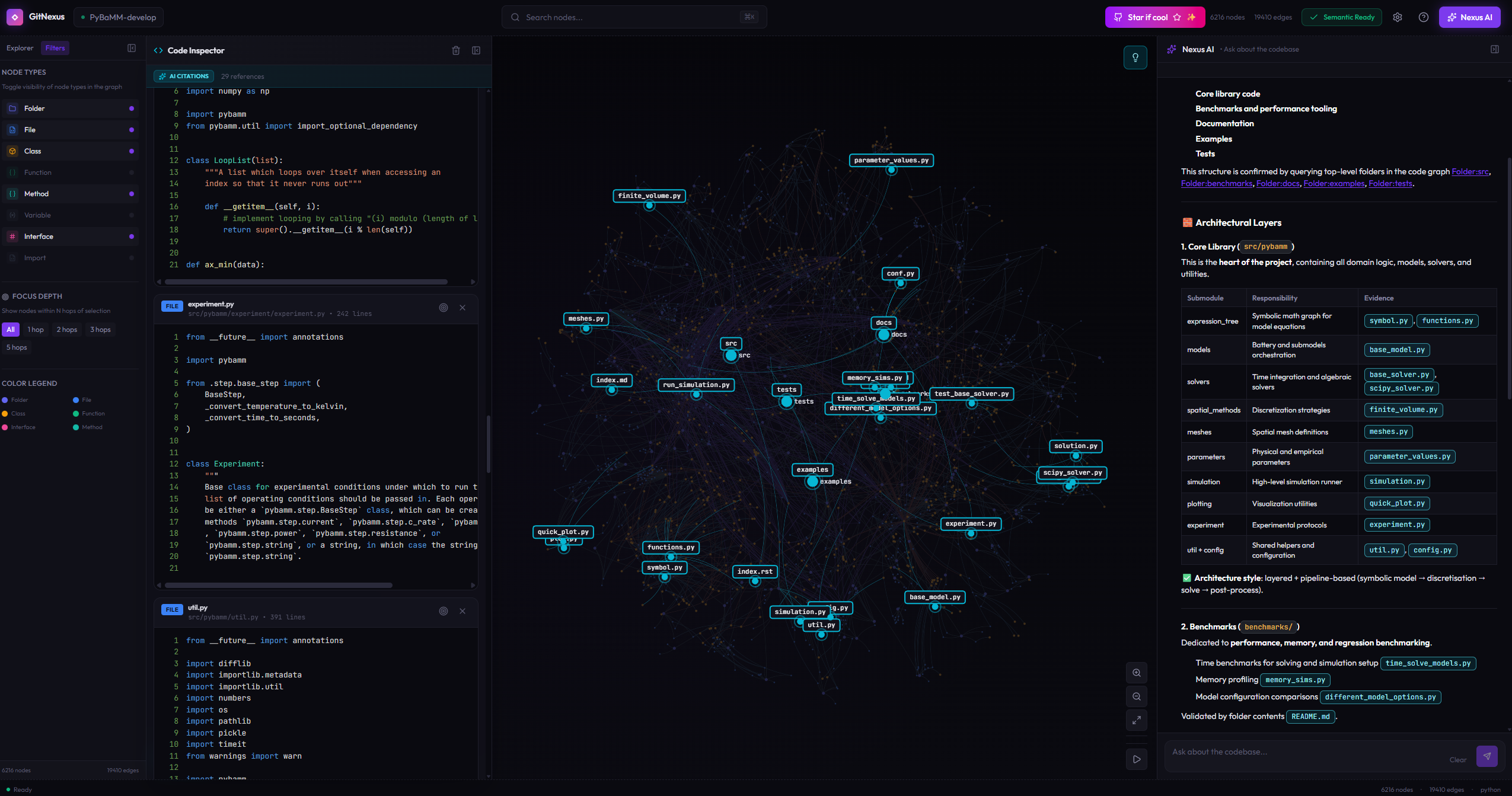
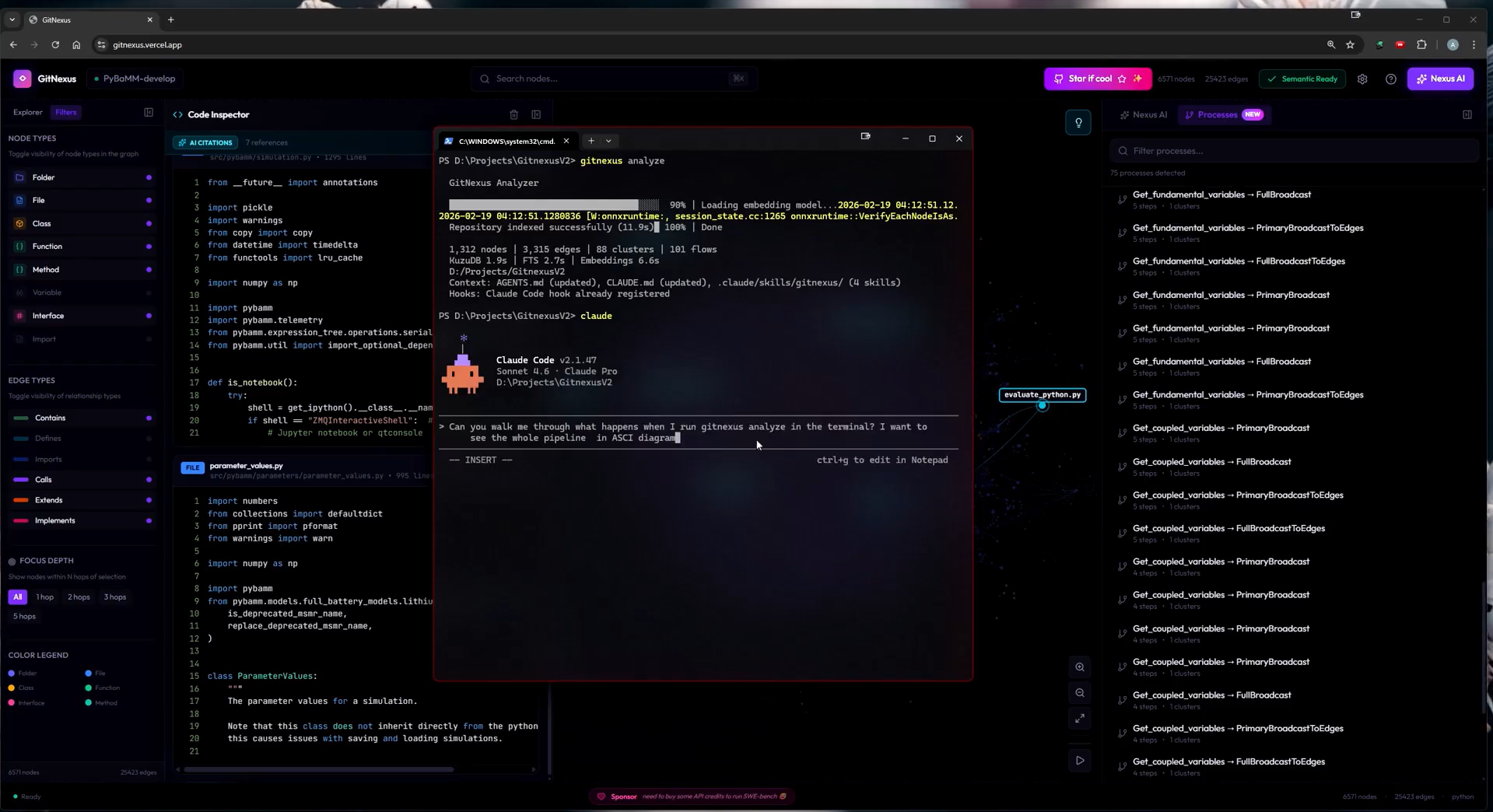
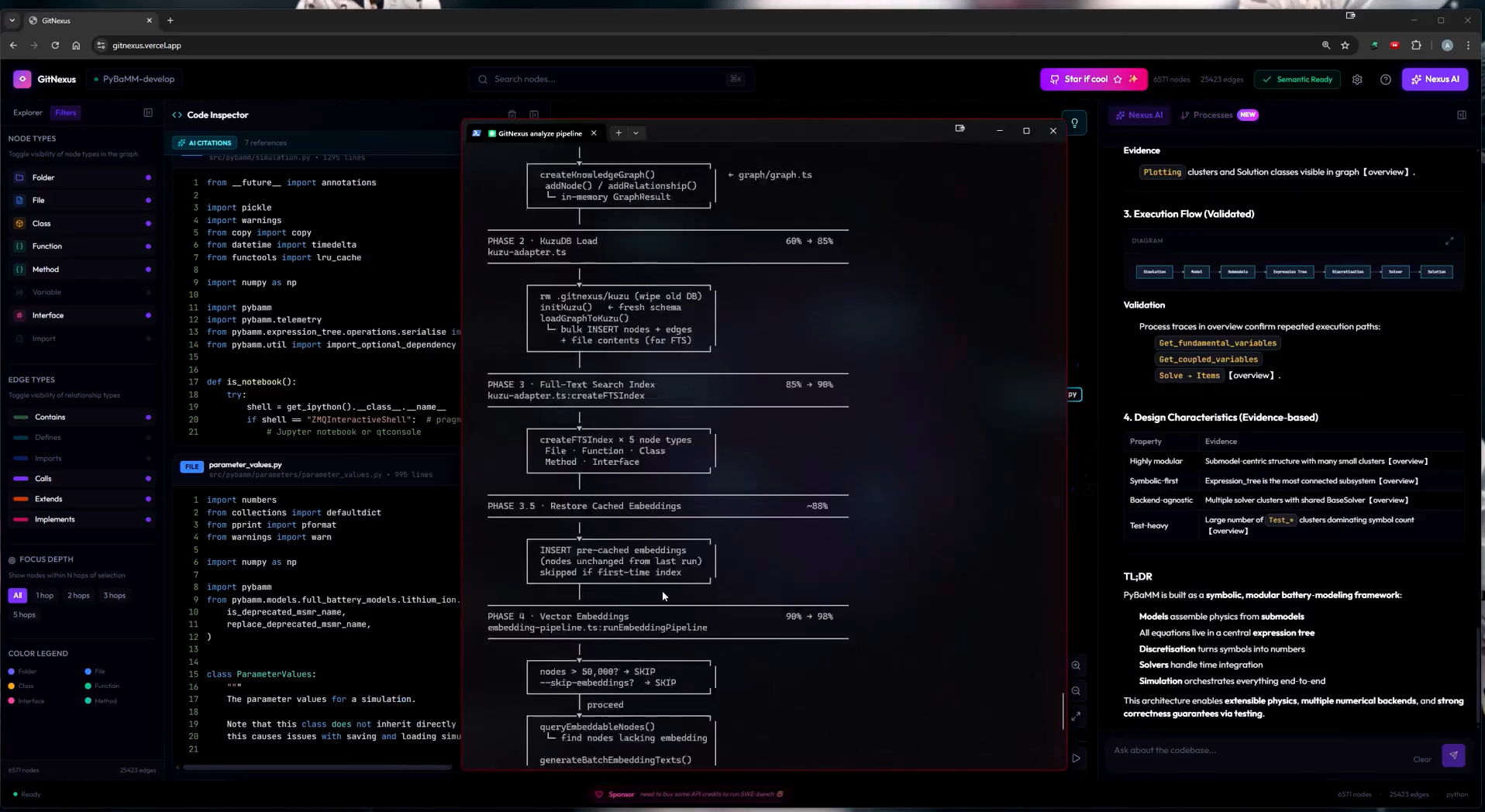
- Graph queries — directly interrogate the underlying architecture The result is an AI agent that can reason about relationships, dependencies, and architecture—not just text. How we built it ## How we built it GitNexus is built as a local-first code intelligence platform. Our indexing pipeline combines: Repository structure → Tree-sitter AST parsing → symbol resolution → relationship extraction → community detection → process tracing → hybrid search → KuzuDB knowledge graph The core engine is implemented in TypeScript, with native KuzuDB storage and Tree-sitter-based parsing across multiple programming languages. We built an MCP server on top of the graph so AI agents can access structured architectural intelligence through specialized tools instead of repeatedly searching the repository. We also developed agent-specific skills, prompts, and hooks, allowing GitNexus to become part of an agent's development workflow rather than simply being another standalone developer tool. A browser-based Web UI provides visual graph exploration and AI-assisted repository analysis, while the CLI + MCP architecture is designed for serious day-to-day development. ## Challenges we ran into The hardest part wasn't building a graph—it was making the graph useful and reliable for an AI agent. Some of the major challenges were:
- Resolving relationships across files and programming-language constructs
- Distinguishing meaningful architectural relationships from noisy references
- Building useful execution processes from static code
- Designing graph queries that return enough context without overwhelming the model
- Combining semantic retrieval with structural relationships
- Handling large repositories efficiently
- Maintaining local-first privacy while supporting powerful AI workflows
- Making the system work naturally across different AI coding environments
- Designing confidence-aware impact analysis so agents can distinguish strong relationships from uncertain ones We learned quickly that raw graph data isn't enough. The intelligence has to be pre-structured into information that an agent can actually reason with. ## Accomplishments that we're proud of We're proud that GitNexus has evolved beyond a prototype graph visualization into a complete code intelligence layer for AI agents. Some highlights:
- Built a multi-language code knowledge graph
- Implemented functional community detection and execution-process discovery
- Developed specialized MCP tools for context, search, impact analysis, change detection, and refactoring
- Added multi-repository MCP support through a global registry
- Built integrations for Claude Code, Cursor, Windsurf, and OpenCode
- Developed Claude Code skills for exploring, debugging, impact analysis, and refactoring
- Added automated context augmentation through agent hooks
- Built a browser-based graph explorer
- Added hybrid BM25 + semantic retrieval with process-aware results
- Created an evaluation framework to measure the effectiveness of agent workflows Most importantly, we demonstrated that precomputed architectural context can reduce the amount of architectural reasoning an AI agent has to reconstruct from scratch. ## What we learned The biggest lesson was simple: Better AI coding isn't only about better models. It's also about giving models better tools and better context.
We learned that code should be treated as a relational system, not simply a collection of documents. A function isn't just a piece of text. It has callers, dependencies, downstream effects, architectural ownership, and a place in an execution process. We also learned that giving an agent everything is not the same as giving it the right information. Good developer tooling must transform complex internal data into concise, high-confidence context that an agent can act on. This shaped our approach toward precomputed relational intelligence rather than forcing an LLM to repeatedly traverse a raw graph.
What's next for GitNexus (SecureGraph-AI)
We're taking GitNexus toward a broader AI-native software engineering intelligence platform. Our next focus areas include:
- Smarter impact prediction with improved confidence and risk scoring
- Deeper multi-language analysis and more accurate cross-language relationships
- Real-time incremental indexing as developers modify their repositories
- PR-aware architectural analysis that explains what a pull request changes across the system
- AI-assisted debugging using execution-flow and dependency reasoning
- Architecture drift detection to identify when implementation diverges from the intended architecture
- Agent action validation before potentially dangerous code changes are applied
- Stronger evaluation benchmarks to quantify improvements in coding-agent accuracy, token efficiency, and regression rates
- Richer visual architecture intelligence for developers and engineering teams
- Expanded MCP and agent ecosystem support Our long-term vision is to make GitNexus the context and reasoning layer between AI coding agents and complex software systems—giving every agent a persistent, structured understanding of the code it is working on. GitNexus isn't trying to replace the coding agent. It's building the map that lets the agent navigate the codebase correctly.
Built With
- ai-agents
- antigravity
- cluade
- developer
- git
- graphrag
- knowledge-graph
- kuzudb
- llm
- mcp
- node.js
- react
- semantic-search
- static-analysis
- tree-sitter
- typescript
- webassembly

Log in or sign up for Devpost to join the conversation.