-
-
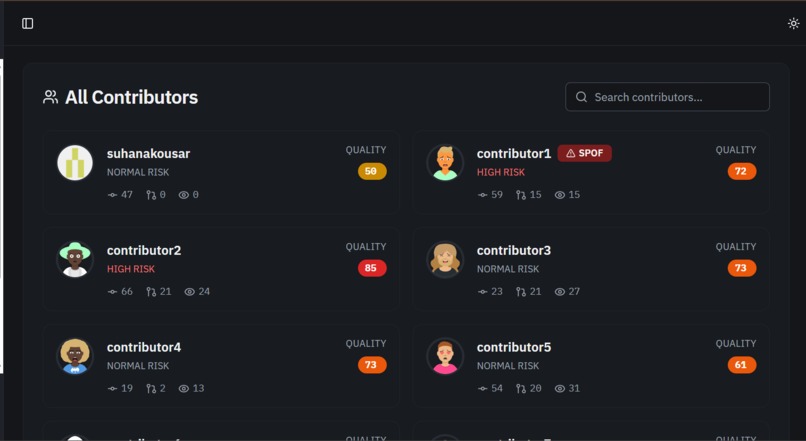
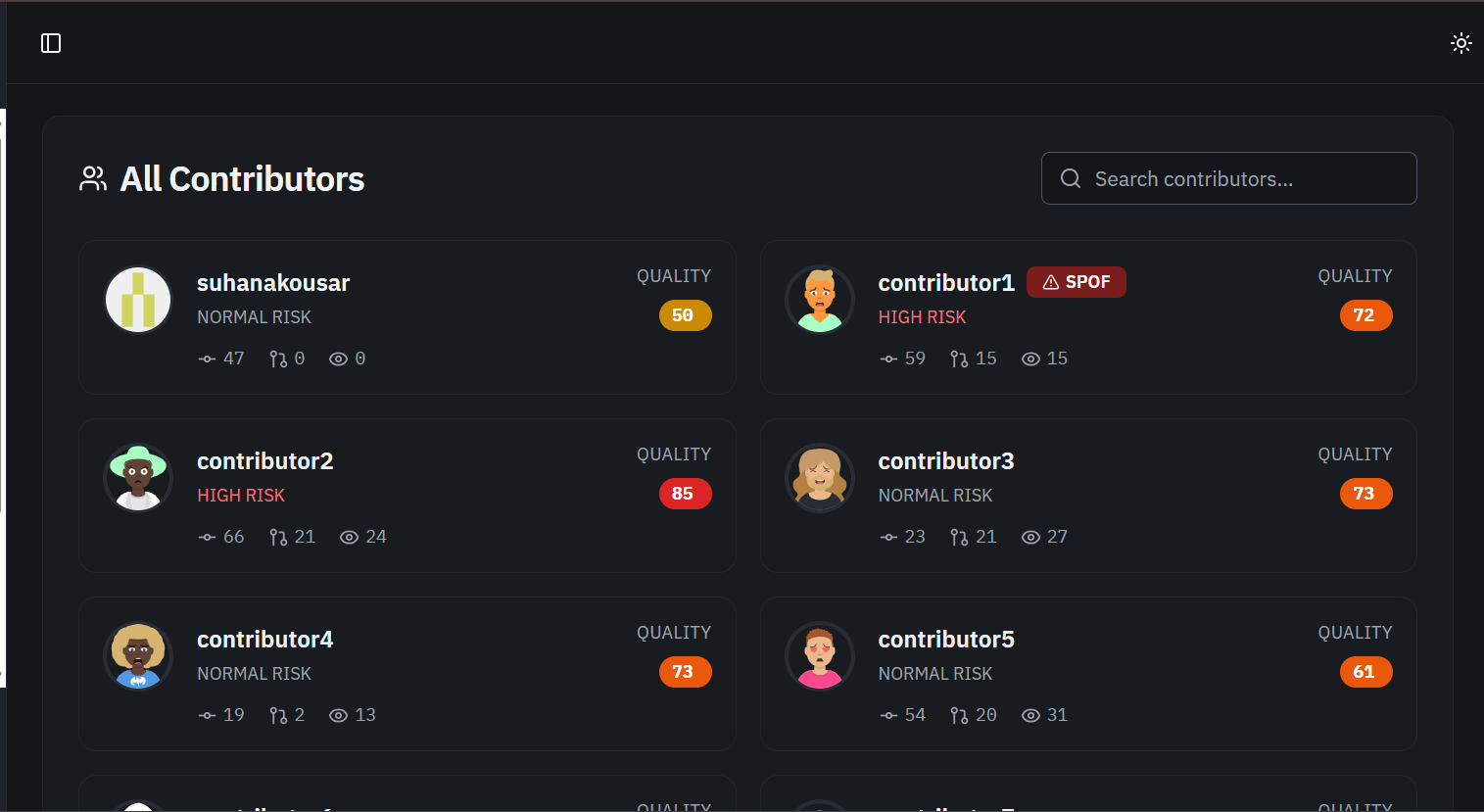
Intelligence Contributors
-
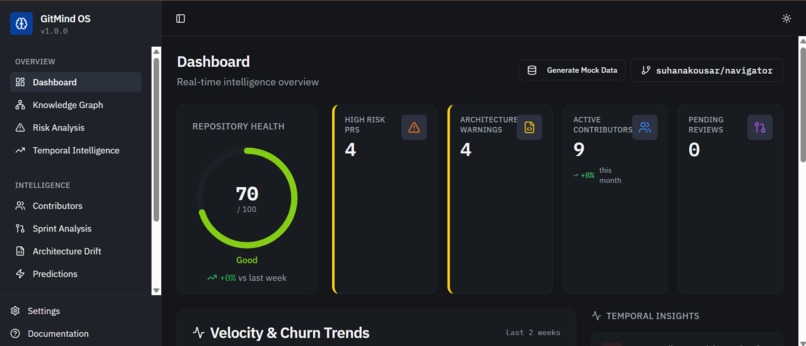
Dashboard
-
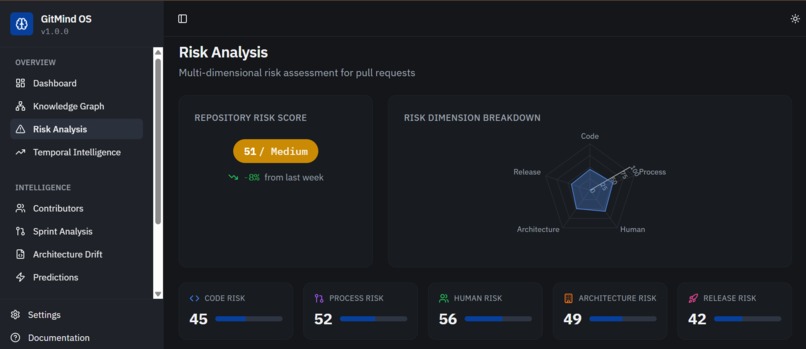
Risk Analysis
-
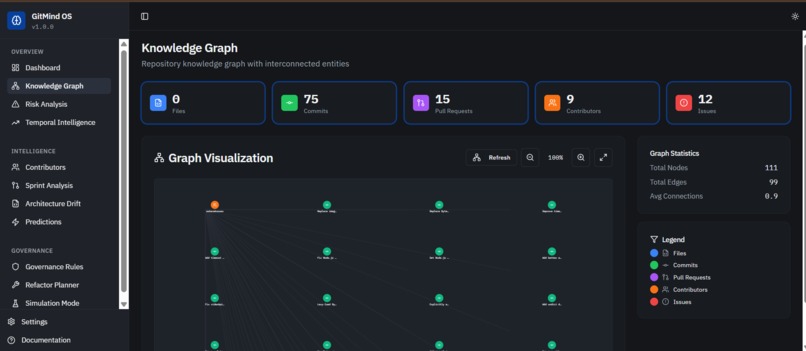
Knowledge Graph
-
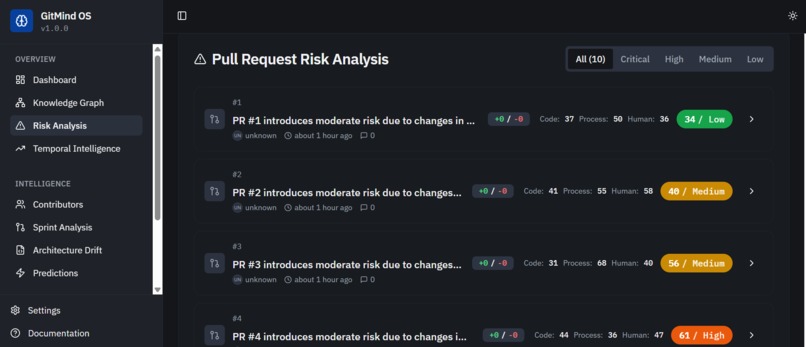
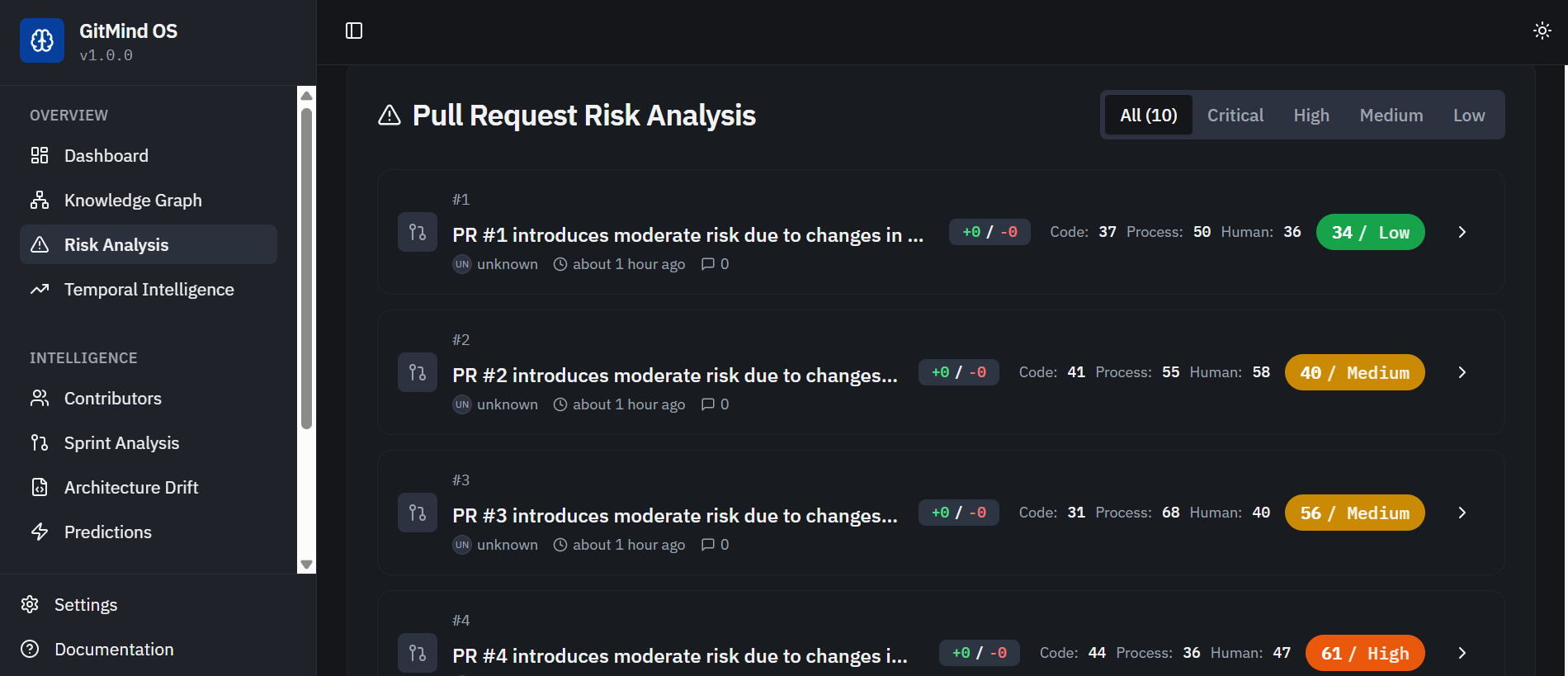
Risk Analysis PR
-
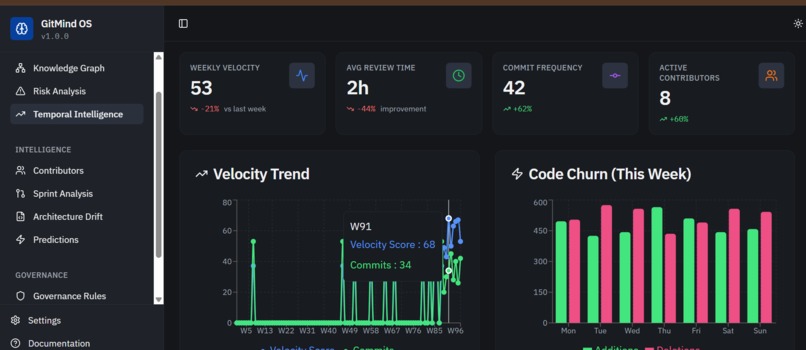
Temporal Intelligence


Inspiration
Modern software teams rely heavily on GitHub, but GitHub mainly shows what is happening, not why it is happening or what will happen next. During hackathons and real projects, we noticed that risks like oversized pull requests, architectural decay, sprint delays, and single points of failure are usually discovered too late.
GitMind OS was inspired by the idea of turning GitHub into an intelligent, self-aware system—one that behaves like a senior tech lead by continuously analyzing the repository, predicting problems, and enforcing best practices automatically.
What it does
GitMind OS is an AI-powered GitHub Intelligence & Governance platform that transforms repositories into living systems.
It:
- Analyzes repositories in real time using GitHub APIs
- Performs multi-dimensional risk analysis on pull requests
- Detects architectural drift such as god files and boundary violations
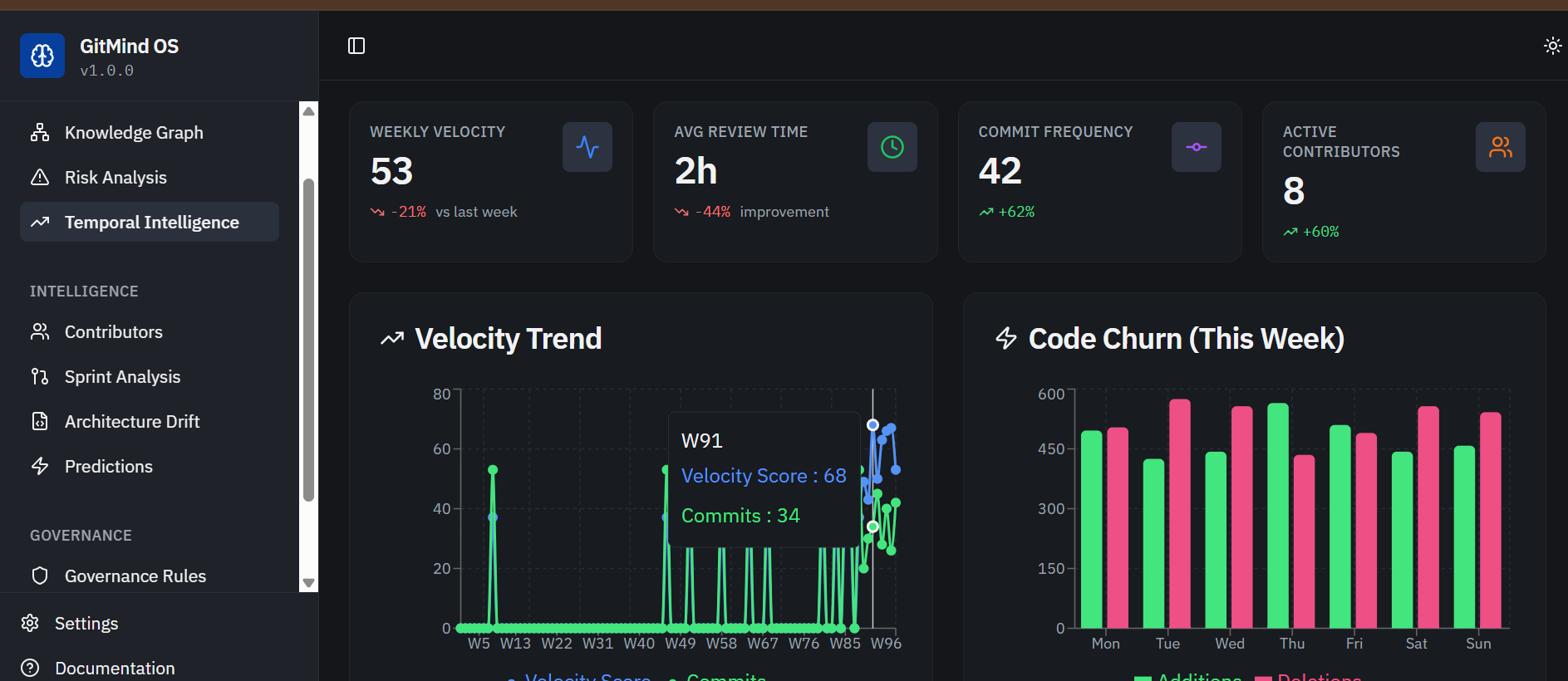
- Tracks temporal trends like velocity drops and review delays
- Evaluates contributor health and identifies single points of failure
- Predicts bugs, PR reverts, and sprint failure risks
- Generates AI-driven refactor plans
- Enforces policy-as-code governance using GitHub Actions
- Visualizes repository relationships through a knowledge graph
- Supports what-if simulations for safer decision-making
How we built it
GitMind OS was built as a GitHub-native platform:
- GitHub REST API for repositories, commits, PRs, issues, and contributors
- GitHub Actions to automate analysis, enforce governance rules, and block risky PRs
- AI-assisted logic for risk scoring, predictions, and explanations
- GitHub Copilot was used extensively to:
- Design multi-dimensional scoring algorithms
- Generate refactor planning logic
- Create GitHub Actions workflows
- Improve code structure and documentation
- Modular architecture with separate intelligence, analysis, governance, and interface layers
The system prioritizes explainability, automation, and clean integration with GitHub workflows.
Challenges we ran into
- Designing meaningful risk scores instead of shallow metrics
- Balancing complex intelligence with hackathon time constraints
- Mapping architectural issues from raw repository data
- Ensuring predictions were explainable, not black-box results
- Integrating multiple GitHub data sources while keeping performance manageable
Each challenge pushed us to refine the system design and improve clarity.
Accomplishments that we're proud of
- Built a multi-layer intelligence platform, not just a dashboard
- Implemented policy-as-code governance enforced by GitHub Actions
- Created AI-generated refactor plans that feel like senior-engineer guidance
- Developed a repository knowledge graph to visualize relationships
- Delivered a project that feels enterprise-grade, not hackathon-only
- Successfully showcased deep GitHub and Copilot integration
What we learned
- GitHub data becomes far more powerful when analyzed over time, not in isolation
- Automation via GitHub Actions can replace many manual review processes
- GitHub Copilot is most effective when used as a co-engineer, not just a code generator
- Clear documentation and explainability matter as much as advanced features
- Complex systems can still be understandable if designed modularly
What's next for GitMind OS
- Deeper CI/CD and deployment risk analysis
- Native GitHub App integration
- Team-level and organization-wide intelligence views
- Smarter long-term prediction models
- Real-time collaboration insights
- Enterprise-ready role-based access and alerts
GitMind OS is designed to evolve alongside modern development teams.

Log in or sign up for Devpost to join the conversation.