-
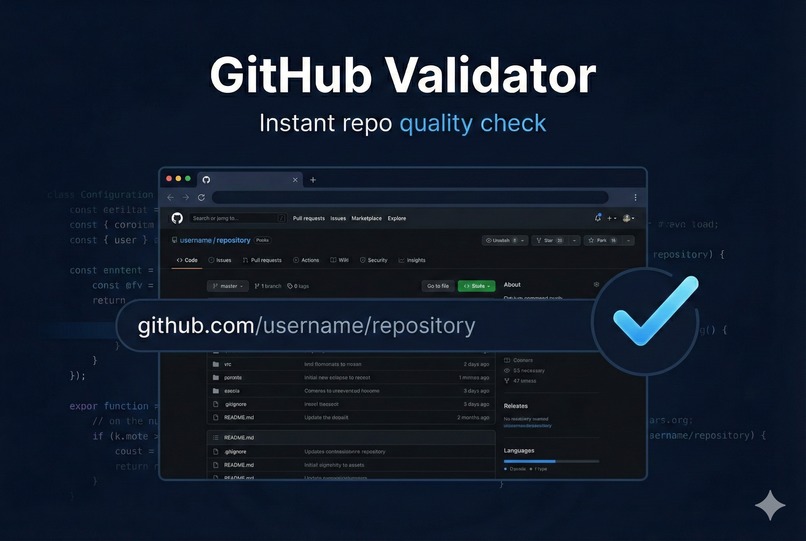
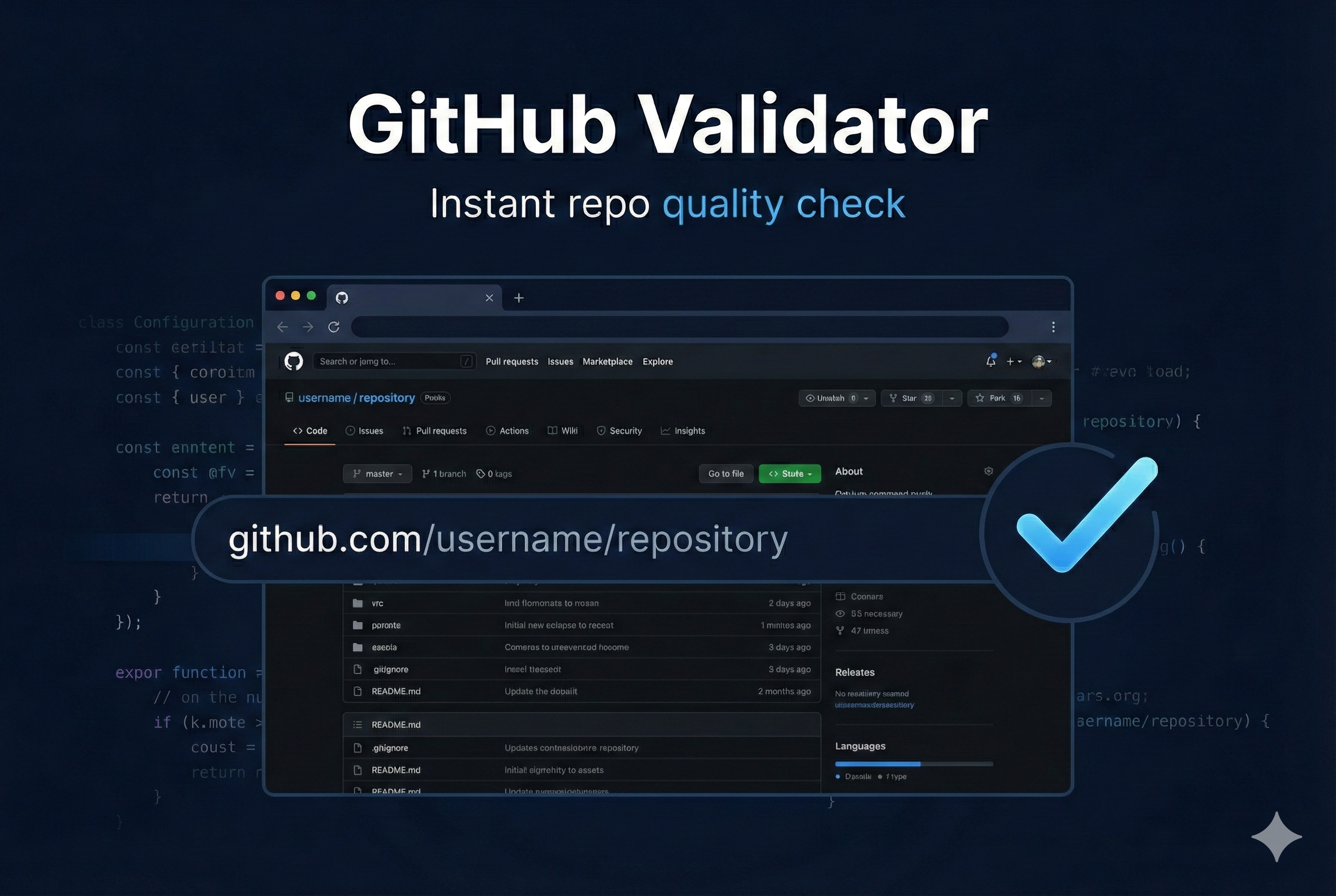
GitHub Validator instantly analyzes any public GitHub repository URL to score its quality and give you a clear roadmap for improvement.
-
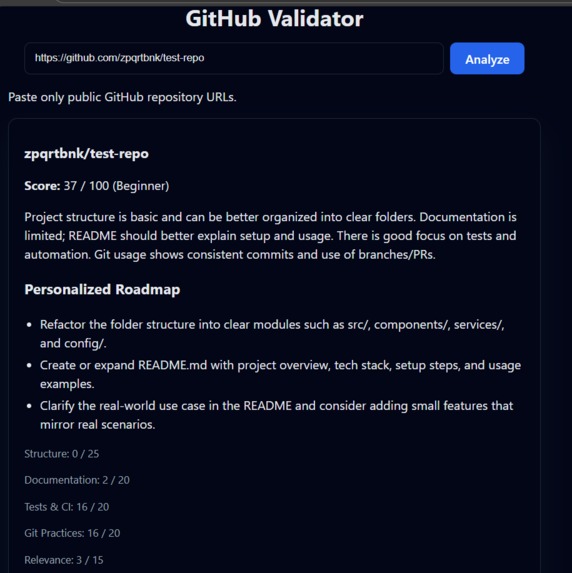
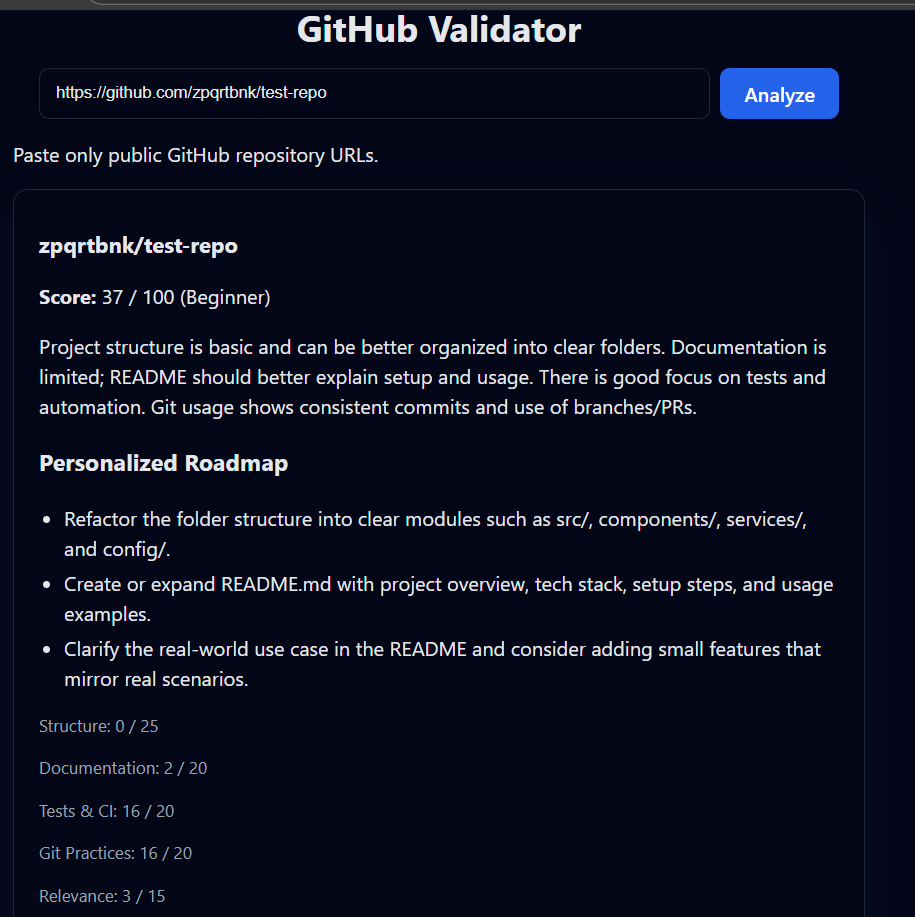
Sample URL Validation
Inspiration As students and developers, so much work lives on GitHub—but judging a repository’s true quality at a glance is hard. Recruiters, mentors, and teammates often look only at stars or last commit dates, missing what actually matters inside the codebase. We wanted a simple way to instantly understand how “ready” a repo is for real-world use, interviews, or hackathons. That frustration with messy, unstructured repositories—and the desire to get honest, actionable feedback on our own projects—sparked the idea for GitHub Validator.
What it does GitHub Validator takes a public GitHub repository URL and instantly evaluates the project’s health. It analyzes structure, documentation, testing, CI/CD practices, commit hygiene, and practical relevance, then generates a single score out of 100 plus a clear rating. Along with the score, it produces a concise summary and a personalized roadmap that highlights what to fix first—like improving the README, adding tests, organizing folders, or tightening Git practices—so users know exactly how to level up their repo.
How we built it We built a React-based frontend that lets users paste a public GitHub URL and view results in a clean, responsive dark UI. The backend ingests the repository metadata and structure, applies a set of weighted heuristics to different dimensions (structure, docs, tests, Git history, relevance), and combines them into an overall quality score. We then generate human-readable feedback and a prioritized roadmap from these metrics so users get both quantitative and qualitative insight instead of just a raw number.
Challenges we ran into One challenge was defining fair scoring criteria that work for very different kinds of repositories—from small personal projects to larger apps—without being biased toward any specific tech stack. Balancing the weights between structure, documentation, testing, and relevance required multiple iterations and real-world testing on our own and friends’ repos. Another challenge was keeping the UX simple while returning a rich amount of feedback, so we had to carefully design the layout and copy to stay clear and not overwhelm users.
Accomplishments that we're proud of We are proud that GitHub Validator turns a vague “Is this repo good?” question into a concrete, structured answer in seconds. It already helps us quickly evaluate our own hackathon projects and identify which improvements will have the biggest impact. We’re also proud of the polished developer experience—from the clean UI to the fast response time—which makes the tool feel like something you would actually want to use regularly in your workflow.
What we learned We learned how hard it is to quantify code quality in a way that feels fair and useful, especially when repositories vary widely in size and purpose. This pushed us to think carefully about metrics, not just features: what really signals a maintainable, professional project? We also deepened our skills in full‑stack development, API design, and UX writing, since the feedback text needed to be both technically accurate and easy to understand for users at different skill levels.
What's next for Github Validator Next, we want to integrate deeper GitHub APIs to analyze issues, pull requests, and CI runs for an even richer view of project health. We plan to add side‑by‑side repo comparisons, shareable score badges, and a history view so users can track how their score improves over time. Longer term, we’d love to turn GitHub Validator into a companion for learning and hiring—helping students showcase polished repos, reviewers give faster feedback, and teams quickly assess open-source dependencies before adopting them.
Built With
- axios
- css
- express.js
- github-rest-api
- javascript
- node.js
- react
- vite

Log in or sign up for Devpost to join the conversation.