-
-
Thumbnail
-
UI Screenshot
-
UI Working
Inspiration
Marine heatwaves are becoming more frequent, more intense, and more expensive, but the people who need to respond to them still have to piece together information from scattered scientific datasets, papers, and dashboards. We were struck by the gap between how serious these events are for aquaculture, marine ecosystems, and coastal economies, and how inaccessible marine heatwave intelligence still is in practice.
That inspired us to build Nereus: a system that makes marine heatwave intelligence immediate, interactive, and actionable. Instead of building another static dashboard, we wanted a voice-driven assistant that helps users explore major events on a 3D globe, understand climate drivers and species impacts, and get grounded answers in plain language across multiple languages. Our goal was to turn complex ocean science into something decision-makers can actually use.
What it does
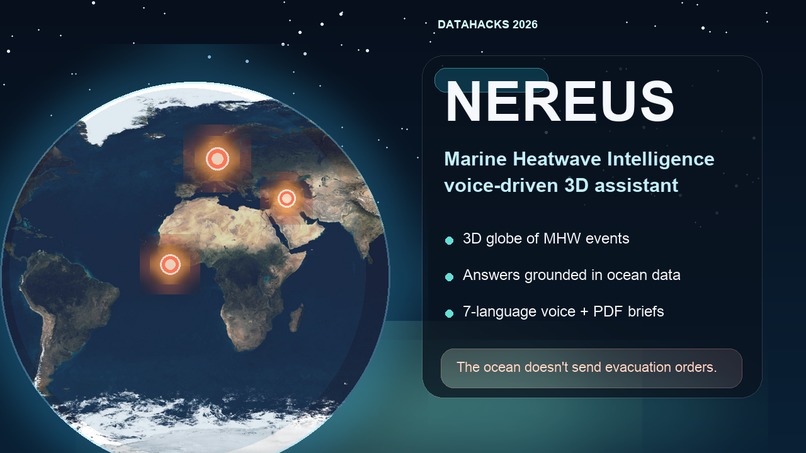
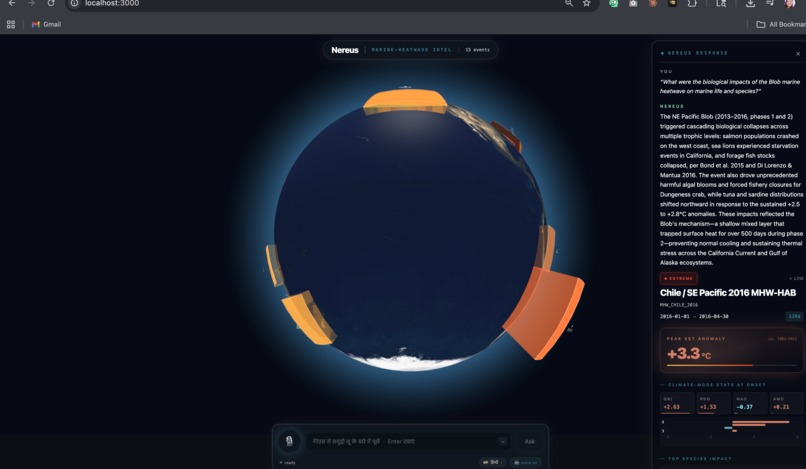
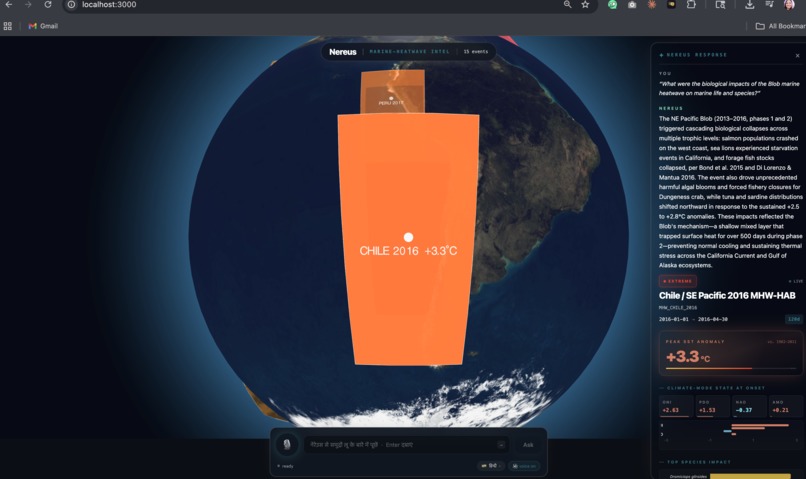
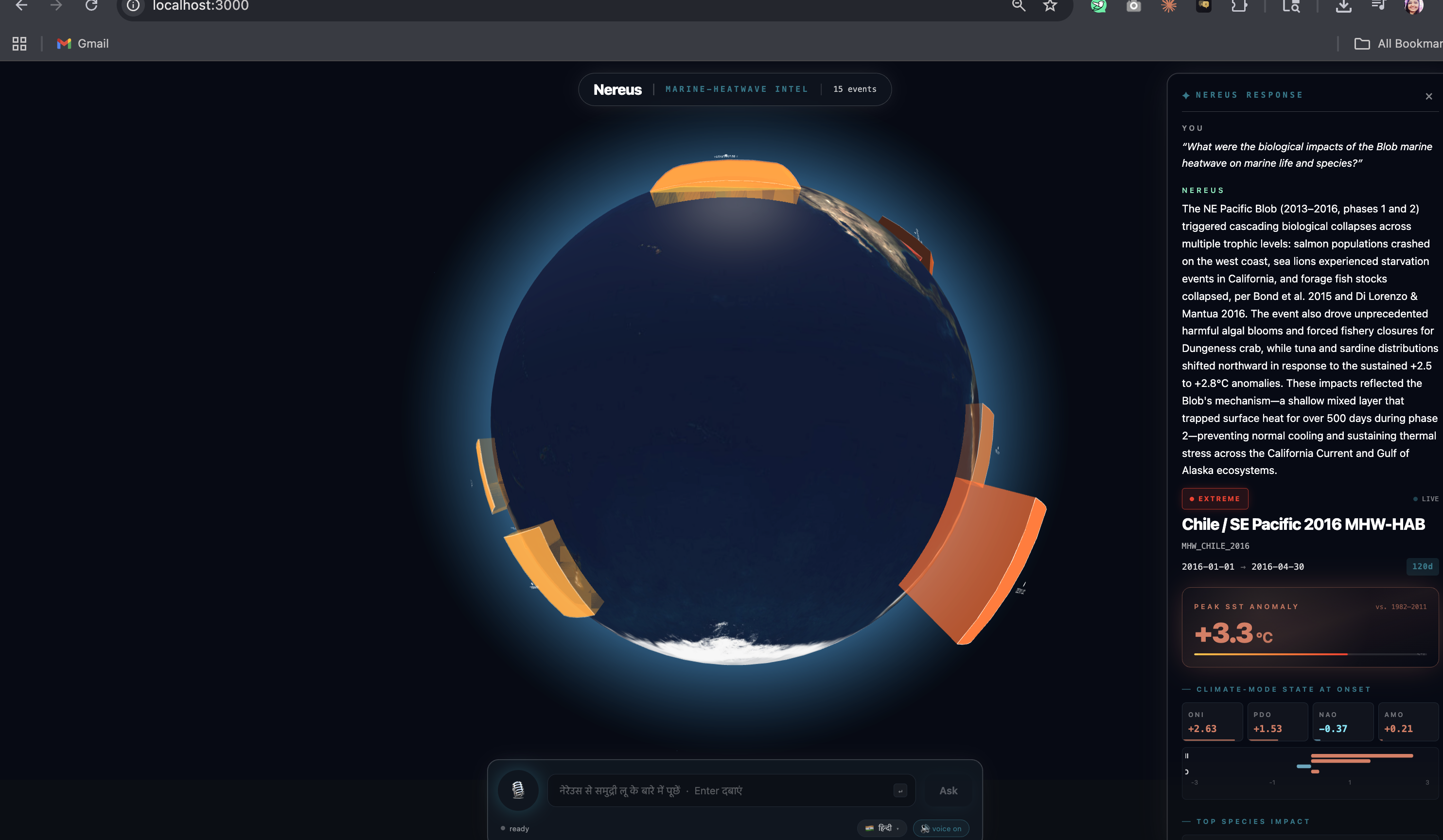
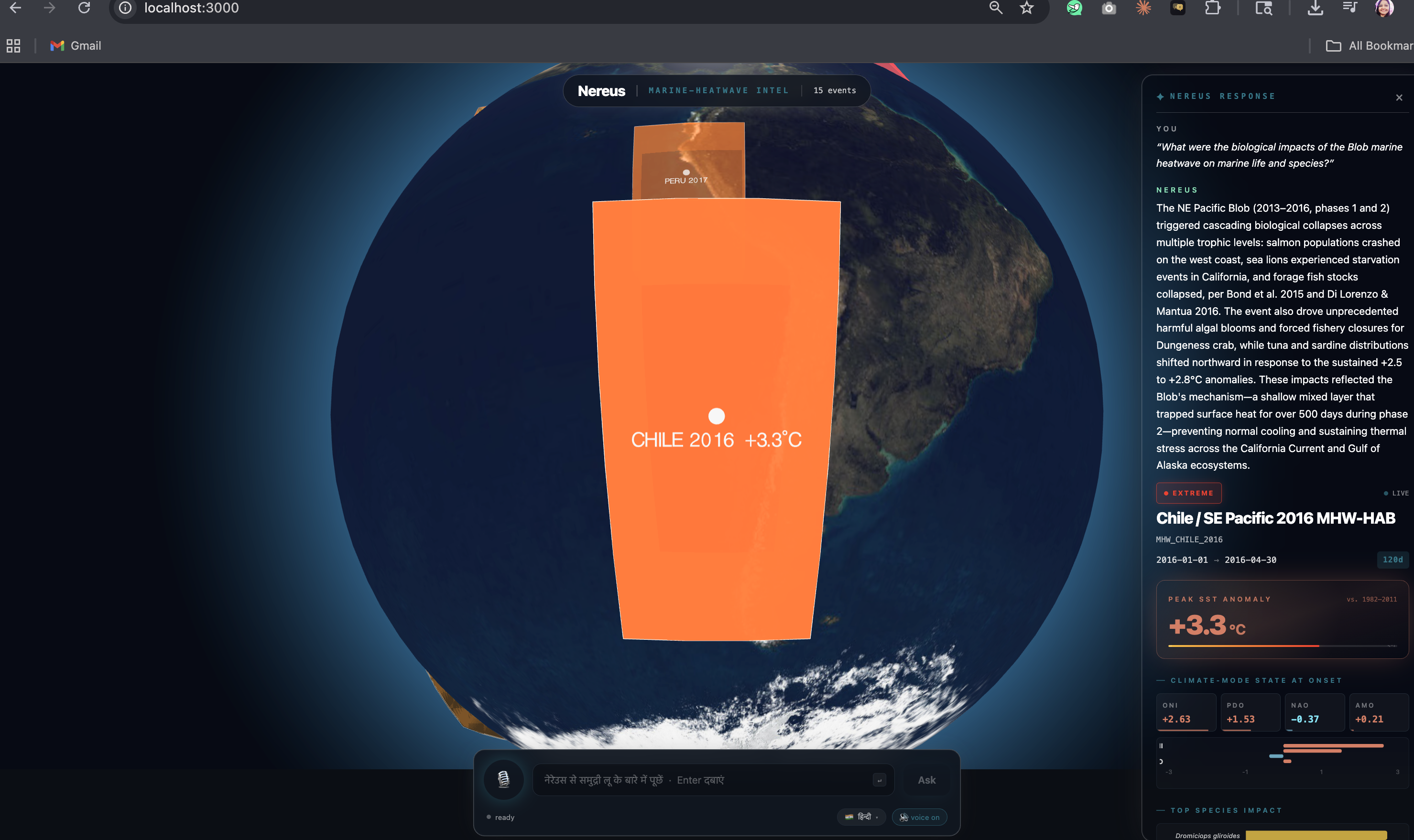
Nereus is a multilingual marine heatwave intelligence assistant. Users can ask questions by voice or text, explore major marine heatwave events on a 3D globe, inspect event-specific details, compare historical events, and generate PDF intelligence briefings.
The system grounds its answers in a curated marine heatwave knowledge base built from ocean and climate data, peer-reviewed event records, and species-impact observations. It can answer follow-up questions about event severity, climate-mode context, affected species, and analog events, while also showing the geographic region associated with each event.
How we built it
We built Nereus as a full-stack AI application. The backend is a FastAPI service that loads a curated event catalog, climate datasets, and a local RAG knowledge base into memory. We embedded our corpus using sentence-transformers and indexed it with FAISS for fast semantic retrieval. For answer generation, we used Anthropic Claude Haiku as the primary synthesis model with Gemini as a fallback layer for resilience.
On the frontend, we used Next.js, React, and TypeScript to build the interactive interface, including the 3D globe, event dossier panel, transcript view, and multilingual interaction flow. We integrated ElevenLabs for voice interaction, allowing users to speak naturally to Nereus and receive spoken responses. We also added PDF report generation so users can turn event intelligence into a structured briefing.
Challenges we ran into
One of our biggest challenges was designing the system so it felt like a real intelligence assistant rather than just a chatbot on top of data. We had to think carefully about how retrieval, event context, voice interaction, and frontend state all fit together.
Another challenge was grounding follow-up questions reliably. Users naturally ask things like “What was the climate state?” or “Which species were affected?” after selecting an event, so we had to make sure the system stayed anchored to the right marine heatwave rather than losing context. We also had to build the application in a way that stayed robust even if one model or service failed, which pushed us to add fallback layers.
Accomplishments that we're proud of
We’re proud that Nereus feels like a real product rather than a collection of disconnected features. It combines a 3D globe, multilingual voice interaction, retrieval-augmented generation, event comparison, and downloadable PDF briefings in one coherent experience.
We’re also proud that the system is grounded in meaningful ocean and climate context instead of generating generic responses. Nereus can connect event-level heatwave intelligence with climate drivers, ecological impact, and geographic visualization, which makes the experience much more useful for real-world users.
What we learned
We learned how to build a full-stack AI system that goes beyond simple prompting. That included retrieval-augmented generation, vector search with FAISS, prompt design, multilingual interaction, voice-agent orchestration, and tying AI outputs into a live frontend experience.
We also learned that for scientific assistants, retrieval quality and context handling matter just as much as model quality. A smaller, well-curated knowledge base with strong grounding can be much more useful than a larger but less structured system.
What's next for Nereus
Next, we want to turn Nereus from a hackathon prototype into a real marine heatwave decision-support platform. That means expanding the event catalog, integrating more live ocean and climate data streams, scaling the Argo processing pipeline on NVIDIA Brev, and adding stronger forecasting and alerting workflows for aquaculture operators, insurers, and researchers.
We also want to deploy Nereus as a hosted product, improve multilingual voice support, and make the PDF briefing and event-comparison tools robust enough for real-world operational use.
Built With
- claude
- elevenlabs
- fastapi
- gemini
- javascript
- next.js
- python


Log in or sign up for Devpost to join the conversation.