Git Lumina
Git-Lumina is a powerful Repository Visualizer designed to help developers understand codebases quickly and intuitively.
Inspiration
Our team shares a combined 10+ internships across big tech and startups, and we’ve consistently seen one major bottleneck: the time it takes for developers to understand an existing codebase. While modern coding agents like Amazon Q can explain code, they often provide "text walls" that are difficult to digest. Research shows that readers of code have significant difficulty understanding the rationale behind decisions made by others. We wanted to solve this by creating a tool that makes the "whys" and "hows" of a project visually clear.
What it does
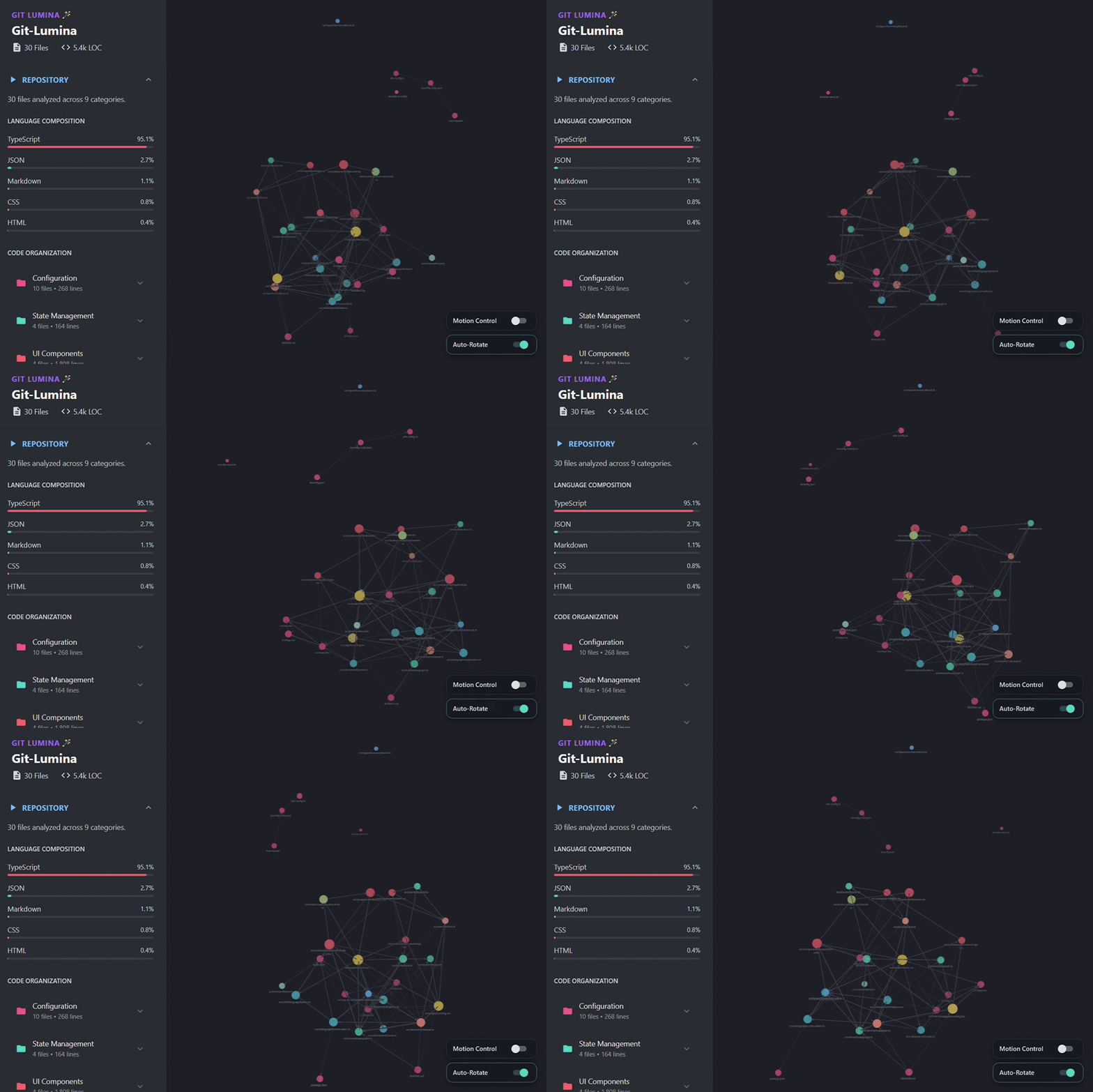
Git Lumina is an interactive codebase visualization tool that transforms a repository into a navigable graph.
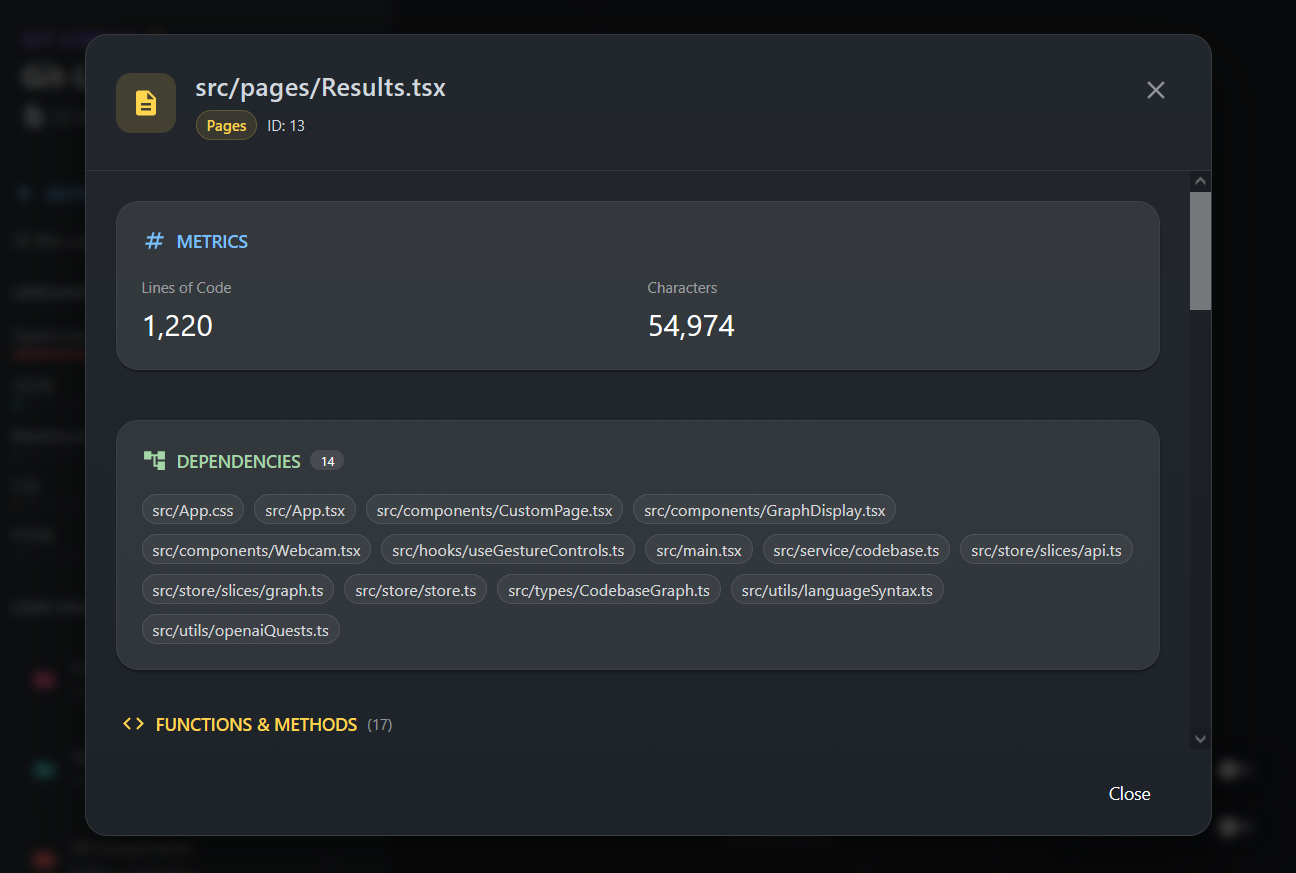
- Graph Visualization: It represents files as nodes and their relationships (imports, references, function calls) as edges.
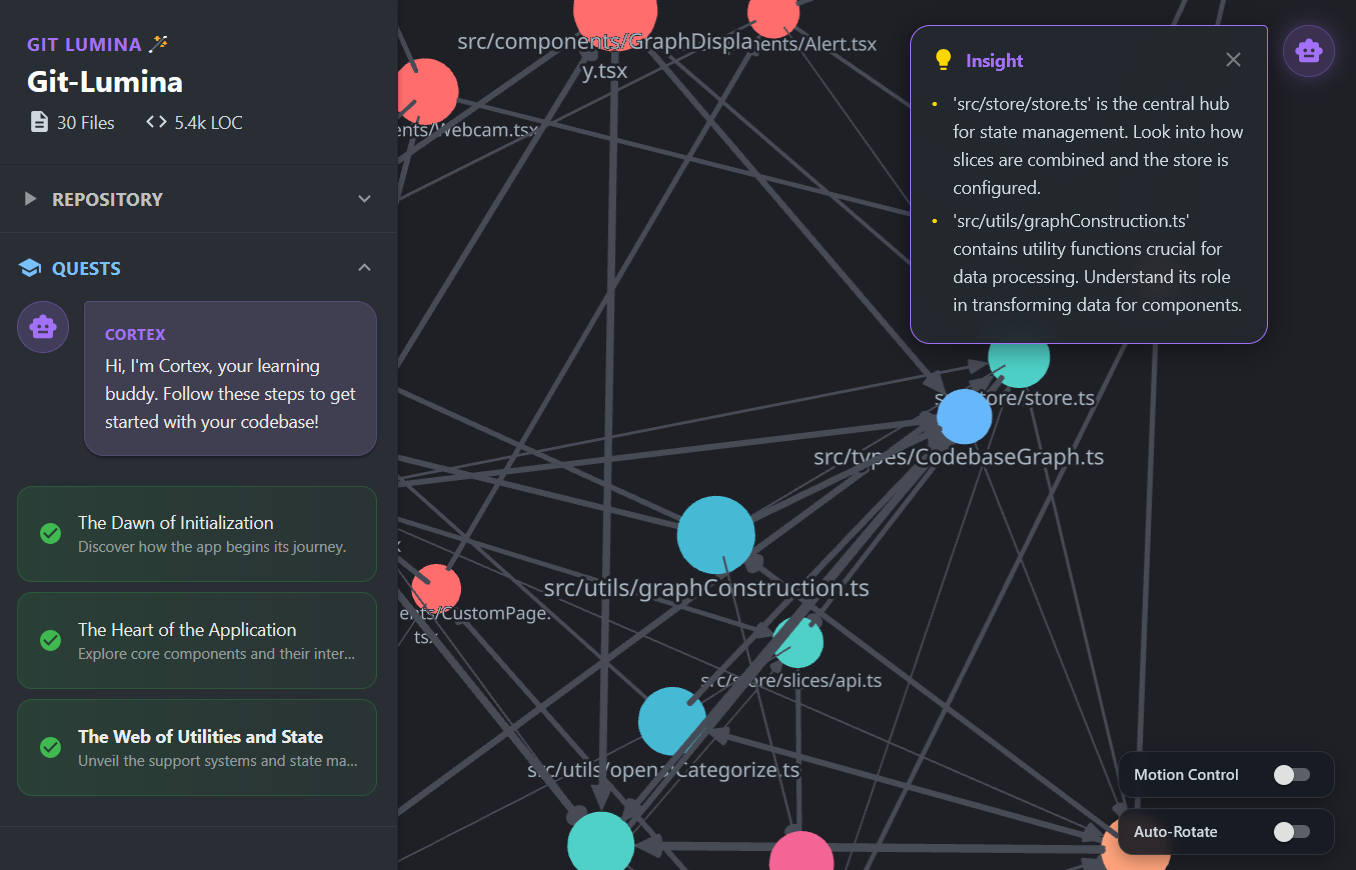
- Guided Quests: Our AI guide, Cortex, generates custom "Quests" for every project to walk users through entry points, main logic, and utilities.
- Flyover Navigation: The tool uses a flyover effect to automatically focus on the most important files during a walkthrough.
- Unique Controls: Users can navigate the graph using traditional mouse controls or innovative webcam-based motion control.
- Broad Support: It supports a wide range of formats including
.ts(x),.js(x),.py,.java,.cpp,.json,.md, and more.
How we built it
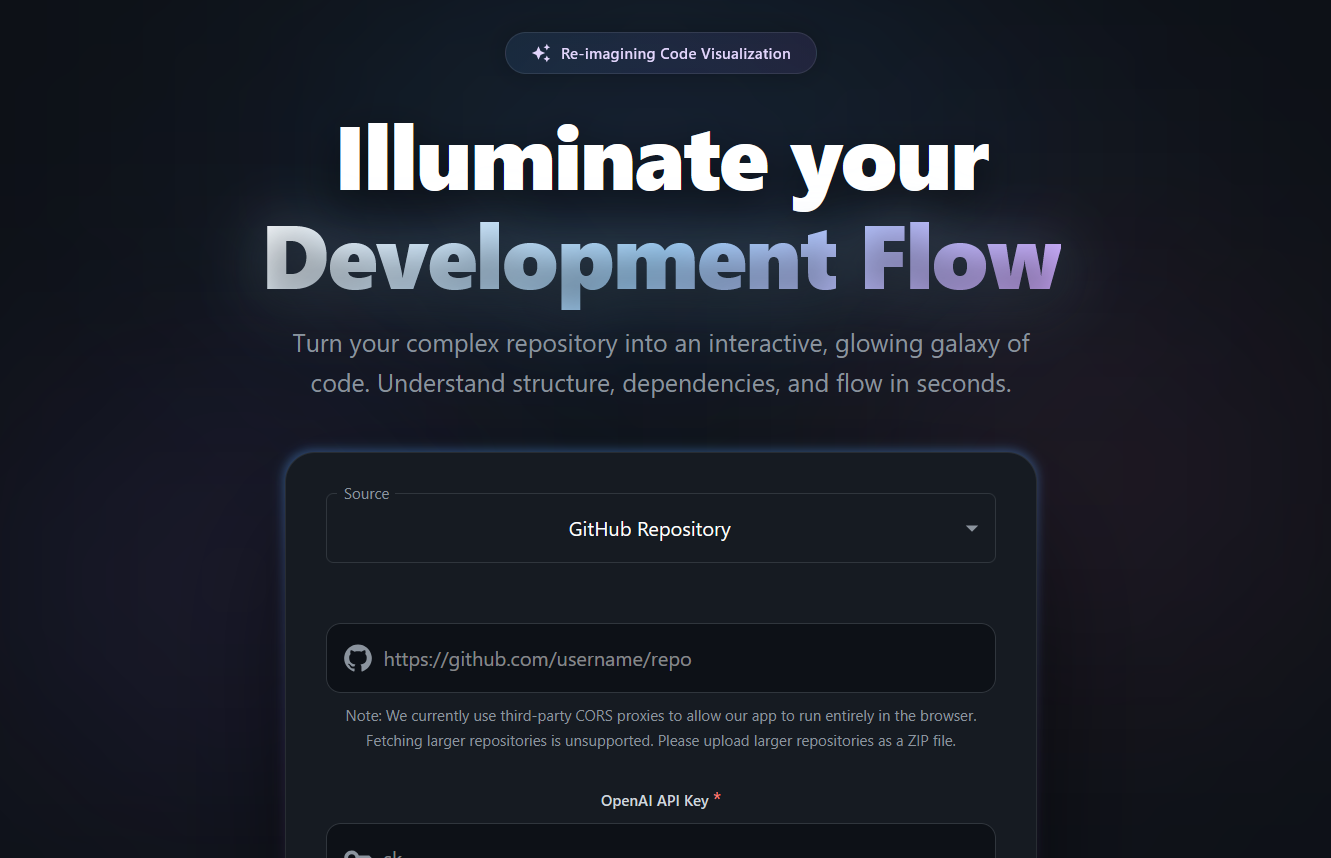
We built Git Lumina to be a web-based experience that handles complex repository parsing in real-time.
- Frontend: Developed with TypeScript and React to handle the interactive UI and graph rendering.
- Graph Engine: We used a 3D visualization framework to map out files as nodes and their dependencies as connections.
- AI Integration (Cortex): We integrated LLMs to analyze code structures and generate the custom "Quests" and "Flyover" insights.
- Motion Control: We implemented webcam-based gesture tracking to allow for hands-free navigation through the codebase.
Challenges we ran into
One of the primary challenges was parsing cross-language dependencies accurately to ensure that "edges" correctly represented imports and function calls across various file types like Python, Java, and C++. Additionally, creating a seamless webcam motion control system that felt intuitive for 3D navigation required significant fine-tuning to ensure the "Flyover" experience remained smooth and helpful rather than disorienting.
Accomplishments that we're proud of
We are incredibly proud of building a functional, live deployment that supports over 10 different file languages/formats. Successfully implementing the Quests feature—which automates the onboarding experience for any project—is a huge win, as it directly addresses the inefficiency of manual codebase walkthroughs.
What we learned
Through this project, we learned the importance of spatial mapping in developer productivity. We discovered that visualizing a codebase as a graph significantly reduces the cognitive load compared to reading raw text. We also gained deep experience in automated code analysis and the complexities of building a multi-modal interface that combines motion, mouse, and AI-driven insights.
What's next for Git Lumina
We see Git Lumina as an essential layer for the future of software engineering across several domains:
- Big Tech: Streamlining onboarding for new engineers at companies like Amazon, Meta, and Google to reduce "time-to-first-commit."
- Startups: Enabling technical project managers to visualize codebase health during sprint planning.
- Academic Research: Helping students dive into massive research repositories such as DeepMind-Research, IsaacLab, or SGLang.
- Open Source: Reducing the barrier to entry for new contributors to major projects like LangChain or Ant-Design.
- Future Features: We plan to integrate directly into IDEs and add real-time collaborative "graph-walking" for team architectural reviews.
Built With
- mediapipe
- mui
- openai
- react
- reagraph
- redux
- typescript
- vite

Log in or sign up for Devpost to join the conversation.