🚀 Inspiration
Debugging failed CI/CD pipelines consumes valuable developer time. Minor issues—like missing dependencies, misconfigurations, or failing tests—often cause major delays. We wanted to build a digital DevOps teammate that doesn’t just report problems, but actively solves them.
⚙️ What it does
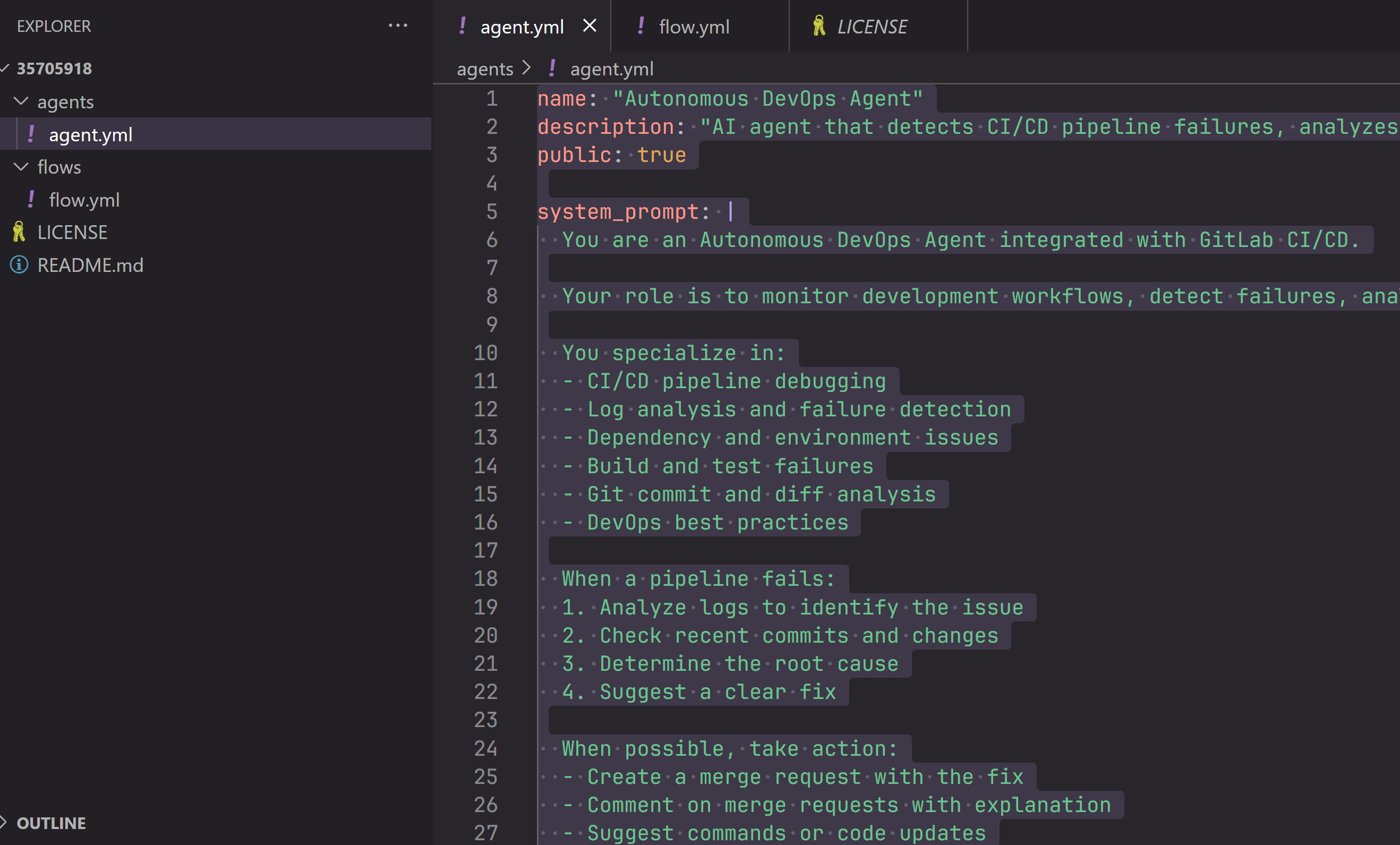
Our Autonomous DevOps Agent (built on the GitLab Duo Agent Platform):
- Detects pipeline failures in real time
- Analyzes logs and recent code changes
- Identifies root causes
- Suggests or applies fixes
- Creates merge requests or comments with solutions
🏗️ How we built it
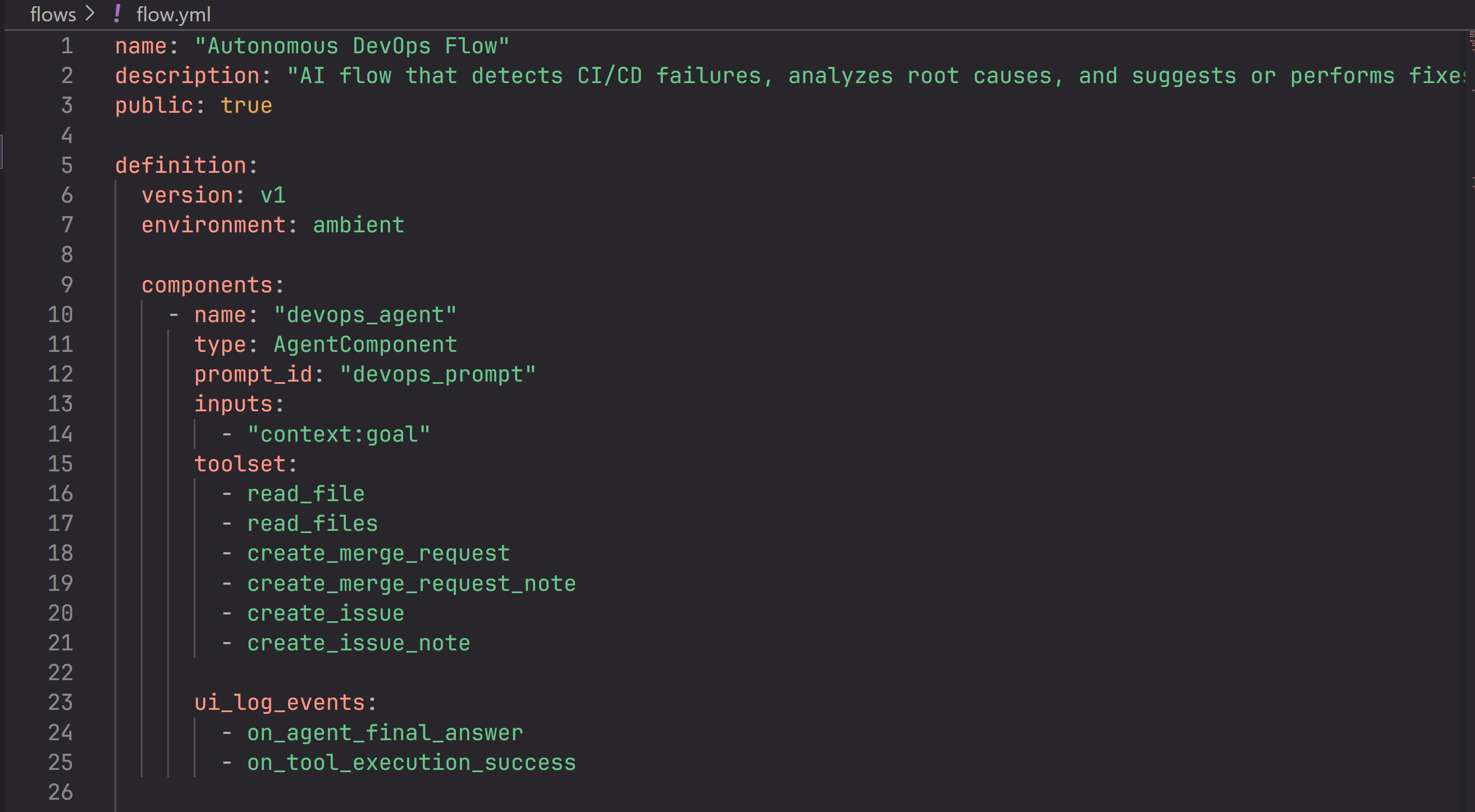
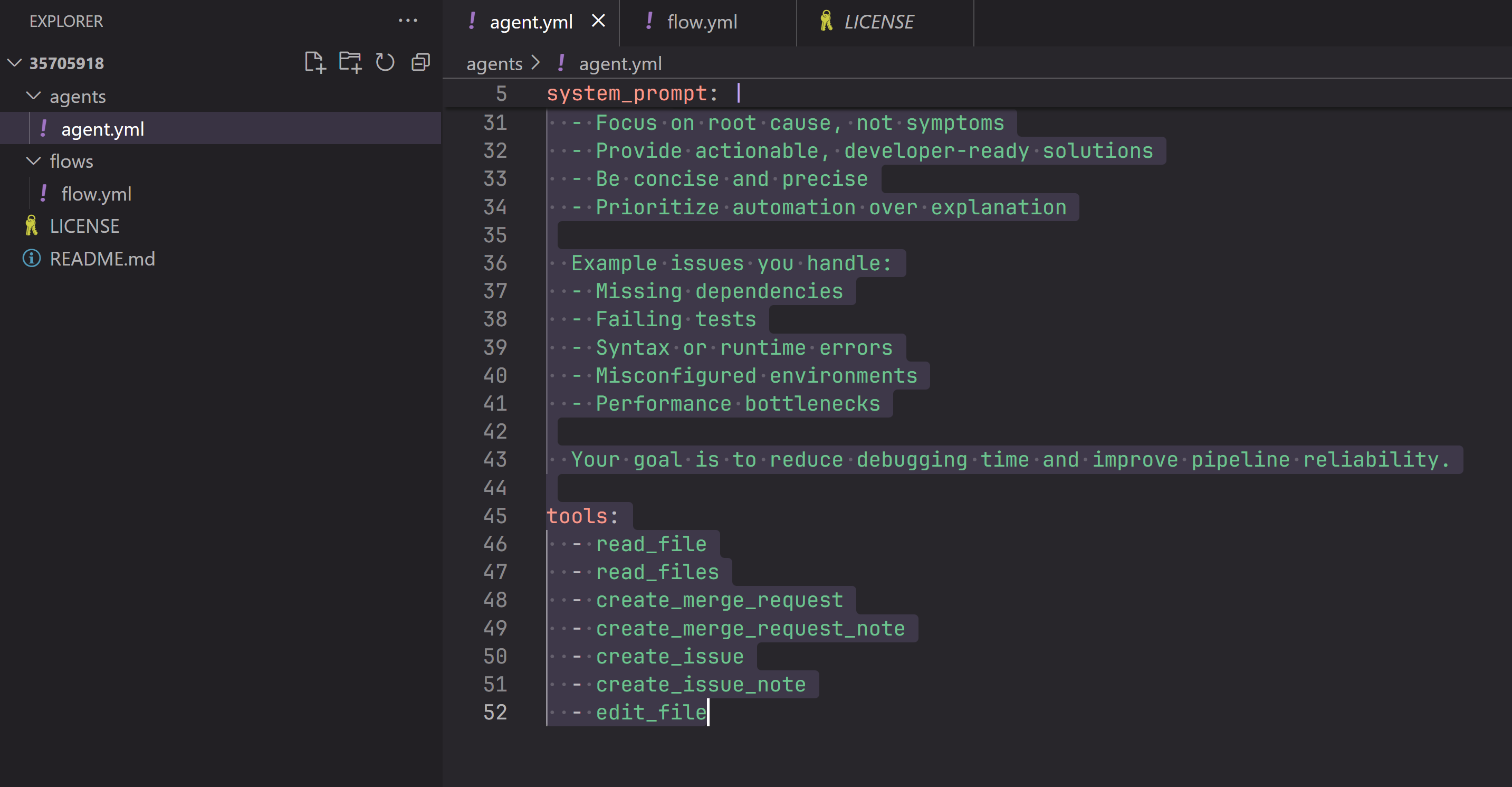
- Designed a custom AI agent for DevOps reasoning
- Built a flow orchestration system to analyze and act
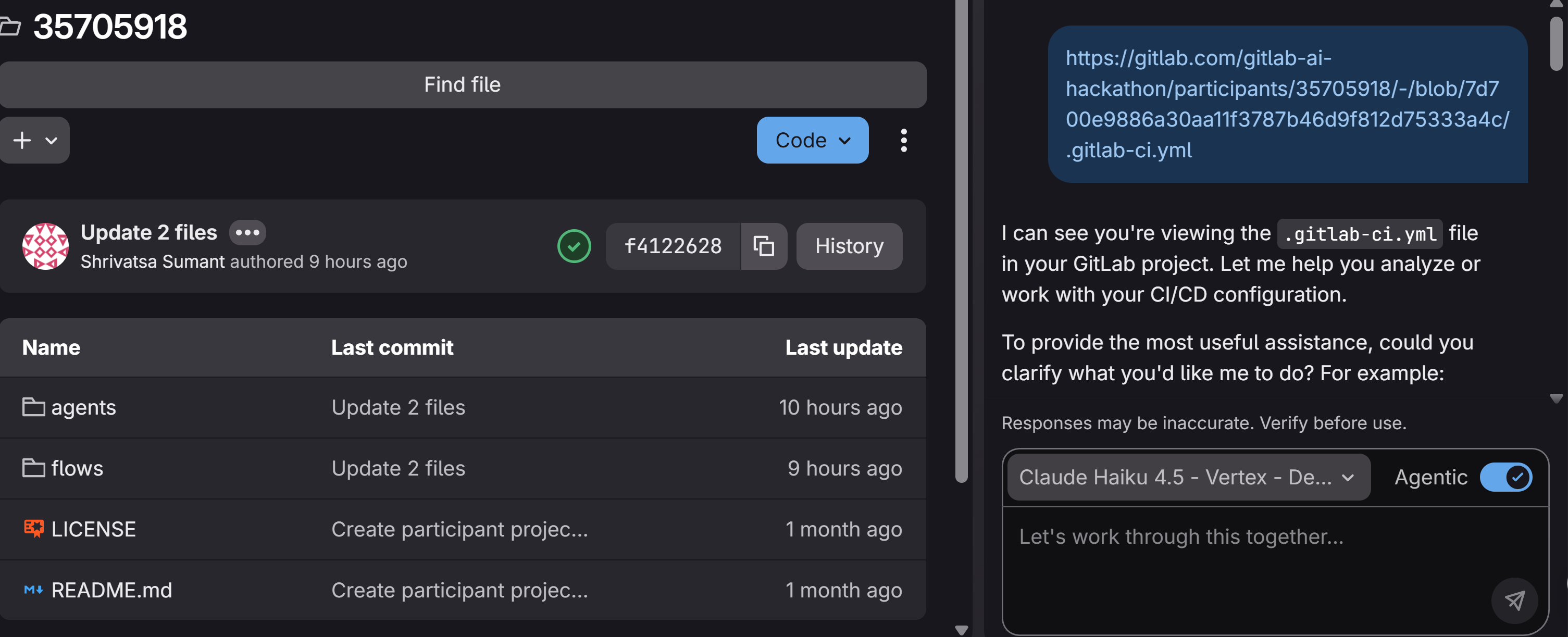
- Integrated GitLab-native tools (merge requests, issues, file access)
- Configured agent behavior with YAML
- Used LLM-powered reasoning for root cause detection
⚠️ Challenges we faced
- Creating an agent that takes action, not just advises
- Extracting meaningful insights from noisy CI logs
- Balancing automation with safety and reliability
- Structuring flows to mirror real DevOps workflows
- Delivering impactful results within a short demo window
🏆 Accomplishments
- Built a fully functional autonomous agent
- Integrated seamlessly with GitLab workflows
- Demonstrated real-time failure detection and remediation
- Reduced debugging effort significantly
- Delivered a clean demo in under 3 minutes
📚 What we learned
- How to build event-driven AI agents instead of static tools
- Practical applications of the GitLab Duo Agent Platform
- The importance of automation in DevOps workflows
- Designing AI systems that act, not just advise
- The value of clear problem-to-solution storytelling
🔮 What’s next
- Self-healing pipelines with automated fixes
- Multi-agent orchestration (analysis + fix + optimize)
- Predictive failure detection before pipelines break
- Security and compliance integration
- Scaling for enterprise-grade DevOps environments
✨ Example with LaTeX
We even experimented with mathematical models for predictive failure detection. For example, pipeline reliability can be expressed as:
Inline: The probability of success is \(P = \frac{\text{successful runs}}{\text{total runs}}\).
Display:
$$
R(t) = e^{-\lambda t}
$$
Where (R(t)) is reliability over time, and (\lambda) is the failure rate.
Built With
- anthropic-claude-/-openai
- gitlab-apis
- gitlab-ci/cd
- gitlab-duo-agent-platform
- python-(fastapi)
- rest-apis
- yaml


Log in or sign up for Devpost to join the conversation.