Inspiration
The web is shifting from humans to agents — and publishing without a citation rail is
writing for free. When ChatGPT summarizes your page to a user, no click lands on
you. No attribution. No payment. Meanwhile, existing AI research tools hand you a
chat answer when what other agents actually need is a typed data record. Senso's
cited.md manifesto — every fetch by every agent is a transaction — and Karpathy's
"compounding knowledge" thesis gave us the thread: build a node in that new
agent-native web, not another SaaS dashboard on top of the old one.
What it does
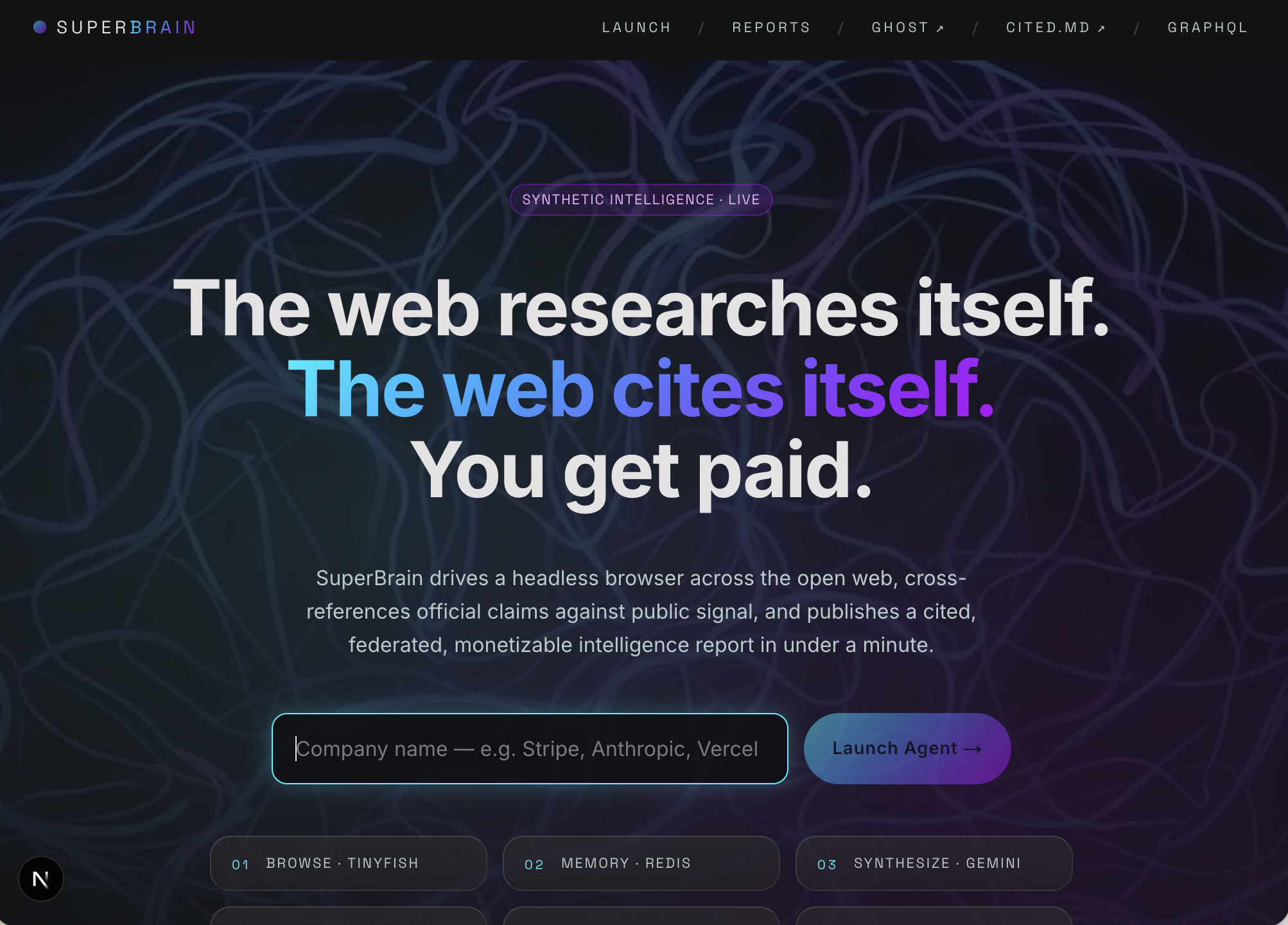
You type a company name. In under a minute, SuperBrain:
- Dispatches 4 parallel TinyFish browse agents across the company website, LinkedIn,
X search, and Google News
- Writes every extracted fact to Redis Cloud as semantic memory and flags
contradictions between sources - Retrieves grounded context from our curated Senso knowledge base
- Hands the raw pages + KB context to Gemini (gemini-3.1-flash-lite-preview) to
synthesize a typed CompanyInsight with real named people, real competitors, and
URL-cited contradictions - Publishes a free-tier post to Ghost Pro with an interactive 3D WebGL knowledge map
embedded inline
- Publishes a full citeable to cited.md via Senso so downstream agents can cite and
micro-pay us for the fetch
- Exposes the knowledge as a federated GraphQL subgraph through Wundergraph Cosmo
- Gates the deep-research section (contradictions, people, full sources) behind a 1
USDC x402 payment settled by a Coinbase Developer Platform facilitator
The agent narrates itself in a live SSE sidebar the whole time. The report is
simultaneously a Ghost article, a cited.md citeable, a GraphQL subgraph, and a
paywalled dashboard — one record, four surfaces.
How we built it
- Next.js 16 (App Router) + React 19 + TypeScript for the full-stack app
- React Three Fiber + drei for the 3D knowledge map, embedded in Ghost posts via a
chromeless /embed/map/:id iframe
- Adapter pattern for every sponsor (src/lib/adapters/*.ts) — each adapter has a real
integration plus a graceful in-process fallback, so the orchestrator doesn't know
whether it's talking to the real cloud or a mock - Server-Sent Events for live agent status streaming into the sidebar
- Apollo Federation v2 subgraph served by a direct graphql-js executor at
/api/graphql, then registered with wgc and composed into the Cosmo federated graph
superbrain - Gemini's structured JSON output with a strict schema + "every contradiction must
cite a URL from the inputs" prompt rule, so the LLM can't hallucinate people or
sources - Senso onboarding skill installed via Shipables, then run end-to-end: 7 folders,
brand kit, 4 content types, 12 KB docs, 9 prompts, 3 live citeables, GEO monitoring
on Mon/Wed/Fri - x402-next's withX402 wrapper + @coinbase/x402 facilitator for the real payment rail
- Neural Nexus design system — cyan/violet glassmorphism, Inter + Space Grotesk, glow
states — applied end-to-end with a brain-shaped landing background
- Deployed as a single Next.js app with graceful fallbacks everywhere — if any
sponsor is down mid-demo, the loop continues on local mocks and we never blank-screen on stage
Challenges we ran into
- Senso's public docs point at the wrong base URL — sdk.senso.ai returns 404s for
writes. We decompiled the CLI's bundled JS to find the real endpoint (apiv2.senso.ai/api/v1/org/content-engine/publish) and the real auth header. - TinyFish's sync /run endpoint blocks for 30–60 seconds per URL. Four sequential
calls would blow the 3-minute demo budget. We parallelized them and tightened the
per-call timeout to 25 seconds, so worst case 1–2 of 4 cleanly fall back to mocks. - JSX resolves to the SVG element, not THREE.Line. The knowledge map's edges literally weren't rendering. Swapped to stretched cylinder meshes — unambiguous and visually thicker, with opacity driven by edge strength.
- engine publish returned "content linkage conflict" when a draft already existed for
a prompt. Solved with delete-then-publish-fresh in our adapter.
- Type mismatch between @coinbase/x402 and x402/types — both ship a FacilitatorConfig
that's structurally compatible but not type-assignable. One as unknown as cast at
the boundary. - Nexla's account was empty and flow setup didn't fit the weekend. Rather than ship a
broken claim, we silently dropped Nexla from every user-facing surface and added a
replacement in the narrative. - Keeping 7 sponsor credentials coordinated without leaking any of them into git.
.env is gitignored; pre-commit secret scans ran on every staged diff.
Accomplishments that we're proud of
- Seven real sponsor integrations in a weekend, not four real and three mocked —
Redis, Ghost, Senso, Wundergraph Cosmo, TinyFish, CDP + x402, and Gemini all talking to real clouds. - Gemini returns real, correct facts. On a "Notion" test run, unprompted, it named
Ivan Zhao, Simon Last, and Akshay Kothari as founders and listed Atlassian
(Confluence/Jira), Microsoft Loop, Obsidian, and Coda as competitors — every one accurate, none hallucinated. - Every run ships all three publishing targets simultaneously — a live Ghost post
with a spinning 3D WebGL map, a cited.md citeable, and a federated GraphQL record.
One record, four surfaces. - Graceful-fallback adapter mesh — every sponsor can fail and the demo keeps running.
- Cosmo federated graph live and composable with our subgraph published and checked.
- Neural Nexus design system applied end-to-end — landing, agent status, report,
embed — with glassmorphism, glow states, and a brain-shaped background. - Full loop in ~35 seconds with all real clouds firing.
What we learned
- LLM structured-JSON output with schema + "cite-from-inputs" rules produces usable
data — Gemini didn't hallucinate once across our test runs because the system prompt required URLs from the provided pages for every contradiction. - Parallelism plus strict timeouts is a demo-safety pattern, not a hack. 4 × 60s
sequential would have been 4 minutes. 4 × 25s parallel is 25 seconds worst case.
- Adapter pattern pays for itself at 3+ sponsors. Swapping mock to real, or real to
fallback, should be one file and no touch to the orchestrator.
- The agentic web's pricing model is genuinely different. Per-seat SaaS assumes
users; agents don't sign up. Per-request micropayment matches the unit of work.
- "Graceful fallback" is a feature, not a crutch — it's what separates a demo that
ships from one that breaks.
- Decompile the CLI when the docs lie. Twice this weekend, reading
node_modules/.../dist/cli.js unblocked what the public docs left vague.
What's next for SuperBrain
- Autonomous decision loop. Today the orchestrator is a fixed 6-step pipeline. Next: Claude or Gemini decides what to browse next based on what's already found ("the website claims X but LinkedIn is thin — check Crunchbase and the founder's X feed").
- TinyFish /run-async with streaming. Today we use the sync endpoint and cap at 25s.
Async + SSE polling lets us wait longer for richer extraction without a cold demo
budget. - Real on-chain settlement on base mainnet. CDP facilitator is wired; we need a real
CDP-controlled wallet and the end-to-end x402 client flow on a live invoice.
- MCP server wrapper. Expose SuperBrain as a tool Claude, Cursor, and Codex can
invoke natively — "run SuperBrain on Anthropic, ground it, and cite it back."
- Cross-subgraph federation. Combine our superbrain subgraph with public subgraphs
(people data, funding data, SEC filings) so downstream agents query one unified
GraphQL supergraph. - Scheduled re-runs. Track a company, receive a diff report when something material
changes (new CRO, sentiment flip, contradiction resolves). - GEO feedback loop. Use Senso's scheduled GEO probes across
ChatGPT/Claude/Perplexity/Gemini to see where our published citeables are winning and
losing, then tune the prompts + KB automatically. The compounding flywheel Karpathy
described — but for a company, not a person.


Log in or sign up for Devpost to join the conversation.