-
-
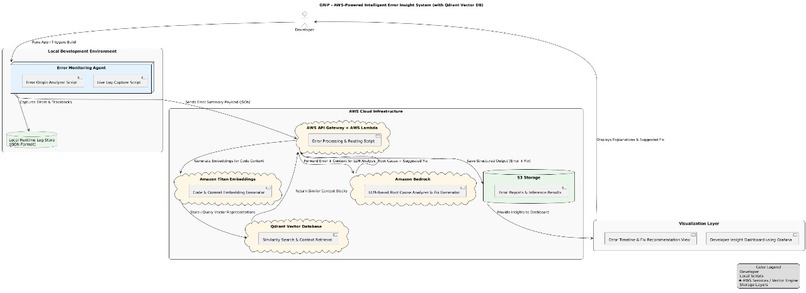
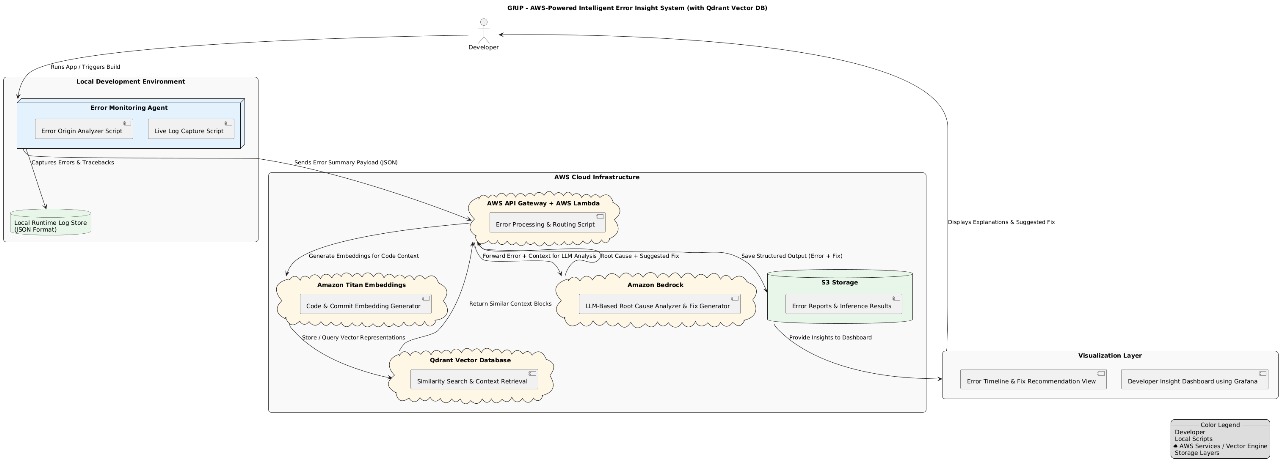
This is the architecture diagram of the GRIP .
Inspiration
The idea for GRIP — Git-based Reasoning and Intelligent Persistence — came after watching a Instagram reel about how teams often struggle when a core developer leaves a project. It highlighted how new or remaining developers find it difficult to understand legacy code, trace unresolved bugs, and identify why certain errors occur repeatedly. That observation inspired us to design a system that could capture the reasoning behind past errors and persist it in a structured, intelligent form. Our goal was to create a tool that allows any developer — new or experienced — to instantly retrieve past debugging knowledge and understand the underlying cause of issues through AI-powered reasoning.
What it does
GRIP functions as an intelligent runtime debugger that automatically captures, structures, and analyzes every exception or traceback that occurs within a system. It uses a custom Django middleware to log detailed error origins, including function definitions, file locations, and stack frames. The captured information is embedded and stored in a Qdrant vector database for semantic retrieval. Future integrations with AWS Bedrock will allow the system to use LLM reasoning to summarize root causes, suggest fixes, and provide commit-level context through Git analysis.
How we built it
We built GRIP using Python and Django for the backend, developing a custom middleware (ErrorOriginMiddleware) capable of extracting detailed traceback information and mapping it to its original file and function definitions using the inspect module. Each captured error is serialized into structured JSON and logged in timestamped files. These logs are designed to feed into Qdrant, where they are vectorized for semantic similarity searches. The architecture is being extended to connect with Amazon Bedrock, using Titan Embeddings for vector generation and Bedrock AgentCore/Nova for reasoning. The infrastructure is designed to later scale as an autonomous debugging assistant that interacts with local Git repositories through GitPython.
Challenges we ran into
One of the main challenges was the steep learning curve associated with integrating AWS components like Bedrock and AgentCore, which were relatively new to our team. Understanding how to connect them securely while maintaining compatibility with a local vector database setup required extensive experimentation. Additionally, designing middleware that could trace not just the error but its originating definition (e.g., finding where a function or class was first declared) was a complex task involving Python’s introspection capabilities. Time constraints during the hackathon limited our ability to implement the complete Bedrock integration and the visual interface we initially envisioned.
Accomplishments that we're proud of
We successfully developed a robust runtime introspection system that can automatically capture and analyze stack traces, identify symbol definitions, and format them into a structured, machine-readable log. We also managed to merge multiple Git histories into a unified project repository while retaining historical commits — ensuring that GRIP’s development process itself demonstrated intelligent repository management. Our current backend now provides a strong foundation for future integration with AI-powered reasoning systems.
What we learned
Through this project, we gained a deep understanding of Django middleware architecture, Python introspection, and error propagation mechanisms. We also learned how hybrid retrieval systems can bridge local runtime intelligence with large-scale cloud reasoning using vector embeddings. Most importantly, we learned the importance of designing developer tools that focus not only on automation but also on knowledge continuity — preserving the understanding that often leaves when a developer does.
What's next for Git-based Reasoning & Intelligent Persistence (GRIP)
Our next steps are to:
Integrate Amazon Bedrock Titan for embedding generation.
Connect Bedrock AgentCore to interpret runtime error patterns and generate contextual debugging advice.
Expand Qdrant’s schema to support semantic search over past error logs, commit messages, and code comments.
Develop a lightweight VS Code extension that surfaces these AI insights directly within the developer environment.
Deploy GRIP as a cloud-ready service with multi-user support and project-level analytics.
GRIP’s ultimate vision is to become an intelligent, self-learning debugging assistant that remembers, reasons, and evolves with every project it supports.
Built With
- agentcore
- amazon
- amazon-web-services
- bedrock
- django
- embeddings
- gitpython
- python
- qdrant
- sqlite
- titan

Log in or sign up for Devpost to join the conversation.