-
-
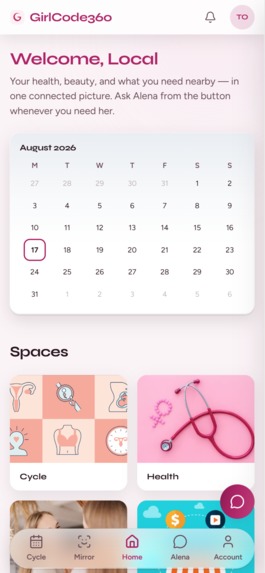
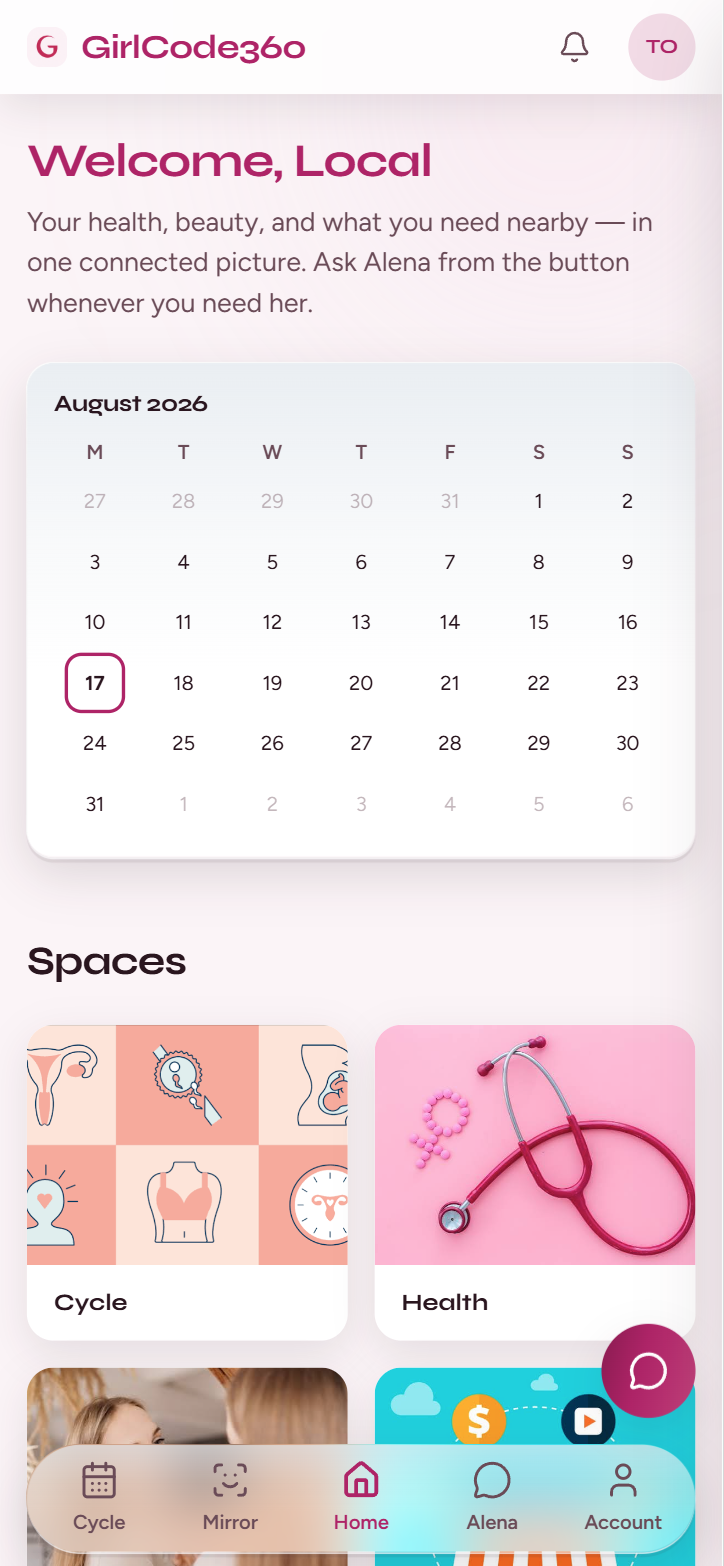
Home screen - Mobile
-
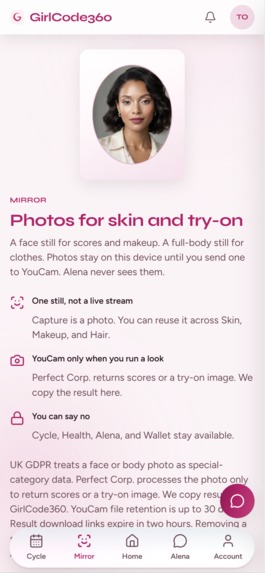
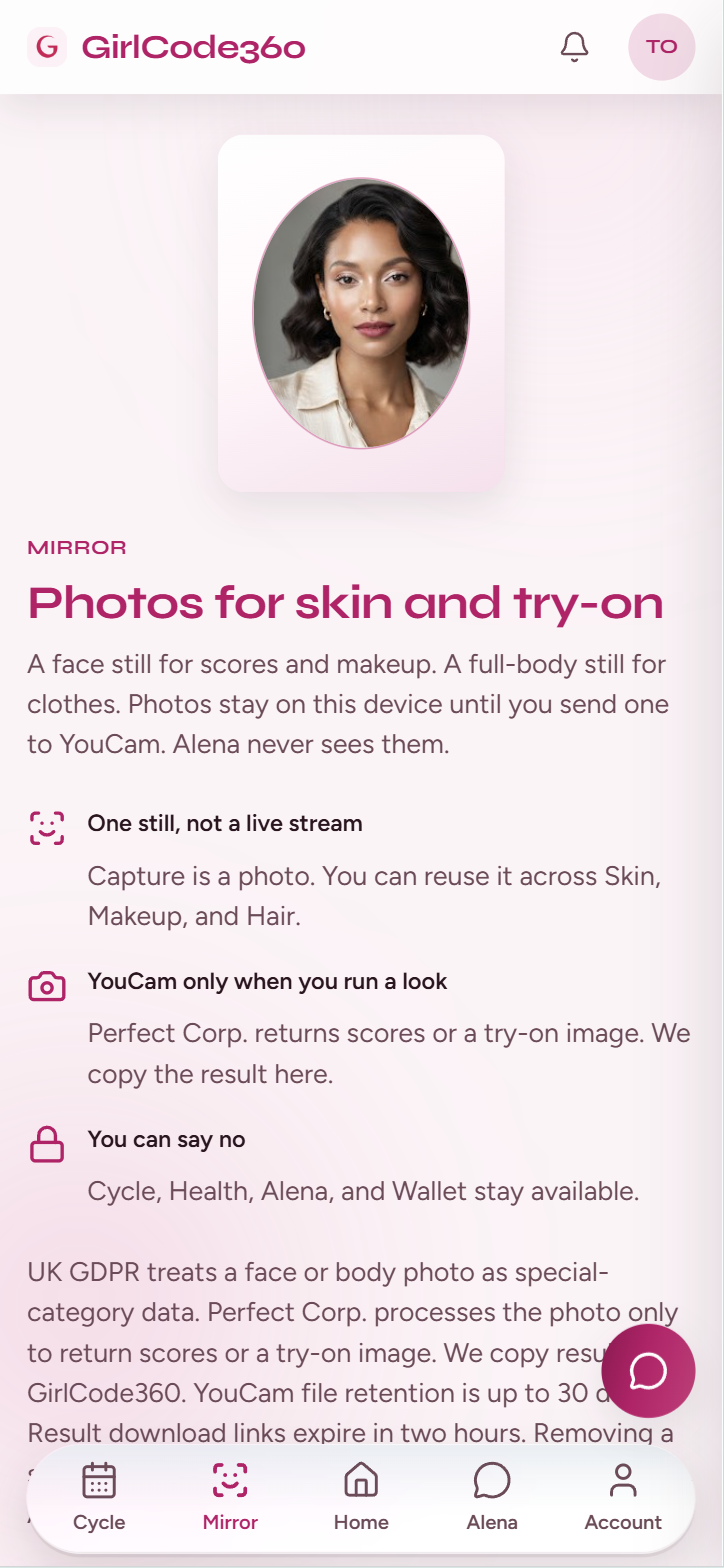
Introducing Mirror
-
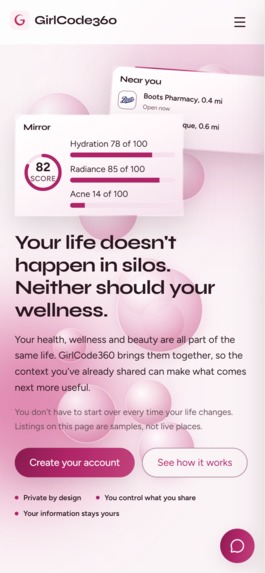
Landing Page- Mobile
-
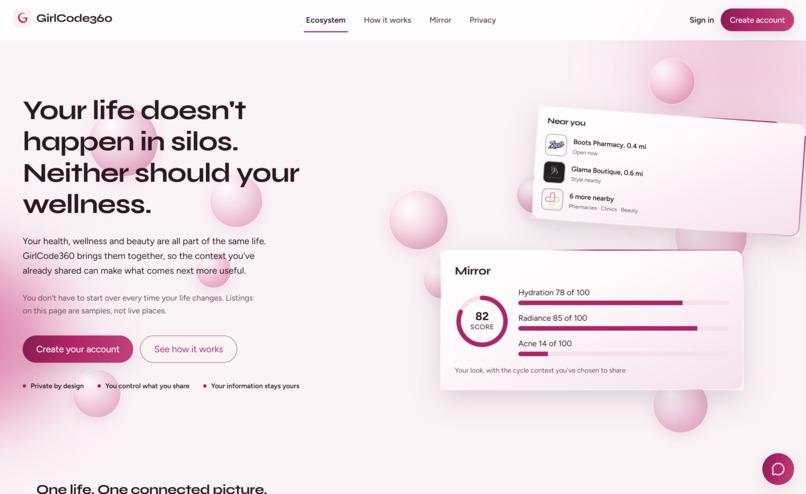
Landing Page
-
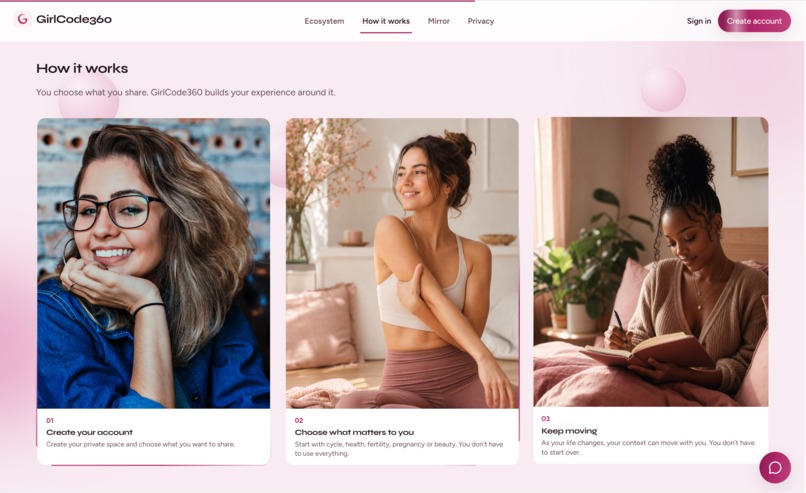
How it works
-
Virtual clothing try on
Inspiration
Beauty doesn't exist in isolation. Neither does she.
We started GirlCode360 because we believe women shouldn't have to experience their health, wellness and beauty as a collection of disconnected apps.
A woman can be tracking her cycle, managing hormonal symptoms, dealing with a skin concern, thinking about what to wear, or simply wanting to feel more confident — sometimes all at the same time.
Yet most digital experiences treat these as completely separate problems.
The idea behind GirlCode360 is simple: there should be one connected picture of her.
When we discovered the YouCam API Skin AI & Apparel VTO capabilities, we saw an opportunity to bring that philosophy into beauty and fashion. Instead of building another standalone skin scanner or virtual try-on tool, we wanted to connect visual AI with the context a woman has already chosen to share.
That means a skin insight doesn't have to exist in isolation. It can sit alongside cycle and hormonal context. A virtual try-on doesn't have to be just a fun filter — it can become part of a broader experience around confidence, discovery and personalised recommendations.
We wanted to build beauty technology that sees more than what is in the camera frame.
GirlCode360's core product philosophy is that the connection between experiences is the real product.
What it does
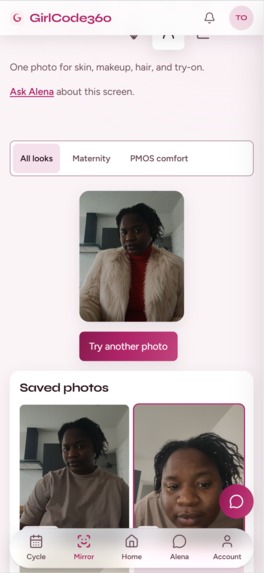
Mirror is where that philosophy becomes something you can actually see.
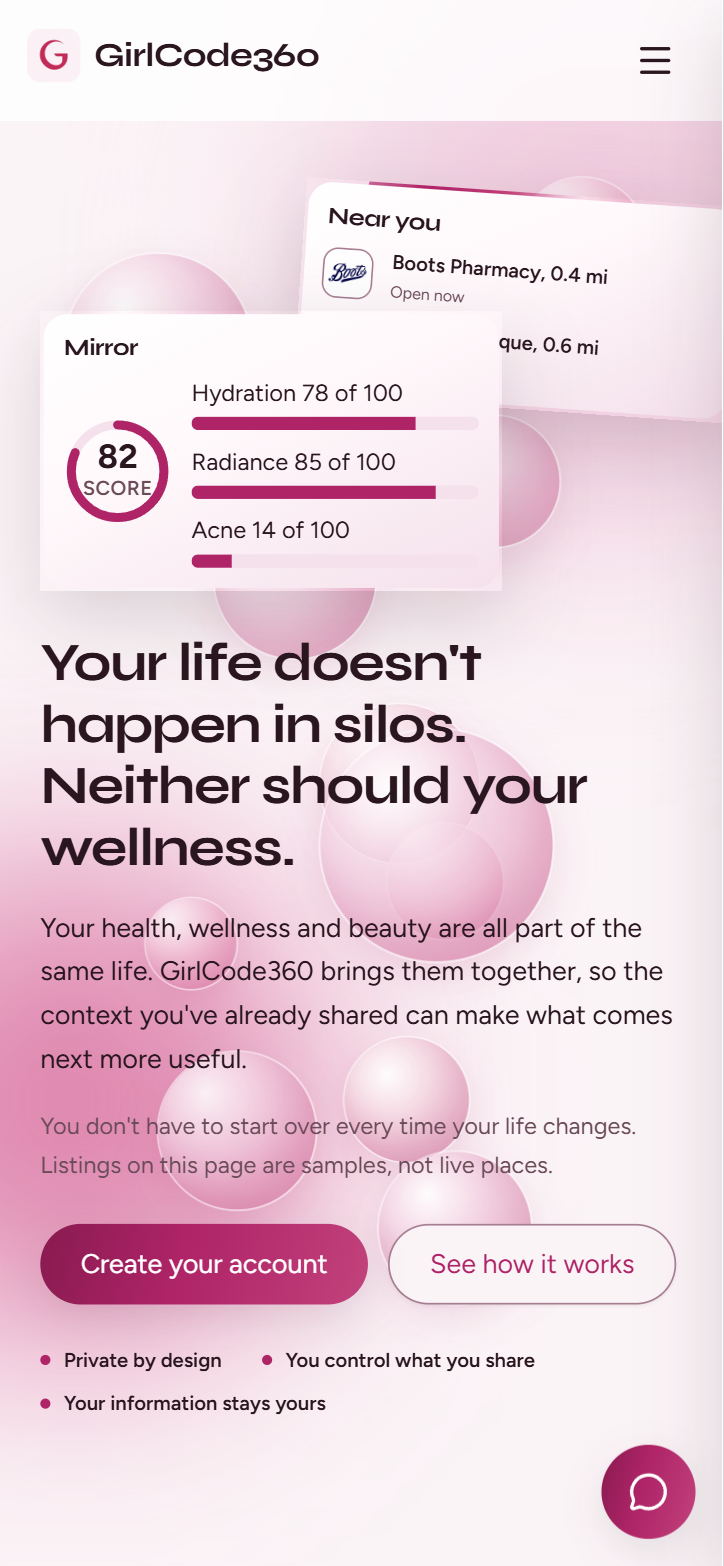
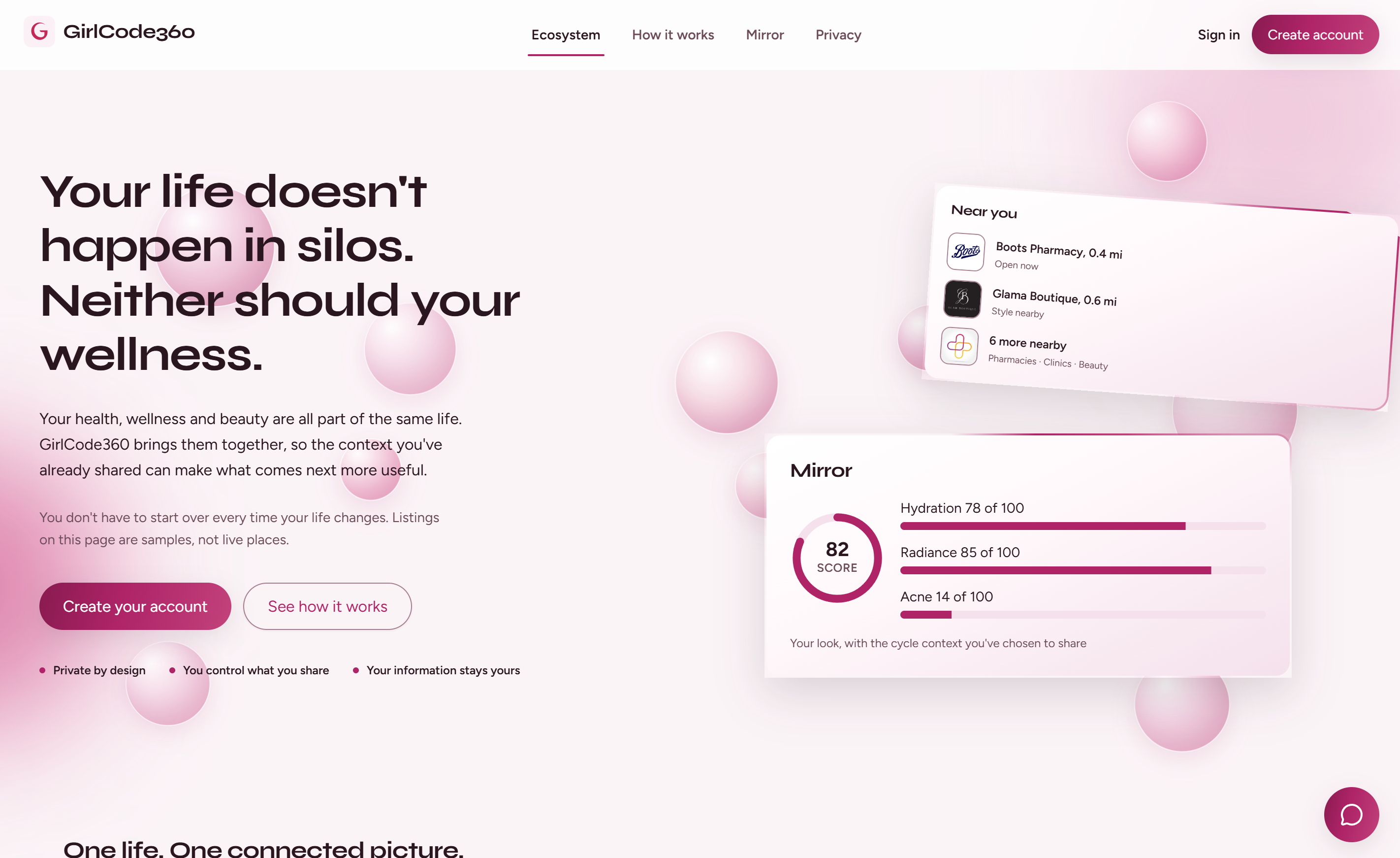
A woman scans her skin and gets real, quantified scores — not a filter, not a guess — across concerns like acne, oiliness, and hydration. But the scan alone was never the point. Because GirlCode360 already knows her cycle, Mirror reads that score differently than any standalone skin app could: against her logged cycle phase and PMOS symptoms, so it can tell her when a breakout isn't random. "Your acne score has been highest in the same window for your last three cycles" is not a sentence a beauty app can say on its own. It has to already know her.
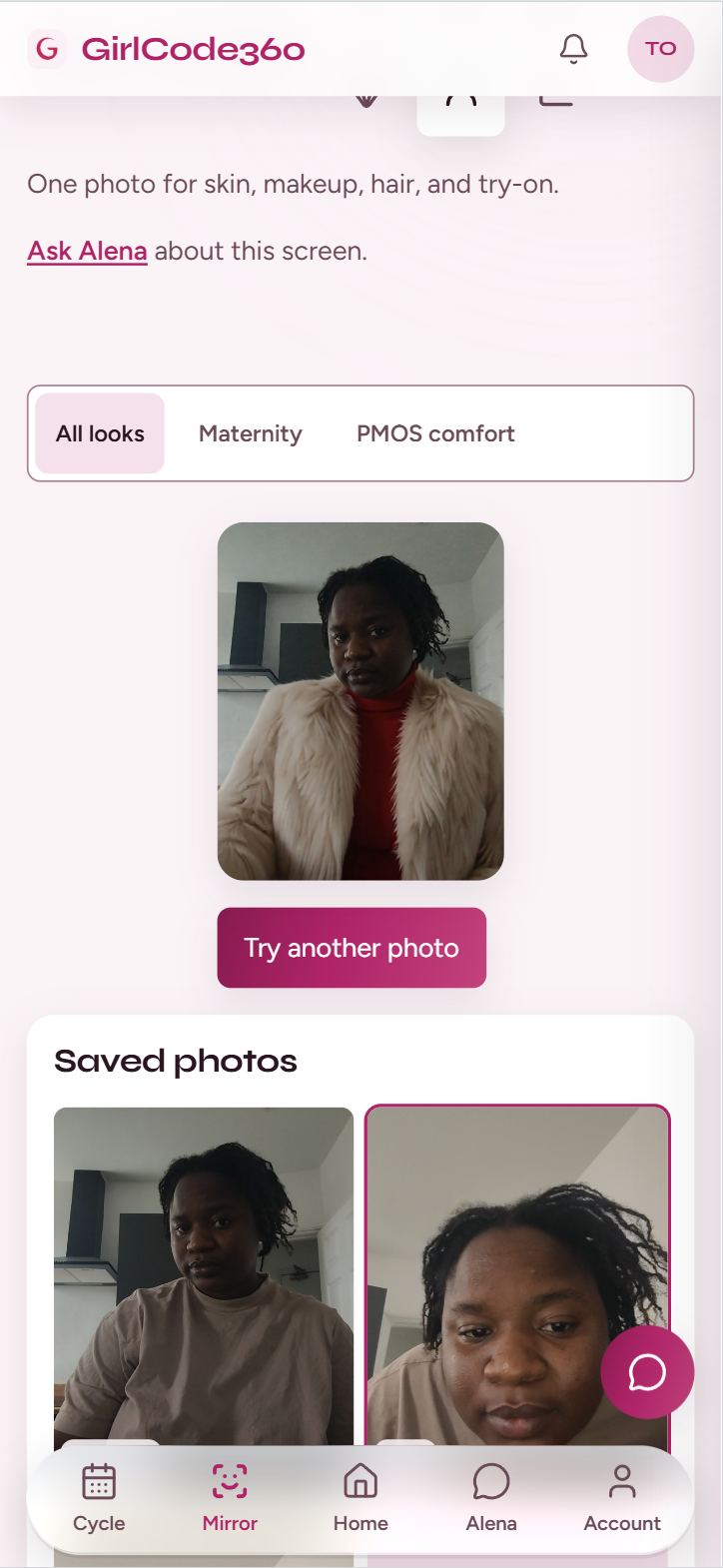
The same philosophy carries into what she wears. Virtual try-on lets her see a piece on her own body before she buys it — and because that try-on is connected to SheMatch, our location-based marketplace, it can point her to a real boutique nearby that actually has it in stock. A skin insight and a shopping decision, drawn from the same picture of her, because that's what "connected" was always supposed to mean.
How we built it
If connection is the philosophy, extension is the engineering discipline that makes it real. We didn't build Mirror as a separate product bolted onto GirlCode360. We built it as a new organ on an existing body.
GirlCode360 already runs on AWS — Aurora DSQL for the data layer, a single Lambda router for the API, Bedrock Nova 2 Lite powering Alena, our AI companion, and a React PWA on the front end. Mirror's YouCam integration sits behind a dedicated gateway service that owns everything specific to YouCam: authentication, rate-limit pacing, and the async task-and-poll pattern their API requires — submit an image, get a task ID, poll until it resolves, retrieve the result. Nothing about that gateway knows what a menstrual cycle is. Nothing about our cycle-correlation logic knows what an API key is. Each piece does one job, and the connection happens above them, not inside them.
We sequenced the ten days around what had to exist before the next thing could mean anything. Consent came first — a photograph of someone's face is a different category of sensitive data than anything else in our app, and it earned its own explicit screen rather than riding on our existing health-data consent. Skin scanning came next, then cycle correlation, because that's the feature that actually proves the philosophy rather than just stating it. Apparel try-on and the marketplace bridge came last, once the core loop already worked.
Challenges we ran into
YouCam's result URLs expire two hours after a scan completes. We didn't catch this until partway through building the skin scan feature, when a scan we'd generated that morning was no longer retrievable. The fix wasn't a patch — it meant restructuring the pipeline so that the moment a scan finishes, the system immediately copies the result into our own storage before showing it to the user at all, rather than treating "show the user" as the first step.
Our first accuracy pass on skin-tone and shade-matching used whatever test images were easiest to pull together, which skewed toward lighter skin tones. The results looked strong, which was itself the warning sign — shade-matching tools have a well-documented history of underperforming on darker skin, and a clean-looking result on a biased test set doesn't mean the feature works. We rebuilt the validation set to cover the full Fitzpatrick range and re-ran everything before shipping any skin or shade feature. That took time we were short on, and we did it anyway.
Partway through the build, it would have been faster to give the wardrobe feature its own standalone backend endpoint rather than route it through the YouCam gateway we'd already built for skin and try-on. It's a smaller, more isolated piece of code, and isolated code is easier to debug under time pressure. We didn't do it, because a second system duplicating what the first one already does is exactly the outcome our whole product philosophy exists to avoid. We built it the slower way, through the existing gateway.
Accomplishments that we're proud of
Our defining differentiator is the ability to cross-reference Mirror skin insights with existing cycle and PMOS information.
That creates a category of contextual beauty insight that a standalone beauty application cannot easily reproduce because it doesn't have access to the user's longitudinal health context.
We connected visual discovery to action
We designed the experience so that insights can lead somewhere.
A skin result can connect to skincare discovery.
A foundation result can connect to shade matching.
A completed look can connect to shopping.
An apparel try-on can become part of a broader styling experience.
The product requirements specifically route shade and beauty discovery through SheMatch rather than generic retailer links.
We designed for the woman, not just the feature
The biggest accomplishment for us is conceptual:
YouCam isn't a feature inside GirlCode360. It becomes another way GirlCode360 understands and supports the woman using it.
That is the direction we believe makes the product defensible.
What we learned
We learned that "connected" is easy to say and genuinely hard to build. It's one thing to believe a skin insight and a cycle log belong in the same sentence. It's another to build the pipeline, the consent model, and the correlation logic that let that sentence be true and honest at the same time — true to the data, honest about its limits, never overstating what a pattern means.
We also learned, technically, how to speak YouCam's language fluently — the task-and-poll rhythm, the rate limits, the retention windows. That knowledge is useful. But the more durable thing we learned is that the hardest part of building one connected picture of her was never the API. It was resisting the pull to treat Mirror as a feature launch instead of what it actually is: proof of a belief we already held before YouCam existed.
What's next for GirlCode360
Mirror is the beginning of that philosophy in beauty and fashion, not the end of it. Next comes Mirror Studio: real-time makeup try-on, a shade-matching engine that works honestly across every skin tone, a hair diagnostic that reads against PMOS symptoms the same way skin already does, a wardrobe built from clothes a woman actually owns instead of only a catalogue, and jewelry, eyewear, and nail try-on layered on top. Each one earns its place the same way Mirror did — by extending something real, not standing beside it.
We're also building this for the woman wherever she is, not only where we happen to launch first. GirlCode360 is architected as a global product from day one — the UK, Nigeria, and Ghana are where we start, not the edge of where this goes. And we're taking the same philosophy one level further: population-level pattern detection, opt-in only, so what makes sense of one woman's skin and cycle together can eventually help someone else make sense of hers, sooner.
Built With
- amazon-web-services
- apigateway
- aurora
- bedrock
- lambda
- youcam

Log in or sign up for Devpost to join the conversation.