Inspiration
The project began with a shockingly simple observation: more than 20,000 AI-generated tracks are uploaded online every single day. This overflow of automated music raised questions that felt urgent to me: What remains of the author when the machine writes, sings, and composes? How do we still recognise ourselves in the noise?
I turned to Colette Renard’s 1958 song Les Nuits d’une demoiselle - a masterpiece of playful eroticism, linguistic virtuosity, and feminist subversion. Reinterpreting it in 2025 through the lens of AI felt like a way to test the resilience of the French language, its humour, and its sensuality in an era of infinite machine-made content.
Visually, I drew from a deliberately eclectic constellation:
Barbara Cartland, Colette Renard, Barbie, Booba, SCH, PNL, Jul, Sofia Coppola, Tim Burton, Chris Cunningham, David LaChapelle, Eva & Adele, Martin Parr, Cardi B, Michel Gondry, Julien Doré, Lil Nas X …
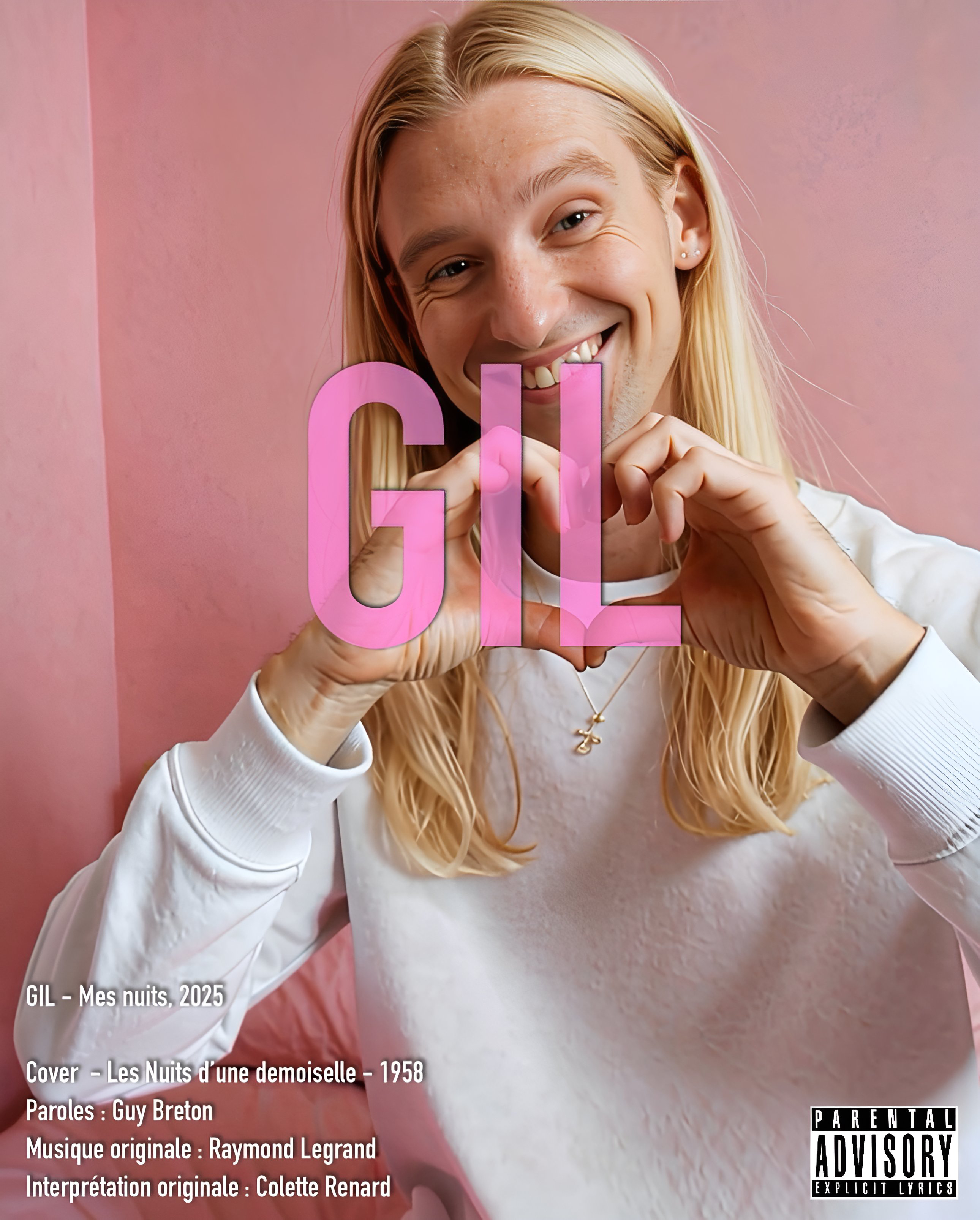
This hybrid landscape shaped the identity of GIL, a character who is both masculine and ambiguous, tender and ironic, a pink-washed witness of our mediated world.
The entire film is also rooted in my ongoing artistic practice :
making AI a painter’s palette, a material to knead, sculpt, and bend. Light, texture, colour - everything is mixed like pigments to find the right tone. This approach aligns with the Brechtian “mise en étrangeté” that runs through my work: a deliberate slight strangeness that invites distance, reflection, and play.
I chose the 4:5 portrait format in conscious reference to social-media codes- the spaces where identity is performed, multiplied, and consumed.
What it does
GIL- Mes nuits, 2025 is a short AI-driven music film that
• reinterprets a historic French song through contemporary aesthetics,
• blurs the line between gendered identities,
• questions authorship in the age of algorithmic creation,
• and stages an intimate, ambiguous self-portrait.
It is at once playful and critical: a pop object, a visual poem, a digital mirror.
How I built it
The film was created entirely on a smartphone, from concept to final export.
• AI image generation (Photoleap) – creation of all portraits through layered prompting, texture tuning, and iterative refinement.
• AI video animation (PixVerse) – giving life to still images via micro-gestures (breathing, blinking, soft head movements).
• AI music (Suno) – generating the musical reinterpretation while preserving the structure and melodic spirit of the 1958 piece.
• AI voice sculpting – blending tonal qualities to create a voice that feels both human and synthetic.
• Adobe Premiere Rush (mobile) – assembly, editing, pacing, overlays, and colour micro-adjustments.
• Prompt editing as artistic method – the real craft: mixing visual “pigments”, sculpting atmosphere, calibrating pink tones, and defining GIL’s identity through hundreds of iterations.
Challenges I ran into
• Controlling the AI’s stylistic excess: avoiding caricature while embracing pop aesthetics required endless refinement.
• Balancing irony and sincerity: GIL had to be strange, tender, and unsettling at once.
• Adapting the erotic humour of 1958 to 2025 without falling into parody.
• Ensuring coherence across multiple AI tools, each producing different textures and behaviours.
• Working entirely on a smartphone, which imposed constraints that ultimately became part of the film’s identity.
• Finding a musical tone that honoured Colette Renard without imitating her.
Accomplishments that I’m proud of
• Crafting a consistent visual universe from fragmented tools.
• Turning historical material into a contemporary, queer-coded, ambiguous character.
• Achieving all production steps - writing, images, sound, editing, mastering - solo, with a coherent artistic direction.
• Using AI not as a shortcut but as a delicate, painterly material, with real craftsmanship in prompt editing.
• Remaining faithful to the playful spirit of the original text while making it resonate today.
What I learned
• AI is only as interesting as the intent behind it.
• Prompt editing is a true artistic discipline, close to colour mixing or photographic direction.
• Constraints (like the 4:5 format or mobile production) can become aesthetic strengths.
• The frontier between human and machine creation is less about tools than about tone, humour, and sensitivity.
What's next for GIL - Mes nuits, 2025
This film is the first chapter of a broader exploration of identity, pop culture, and the performativity of the self in AI-augmented spaces.
Next steps include:
• expanding GIL into a micro-series of portrait-songs.
• documenting the creative process as a form of research.
• and building a longer film where human and machine co-author an evolving narrative.
Built With
- photoleapai
- pixelup
- pixverseai
- premieremobile
- suno


Log in or sign up for Devpost to join the conversation.