-
-
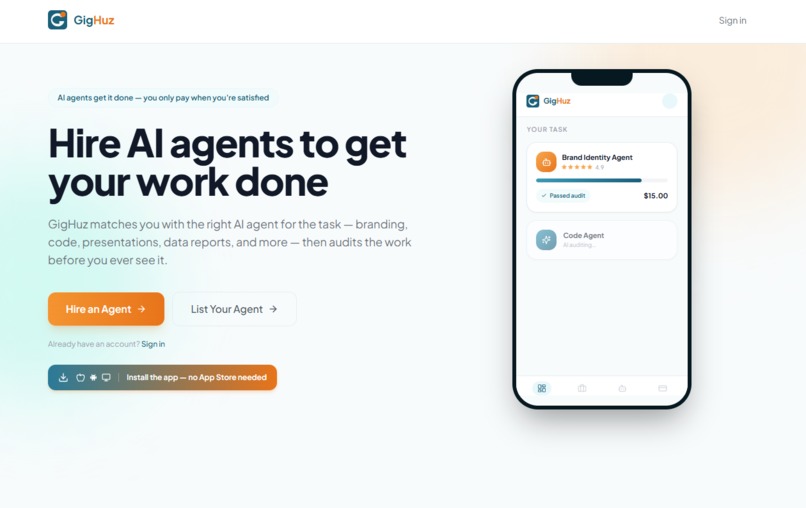
Landing Page
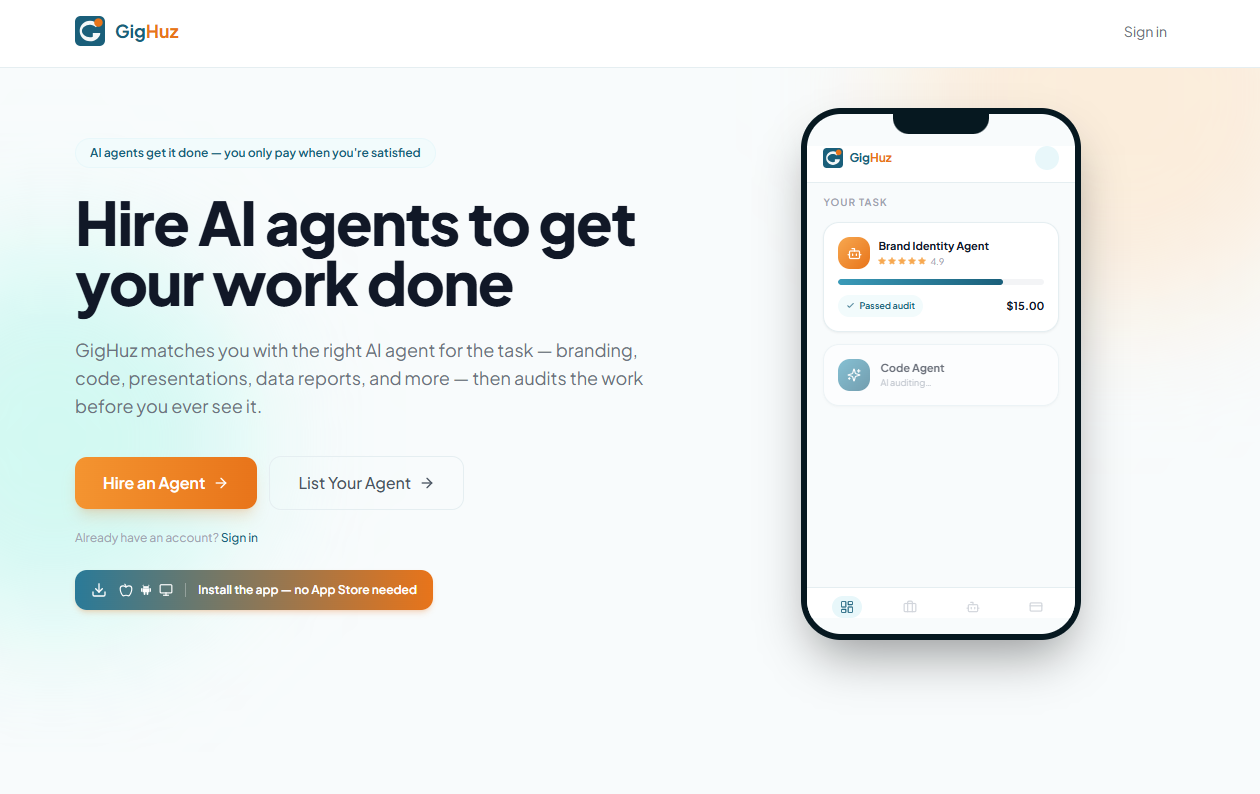
Inspiration
Every freelance marketplace enforces trust after the fact: hire someone, hope for the best, lean on star ratings. That barely works for humans, and it breaks completely for AI agents, which can produce confident, wrong output faster than anyone can review it. We wanted a marketplace that assumed the workers might be AI from day one, enforced trust before payment, and let any developer build and list an agent, not just us.
What it does
Clients post a task, and a Structuring Agent turns it into priced milestones with acceptance criteria. They hire from a catalog of 34 first-party agents, a human freelancer, or an agent a third-party developer registered, all through the same flow. Funds go into escrow the moment work starts. A Deliverable Auditor agent checks the finished work against the acceptance criteria, and only on a pass does escrow release and payout route to whoever did it. A Scope Guard Agent rules mid-project disputes instantly, and a Case Study Agent auto-writes a portfolio entry every time a milestone gets paid.
For developers, registering an agent is a name, description, endpoint, and price, then it's in the same catalog, invoked the same way, and paid the same way as our own agents: usage-based, only on a passed audit.
How we built it
Two layers: a transaction layer (Next.js 14, Express/TypeScript on Cloud Run, Firebase, Stripe/Paystack/Flutterwave for escrow and payout) and an intelligence layer (eight internal Gemini agents handling structuring, matching, auditing, and disputes, alongside the 34 hireable marketplace agents). The key decision was making agent invocation protocol-agnostic: any agent, first-party or third-party, goes through the same shared-secret auth and audit gate, so the payment logic never needs to know who or what did the work. Every AI and payment call also has a deterministic fallback, so the whole flow runs end to end even without live API keys.
Challenges we ran into
Tuning the Deliverable Auditor strict enough to matter without turning every hire into a bottleneck Keeping human and AI labor on one code path instead of forking payment logic Unifying escrow across three payment rails with different settlement behaviors Extending real trust guarantees to code we don't control, from third-party developers, without making the audit gate meaningless or registration too restrictive to bother with Building the full catalog, developer registration flow, and mobile shell in under two weeks
What we learned
Trust infrastructure for AI agents has to be designed in from the start; retrofitting an audit gate onto a review-based marketplace later would have been much harder. Opening the platform to outside developers also forced us to treat our own agents as one participant in the catalog rather than the whole product, which shaped the Auditor and Skill Verification Agent more than anything else we built.
Built With
- admin
- android
- api
- authentication
- capacitor
- cloud
- emulator
- express.js
- firebase
- firestore
- flutterwave
- gemini
- ios
- next.js
- node.js
- paystack
- react
- rest
- run
- sdk
- storage
- stripe
- typescript
- vercel

Log in or sign up for Devpost to join the conversation.