Inspiration
Over 70 million Americans participate in the gig economy, but traditional financial apps are built for people with steady, predictable $4,000/mo paychecks. If you drive for Uber or deliver for DoorDash, your income is a chaotic rollercoaster; you might make $1,200 one week and $200 the next. We realized that gig workers don't need a rigid "budget"; they need a dynamic financial safety net. We were inspired to build a platform that thrives on income volatility while simultaneously protecting workers from the hidden risks of gig work, like discovering your personal auto insurance explicitly drops coverage the second you accept a delivery.
What it does
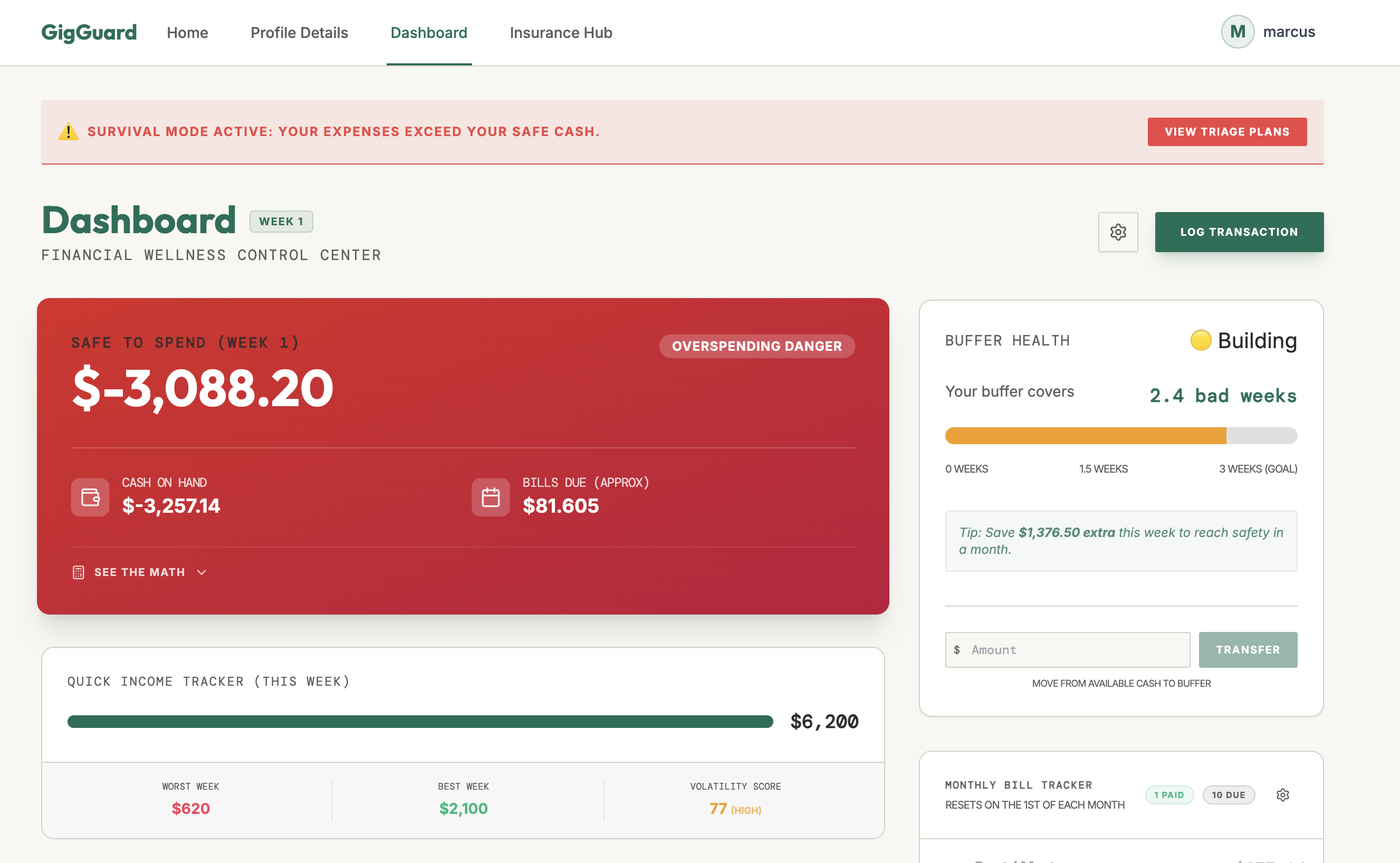
GigGuard is a financial control center purpose-built for variable incomes:
- Dynamic 'Safe-to-Spend': Abandons monthly budgeting in favor of a mathematically safe, real-time weekly spending limit that adjusts to your income crashes.
- Windfall Stabilizer: Automatically intercepts your "good weeks" (windfalls) to silently fund a 3-month survival emergency buffer before you can spend the excess.
- Survival Mode: When expenses exceed available cash, the app locks down and provides pre-calculated "Triage Plans" to guide you back to safety.
- AI Insurance Hub: Upload a massive, confusing personal auto policy PDF. Our AI instantly extracts the painful hidden exclusions for gig drivers, generates a gamified knowledge quiz, and drops a side-by-side gap analysis proving exactly why you need a State Farm Commercial Auto or Rideshare policy.
How we built it
We built the frontend as a buttery-smooth React 18 single-page application using Vite, styled with Tailwind CSS, and managed by Zustand for rapid state updates. The backend is powered by Node.js and Express, with Prisma ORM for interacting with our Supabase PostgreSQL database. For the "brain," we integrated the Google Gemini 2.5 Flash API to parse complex legal PDFs and intelligently reconstruct them into strictly typed, scannable JSON UI components in real time.
Challenges we ran into
- Financial Algorithms: Designing math for volatility is tough. Our initial algorithm accidentally penalized users by deducting their entire multi-month savings goals from their immediate weekly cash, causing their balances to drop into the negative. We had to completely rethink our formulas to successfully isolate "weekly cash" from "long-term buffer gaps."
- AI Quotas and UI Waterfalls: Firing multiple parallel Gemini queries to generate policy summaries and comparison matrices simultaneously triggered rate-limit crashes. We solved this by architecting a staggered "waterfall" frontend sequence that seamlessly triggers loading states and spaces out the API bursts.
- Prompt Jargon: Forcing an LLM to generate ultra-short, punchy UI elements instead of massive blocks of legal jargon took intense prompt-engineering and strict JSON enforcement.
Accomplishments that we're proud of
We are incredibly proud of the Coverage Comparison Matrix. It feels like magic to drag-and-drop a complex PDF and watch an AI instantly extract your exact driving scenarios (e.g., "App On, Waiting for Request" vs "Active Delivery") and cross-reference them against State Farm's premium products in a visually stunning, easy-to-read table. We're also proud to have built an app that replaces the anxiety of a red bank account screen with actionable, empathetic recovery features like the Triage Modal.
What we learned
We learned that building AI for financial applications requires massive structural guardrails. You can't just throw raw text onto a screen; you have to coerce the LLM to output highly strict JSON schemas so your frontend can render beautiful, deterministic tables and icons. We also learned how deeply UI/UX impacts financial anxiety.
What's next for GigGuard
- Open Banking Integration: Connecting securely to Plaid so gig workers can track their earnings from DoorDash, Uber, and Lyft in real-time without manual logging.
- Live State Farm APIs: Turning our AI recommendations into direct, one-click quote generation seamlessly connected to State Farm's backend systems.
- Tax Withholding Automation: Expanding our algorithm to automatically hive off SE estimated taxes during "good weeks" to completely eliminate April tax shocks.

Log in or sign up for Devpost to join the conversation.