About the Project
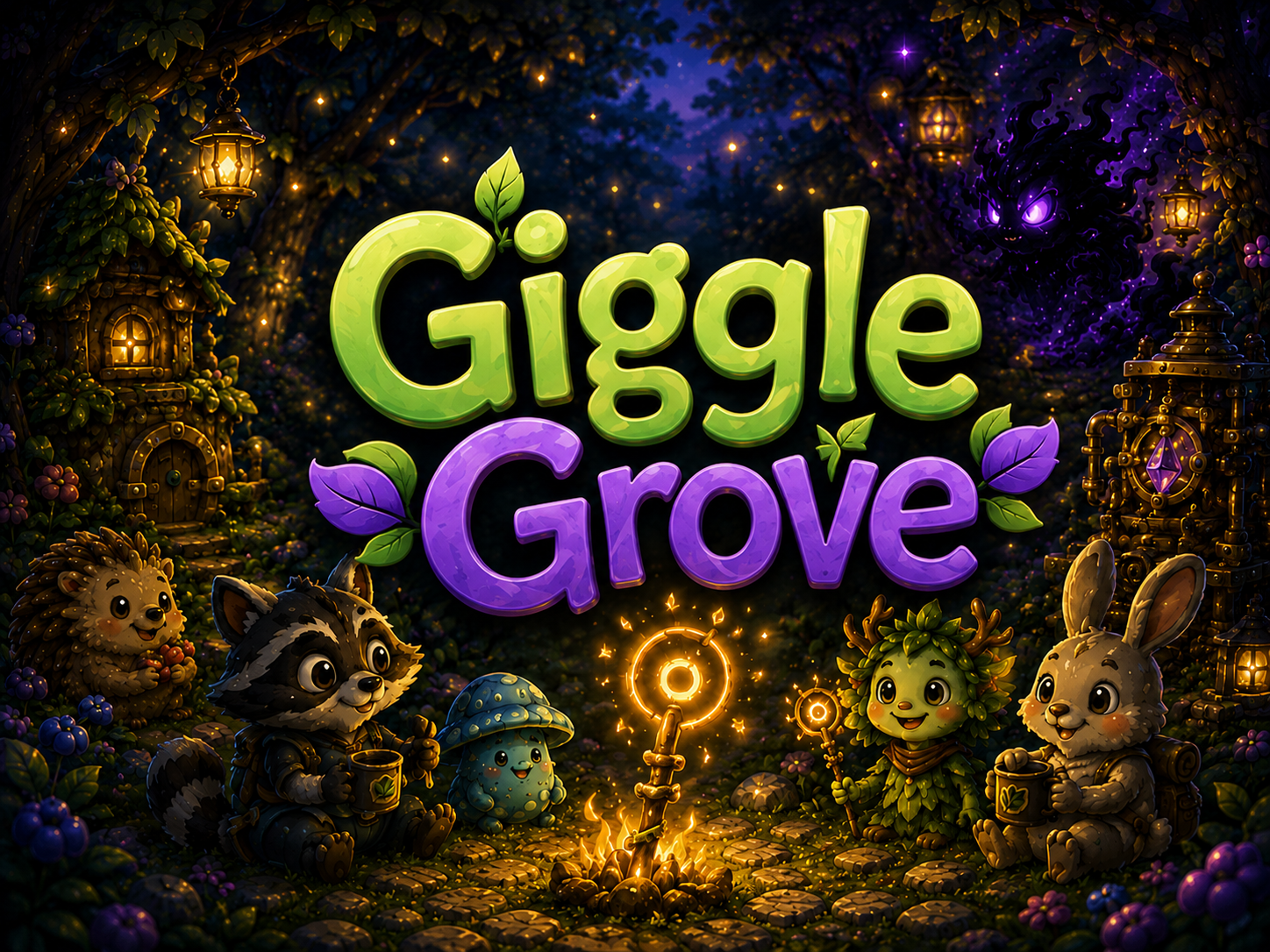
Giggle Grove began with a simple idea: what if a cheerful, whimsical forest became a survival game after dark?
That became our core promise:
Laugh today. Survive tonight.
During the Day, players explore the Grove, gather resources, rescue magical helpers and build ridiculous defensive machines. When Night falls, waves of Gloom close in, and the player must use everything they prepared to keep the Joyfire burning until Dawn.
Inspiration
We wanted to make survival and resource management approachable without losing the tension that makes the genre satisfying.
Instead of weapons and grim fortifications, Giggle Grove uses Bellylaugh Bellows, Pratfall Mushrooms, magical creatures and Echo Berries.
The central design question became:
Can comedy itself provide the language for a survival game?
How We Built It
Giggle Grove was developed through a human-directed, AI-accelerated workflow.
Human creative direction drove the concept, game-design decisions, priorities, playtesting, music and performance choices, and final approvals. AI was used extensively for implementation, debugging, balancing, UI/UX iteration, production tooling, automated testing and compliance work.
The final prototype is a self-contained, portrait HTML5 game designed primarily for mobile.
Its core loop is:
Gather → Build → Rescue → Survive → Reach Dawn → Progress
The first two runs are deliberately authored to teach the game through play.
From Run 3 onward, the Adaptive Grove Director evaluates how the player is performing and adjusts encounter timing, composition, direction and pressure.
We also used AI-assisted workflows for visual production, soundtrack development and reactive narration, while keeping human selection and creative judgement at the centre of those processes.
Challenges
Our biggest challenge wasn't adding features. It was learning when to stop adding them.
Early versions had unclear resource relationships, dead time, intrusive UI, inconsistent touch interactions and tutorial sequences that explained mechanics instead of letting players experience them.
Real-device testing became critical.
Playing repeatedly on an iPhone exposed problems that weren't always obvious from code or desktop testing, including:
- Safari viewport behaviour
- unreliable touch interactions
- crowded helper UI
- narrator timing
- music transitions
- tutorial soft-locks
- mobile readability
Blind playtesting reinforced the same lesson.
Players generally understood the fantasy and survival objective, but sometimes struggled to understand why something had happened.
That shifted development toward clarity, feedback and cause-and-effect rather than simply adding more systems.
What We Learned
The most important lesson was how much a small prototype benefits from disciplined iteration.
Our development process increasingly became:
Play → Identify friction → Make one controlled change → Test → Compare → Keep or revert
AI made that cycle dramatically faster.
It allowed a very small creative team to work across engineering, game design, balancing, audio integration, UI/UX and QA at a pace normally associated with a much larger production team.
But AI couldn't tell us whether the game was actually fun on a phone, whether a joke landed, whether a narrator performance felt right, or when another feature would make the experience worse rather than better.
Those remained human decisions.
The Result
Giggle Grove became a game about preparation, pressure and adaptation disguised inside a cheerful woodland comedy.
It starts by teaching the player how to survive its strange little world.
Then it gradually stops helping.
The Grove has shown you the rules. Now keep the Joyfire burning.


Log in or sign up for Devpost to join the conversation.