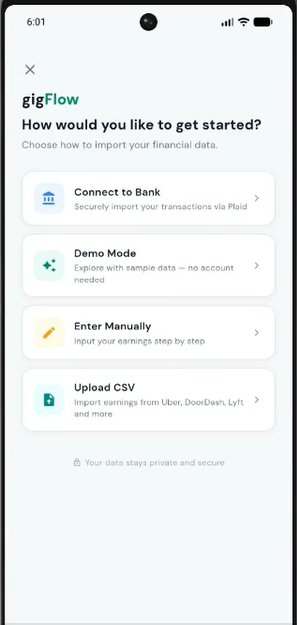
Inspiration
The inspiration for gigFlow came from the massive shift in the American labor market toward independent contracting. We saw that while millions of workers are moving into the gig economy, the financial infrastructure to support them is stuck in the past. High reporting thresholds and complex tax codes create immense friction for freelancers. Specifically, the realization that 73% of gig workers are unaware of the payment thresholds that trigger tax returns made it clear that a specialized solution was necessary. We wanted to build a tool that protects the most financially vulnerable workers by turning tax compliance into an automated, proactive experience.
What it does
gigFlow is an AI powered financial engine that automates tax compliance and maximizes take home pay for the 76.4 million freelancers in the United States. Unlike standard filing tools that you only use once a year, gigFlow is a year round assistant that identifies an average of $3,700 in missed deductions per user. It handles everything from mileage and home office math to the new federal No Tax on Tips deduction. For a competitive subscription of $12 a month, the platform provides a real time view of net income and ensures that 1099 workers are never hit with a surprise tax bill.
How we built it
We built gigFlow using a robust deductions engine that follows the latest IRS guidelines for the 2026 tax year. We integrated advanced Large Language Models like Claude 3.5 Sonnet and GPT-4o to handle complex document analysis and multi step tax math. The backend logic is designed to process various data streams, including digital receipts and mileage logs, while maintaining strict adherence to federal regulations. We focused on creating a seamless experience for Gen Z and Millennial workers who prioritize financial convenience and high quality mobile interfaces.
Challenges we ran into
One of the biggest hurdles was navigating the legal complexities of providing AI driven financial advice. To avoid the unauthorized practice of law, we had to ensure our AI agents operated strictly as data aggregation engines governed by specific IRS disclaimers. We also had to work through the issue of outdated market statistics. Many industry reports still rely on data from 2018, so we spent significant time verifying our claims against 2026 macroeconomic figures. Competing with established players who already have AI features meant we had to focus on superior reasoning and better price points.
Accomplishments that we're proud of
We are proud of developing a highly accurate mathematical model that identifies significant tax savings while remaining conservative and defensible. Our system successfully incorporates the new No Tax on Tips provision, allowing eligible users to deduct up to $25,000 in qualified tips. We also proved the economic viability of gigFlow by creating a subscription model that pays for itself if the tool identifies just $144 in missed deductions annually. Validating our total addressable market at 76.4 million freelancers gives us a massive foundation for future growth.
What we learned
We learned that the traditional employer employee relationship is fracturing much faster than the current financial tools can keep up with. The huge gap in tax awareness among gig workers showed us that technology needs to do more than just calculate numbers; it needs to educate the user. We also gained a deep understanding of the stratified nature of the gig workforce, from high earning consultants to delivery couriers with high operational costs. This project reinforced the idea that for AI to be useful in fintech, it must provide a clear and immediate return on investment for the user.
What's next for gigFlow
The next step for gigFlow is scaling to support the projected 90.1 million freelancers who will make up over half of the U.S. workforce by 2028. We plan to move beyond simple categorization into more advanced reasoning models that can handle complex, multi step tax scenarios automatically. We are also looking into deeper integrations with banking platforms to capture a larger share of the $1.5 trillion in annual gig income. Our goal is to remain the definitive financial partner for the independent workforce as the labor market continues its inevitable shift toward 1099 work.
Built With
- claude
- css
- flutter
- framer
- javascript
- next.js
- plaid
- tailwind
- typescript

Log in or sign up for Devpost to join the conversation.