-
-
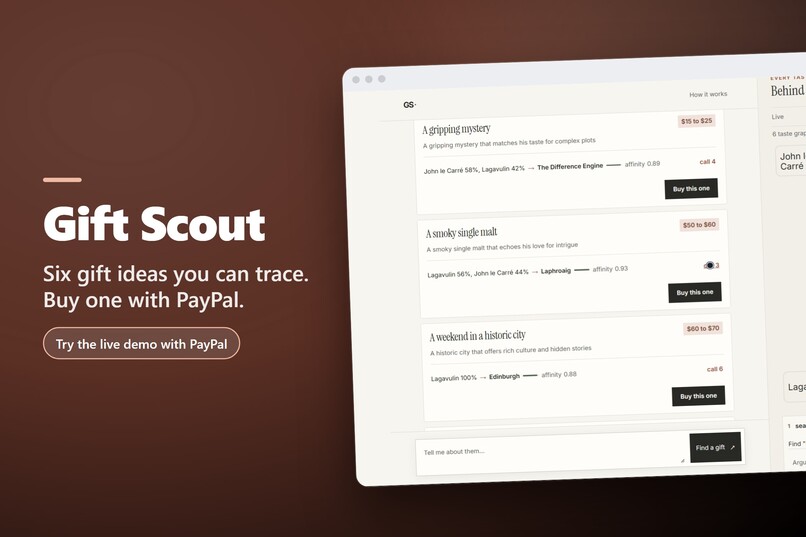
Gift Scout
-
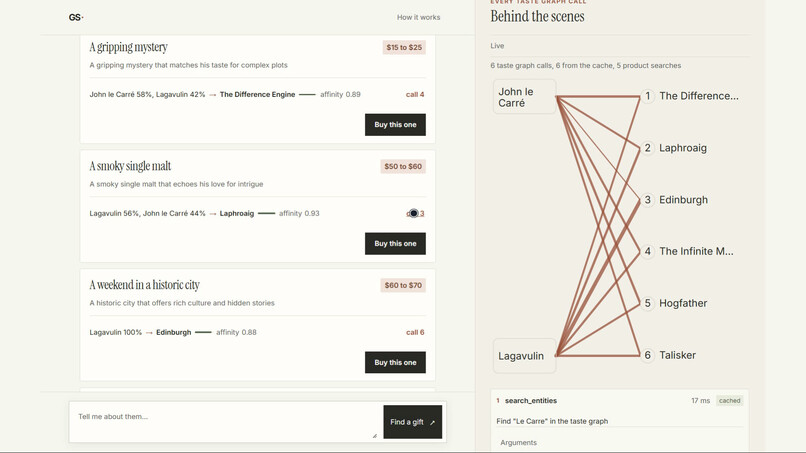
Gift ideas, each traced to what they love
-
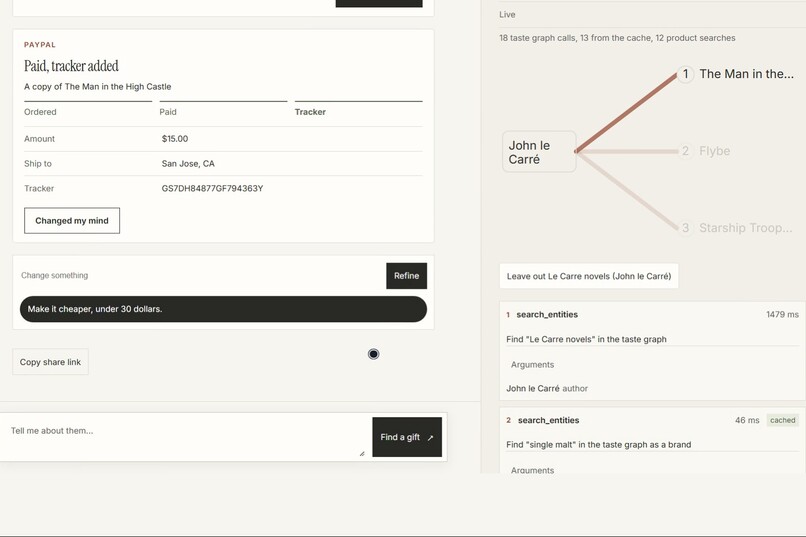
Paid with PayPal, with a tracker to watch
Judging criteria at a glance
In short. Gift Scout is for anyone buying a gift for someone they only half know. Type one line with what the person loves and a budget. An agent looks up each love in the Qloo taste graph, asks what the same fans also love, and returns up to six gift cards. Channel3 product search turns a card into a real store listing with an exact price when one exists. Pick one and pay on the same page with PayPal, with no login. A refund is one tap.
Technological Implementation. PayPal Orders v2: create, capture, tracker and refund, with a verified webhook and a stable PayPal-Request-Id on every attempt, so a lost answer is read back instead of charged twice. AI: an agent on Cloudflare Workers AI (@cf/openai/gpt-oss-20b) calls three Qloo tools and writes the cards. Code checks that each card rests on a Qloo result from this conversation, fits the price limits and repeats no other card. Channel3 product search finds the store listing for a card, and a listing must match the card's product type. Check it: src/paypal/client.ts, src/paypal/webhook.ts, src/qloo/tools.ts, src/channel3/client.ts, src/agent/agent.ts.
Design. One line in, up to six gift cards out. Each card says whether it is a store listing with an exact price or a gift idea with an estimate. "Behind the scenes" lists every lookup as it runs, and "Leave out" removes one interest and redraws the cards.
Potential Impact. For anyone buying a gift for someone they only half know. Search gives the same mug and the same socks; Gift Scout starts from what the person already loves.
Innovation/Idea. Every gift traces back to the exact taste graph lookup that found it. "Compare with the taste graph off" puts the same model's picks without the taste graph side by side. A plain chat model suggests gifts from general knowledge and cannot show why. Gift Scout shows the lookup behind each card. Check it: src/agent/compare.ts.
Presentation. The video runs 2 minutes 46 seconds. At https://gift-scout.midknight-labs.workers.dev you can choose a gift, pay with the sandbox test card with no login, and refund it on the same page. Video guide: 0:09 one line in, and the Qloo lookups start; 0:22 each card names the result behind it; 0:58 the same request with and without the taste graph; 1:19 leave out one love and the cards redraw; 1:49 pay by card with no login; 2:02 one tap refunds it in full.
Inspiration
Buying a gift for someone you only half know is hard. You know your dad reads spy novels and likes a good whisky. That is about it. Search gives you the same mug and the same socks everyone else got.
People who share a taste tend to share other tastes too. So we built something that starts from what the person already loves and walks out from there, then lets you pay for the idea right where you found it.
What it does
You write one line, like "My dad. Le Carre novels and single malt. Christmas." Gift Scout looks up the interests it can identify in Qloo's taste graph, asks what the same audience also loves, and comes back with up to six gift ideas.
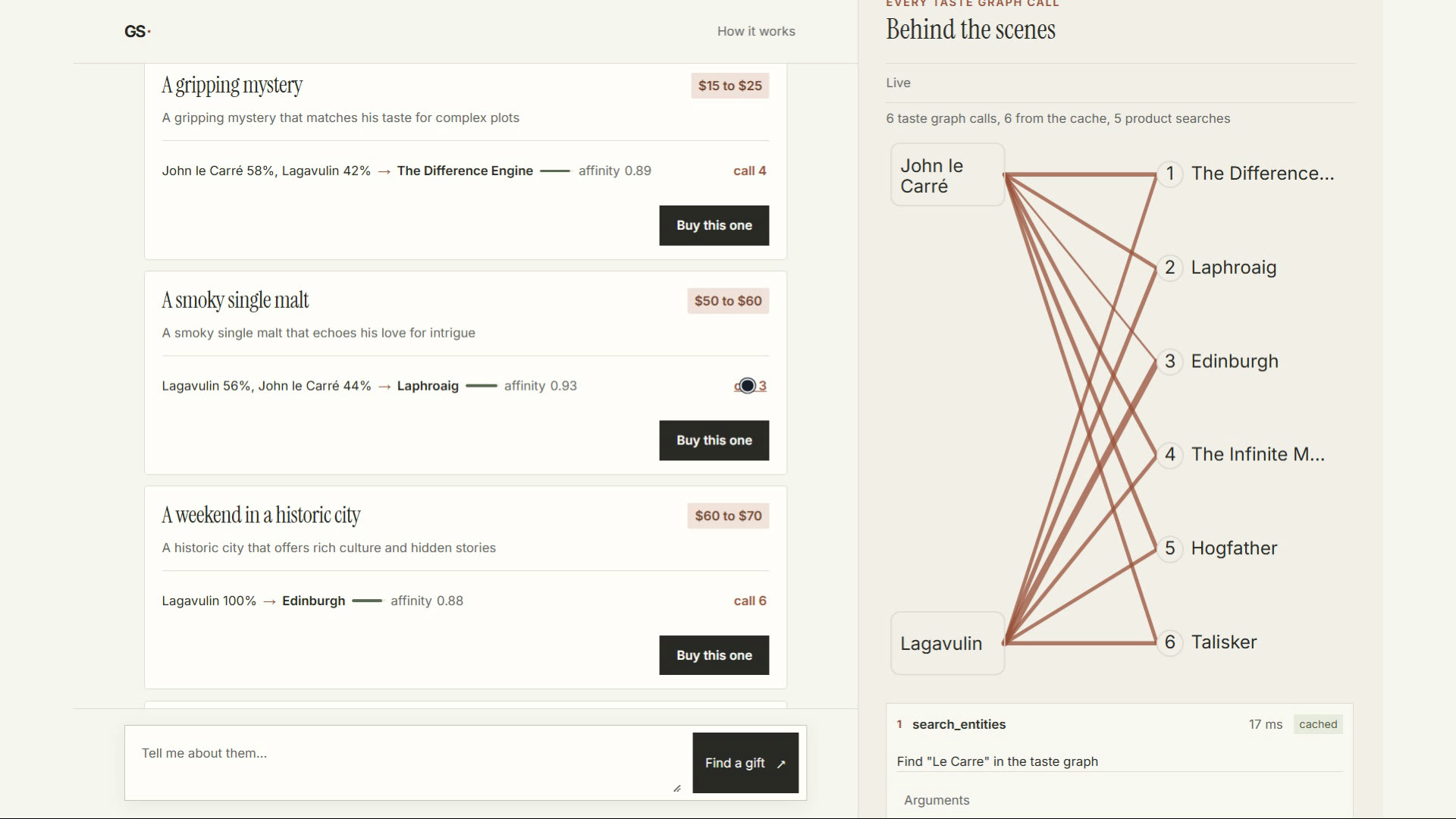
Each card shows the result it rests on and how strongly it matches. Where Qloo returns a split, it also shows which of his loves pulled it in. The panel on the right, "Behind the scenes", lists every lookup as it runs. A small picture there draws the walk from his loves to the ideas.
Each card says what it is before you pay. "Store listing" means product search found a real item: the card shows its exact price and the shop. "Gift idea" means no listing was found: the card shows an estimated price.
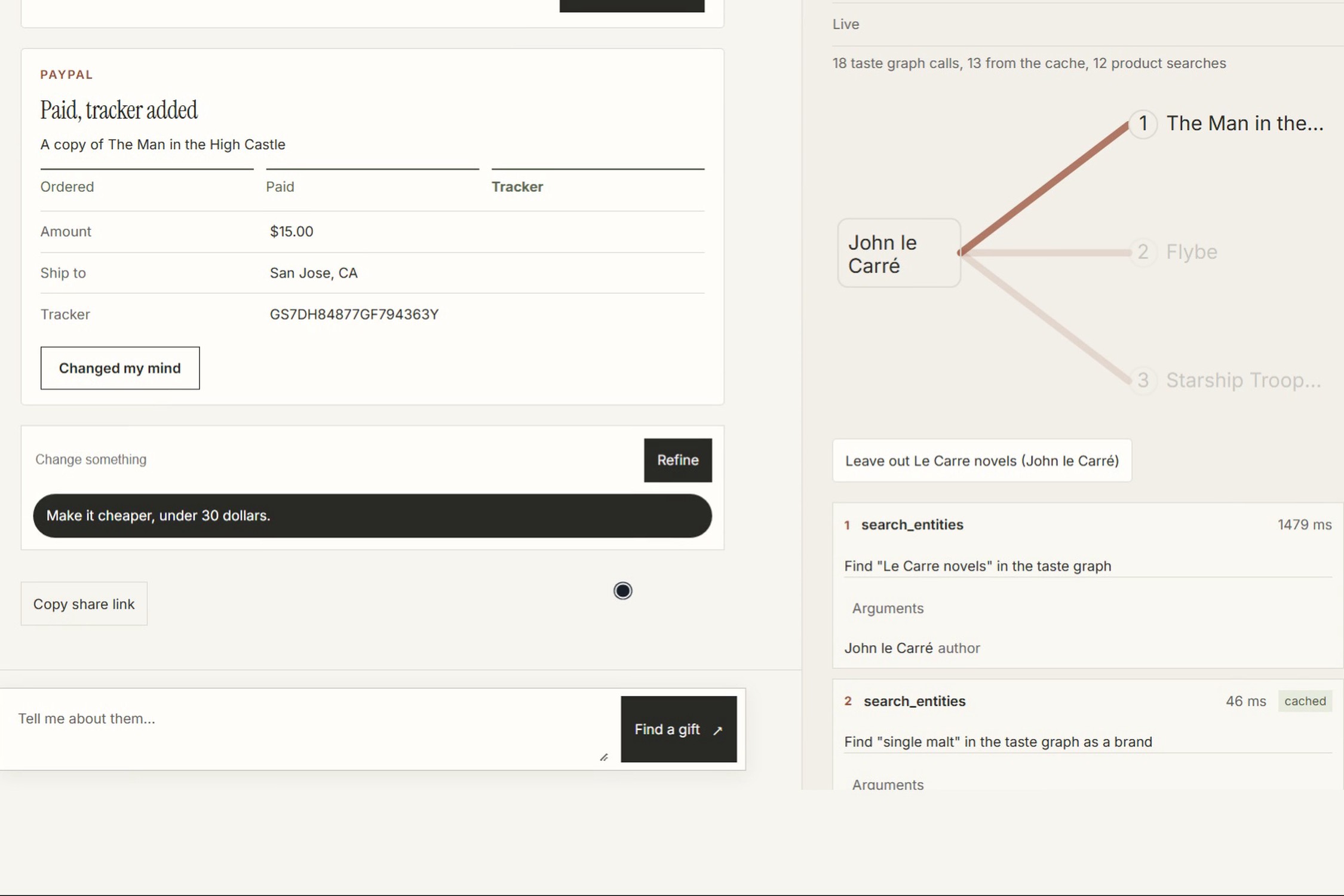
You can push back in plain words. "Make it cheaper, under 30 dollars." keeps what still fits and drops the rest. Earlier ideas fold into one closed box, so the current shortlist comes first. Pick a card and its lines in the graph and its lookup in "Behind the scenes" light up, while the rest fade.
"Compare with the taste graph off" asks the same model with no taste graph, then scores its picks against the same loves. It shows your first request, Gift Scout's picks and the plain model's picks side by side. Picks scored on the same signals and on the nearest signals are kept apart, and it says plainly that affinity is not proof he would like the gift.
Next to each interest there is a "Leave out" button. Tap "Leave out single malt" and the cards that rested on it are withdrawn and named, and the picture is drawn again without it.
"Buy this one" on a listing (or "Try a sandbox payment" on an idea) asks where the gift goes, checks the offer again, then makes a sandbox PayPal order for that offer's title and price. No order is placed with the shop and nothing ships. You can approve it at PayPal or pay with the sandbox test card with no login. The capture shows up next to the lookups that found the gift. A PayPal tracker follows, showing only the city. "Changed my mind" refunds the capture through PayPal.
A share link shows the cards and the order to anyone, without the buy, compare or refund buttons.
How we built it
One Cloudflare Worker serves the page, the agent and the payment routes. D1 keeps conversations, the run cache and every payment attempt. A Durable Object counts the daily limits.
The agent runs on Cloudflare Workers AI (@cf/openai/gpt-oss-20b). It plans, calls three Qloo tools (search, tags and
insights) and writes the cards. Code checks named parts of each card: it must rest on a result a Qloo call returned in this conversation, be the right
kind of thing, fit the price limits, not repeat another card, and avoid some banned wording. The match score, the name
and the split are copied from Qloo by code, never by the model. Code keeps each price band inside the budget numbers.
For an idea with no product, the band is the model's estimate, so it does not prove the gift sells at that price. The
code does not check every description or genre claim.
Product offers come from Channel3 search. The search uses the name the taste graph resolved, plus the format (a paperback, a 16 year old single malt), not the model's loose title. A book idea must be a book, not a poster or a mug, and a book listing must share a genre family with the book it stands for, so a fantasy novel with the same title as a spy novel is refused. A card with no matching listing stays a gift idea.
PayPal Orders v2 handles the money. The server creates the order, captures it, adds a tracker, and refunds the capture.
The test card path sends the card as the order's payment source, so a judge can pay with no account. Each attempt is
saved before PayPal is called and carries a stable PayPal-Request-Id, so a lost answer is read back instead of charged
twice. The pay request carries the offer the visitor saw; if the price, title or shop changed, it stops and asks for
another tap. The webhook is verified with PayPal before it can mark anything paid, and it can recover a purchase whose
answer was lost.
Buying, comparing and refunding need the private owner token the page received when it started the conversation. The page keeps it in session storage.
Challenges we ran into
A model that writes gift ideas will happily invent a gift with nothing behind it. Every rule that matters had to move out of the prompt and into code.
Money needed the same care. A payment answer can vanish after PayPal has already acted. We save the attempt first and treat "no answer" as unknown, never as failed. Usually the next tap finishes the same order. An attempt that stays unknown past the retry window, or a changed request, stops for a manual check instead.
Free has to stay free. Before a model call runs, it reserves the most it could cost in a shared ledger. That figure comes from the size of what it sends plus every word it may write, at the published price. A call too large for its limit is refused before it runs, and each day stops at a cap set under the free amount. A busy day ends with the recorded examples.
Accomplishments that we're proud of
You can follow any gift back to the exact lookup that found it. Where Qloo returns a split, you can see how much each love counted. A vague love like single malt is matched to a stand in such as Lagavulin. That is a proxy, not a brand he named.
Choose a gift, make a sandbox payment, then test a refund on the same page.
What we learned
We aimed to show the work instead of writing a better sentence: a gift idea should come with where it came from. We have not measured whether this makes people trust it more.
What's next for Gift Scout
Gift lists for a whole family, a reminder before birthdays, and real shipping once it leaves the sandbox.
Built With
- channel3
- cloudflare-d1
- cloudflare-workers
- durable-objects
- mcp
- paypal
- paypal-orders-api
- playwright
- qloo
- typescript
- workers-ai
